- The paper introduces a novel audit pipeline that constructs 100 parametric ladders to assess LLM ordinal coherence.
- The study reveals that even models with high predictive utility often fail strict monotonicity, with average coherence only 59.5%.
- The experiments demonstrate that reasoning enhancements boost coherence but cannot fully repair intrinsic preference intransitivity.
Parametric Probing of LLM Value Coherence: An Empirical Audit
Motivation and Conceptual Framework
The paper "Incoherent Values? Probing LLM Preferences Through Parametric Variation" (2606.21102) addresses a critical requirement for deploying trusted autonomous agents: the coherence of their underlying value systems. Value coherence, as formalized here, is not simply internal consistency over a fixed set of pairwise choices (transitivity and utility representation), but rather the preservation of ordinal structure when statements are varied parametrically along a single value-relevant property. The thesis tested is whether existing LLMs—a diverse set of open and closed-weight models, ranging from student to instructor variants—maintain monotonic preference order when choices are parametrically intensified. Accompanying this evaluation, the paper introduces a robust procedural pipeline for constructing, auditing, and probing instruments capable of detecting genuine preference intransitivity at scale.
Instrument Design and Audit Pipeline
The methodological innovation lies in extending forced-choice preference elicitation beyond binary comparisons to multi-tiered, parametric ladders. The authors first curate statements from prior benchmark datasets with single value-relevant properties amenable to ordered intensification, resulting in 100 ladders spanning 12 meaningful categories (e.g., life/species, religion, personal freedom).
Each ladder consists of seven tiers (T1 to T7), where adjacent tiers increase the intensity of the stipulated property (e.g., from “minimal protection of species” to “maximal protection”), and a rational agent should strictly prefer higher tiers. Ladder construction is audited via three filters: tier-pair accuracy, property validation through red-teaming, and ordinal recoverability via full-ranking queries. Only ladders passing all filters are retained for coherence experiments, eliminating instrument-induced confounding.
Experiments and Metrics
A core experiment compares each ladder tier against a fixed pool of 30 comparison statements via 20 forced-choice trials, generating win-rate curves for each (model, ladder, reference) triplet. The primary descriptive metric is strict monotonicity: a win-rate curve is coherent if selection probability never decreases as tier rises. Supplementary metrics include isotonic regression R2, Jonckheere–Terpstra (JT) trend test, logistic GLM slopes, and bootstrap monotonicity confidence.
For predictive utility, the authors fit logistic regressions of extracted preference on tier index and comparison statement, then evaluate out-of-distribution generalization (held-out AUC) against tier-permutation nulls, applying Benjamini–Hochberg FDR control.
Empirical Results
Parametric Variation Reveals Incoherence
Across all tested models, strict monotonicity averages only 59.5%, with substantial variance (10.1–80.1%), demonstrating pervasive ordinal incoherence undetected by traditional pairwise utility analysis. Models frequently violate stepwise order even as isotonic R2 approaches 0.93 (indicating a strong monotonic trend), and JT significance is high (77.2%). Decisive trial-level choices do not compose into globally ordered structures.
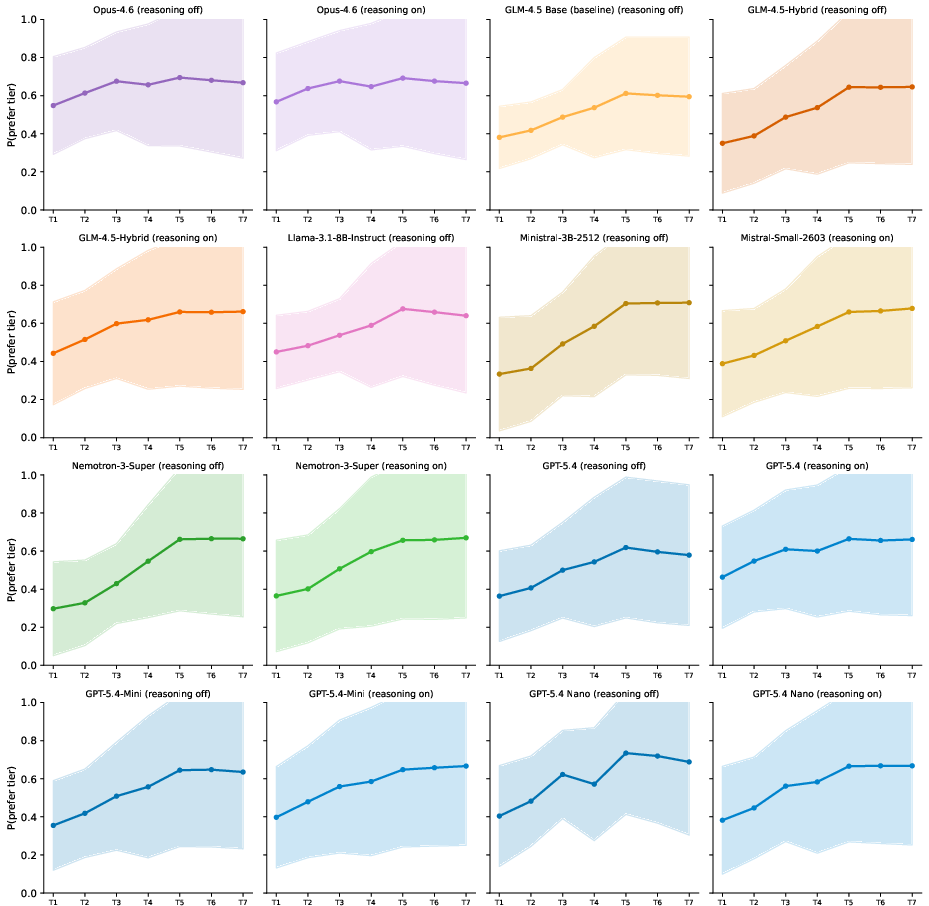
Figure 1: Win-rate curves across 100 valenced ladders for each model configuration, showing substantial non-monotonicity and local reversals except for select variants.
Held-out logistic regression AUCs average 91.8% (vs. null 66.4%) and most ladders (95.1%) reject tier-permutation nulls after BH correction, indicating tiers carry genuine predictive signal even in the absence of full monotonicity. GLM-4.5 Base achieves 99% predictive significance but only 10.1% strict monotonicity, illustrating the dissociation of directional trend and ordinal coherence.
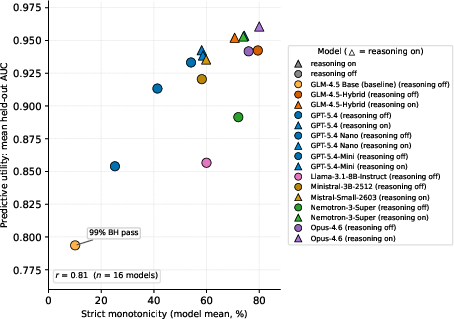
Figure 2: Strict monotonicity vs. predictive utility across 16 models, revealing high predictive signal without ordered monotonicity for most configurations.
Category and Model Dependency
Monotonicity failures are neither uniform nor random: some categories (life/species) achieve 68–89% monotonicity, while others (personal freedom, religion) fall to 38–43%, reflecting correlated incoherence in training data for certain normative domains. Ordinal violations localize to controversial or intrinsically ambiguous domains, reinforcing the need for domain-specific audits.
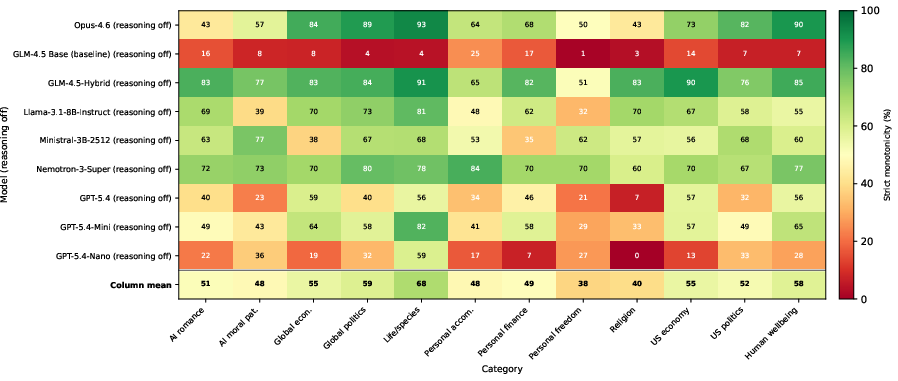
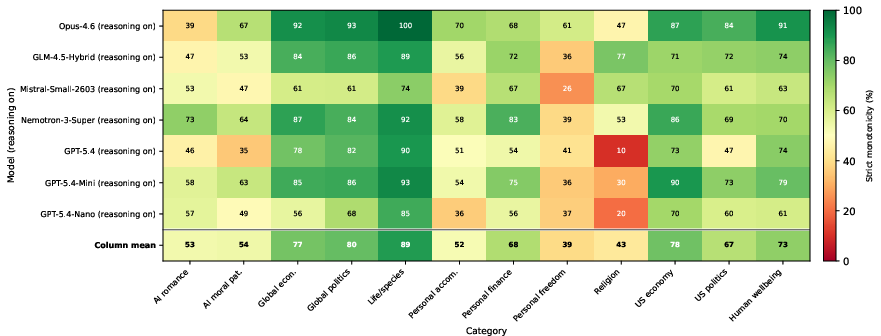
Figure 3: Mean strict monotonicity (\%) for reasoning-off models by category, with highest coherence in life/species and lowest in personal freedom and religion.
Reasoning and Model Scale
Contrary to conventional expectations, monotonicity does not emerge with greater parameter count. Among GPT-5.4 variants, Mini (74.3%) outperforms Standard (58.6%) despite lower scale. Reasoning-enable toggles yield strong gains: GPT-5.4-Nano strict monotonicity rises +32.9 pp (25.3% → 58.2%), Mini +20.2 pp, Standard +17.3 pp, such that the smallest model with reasoning enabled surpasses larger reasoning-off variants. This compensatory pattern suggests distillation or explicit deliberative prompting unlocks latent evaluative structure without resolving ordinal failures.
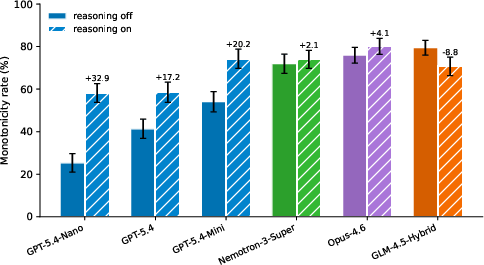
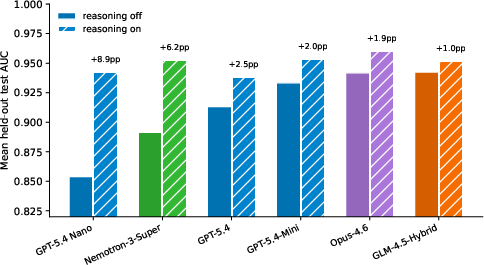
Figure 4: Strict monotonicity uplift for GPT-5.4 variants, showing substantial gains from reasoning at all scales.
Discussion and Implications
The findings challenge bold claims of emergent coherent values in frontier LLMs. Models exhibit robust trial-level signal and predictive utility, but strict coherence is lacking, especially in controversial normative domains. Ordinal failures are not instrument noise, but genuine preference reversals. Reasoning amplifies coherence, but cannot fully repair intransitivity, and its effectiveness is model-category dependent; reasoning gains are smallest where models are most incoherent.
This dissociation between directional signal and ordered structure necessitates skepticism towards utility engineering and moral competence claims premised solely on pairwise transitivity or fitting. Paradigmatic trust, alignment, and multi-agent capability depend not only on internal consistency but generalizability of order under parametric stress. For practical agent deployment, reward functions must target ordinality, not just directional trend.
The study also hints that smaller distilled models may be more amenable to post-hoc coherence interventions, suggesting new routes for value system repair and curriculum design. Future work should audit value tradeoffs (multi-property exchange), undertake human-LLM concordance studies at scale, and extend coverage to diverse architecture/family variants.
Conclusion
The paper's parametric probe framework robustly surfaces ordinal incoherence in LLM preference structures and distinguishes predictive utility from genuine value coherence. Until strict monotonicity approaches unity across value categories, claims of emergent values must be regarded as provisional. For alignment, trustworthiness, and agentic deployment, coherence metrics should become standard benchmarks. This methodology stands as a reference protocol for future investigation and remediation of LLM value systems.