- The paper introduces the entanglement wedge polygon (EWP) as a novel geometric construct that isolates genuine multipartite entanglement within holographic frameworks.
- It employs both analytical and numerical methods to characterize EWP properties in pure, mixed, and time-dependent states across various AdS geometries.
- The study reveals quantized topological behavior in AdS3 and continuous, geometry-dependent transitions in higher dimensions, probing holographic phase transitions.
Entanglement Wedge Polygon: Geometry, Multipartite Entanglement, and Holography
Introduction and Motivation
The entanglement wedge polygon (EWP) is introduced as a new codimension-1 bulk region, designed to geometrically capture multipartite entanglement structures within the AdS/CFT correspondence. Motivated by the interplay between holographic entanglement entropy, tensor network toy models, and the search for geometric diagnostic tools for multipartite quantum correlations, this work aims to delineate the EWP's definition, properties, computational strategies, and its behavior in diverse holographic states, including pure and mixed states, varying spacetime dimensions, and both static and dynamical settings.
The EWP is defined, for a boundary partition {Ai}, as the maximal volume region in a bulk Cauchy slice bounded by the union of the extremal surfaces ΓAi for each Ai. For pure states, it corresponds to the portion of the total entanglement wedge not included in the subregion wedges, isolating a domain purely associated with multipartite correlations, excluding all bipartite contributions. The definition is generalized for mixed states by replacing boundary-anchored extremal surfaces with appropriate entanglement wedge cross-sections.
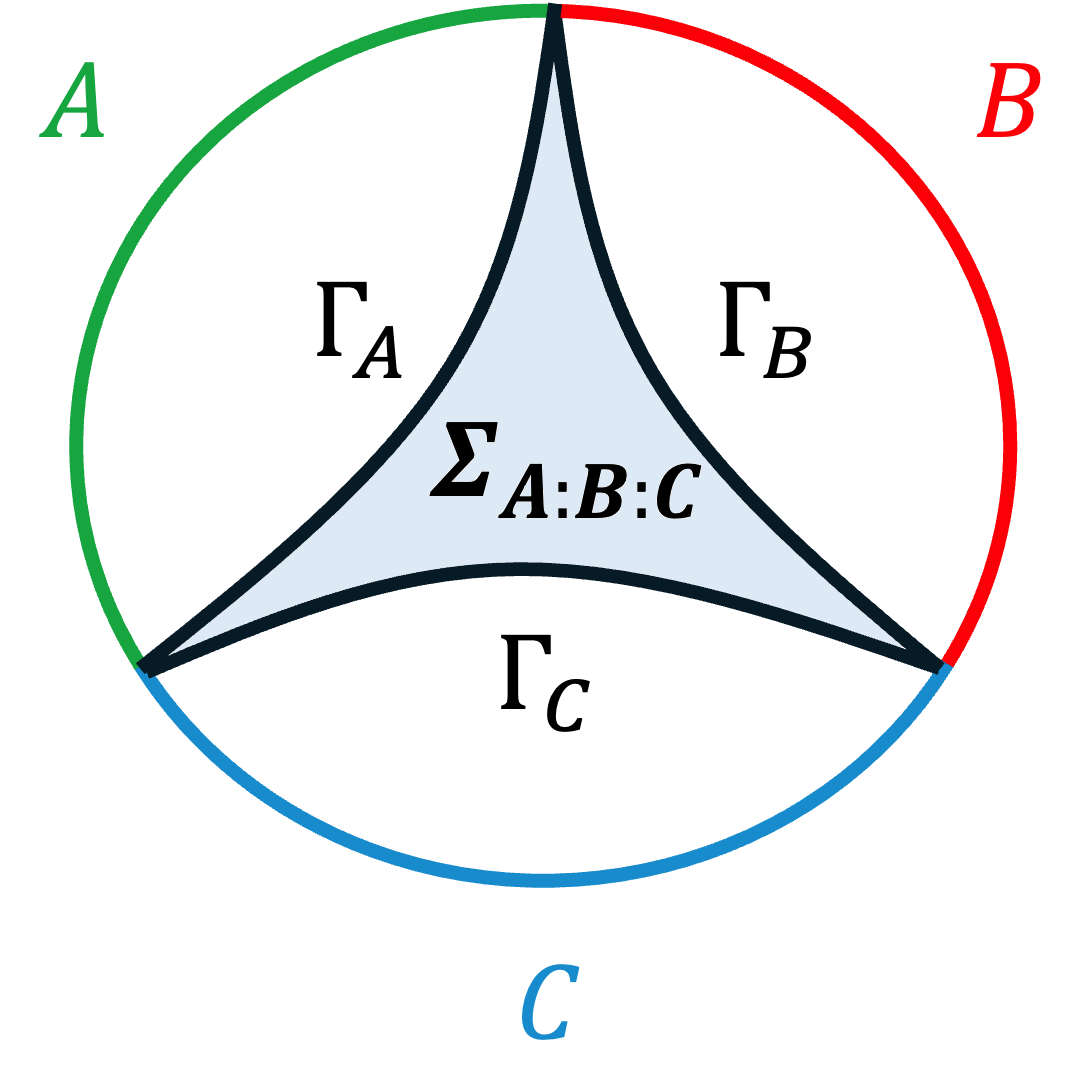
Figure 1: The entanglement wedge polygon ΣA:B:C for a pure state, bounded by extremal surfaces ΓA, ΓB, and ΓC.
This geometric construction is also motivated by tensor network models of AdS/CFT, where the EWP covers the region supporting nontrivial multipartite entangling tensors. While prior notions such as mutual information and the entanglement of purification have been utilized as multipartite and bipartite indicators respectively, the EWP aims to provide a bulk geometric measure that directly isolates genuine multipartite contributions.
For q boundary subregions in a pure state, the EWP is the codimension-1 domain inside the entanglement wedge of the union but external to the homology regions of all individual Ai. In the static case, this is realized as the difference:
ΣA1:⋯:Aq=r(A1⋯Aq)∖i=1⋃qrAi
where ΓAi0 denotes the codimension-1 homology surface for region ΓAi1.
For mixed states, involving disconnected or traced-purifier cases, the construction replaces these minimal surfaces with entanglement wedge cross-sections.
Two key properties emerge:
- P1: The volume of the EWP vanishes for any pure bipartition.
- P2: The EWP volume is monotonically non-decreasing when partitioning composite regions further; e.g., ΓAi2. This can be interpreted in the tensor network framework as the number of multipartite gates/links.
Topological Quantization in ΓAi3
In ΓAi4, the EWP exhibits remarkable topological behavior. By application of the Gauss-Bonnet theorem, the EWP's volume depends solely on the number of its bulk vertices and its Euler characteristic:
ΓAi5
This occurs when the EWP boundary is composed of geodesics. For generic vacuum and thermal states, or excited pure states in ΓAi6 or BTZ spacetimes, the volume is quantized in integer units of ΓAi7, with transitions corresponding to topological changes in the bulk region as the boundary partition is modified.
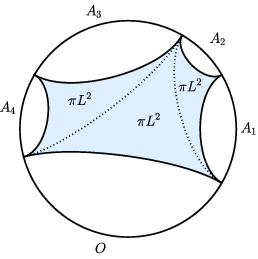
Figure 3: Ideal polygons on the hyperbolic plane (left) and disk (right) with ΓAi8 sides; each triangle has area ΓAi9 leading to total area Ai0.
Multiple explicit configurations and transitions, such as the fully connected and various disconnected phases, are analyzed. The maximal possible EWP volume for a Ai1-partite partition is Ai2, representing the fully connected phase, with the minimal (zero) value corresponding to fully disconnected boundaries.
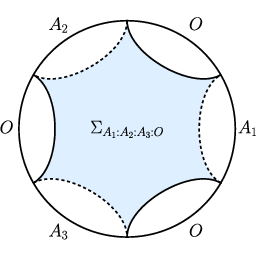
Figure 5: Example of fully connected phase for Ai3 partitions in Poincaré (left) and global (right) Ai4, showing the union of boundary-anchored extremal surfaces and the resulting EWP.
Analytical details of these quantizations rely crucially on the behavior of geodesic curvatures and interior angles at polygon vertices, governed by the constant negative curvature of the time slices.
Generalization to Higher Dimensions and Diverse Geometries
For Ai5, the EWP loses its strict topological character, with the volume now depending on subregion sizes and separations. In higher-dimensional Poincaré-AdS and black brane geometries, two regimes are analytically accessible: small subregions (Ai6) and the high-temperature/large-volume limit (Ai7). The EWP volume directly tracks multipartite entanglement as a function of the geometry, with clear phase transitions when minimal surfaces undergo changes in connectivity or topology. For BCFTs (bulk EOW-brane), the presence of branes destroys quantization, yielding continuous interpolation between phases as boundary angles, strip widths, and other parameters are varied.
Strong numerical results include precise quantification of the volume in the pure AdS, soliton, and black brane backgrounds, as well as identification of topological jumps in the EWP volume at critical partition sizes.
Extensions to Mixed States and Time Dependence
The EWP is generalized to mixed states by carefully defining bulk boundaries using entanglement wedge cross-sections—a prescription that maintains the key features seen in the pure state case. The EWP volume continues to vanish for bi-partitions (M1) and satisfies the property M2: refinement of partitions increases the EWP volume. Additionally, the EWP for mixed states is always less than or equal to that of a corresponding purification, consistent with holographic dualities.
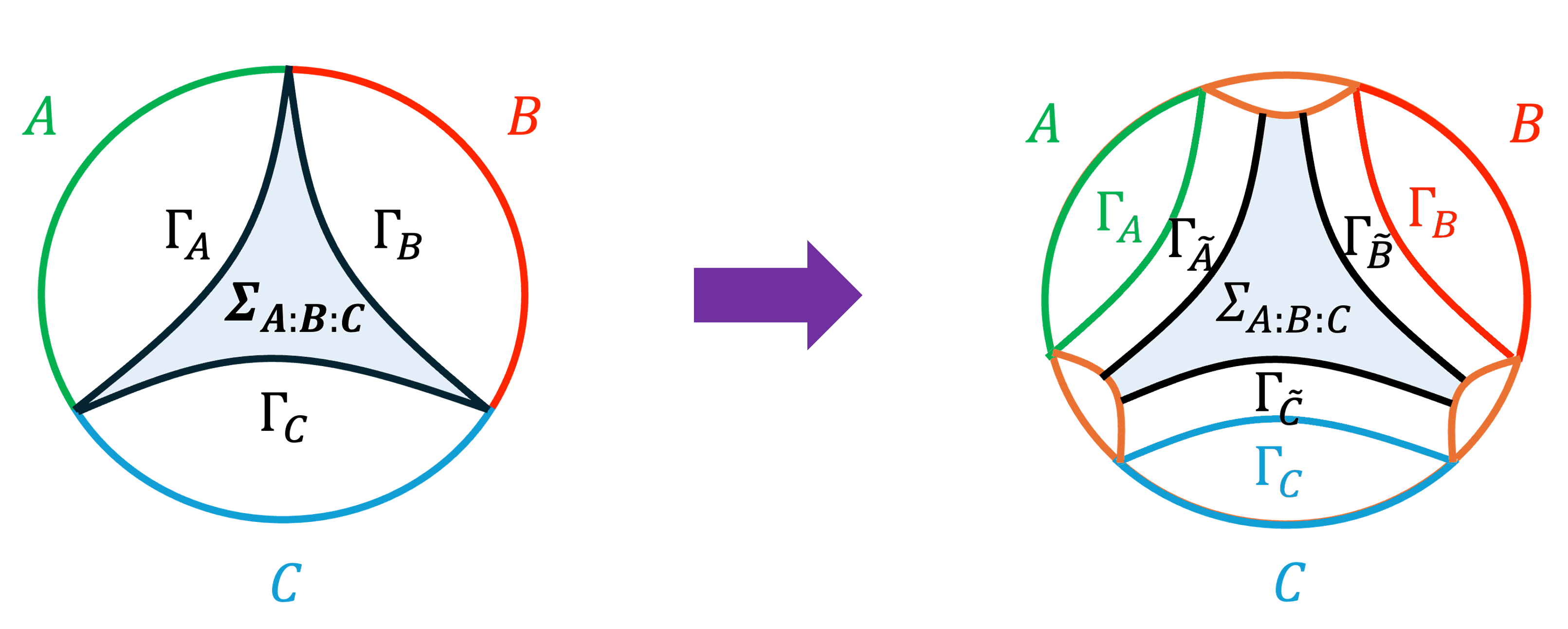
Figure 2: Schematic illustration of the mixed state generalization of the entanglement wedge polygon, with boundaries set by wedge cross-sections rather than extremal surfaces.
Explicit computations for BTZ and higher-dimensional black brane backgrounds are provided, including analyses showing that, for mixed thermal states, maximal EWP volumes are always reduced relative to the purified TFD constructions. Examples demonstrate that EWP volume is non-monotonic as a function of subregion sizes or separations, making it distinct from standard correlation measures.
Time-dependent scenarios, including global (Vaidya) quenches and TFD evolution, are treated, showing that the EWP exhibits abrupt transitions in its growth rate and eventual saturation at late times depending on the chosen boundary partitions. In Vaidya backgrounds, the EWP tracks the local thermalization process and phase transitions in entanglement structure.
Critical Assessment, Non-Monotonicity, and Interpretational Questions
An important contradictory claim established is that the EWP volume does not satisfy any monotonicity property under enlargement of partitions, precluding its interpretation as a bona fide correlation measure. This is supported by explicit counterexamples, especially in higher dimensions and mixed state configurations.
Various alternative definitions, motivated by multipartite generalizations of wedge cross-section minimization, are investigated, but these too fail monotonicity. The precise connection between the EWP and information-theoretic quantities such as multientropy requires further boundary CFT analysis.
The EWP provides a distinctive, topologically robust geometric diagnostic (in Ai8) for multipartite entanglement, and a quantitatively rich, phase-sensitive probe of multipartite structure (for Ai9). Its explicitly non-monotonic nature suggests that while it does not directly quantify entanglement, it isolates multipartite-structured regions in bulk reconstructions and quantifies the population of nontrivial entangling gates in the tensor network dual. The EWP volume is also sensitive to phase transitions, confinement, and other dynamical effects, making it a useful probe for dynamical holographic systems with complex entanglement evolution.
Further development should focus on boundary-side definitions in QFT/CFT language and relations to newly developed multipartite measures (such as multientropy [Fujiki:2026qdt]), as well as higher-dimensional and time-dependent tensor network analogues.
Conclusion
The entanglement wedge polygon is established as a novel bulk region with properties sharply distinguishing multipartite from bipartite holographic entanglement. In ΣA:B:C0, it is a quantized, topological observable; in higher dimensions, it provides a continuous, geometry-dependent measure of multipartite correlation structure, sensitive to both static and dynamic changes in field theory states. The EWP is not a correlation monotone, but instead provides an alternate geometric perspective tightly linked to tensor network intuition and holographic complexity proposals. This work opens new directions for the geometric study of multipartite structures in holographic duality and motivates further investigation of multipartite information in quantum field theory and gravity (2606.21081).

