- The paper demonstrates that gravitational path integrals can produce pure states for spatial subregions in quantum gravity through a partial freezing procedure.
- It develops a generalized RT-like method to compute entanglement entropy, satisfying key consistency checks such as SSA and complementarity.
- The work bridges known holographic entropy formulas, offering practical insights into observer-dependent quantum descriptions in gravitational systems.
Pure States for Spatial Subregions in Quantum Gravity
Introduction and Motivation
The conventional paradigm in quantum many-body physics posits that spatial subregions are described by mixed reduced density matrices, arising from tracing out external degrees of freedom. However, the presence of gravity fundamentally modifies the structure of quantum information localization, as the holographic principle and semiclassical gravity suggest that boundary data may fully encode the information in a subregion. This paper proposes a precise operational definition whereby spatial subregions in quantum gravity can be associated with pure states prepared via a gravitational path integral with part of the spacetime frozen. The approach yields a pure quantum state for the subregion, rather than a mixed density matrix, and admits a RT-type holographic prescription for entanglement entropy. The construction is formulated in the semiclassical regime and systematically analyzed for consistency, complementarity, and reduction to known entropy formulas.
Gravitationally Prepared Subregion States
Gravitationally prepared states have been previously formulated for closed spatial slices Σ [CGM20]. The paper generalizes the setup to arbitrary spatial subregions F by considering a gravitational path integral over geometries and quantum fields, partially frozen to a spacetime subregion F whose boundary data are held fixed. The resulting object is an ensemble-averaged reduced transition matrix TF∘∪∂F, defined on the Hilbert space of the interior F∘ and its boundary ∂F. By employing the replica trick, the rank of T is shown to be one for each ensemble member, indicating that the path integral prepares a pure state ∣Ψ⟩F∘∪∂F localized to F. This construction provides an explicit purification mechanism: the interior mixed state is purified by holographic degrees of freedom on the boundary.
Semiclassical Entanglement Entropy: RT-like Prescription
The entanglement entropy for bipartitions of the subregion F is addressed via a generalization of the Ryu-Takayanagi formula. In the semiclassical saddle-dominated regime, for any bipartition F0, the entropy is given by minimizing the sum of quantum and geometric terms over regions F1 such that F2, with the area term arising from the intersection of the closure of F3 and the ambient gravitating region F4:
F5
where F6 is the codimension-2 surface determined by the "frozen" homology constraint.
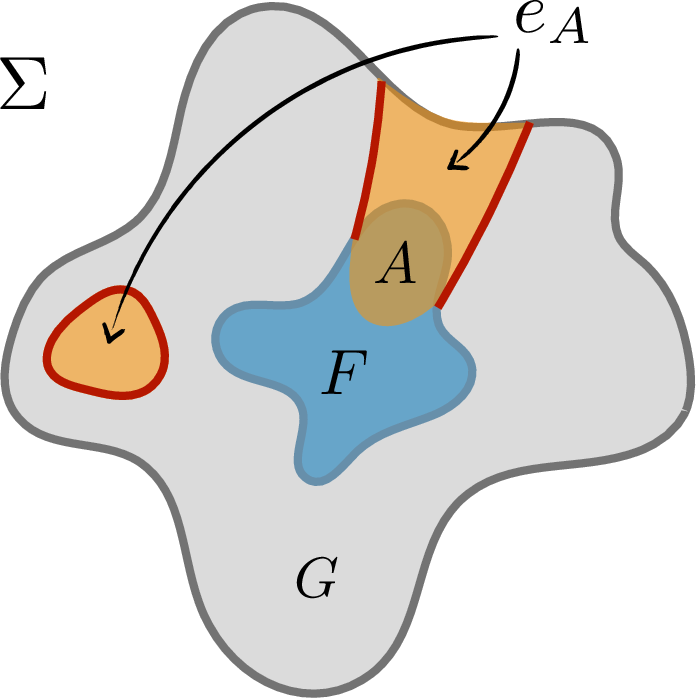
Figure 1: Sketch illustrating the spatial slice F7 with the frozen subregion F8 (blue), ambient gravitating region F9 (gray), bipartition F0, and the minimization surface F1 (red) for entanglement entropy computation via the RT-like formula F2.
The prescription satisfies strong consistency checks:
- Consistency for pure states: F3 for the full frozen subregion.
- No-cloning property: Nested wedges from non-overlapping F4 do not overlap.
- Strong subadditivity (SSA): Explicitly proven employing geometric and quantum entropy, with candidate extremal regions showing monotonicity and nesting.
- Entanglement wedge nesting: F5 if F6.
- Complementarity: For F7, F8; F9.
The framework interpolates between and generalizes several established entropy formulas:
- For TF∘∪∂F0 as the bulk beyond an IR cutoff in AdS, the formula reduces to the RT prescription for boundary CFT states [RT06, RT06b].
- For TF∘∪∂F1 as a heat bath in AdS with a cutoff, it reproduces the "island formula" for black hole evaporation entanglement entropy [Penington19, AMMZ19, AEMM19, PSSY19, AHMST19].
- If TF∘∪∂F2 is regulated to a codimension-2 defect, it yields the AdS/BCFT entropy formula with an end-of-the-world brane [Takayanagi11, FTT11, HM13]. Codimension-3 limits correspond to wedge holography [AKTW20, GKPRRRS22].
- For disconnected TF∘∪∂F3, selecting TF∘∪∂F4 gives Bousso-Penington generalized entanglement wedges [BP22, BP23, BC23, KRR25].
Observer-dependence and Complementarity
A salient feature of the construction is its observer-dependent nature: different choices of frozen subregion TF∘∪∂F5 and associated spacetime TF∘∪∂F6 give rise to inequivalent quantum descriptions for the same semiclassical geometry. This translates to observer-dependent entanglement wedges and entropy measures. The construction thus supplies a framework for complementarity in gravitational systems, distinct from standard quantum field theoretic intuitions, and indicates that quantum gravity admits a family of boundary quantum theories depending on partial freezing choices. The challenge lies in identifying observer-independent content and precise mappings between quantum descriptions associated to different TF∘∪∂F7, a subject to be addressed in future work [Wei26].
Conclusion
The paper demonstrates that spatial subregions admit pure state descriptions in quantum gravity, constructed via partially frozen gravitational path integrals. The associated entanglement entropy is computed using a generalized RT prescription, reducing in limits to known holographic entropy formulas. The results validate consistency (SSA, nesting, complementarity, no-cloning) and reveal new structure—observer-dependent entanglement wedges and entropy measures. The implications extend to the operational foundations of holography, the encoding of semiclassical geometry in quantum boundary data, and the purification of field-theoretic mixed states via holographic degrees of freedom. Further exploration of mappings between observer-dependent descriptions and isolation of invariant content is anticipated to clarify the quantum structure of spacetime and gravity (2606.03977).

