Finite-Time Electrometry with a Quantum-Regime Single-Ion Phonon Laser
Published 19 Jun 2026 in quant-ph and physics.atom-ph | (2606.21068v1)
Abstract: The phonon laser realized in a trapped ion, i.e., a self-sustained mechanical oscillator, has demonstrated the unique characteristics in practically detecting externally applied electric signals without the prerequisite of sideband cooling. Entering the quantum regime via sideband cooling is expected to further improve its sensing performance. Here we report the first experimental realization of a quantum-regime single-ion phonon laser ($\bar{n}<10$) using a trapped ${40}\mathrm{Ca}+$ ion and demonstrate electrometry based on its phase-space symmetry-breaking response to weak resonant electric fields. By tuning the phonon-laser parameters, we reveal that the sensing performance is fundamentally governed by the finite-time relaxation dynamics of the underlying open quantum system. We find that a slow Liouvillian relaxation, correlated with the finite experimental interaction window, effectively enhances the dynamic susceptibility while maintaining the structural robustness of the limit cycle. This regime, when applied to the detection of electric fields, produces a shot-noise-limited peak sensitivity of $14.15 \pm 0.77~μ\mathrm{V/m}/\sqrt{\mathrm{Hz}}$ and a minimum detectable field variation of $δE_{\mathrm{min}} \approx 1.83~μ\mathrm{V/m}$. Our results establish quantum phonon lasers as a practical platform for advanced sensing and highlight the central role of Liouvillian dynamics in non-equilibrium electrometry.
The paper demonstrates finite-time quantum electrometry by leveraging dynamic symmetry breaking in a single-ion phonon laser to achieve shot-noise-limited electric field detection.
The experimental platform engineers red and blue sideband couplings to generate a non-equilibrium limit cycle and performs precise phase-space tomography.
The study reveals that reducing the Liouvillian gap enhances sensitivity, offering a quantitative design principle for robust, high-precision quantum sensors.
Finite-Time Quantum Electrometry with a Single-Ion Phonon Laser
Introduction
This work presents the first experimental realization of quantum-regime phonon lasing in a single trapped ion and demonstrates finite-time quantum electrometry based on symmetry-breaking response in phase space (2606.21068). The authors employ a single 40Ca+ ion in a surface-electrode trap (SET) operated deep in the quantum regime (nˉ<10) and explicitly connect the electric-field sensing performance to the finite-time relaxation dynamics governed by the Liouvillian gap. The experimental protocol leverages dynamic symmetry breaking of a quantum limit cycle, enabling phase-sensitive detection of weak resonant electric fields through high-contrast motional-state tomography. The measured shot-noise-limited electric-field sensitivity reaches 14.15±0.77μV/m/Hz, setting a minimum detectable variation of δEmin≈1.83μV/m.
Experimental Platform and Quantum-Regime Phonon Lasing
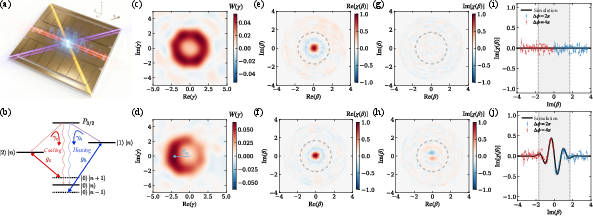
The single-ion phonon laser is realized in a SET with axial frequency ωz/2π=676.35 kHz. System gain and dissipation are engineered via laser-coupled transitions: red-sideband Jaynes-Cummings (H^c) and blue-sideband anti-Jaynes-Cummings (H^h) Hamiltonians, supplemented by engineered dissipative channels. This configuration produces a robust non-equilibrium limit cycle under appropriate gain/loss combinations.
Phase-space tomography is central to the characterization of quantum-lasing dynamics. The motional state is interrogated both with and without resonant driving fields, revealing a transition from isotropic limit cycles to symmetry-broken, phase-converged distributions. This symmetry-breaking enables the system to encode weak signals as phase-space asymmetries, directly mapped to experimentally accessible observables.
Figure 1: Experimental architecture and quantum-state tomography of the single-ion phonon laser highlighting symmetry-breaking under drive.
Non-Equilibrium Phase Diagram and Regimes of Operation
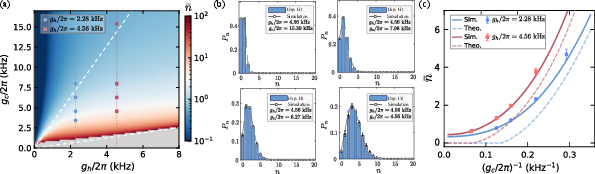
The study systematically explores the parameter space defined by red and blue sideband couplings. The steady-state mean phonon occupation nˉ and distribution functions are mapped across this space, delineating operational regimes: dark state, phonon lasing, and instability. In the quantum regime, boundaries are smooth crossovers (not non-analytic phase transitions), as expected for non-thermodynamic systems. Direct experimental measurements of phonon distributions show excellent agreement with quantum master-equation simulations, with clear deviations from mean-field predictions in the quantum limit nˉ<10.
Figure 2: Phase diagram and experimental/numerical comparison of phonon distributions for varying gain and dissipation parameters.
Electrometry via Dynamic Symmetry Breaking
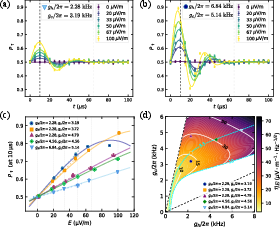
Electrometric sensing is implemented as a fixed-time readout protocol. A calibrated resonant electric field is applied, and the motional characteristic function is probed via a bichromatic sideband interaction. The imaginary part of the characteristic function, which vanishes absent symmetry breaking, serves as a zero-background, high-contrast signature for electric field detection. As a function of field strength, the population response P↑ is highly linear near the working point, allowing direct extraction of the sensitivity.
The optimal sensing time nˉ<100 is primarily determined by geometric overlap between the motional state and the measurement axis in characteristic-function space. This is analytically captured by a cumulant expansion, where nˉ<101 is set by a balance between measurement signal growth and wavepacket separation.
Figure 3: (a)-(b) Time-resolved spin population nˉ<102 under various field amplitudes, (c) linearity of response, and (d) sensitivity map as a function of phonon-laser parameters.
Liouvillian Gap Suppression and Sensitivity Enhancement
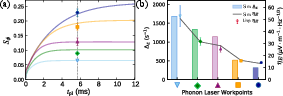
The sensitivity of the phonon-laser sensor is fundamentally dictated by the open system's relaxation dynamics. By reducing the Liouvillian gap nˉ<103 (the real part of the lowest nonzero Liouvillian eigenvalue), phase-space stabilization is rendered soft, dynamically amplifying susceptibility to weak signals. This inverse-gap scaling of sensitivity, nˉ<104, is confirmed both experimentally and numerically. Exploiting this regime is limited by practical constraints: control instability at low coupling strengths, environmental heating, and loss of protocol robustness as the system approaches instability.
The authors operate at the practical boundary between enhanced sensitivity and stable readout, achieving a relaxation time of nˉ<105 ms, ensuring long and coherent signal accumulation without technical breakdown.
Figure 4: (a) Time-dependent phase-space response nˉ<106 for various phonon-laser configurations; (b) monotonic scaling of sensitivity with the Liouvillian gap.
Quantum-State Analysis and Tomography
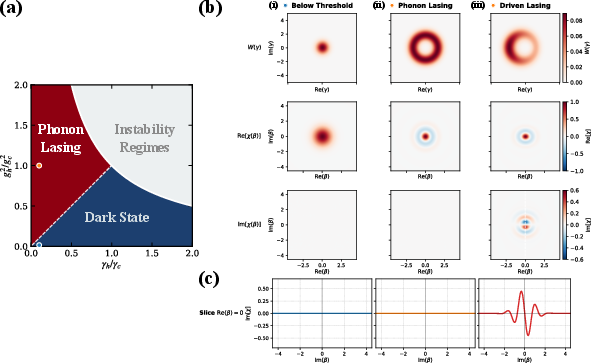
Full phase-space quantum-state tomography further clarifies the symmetry-broken structure of the driven phonon-lasing state and its metrological relevance. Comparison of tomography results below threshold, in the phonon-lasing regime, and under external field drive showcase the transformation from isotropic to anisotropic distributions. The metrological signal is optimally extracted along the direction of symmetry breaking, consistent with analytic results for the maximum-contrast slice in characteristic function space.
Figure 5: (a) Phase diagram regimes, (b) numerically reconstructed Wigner and characteristic functions in the dark, lasing, and symmetry-broken regimes under field drive.
Practical and Theoretical Implications
This work establishes quantum-regime single-ion phonon lasers as viable, stable, and high-sensitivity quantum sensors for electric fields. The demonstrated protocol directly harnesses finite-time nonequilibrium relaxational dynamics and open-system engineering to amplify weak signals without sacrificing readout determinism or requiring post-selection—contrasting with standard ground-state or coherent-state-based quantum sensing, which rapidly suffer heating and technical overhead at long interaction times.
Numerical and experimental results exhibit strong agreement for both sensitivity scaling and phase-space tomography. The method circumvents the vulnerability of ground-state approaches and unlocks dissipative metrological resources previously inaccessible in the quantum regime. Theoretical analysis of Liouvillian spectrum gap scaling provides a quantitative design principle for next-generation dissipative sensors. The framework offers extensibility: multi-ion implementations, structured dissipation, and collective many-body symmetry breaking could target quantum-enhanced sensitivities or exploit non-Hermitian phenomena (exceptional points, chiral phononics).
Conclusion
The experimental demonstration of finite-time quantum electrometry with a single-ion phonon laser establishes the centrality of Liouvillian-gap-controlled dynamics for nonequilibrium quantum sensing. By directly linking open-system relaxation rates to practical sensitivity, this platform enables robust, high-precision metrology in the quantum regime. These results delineate a path forward for exploiting non-equilibrium steady states, dynamical amplification, and dissipation engineering in quantum technologies for sensing and information processing.