- The paper presents an analytical quantum theory for phonon lasing, validated by numerical simulations that detail steady-state phonon statistics and coherent behavior.
- It identifies key parameter regimes where higher-order Lamb-Dicke effects and squeezed-mode operations generate distinct coherent and non-classical motional states.
- The study introduces a scalable single-ion lasing protocol demonstrating up to 80× sensitivity improvements, paving the way for advanced quantum sensing and metrology.
Quantum Theory for Phonon Lasing and Non-Classical State Generation in Mixed-Species and Single Trapped Ions
Overview
This work presents an analytically rigorous and numerically validated quantum theory for phonon lasing in mixed-species and single-ion trapped ion systems. Extending the mean-field semiclassical treatments of phonon lasers, the authors deliver analytic forms for steady-state phonon statistics and the second-order coherence function, thereby unambiguously establishing the quantum optical nature of engineered phonon lasers and identifying parameter regimes that generate coherent and non-classical motional states. Additionally, the manuscript introduces a single-ion lasing protocol, favorable for scalable experimental realization, and details the impact of lasing in squeezed basis as well as the exploitation of higher-order Lamb-Dicke terms—both as saturation mechanisms and for tailoring non-classical resource states relevant to quantum sensing. The theoretical protocol supports a sensitivity enhancement of up to two orders of magnitude for sensing applications, contingent on realistic parameter regimes in current experimental platforms.
Two-Ion Phonon Lasing Model: Quantum Theory and Phase Diagram
The two-ion architecture employs species-selective sideband interactions: one ion implements anti-Jaynes-Cummings (AJC) heating, the other Jaynes-Cummings (JC) cooling, each with engineered dissipation. The mean-field treatment yields coupled nonlinear equations for the average phonon number, identifying lasing (finite phonon steady-state), dark (vacuum), heating (divergence of phonon number), and unstable dark (vacuum, but unstable) phases as delineated by the coherent and incoherent coupling strengths.
The system's phase structure is clearly visualized in the mean-field phase diagram, which highlights the threshold at which phonon lasing arises, governed by the equality of heating and cooling rates and their associated dissipation rates.
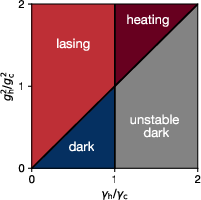
Figure 1: Mean-field phase diagram showing transitions between "dark," "lasing," "heating," and "unstable dark" phases determined by the ratio of coherent couplings and decay rates.
Numerical simulations corroborate the mean-field boundaries but reveal the quantum smoothing of the lasing transition, with finite low phonon number even in nominal “dark” regimes and softening of the boundary as quantum fluctuations dominate for small phonon occupation.
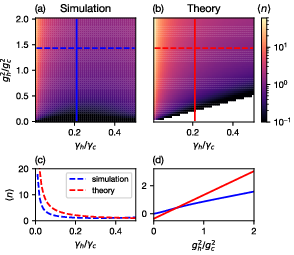
Figure 2: Logarithmic comparison of numerically simulated and mean-field predicted steady-state phonon number; mean-field breakdown is apparent in the white, unphysical regime.
Steady-State Phonon Statistics and Coherence
The quantum theory proceeds with a recurrence analysis for the phonon-number distribution p(n), yielding closed-form expressions (for certain parameter limits) for the second-order coherence function g(2)(0) in steady state. The analytic treatment, beyond mean-field, clarifies the nature of the lasing state: g(2)(0)≈1 (Poissonian) in the lasing regime, g(2)(0)→2 (thermal) in the dark or heating regime, and the ability to interpolate between via parameter tuning.
Direct comparison between theory and simulation for g(2)(0) affirms the validity of the analytic approach within expected regimes and exposes the parameter ranges where quantum corrections (fluctuations, low-number effects, higher-order cumulants) are significant.
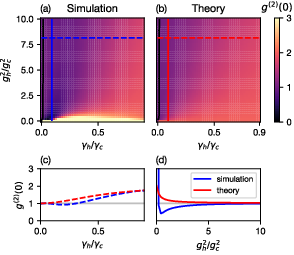
Figure 3: Numerical vs analytic g(2)(0); the coherent-thermal crossover and limit of analytic approximations are directly visible.
Reservoir Engineering Beyond Mean-Field: Higher-Order Lamb-Dicke Effects
A salient contribution is the inclusion of higher-order terms in the Lamb-Dicke parameter expansion, which are shown to function as effective nonlinear saturation mechanisms for lasing. These modify the steady-state phonon-number distribution, facilitating access to non-classical (sub-Poissonian) states unattainable within the lowest-order theory.
The impact on both the steady-state values and the phonon-number distribution is evident in the simulated phonon distributions: higher-order terms create sub-Poissonian, non-classical motional states.
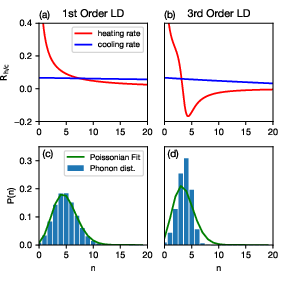
Figure 4: Mean-field and third-order Lamb-Dicke theory—steady-state phonon distributions showcase transition from Poissonian (coherent) to sub-Poissonian (non-classical) via engineered saturation.
Squeezed-Mode Phonon Lasing and Quantum Sensing Enhancement
The theory is further extended to phonon lasing in a squeezed bosonic mode. By driving both sidebands on each ion and applying a Bogoliubov transformation, lasing is realized in a squeezed quadrature. The resulting steady state is a squeezed coherent state, as validated in numerical phase-space (Wigner function) representations.
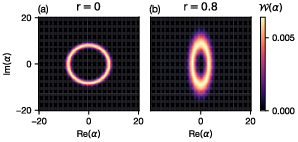
Figure 5: Wigner functions in the absence (left) and presence (right) of squeezing; clear squeezing of one quadrature is achieved for r=0.8.
A metrological analysis quantifies a quantum Fisher information improvement proportional to the applied squeezing parameter, yielding theoretical sensitivity gains of up to 80× over the standard phonon-lasing case for realistic experimental parameters. The limitations imposed by heating and decoherence rates are discussed, with squeezing-enhanced sensing well within current technological reach.
Single-Ion Phonon Laser: Simplified Realization and Analytic Treatment
Motivated by challenges in scaling the two-species approach, the article introduces a single-ion phonon lasing protocol utilizing three internal states and sideband-specific drives and dissipators. Theoretical analysis—both at the mean-field and full quantum levels—reproduces coherent lasing dynamics and phase transitions analogous to the two-ion case, but with altered stability boundaries and phase regions due to mutual influence of cooling and heating pathways through a shared ground state.
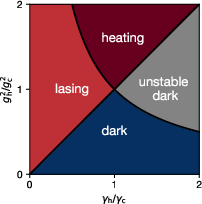
Figure 6: Single-ion lasing phase diagram; the lasing threshold remains analytically sharp but the phase boundaries exhibit significant topological modification compared to the two-ion case.
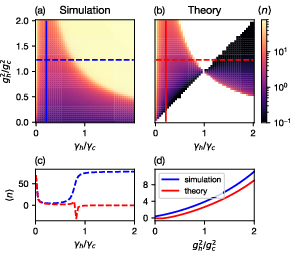
Figure 7: Simulated vs analytic steady-state phonon number in the single-ion device; boundaries and softening are quantitatively captured.
An analytic solution for the steady-state coherence function g(2)(0) is derived, and as in the two-ion case, the lasing region admits Poissonian photon statistics, whereas other parameter regimes produce thermal or sub-Poissonian statistics depending on the detailed balance of rates.
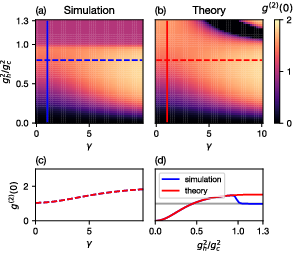
Figure 8: Analytic and numerical g(2)(0) in the g(2)(0)0 case demonstrate correctness of the approach in the single-ion parameter regime.
Comparative Analysis and Generalized Phase Structure
The two architectures—two-ion and single-ion—share essential features (e.g., threshold behavior at matched heating/cooling rates, lasing and dark phases) but diverge in the details of nonlinear phase boundaries and in sensitivity to parameter inhomogeneities. The underlying physical cause is traced to the coupling through a shared ground state in the single-ion construction, eliminating the strict separation of heating and cooling channels.
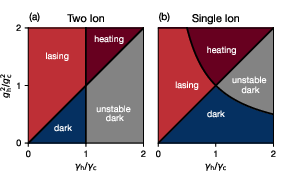
Figure 9: Schematic phase diagram overlay comparing single- and two-ion lasing systems, indicating structural similarities and key differences in the nonlinear regime and stability boundaries.
Conclusion
This paper delivers a rigorous quantum foundation for phonon lasing mechanisms in mixed-species and single-ion trapped-ion devices. Analytic expressions for steady-state statistics and phase diagrams are provided and validated by numerical solutions. Key experimentally relevant extensions—high-fidelity non-classical state generation via higher-order nonlinearities and squeezed-mode lasing for quantum-enhanced metrology—are explored in depth, with sensitivity improvements quantitatively characterized. The single-ion protocol removes significant experimental bottlenecks, enabling high-density integration of phonon lasers and thus broadening the platform's applicability to quantum metrology, synchronization, and error-correction research. Future directions include multi-laser synchronization, dark-state stabilization, and engineered decoherence for quantum information processing.
Reference: "Quantum theory for phonon lasing and non-classical state generation in mixed-species and single trapped ions" (2604.18295)