- The paper introduces a real-time human-AI music system that uses Role-Aware GRU to achieve zero-latency, turn-based musical interaction.
- It employs a novel event stream representation integrating time-shifts, harmonic embeddings, and explicit role encoding to enhance musical dialogue.
- The system features a lock-free, multi-threaded C++ architecture with RTNeural to ensure stable audio thread safety and prevent latency spikes.
Authoritative Technical Analysis of "LK Jam: System Architecture and Implementation of a Real-Time Human-AI Interactive Music Generation System using Role-Aware GRU" (2606.21018)
Context, Motivation, and Challenges
The ongoing shift from offline, tool-oriented music generation towards embodied co-performing AI amplifies the need for ultra-low-latency, highly interactive systems capable of real-time musical dialogue. Traditional deep learning models, particularly self-attention architectures such as Transformer/GPT, although capable of capturing global musical structure, are fundamentally constrained by inference latency (O(N2) complexity) and lack the role-awareness critical for authentic improvisational interaction. The core pain point addressed is twofold: (a) achieving strict, zero-latency inference suitable for DAW plugin edge-deployment, and (b) embedding role logic and turn-taking necessary for true bidirectional human-AI musical dialogue.
Algorithmic Innovations: Event Streams and Role-Aware GRU
"LK Jam" abandons fixed time-grid representations—prevalent in prior symbolic generation pipelines—in favor of a multi-dimensional, sparse event stream integrating time-shifts, continuous harmonic embeddings, explicit role encoding, and phrase position identifiers. The input feature vector at time step t concatenates pitch, velocity, micro-timing, harmonic context, role (Erole(rt)), and phrase position (Ephrase(loct)). This enables the lightweight GRU to perceive monophonic musical attributes as well as nuanced interaction logic in single-step inference, reducing computational complexity to O(1) for each event.
The closed-loop turn-taking mechanism generalizes jazz trading fours, cyclically alternating between human and AI. Each loop segment becomes a turn unit, with role encoding hardcoded, allowing the model to explicitly synchronize generative logic with interactive state. This design ensures stateful, phrase-bound responses rather than unidirectional continuations, structurally enforcing musical dialogue through motif pairing and cadence recognition.
Engineering Architecture: Lock-Free Real-Time Host Deployment
A strict multithreaded, lock-free architecture is devised using C++ and the JUCE framework, with the RTNeural inference engine exclusively deployed for real-time audio thread safety. The core principle is compile-time solidification of network topology and weights through template metaprogramming, ensuring true zero-allocation execution during runtime. This prevents latency spikes or thread contention, which otherwise lead to audio dropouts in typical DAW plugin environments. Triple-thread separation isolates inference from MIDI capture/playback and UI rendering, using lock-free SPSC queues and atomic double buffering for synchronization.
Progressive Training and Interactive Logic: Stages and Features
The dataset and training pipeline are hierarchical, with a three-stage progression:
- Atomic Harmonization: Fundamental chord-constrained melody generation, establishing core pitch-chord binding.
- Stylistic Expansion and Self-Motif Development: Integration of jazz solo corpora, with chromatic, syncopated, and Bebop material augmenting generative syntax. Self-motif development on single turns yields richer phrase logic.
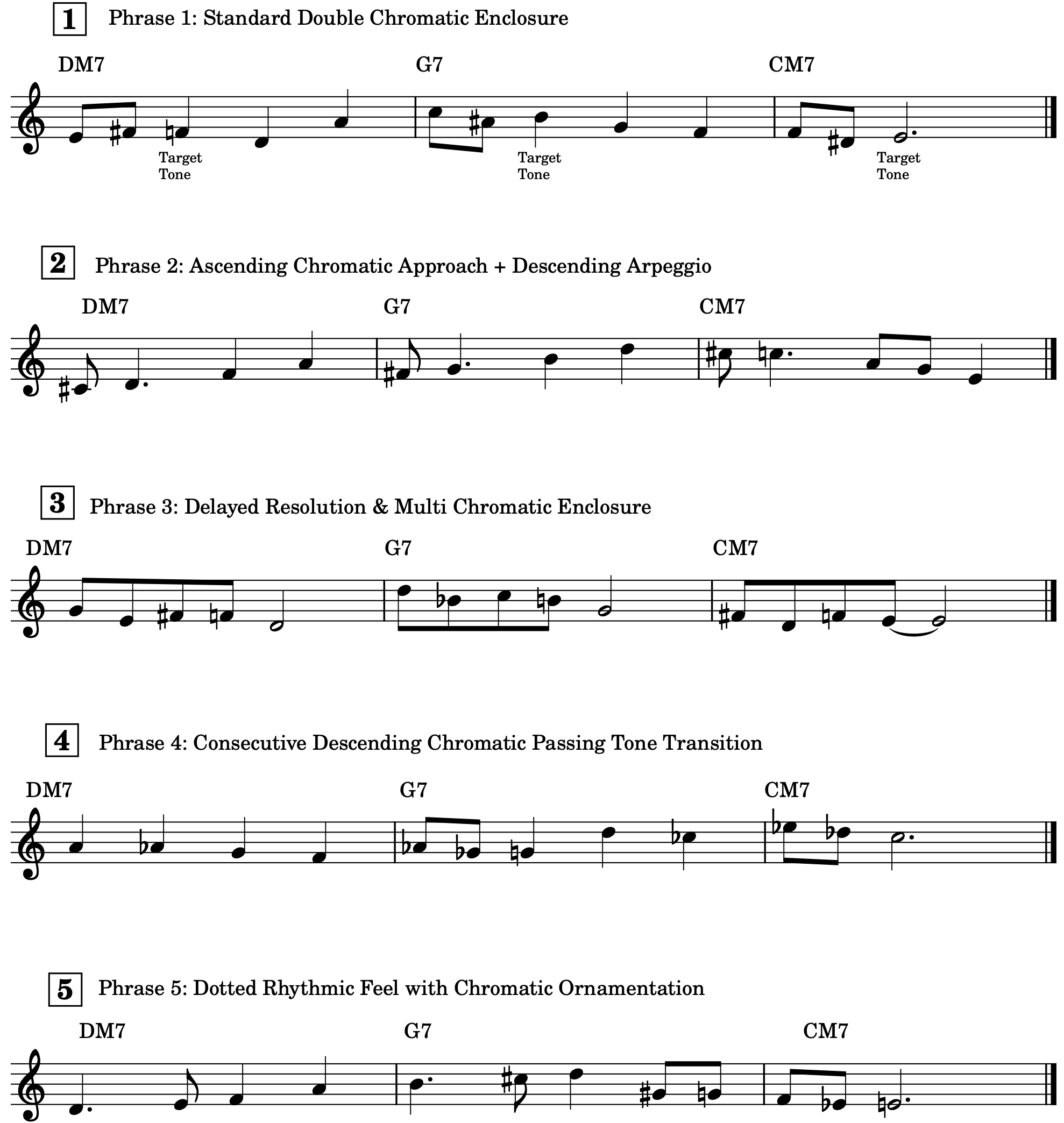
Figure 1: Stage 2: Linear vocabulary expansion and phrase self-motif development, with chromatic approaches and Bebop syntax introducing advanced improvisational features.
- Expert-Level Interaction Alignment: Supervised fine-tuning with motif pairs sourced from professional human-AI call-and-response sessions, enforcing bidirectional interplay and activating role/phrase encoding explicitly.
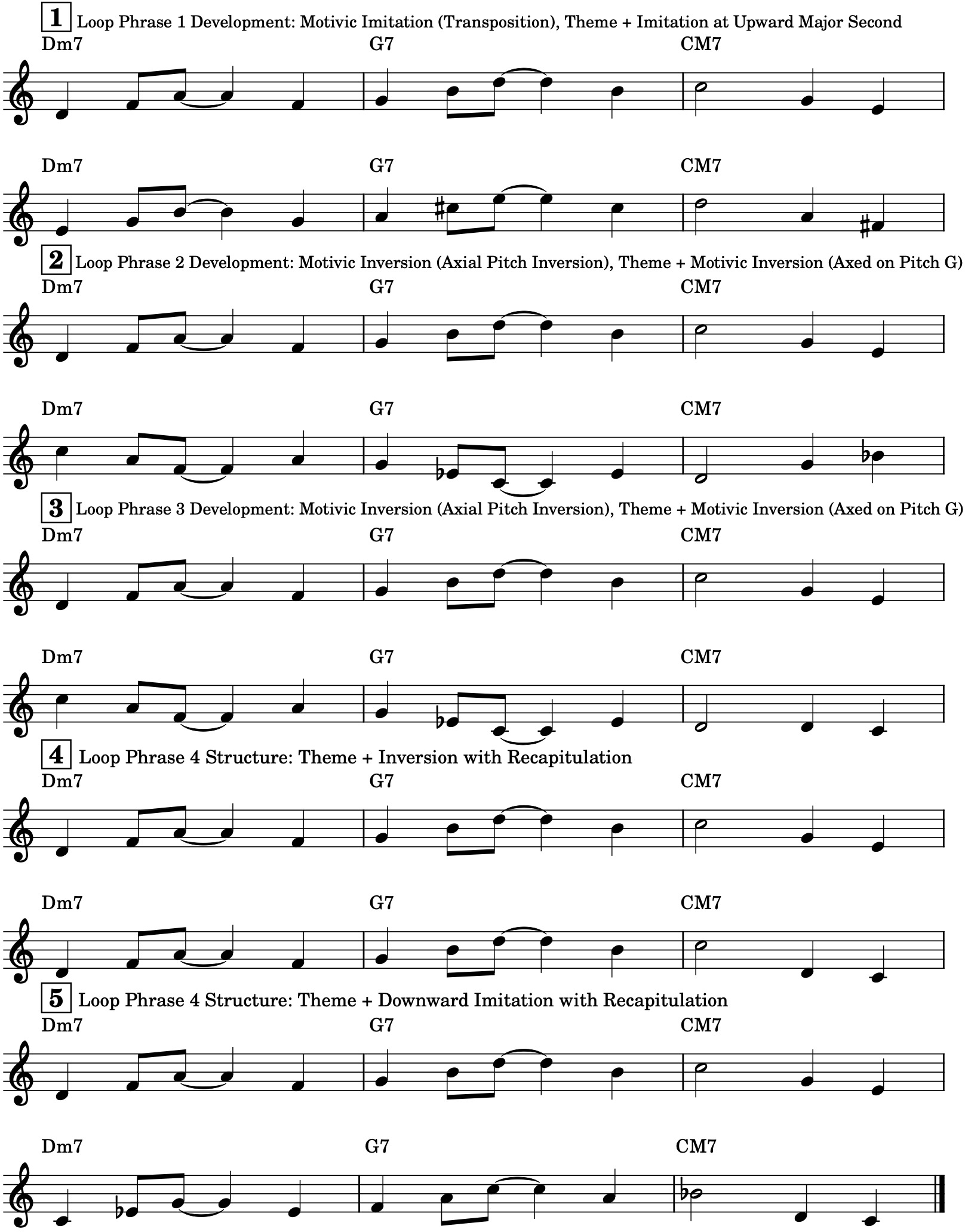
Figure 2: Stage 3: Expert-level alignment, showing AI responses that mirror, invert, or extend human motifs, embodying real-time logic cycles and cadential phrasing.
Scheduled Sampling gradually mitigates exposure bias, with phrase position identifiers (Ephrase(loct)) preventing infinite sprawl and enforcing closed-loop musical structure.
Numerical Results and Evaluation Framework
While detailed quantitative results are slated for future ablation and blind listening studies, architectural analysis predicts strict CPU usage bounds, reduced audio dropouts, and improved thematic coherence in generated motifs especially when role/phrase encoding is enabled. Ablations plan to verify these hypotheses, with expected outcomes including stable perplexity decline and qualitative improvements in motif response, phrase boundary, harmonic adherence, linear ornamentation, rhythmic density, and melodic contour according to an established six-dimension subjective evaluation framework.
Practical and Theoretical Implications
Practically, "LK Jam" offers a robust, deployable paradigm for next-generation AI co-performers in live music, bridging the real-time engineering chasm prevalent in DAW plugin integration for deep models. Theoretically, it substantiates the necessity of explicit role and phrase encoding in interaction-centric music AI, outclassing conventional model architectures that treat music generation as homogeneous, role-blind sequences.
Future developments are projected toward lightweight multi-track concurrent generation in lock-free architectures, and hybrid systems where macro-structural planning models supplement memory-decay-prone GRU inference in extended sessions.
Conclusion
"LK Jam" validates the synergy of event-based representations, explicit interaction logic, and streamlined GRU inference as technical prerequisites for real-time, human-centric music generation. The architectural and algorithmic choices structurally resolve latency, dropout, and interaction bottlenecks, accelerating progress toward fully embodied, interactive AI co-performers in contemporary music environments.