- The paper's main contribution is the introduction of hierarchical storyline trees using scene-based segmentation for detailed narrative structure modeling.
- It applies dual algorithms—top-down and bottom-up—to build multi-level thematic representations, enhancing efficiency in narrative question answering.
- Empirical results show that adaptive retrieval over these trees outperforms baselines, achieving up to 60.27% accuracy on NovelQA.
Hierarchical Narrative Modeling via Storyline Trees for Long-Form Narrative Understanding
Motivation and Problem Context
Long-form narratives, such as novels, pose significant challenges for current long-context LMs due to their inherently implicit structure: events, character arcs, and plotlines span hundreds of pages without explicit organizational cues analogous to headings in technical documents. Conventional segmentation units—chapters or fixed-length chunks—fail to capture thematic coherence or event boundaries, leading to inconsistent granularity and suboptimal document processing. Existing hierarchical approaches are either tied to explicit document structure (section headings, discourse units) or rely on question-specific memory aggregation, thus lacking reusable, interpretable representations of narrative structure. This paper introduces hierarchical storyline trees, constructed via scenes, which serve as granular, event-aligned units to bridge global themes and fine-grained evidence, aiming to unlock improved long-context QA and structured retrieval in narrative settings (2606.20900).
Scene-Based Segmentation as the Foundation
The initial step involves parsing the book into chapters (via metadata or structural heuristics), followed by scene segmentation using standardized LLM prompts. Scenes are contiguous narrative units, each characterized by consistent time, location, and character configuration, and aligned with theoretical models of narrative situation tracking and event indexing. Each scene includes a title, synopsis, significance annotation, and textual boundary, facilitating compact and narratively meaningful summaries.
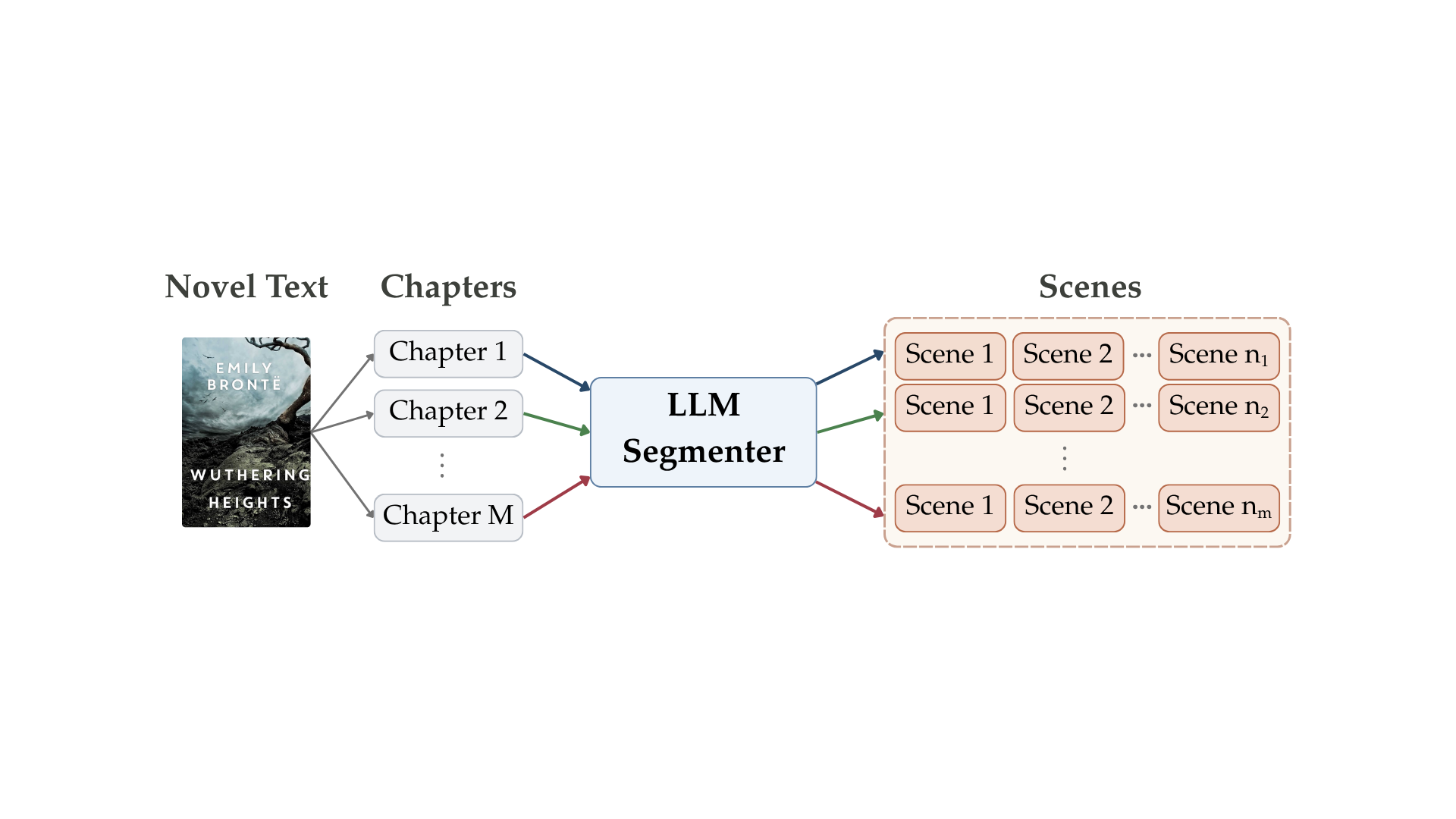
Figure 1: Scene segmentation: a book is first divided into chapters using metadata; each chapter is then passed to an LLM, which segments it into scenes that serve as the basic units for storyline-tree construction.
Defining scenes rather than chapters or generic chunks as the basis yields consistent granularity, improved semantic coherence, and enhances downstream interpretability, supporting the theoretical insight that narrative readers internally model events via discrete situation shifts [zwaan1995eventindexing, zehe2021detectingscenes].
Storyline Tree Induction: Top-Down and Bottom-Up Approaches
Two complementary algorithms for narrative tree construction are proposed:
- Top-Down Tree Induction: Abstract storylines are inferred from the full collection of scenes, recursively refined into more specific sub-storylines. At each level, titles and descriptions are generated, establishing parent-child relations. Conditioning on the complete previous storyline level and scene contexts keeps generation grounded and constrains expansion to elaborative, rather than orthogonal, themes. This leads to a compact hierarchy with broad thematic nodes at the top and fine-grained evidence nodes at the bottom.
- Bottom-Up Tree Induction: Starting from scene representations, scenes are recursively clustered by semantic similarity and each cluster is summarized to generate higher-level storyline nodes, iterating until further clustering is impossible. This yields a hierarchy reflecting local event grouping, where fine-grained clusters dominate the lower levels.
Both strategies enable multi-level abstraction, but exhibit divergent topology: top-down trees impose global structure prior to refinement, while bottom-up trees aggregate local relations and then generalize. Empirical analysis reveals top-down trees are more compact, with broader top-level branching, while bottom-up trees contain more nodes at lower levels, increasing the retrieval search space and sometimes diffusing cross-cutting plotlines.
Storyline-Guided Adaptive Retrieval for Narrative QA
The hierarchical representation supports a novel adaptive retrieval policy for QA over narratives. Upon receiving a question, the model retrieves an initial set of scenes most likely relevant to the query. Iteratively, it uses storyline tree nodes as navigation points, deciding to either answer from current evidence or request further scene-level retrieval guided by storyline titles. This adaptive mechanism permits progressively narrowing search from global structure to local evidence, enabling context-efficient, narrative-aware retrieval rather than reliance on flat chunk selection or static multi-pass aggregation.
Empirical Evaluation and Numerical Results
Experiments on three long-context narrative QA datasets (DetectiveQA, NovelQA, LiteraryQA) with two Qwen3 backbone models demonstrate strong empirical results. Adaptive retrieval over top-down storyline trees consistently achieves best accuracy across all dataset-model combinations. For example, with Qwen3-235B-A22B-Instruct-2507, accuracy on NovelQA reaches 60.27%, exceeding all baselines. Gains are statistically robust on datasets requiring distributed evidence synthesis, especially for plot-centric and character-centric questions (see Table 1).
- Scene-based construction outperforms chapters, generic semantic chunks, and TextTiling segments, confirming the indispensability of event-aligned units.
- Adaptive, tree-guided traversal yields significant improvement versus static or collapsed retrieval, even under matched evidence budgets.
- Top-down organization enables more effective navigation, supporting broader thematic entry points and producing compact yet discriminative hierarchies.
Full ablation and topology statistics (see Figure 2-5 in paper) establish that bottom-up trees, while locally dense, lack the global narrative prior critical for question-guided traversal.
Analytical Implications and Theoretical Considerations
The results support the hypothesis that explicit narrative structure—hierarchical, scene-grounded, and theme-refined—is essential for robust long-context reasoning. The compact abstraction in top-down trees aligns with cognitive theories of narrative comprehension, which posit that readers build mental models from global themes and only then integrate local episodic evidence [zwaan1998situationmodels]. Agentic chunk-based and memory approaches are demonstrably limited by lack of reusable structure, and extension of flat retrieval methods fails to address event dispersal and plot interleaving in narrative texts.
From a practical perspective, storyline trees enable indexing, traversal, and retrieval policies better tuned for narrative QA, opening avenues for amortized tree re-use in multi-query scenarios, and supporting explainable evidence navigation. The method introduces modest computational overhead but is amortized for repeated analysis, and further optimization is possible via incremental tree learning or policy distillation.
Future Directions in AI Narrative Understanding
Potential avenues include learning traversal and retrieval policies beyond prompts, integrating storyline trees with memory-augmented agents for lifelong narrative comprehension, and extending representations to broader forms (verse, screenplay, hybrid genres). Intrinsic evaluation of hierarchical faithfulness, interpretability, and event-thread preservation will be necessary for scaling to diverse narrative settings. Task transfer to summarization, narrative generation, and automated literary analysis is plausible, provided adaptive control and structure learning are further optimized.
Conclusion
Hierarchical storyline trees, constructed from scenes and supporting adaptive retrieval, represent a foundational advance in long-form narrative modeling for structured QA. The approach consistently outperforms strong baselines, with empirical and theoretical support for scene-based representation, global thematic abstraction, and tree-guided exploration. Explicit narrative structure is critical for robust long-context reasoning; further development in policy learning, structure evaluation, and generalization to diverse narrative forms will underwrite sustained progress in AI narrative understanding (2606.20900).