- The paper introduces a narrative-centric retrieval-augmented reasoning framework that dynamically builds narrative structures to enhance long-form question answering.
- It separates construction-time asset extraction from query-time tool-based reasoning, integrating canonical graphs, episode aggregation, and storyline induction.
- Empirical evaluations on benchmarks like STAGE demonstrate improved multi-hop narrative reasoning accuracy and reduced retrieval errors.
Narrative Knowledge Weaver: A Narrative-Centric Retrieval-Augmented Reasoning Framework
Contemporary approaches to long-form narrative question answering (QA) are fundamentally challenged by the functional and dynamic nature of evidence in narrative texts. General-purpose retrieval-augmented generation (RAG) systems organize information mainly around passage similarity, factual retrieval, or static graph abstractions. However, these approaches break down in narratives where answers depend on evolving character states, social relations, causal triggers, and plot progression. Standard retrieval may conflate distinct narrative roles for the same passage—serving simultaneously as premise, turning point, or consequence—and fails to represent the dynamic evolution of entities’ states across the story trajectory.
Narrative Knowledge Weaver Framework
Narrative Knowledge Weaver (NKW) addresses these conceptual mismatches by constructing a narrative-centric RAG architecture that aligns evidence extraction, dynamic graph structure, episode/storyline induction, and narrative progression to the requirements of long-form narrative understanding.
NKW separates construction-time asset building from query-time reasoning (Figure 1). During construction, it produces a source-grounded asset bundle that comprises:
- A canonical entity–relation graph;
- Narrative units: events, interactions, occasions;
- Source-grounded atomic facts and entity attributes;
- Entity profiles tracking states over time;
- Episodes and storylines encoding higher-order narrative progression;
- Provenance links back to source text.
Post-construction, the query-time agent exploits a tool-based interface to combine local text, graph, and high-level narrative evidence for QA, employing post-retrieval reading skills for detailed evidence auditing.
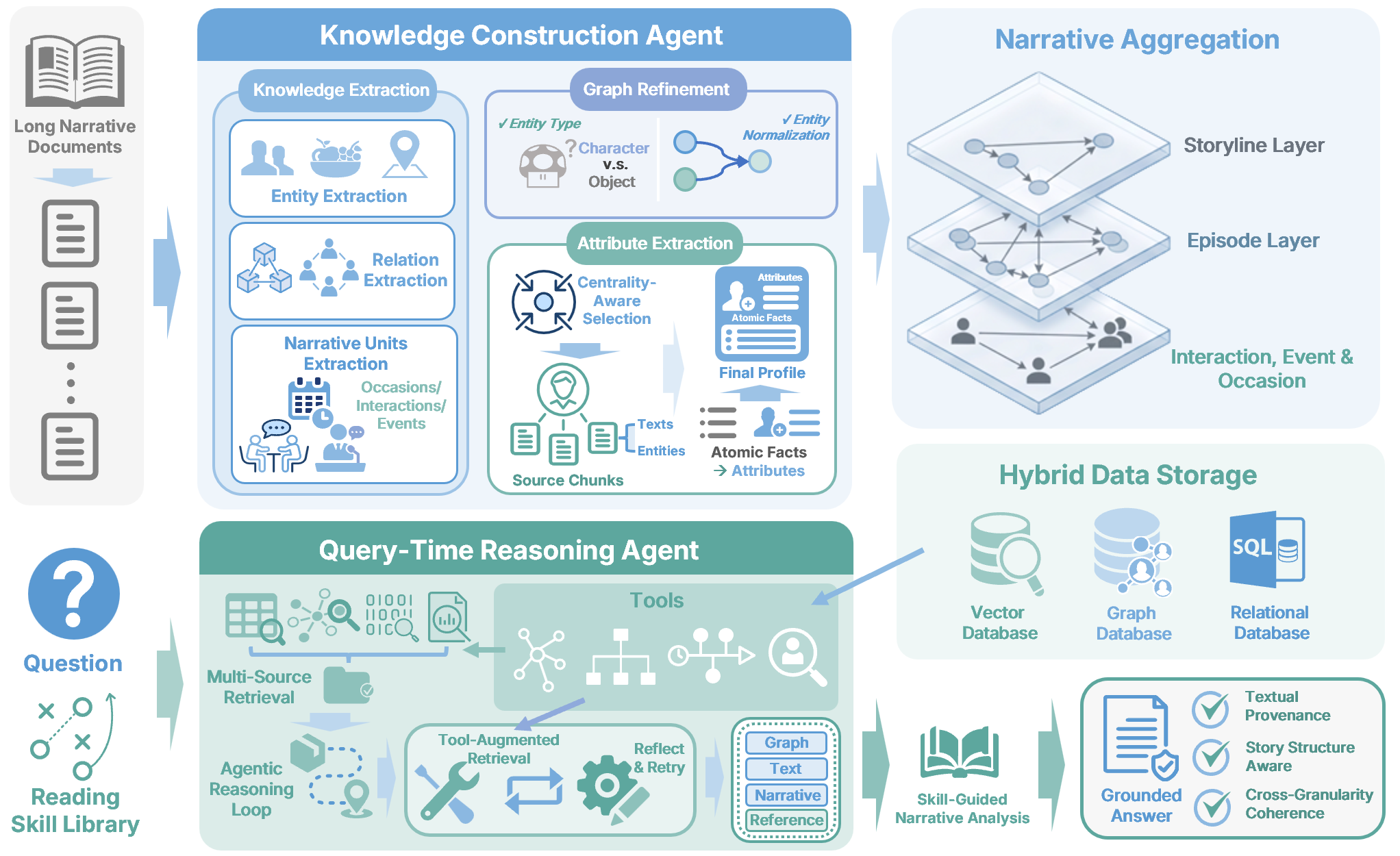
Figure 1: NKW separates construction-time graph and narrative asset extraction from query-time tool-enabled reasoning, aligning local and global narrative structure for QA.
Canonical Graph Construction
Entities—characters, groups, locations, objects, institutions—are identified and unified within a stable, global graph. All mentions (names, aliases, pronouns) are canonicalized, enabling dynamic character and object tracking independent of surface realization. Relations are extracted as binary edges supplemented with descriptors and are merged and indexed for stable reference throughout the narrative.
Narrative Asset Extraction and Aggregation
Events, interactions, and occasions are extracted in a structured manner, each anchored to supporting source text. These local units provide the factual basis for reasoning about state changes and narrative function. Subsequently, units are clustered into episodes based on participant overlap, shared goals/conflicts, temporal continuity, and causal/semantic relatedness. Over episodes, NKW induces a directed acyclic progression graph, extracting storylines via trunk-branch segmentation. These storylines abstract long-range trajectories and enable explicit reasoning about plot development and inter-episode dependencies.
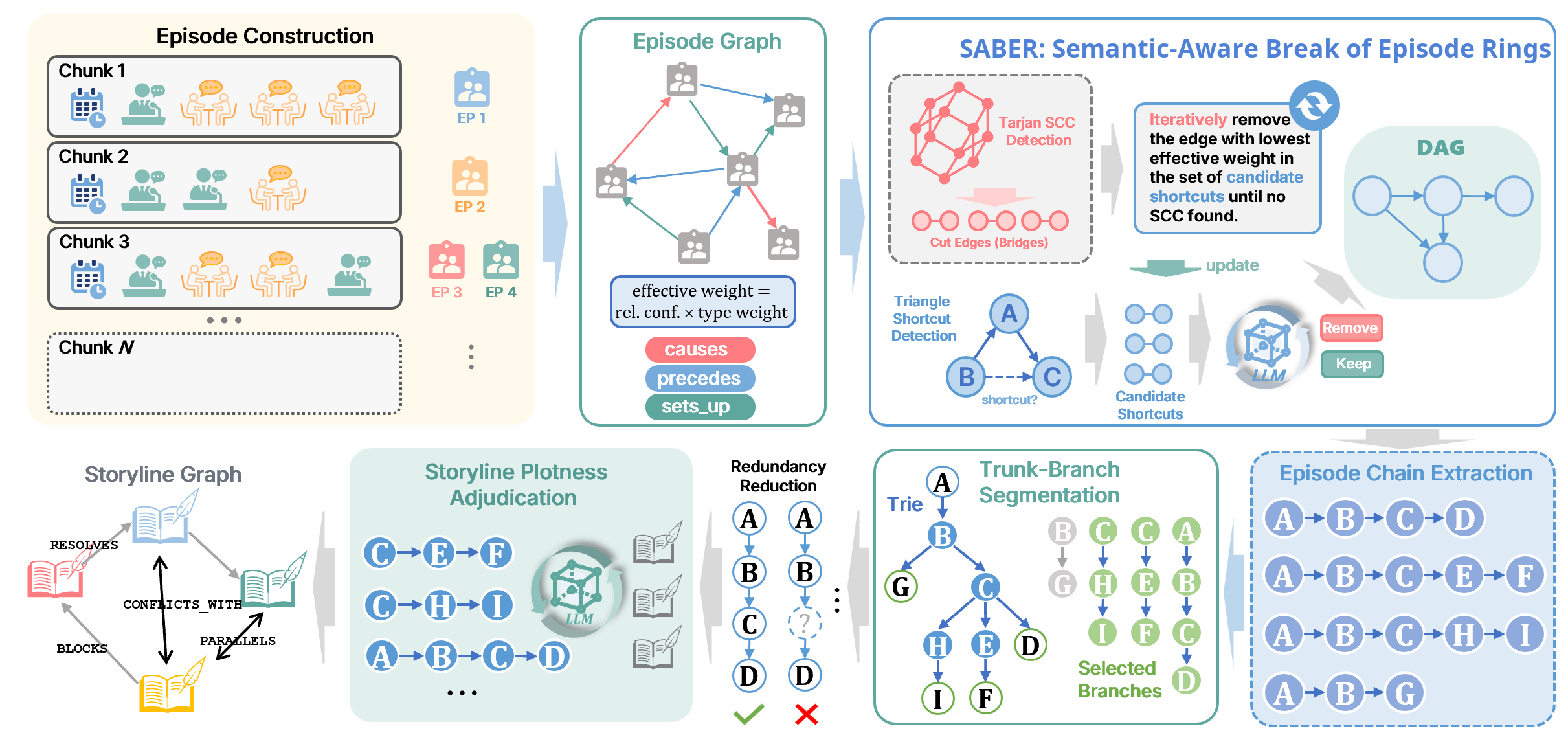
Figure 3: Narrative aggregation from events/interactions/occasions to episodes, episode DAG cleaning, trunk–branch segmentation, and storyline induction.
At inference, NKW provides fine-grained access to:
- Direct textual evidence;
- Atomic facts for compact local propositions;
- Structured representations of entity states and relations;
- Temporal, causal, and storyline-level narrative aggregates.
Crucially, tools enable channel-separated retrieval—over text, graph, or narrative structure—allowing the agent to assemble multilevel evidence packets conditioned on the precise demands of the question.
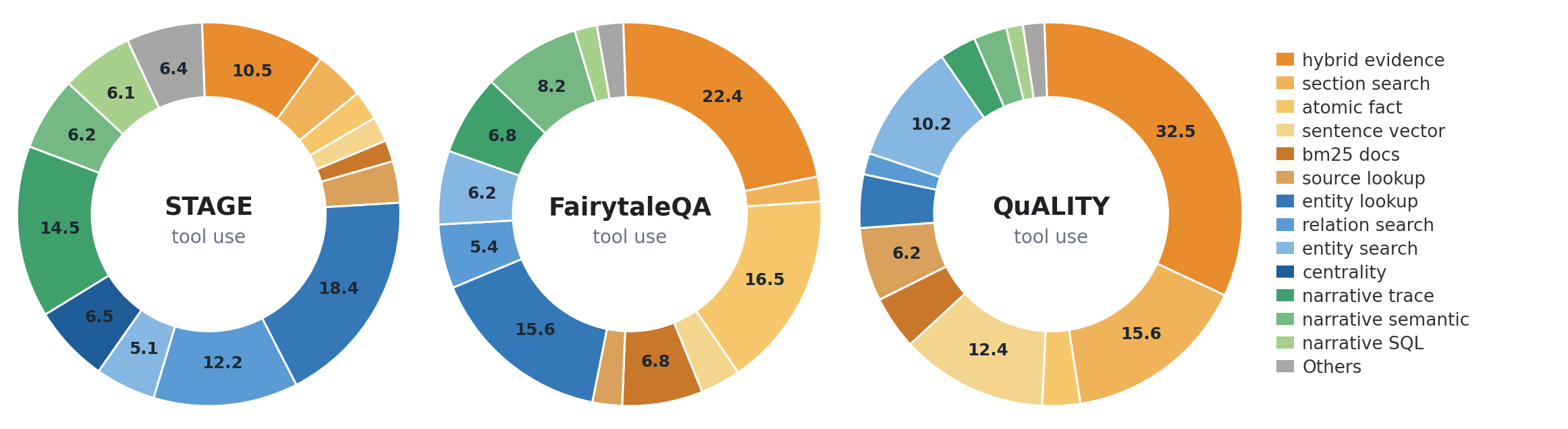
Figure 4: Tool-use distribution by benchmark; STAGE QA relies heavily on graph/narrative tools, while passage-centric tasks involve more text-based retrieval.
Post-retrieval, Reading Skill Cards—a set of theory-informed answer-selection operators—scrutinize the evidence for actor, state, temporal, and causality alignment, minimizing errors such as confusion of actor identity, event chronology, or scope of reference.
Empirical Evaluation
Datasets and Baselines
NKW is evaluated on three benchmarks:
- STAGE: Full-screenplay, scene-structured QA with 5,010 questions spanning six narrative reasoning types (character, scene, temporal, causal, relation, progression).
- FairytaleQA: Factual and interpretive QA over children’s stories.
- QuALITY: Multiple-choice QA on long passages.
Comparative baselines include Hybrid RAG (text-centric), and recent graph-augmented and tool-based retrieval architectures (GraphRAG, LightRAG, HippoRAG, A-RAG).
Main Quantitative Results
NKW demonstrates substantial advantages on STAGE, especially on queries requiring multi-hop narrative reasoning. Pass@5 accuracy on STAGE is highest for NKW under all medium/large open-source and closed-source LLM backbones. For passage-centric benchmarks (FairytaleQA, QuALITY), NKW remains competitive—particularly in high-capacity regimes and Pass@5 metrics—but the benefit of rich narrative structure becomes less pronounced, reflecting the local nature of evidence in these tasks.
Component Ablations and Fine-Grained Analysis
Ablation experiments isolate the main design contributions:
- Removing entity attributes predominantly affects character/state tracking tasks.
- Disabling episode/storyline aggregation leads to pronounced drops in temporal and progression-based QA.
- Omitting graph tool access or post-retrieval reading skills systematically hurts performance on multi-constraint and high-level narrative questions.
The results indicate that NKW’s narrative hierarchy mediates complex evidence assembly, especially where multi-source, temporally or causally distinct, or state-dependent reasoning is required.
Downstream and Practical Implications
Production Continuity Applications
Leveraging NKW’s per-scene narrative asset mapping, downstream tools can address production-oriented tasks, such as continuity checking: scenes are grouped into chains sharing compatible entities, settings, and objects, assisting in logistical optimization for film production workflows.
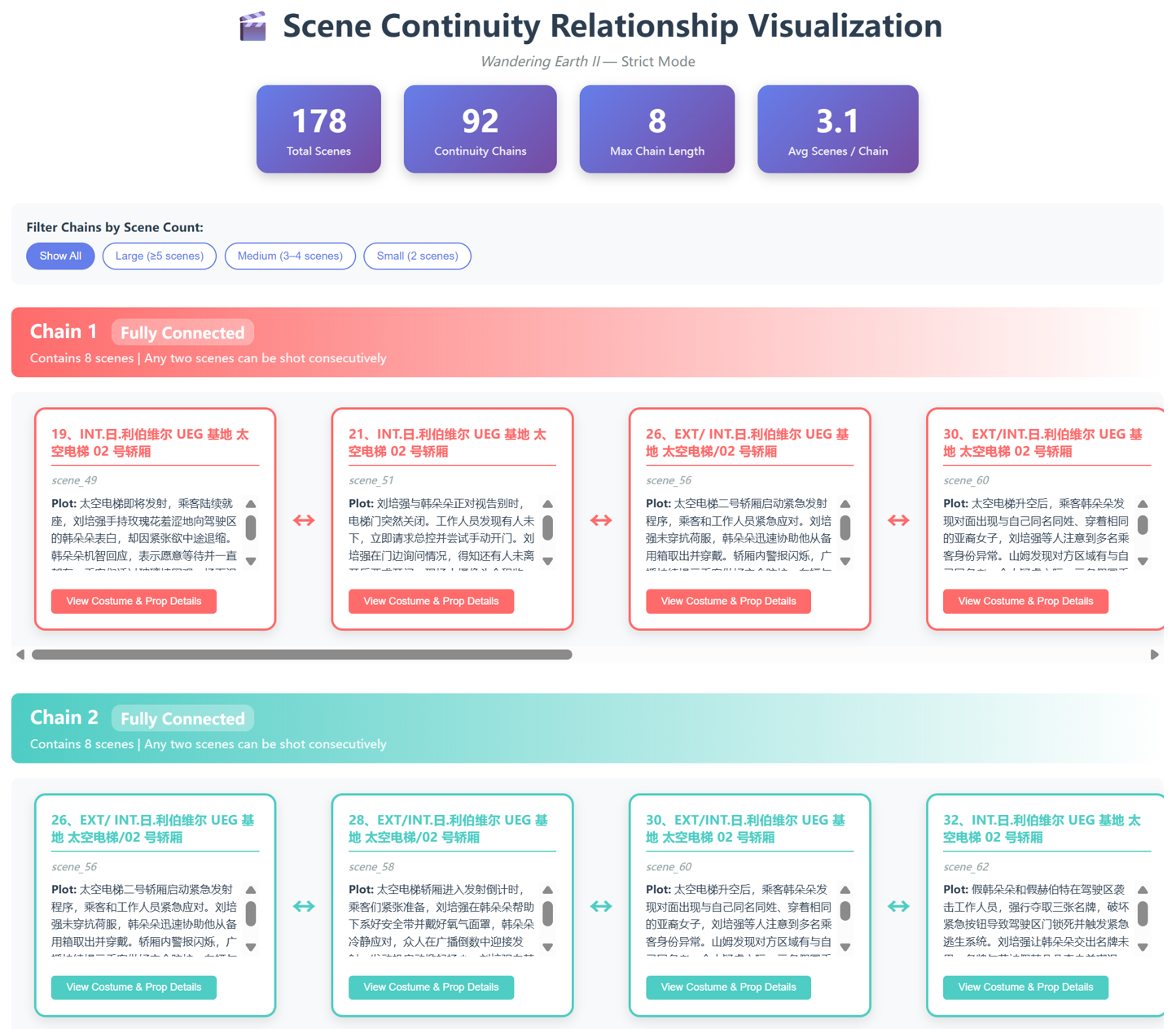
Figure 2: Continuity-chain visualization links scenes with compatible production setups, using narrative and asset cues for global planning.
Character State Visualization
Additionally, NKW enables fine-grained, scene-aligned character tracking, visualized via timeline swimlane matrices for global inspection of character appearance and co-occurrence patterns across the narrative.
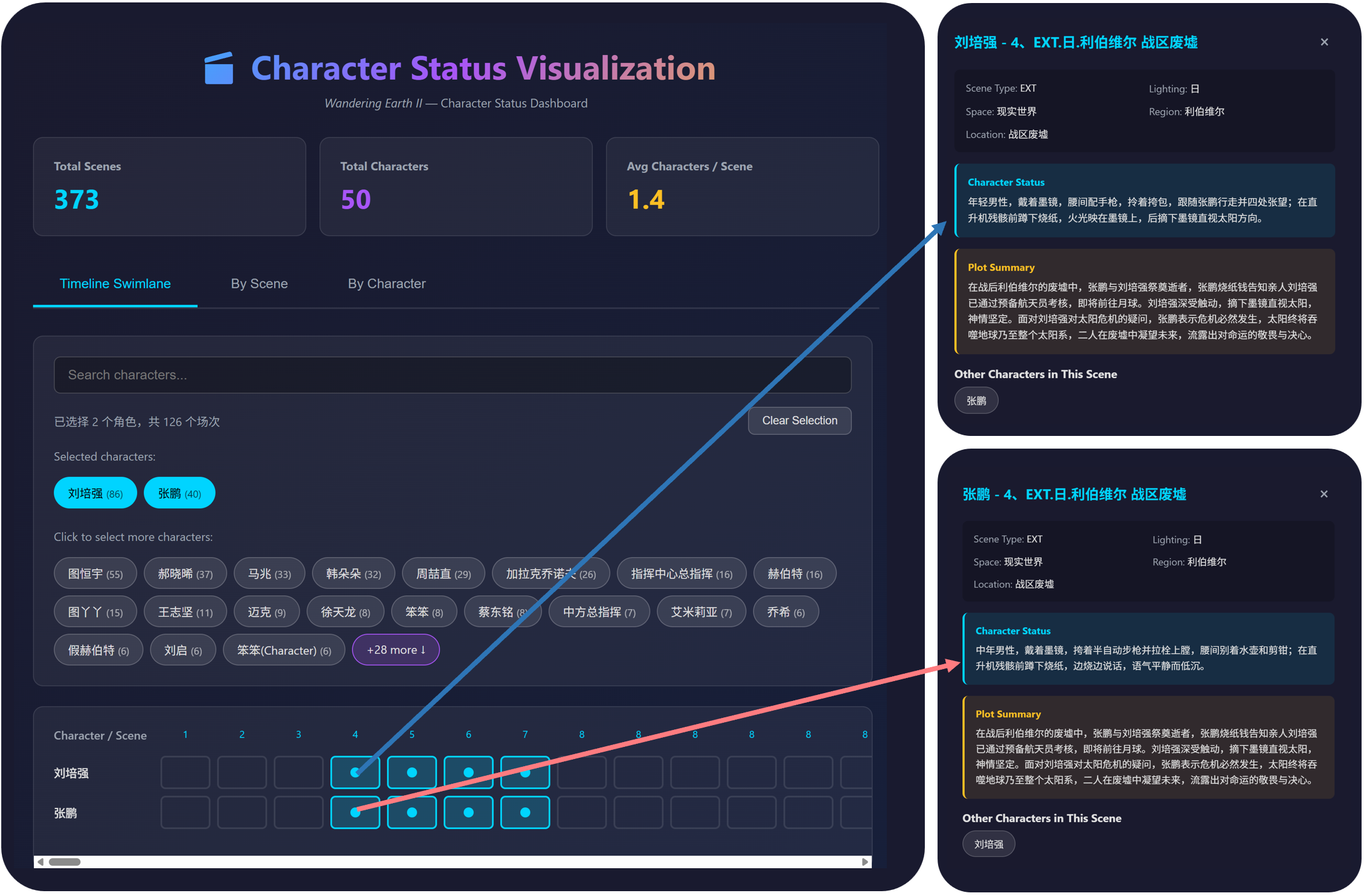
Figure 5: Timeline swimlane view mapping characters’ presence to scenes for analysis of appearance frequency, co-presence, and narrative participation.
Theoretical Implications and Future Directions
NKW’s architecture advances the modeling of narrative evidence as dynamic, functionally situated, and hierarchically structured—moving beyond static entity–relation graphs or flat passage retrieval. This supports alignment with psychological models of narrative comprehension, e.g., situation-model and causal-network theories, and operationalizes cognitive reading strategies as modular, auditable AI components.
Key future research includes:
- Scaling efficiency and auditability for broader domains and multilingual corpora;
- Generalizing evidence roles to non-narrative temporal/causal structures;
- Reducing dependency on upstream extraction quality for robust asset bundle construction;
- Tighter integration of reading-skills modules with retriever–generator pipelines.
Conclusion
Narrative Knowledge Weaver demonstrates that narrative-centric structure—integrating graph-based grounding, episodic and storyline abstraction, and channel-separated retrieval—enables significant improvements in long-form narrative QA, especially when answers depend on dynamic state, relation, and progression reasoning. The findings suggest that modeling the functional roles of evidence within evolving story worlds is essential for advanced narrative understanding and unlocks new capabilities for both academic and applied systems in literary analysis, production, and reading assistance.