- The paper introduces a novel operator-theoretic framework for colored braid groupoids using geometric flips in Delaunay triangulations.
- It constructs explicit matrix and orthogonal representations in GL(2n+1), verified through computational checks of pentagon and commutativity relations.
- Algorithms provided compute nontrivial invariants for colored braids, though they degenerate for certain knot closures like the Borromean rings.
Invariants of the Colored Braid Groupoid: Structural Analysis and Representation Theory
Overview
The paper "Invariants of the Colored Braid Groupoid" (2606.20473) systematically develops invariants and representations for groupoids arising from colored braids, connecting dynamical systems, Delaunay triangulations, and matrix/operator-theoretic invariants in a highly algebraic and geometric framework. The principal outcome is the construction of matrix and orthogonal representations of the colored braid groupoid, together with algorithms for the computation of their invariants, with particular emphasis on their behavior under combinatorial moves such as flips in Delaunay triangulations.
Colored Braid Groupoid: Definitions and Algebraic Structure
Colored braids are formalized as collections of n non-intersecting paths in R3, each labeled with distinct colors or marks, corresponding to endpoints on parallel lines. Unlike classical braids, colored braids admit a partially defined multiplication: the product of two colored braids is defined only if the coloring/marking at the ends of the first matches the markings at the start of the second. This structure naturally yields a groupoid, denoted ColB(n), as opposed to a classical group.
The groupoid is abstracted via dynamical systems — collections of points on a plane evolving from initial to final positions under rules forbidding collisions and merges. The states of these dynamical systems are encoded using Delaunay triangulations, allowing a geometric perspective on braid isotopy classes and the moves (flips) connecting them.
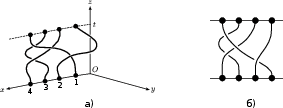
Figure 1: Colored braids with n strands and their diagrammatic representation.
Geometric Model: Delaunay Triangulations and Flips
Each state in the dynamical system is associated with a Delaunay triangulation, including three additional fixed points to maintain stability and ensure a constant number of edges. The elementary moves in braid isotopy are realized as flips within the triangulations, corresponding to replacing a diagonal in a quadrilateral with the alternative diagonal, as detailed in the formalism.
The abstract colored braid groupoid is generated by such flips, subject to a set of algebraic relations:
- Identity: gHiHi=1
- Invertibility: gHjHigHiHj=1
- Pentagon Relation: gHjHigHkHjgHpHkgHqHpgHiHq=1
- Commutativity of Distant Flips: gHjHigHkHj=gHpHigHkHp
These are tightly connected to the combinatorial structure of triangulations and their mutations.
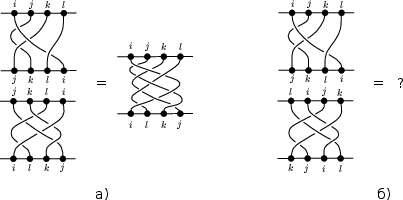
Figure 2: Multiplication operation on colored braids: a) valid product; b) invalid product due to color mismatch.
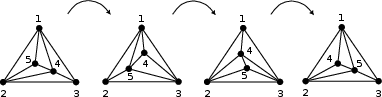
Figure 3: Delaunay triangulation reconstructions under movement of two points (labelled 4,5) amid three fixed points (1,2,3).
Matrix and Orthogonal Representations
The paper constructs matrix representations fn+3 and fn+3′ of the groupoid in R30 and R31, respectively, where the basis vectors correspond to triangles from the Delaunay triangulations. The flips are associated with explicit linear operators, either rational or orthogonal, whose entries depend algebraically on coordinates assigned to the points in the triangulation. The ranks are determined by the formula R32, corresponding to the number of triangles excluding the external face.
The representations obey the groupoid relations, notably the pentagon relation, which translates into matrix pentagon equations; these are checked computationally for orders up to R33.
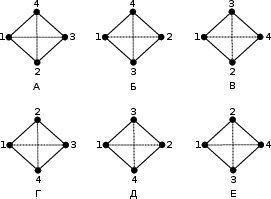
Figure 4: All possible planar quadrilaterals modulo rotations; indices correspond to variable assignments.
Algorithmic and Numerical Realizations
Algorithms are provided for tracking sequences of flips, assigning correct indices to the affected triangles, and computing the resulting matrices. Examples are given through explicit numerical calculations for colored pure braids, validating commutativity relations and pentagon equations. The orthogonality or non-orthogonality of the matrices is flagged, with implications for subsequent invariant construction.
Limitations and Nontriviality of Invariants
The study shows that both R34 and R35 yield nontrivial invariants for colored braids but are typically trivial for knots and links due to their determinant value and diagonal structure. The paper demonstrates that for certain closures, such as the Borromean ring, both invariants degenerate to the identity, underscoring that more refined invariants or deformation of the matrix structure may be needed for full knot-theoretic sensitivity.

Figure 5: Braid corresponding to the Borromean ring showing trivial matrix invariants in both representations.
Broader Implications and Further Directions
This formalism provides a geometrically transparent and algebraically tractable method to analyze colored braid groupoids, extending the invariant machinery of knot theory into groupoid and operator-theoretic settings. The matrix representations can be algorithmically computed for arbitrary colored braids, facilitating practical applications in combinatorial topology and quantum invariants. Future directions proposed include:
- Modifying the representations to construct nontrivial invariants for knots and links.
- Systematic classification of linear operator invariants in this setting.
- Extending the methodology to the entire braid group R36.
The connection between flips in triangulations, pentagon equations, and braid groupoid relations has implications for the study of categorical invariants, topological quantum field theory, and the combinatorial realization of higher groupoids.
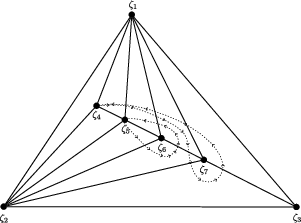
Figure 6: Example dynamical system: arrows indicate the movement direction for the point R37 in the braid R38.
Conclusion
The paper (2606.20473) develops a rigorous operator-theoretic framework for the colored braid groupoid, translating its combinatorial and geometric structure into matrix and orthogonal representations, and algorithms for their computation. While the constructed invariants are nontrivial for colored braids, their extension to knots/links remains to be achieved. The theoretical apparatus, combining dynamical systems, triangulation theory, and algebraic groupoids, opens the way towards new representation-theoretic and combinatorial approaches in low-dimensional topology and mathematical physics.