- The paper establishes sharp dimension formulae for surface braid groups, proving gd₍𝔽ₙ₎(G) = vcd(G) + n via fibration and pushout constructions.
- It rigorously computes exact values for models of classifying spaces by leveraging explicit free abelian subgroups and commensurability arguments.
- The work impacts group cohomology and K-/L-theory by providing precise bounds critical for isomorphism conjectures in equivariant topology.
Virtually Abelian Classifying Spaces for Surface Braid Groups
Introduction and Motivation
The paper "Classifying spaces for families of virtually abelian subgroups of surface braid groups" (2604.15243) investigates the minimal possible dimensions for models of classifying spaces EFnG associated to families Fn of virtually abelian subgroups of rank at most n in surface braid groups G. The main interest lies in the geometric (gdFn(G)) and virtual cohomological (vcd(G)) dimension, providing sharp upper and lower bounds and, for broad classes, exact values for these invariants. This analysis has implications for group cohomology, K- and L-theoretic isomorphism conjectures, and the structure theory of surface braid groups and their subgroups.
Families of Virtually Abelian Subgroups and Classifying Spaces
The family Fn consists of all subgroups of G that are virtually free abelian of rank at most Fn0. The classifying space Fn1 is a Fn2-CW-complex admitting stabilizers in Fn3 and serving as a universal space for equivariant actions with prescribed isotropy. The geometric dimension Fn4 is defined as the minimal dimension of such a Fn5-CW-complex, while the Fn6-cohomological dimension Fn7 is an invariant from Bredon cohomology.
Essential inequalities are established for these dimensions; for example, Fn8 for suitably large values, with sharpness in many cases. The paper applies these frameworks to surface braid groups, which are fundamental groups of configuration spaces of points on surfaces, and whose algebraic and geometric properties are central in topology and group theory.
Main Results: Exact Formulae and Strong Dimension Bounds
The principal results are as follows:
- For surface braid groups Fn9 of a surface n0 with non-negative Euler characteristic and at least one boundary component or puncture, for every integer n1, the minimal dimension of a model for n2 equals the virtual cohomological dimension of n3 plus n4:
n5
This result is established for pure surface braid groups with precise arguments relying on the Fadell-Neuwirth fibration, properties of virtually abelian subgroups, and the Lück–Weiermann pushout construction. The proof combines lower bounds (exhibiting free abelian subgroups in n6) with upper bounds (constructing suitable models for classifying spaces).
- For full braid groups of the sphere (n7), an analogous formula holds:
n8
- For surfaces of infinite type, the virtually cyclic geometric dimension for pure braid groups is computed:
n9
- Strong amenable dimension equivalence: Since braid groups satisfy the strong Tits alternative (every amenable subgroup is virtually abelian), the dimension for the classifying space for families of amenable subgroups coincides with that for virtually abelian subgroups.
These results are validated rigorously by exhibition of explicit free abelian subgroups (see below), careful transfer of dimension bounds via group extensions, commensurability arguments, and pushout constructions.
Structural and Technical Highlights
A pivotal geometric argument is the construction of explicit free abelian subgroups of pure braid groups on surfaces like the annulus or disk with boundary, corresponding to Dehn twists along disjoint simple closed curves encircling marked points.
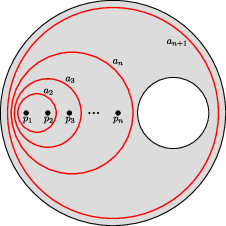
Figure 1: G0 (annulus) with G1 marked points and G2 disjoint simple closed curves, each curve supporting a Dehn twist that generates a free abelian subgroup of rank G3.
The proof employs induction on the number of strands, leveraging the Fadell-Neuwirth fibration and analyzing the geometric and algebraic structure of Weyl groups associated with abelian subgroups. Commensurability of subgroups and normalizer arguments are used to transfer dimension bounds. The Lück–Weiermann pushout construction is crucial for assembling models for classifying spaces with prescribed isotropy.
For infinite-type surfaces, the arguments rely on group-theoretic properties such as condition G4 (conjugacy invariance of powers) to control virtually cyclic dimensions and proper actions via Bredon cohomological conditions.
Numerical and Contradictory Claims
- The paper provides sharp equalities for geometric dimension:
- G5 for braid groups on surfaces with at least one boundary or puncture;
- G6 for infinite-type surfaces.
- It contradicts the general expectation that geometric and cohomological dimensions always coincide, giving explicit inequalities and exact bounds for surface braid groups.
- The dimension for the amenable classifying space is not increased relative to the virtually abelian classifying space, owing to the strong Tits alternative.
Implications and Prospects
Practically, these results enable precise computation of dimension invariants appearing in the Baum–Connes and Farrell–Jones conjectures for group cohomology and algebraic G7- and G8-theory. They inform the construction of G9-CW-complexes with controlled isotropy, essential for computations in equivariant topology. The techniques might extend to other group families, such as mapping class groups, 3-manifold groups, and automorphism groups of RAAGs.
Theoretically, the results elucidate the intersection of geometric group theory, algebraic topology, and the theory of families of subgroups. The sharp dimension formulae may be instrumental in obstruction theory, assembly map computations, and in the search for small models of classifying spaces.
Further developments may explore similar dimension rigidity in broader families (e.g., virtually solvable, polycyclic, or amenable subgroups), extension to higher-rank lattices, and implications for finiteness properties of classifying spaces and their cellular models.
Conclusion
The paper establishes exact, sharp dimension formulae for classifying spaces of families of virtually abelian subgroups in surface braid groups, employing geometric constructions, fibration arguments, and commensurability techniques. These results have direct impact on cohomological and topological invariants relevant for group actions, algebraic gdFn(G)0-theory, and the isomorphism conjectures. The methodology is robust and may be adapted to wider group-theoretic settings, offering valuable insights for the dimension theory of group families.