- The paper introduces the TCA framework that leverages a Random Forest model to predict and accelerate trust convergence under variable network conditions.
- The method achieves up to 28.6% reduction in convergence time and maintains trust accuracy even during adversarial bad-mouthing attacks.
- The framework demonstrates scalability by adapting to networks ranging from 50 to 250 nodes while ensuring robust, real-time trust evaluations.
Machine Learning-Driven Trust Convergence Acceleration in IIoT under Dynamic Network Conditions
Background and Motivation
Industrial Internet of Things (IIoT) deployments confront acute challenges arising from the necessity to secure large-scale, heterogeneous, resource-constrained devices in the presence of fluctuating wireless network quality. Traditional centralized and distributed trust management models often fail to rapidly converge to accurate trust evaluations when network conditions are unfavorable, exacerbating the risk of delayed or incorrect isolation of compromised nodes. The research addresses these deficiencies by proposing the Trust Convergence Acceleration (TCA) framework, which integrates a ML-based prediction pipeline to optimize trust metric convergence under dynamic network conditions.
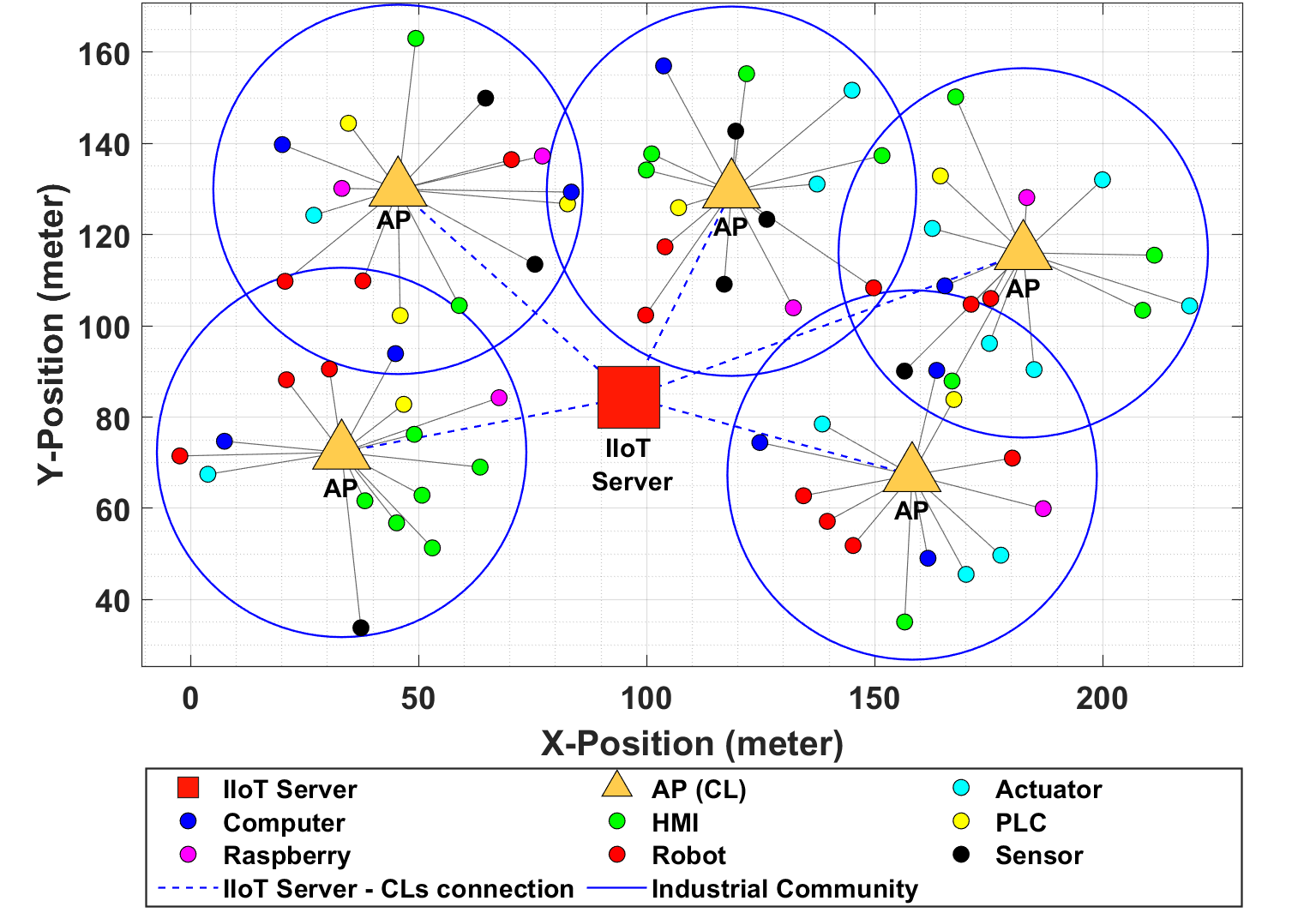
Figure 1: Network architecture for IIoT trust management, highlighting hierarchical organization into community leaders (CLs) and member nodes (MNs) with Wi-Fi 6 APs.
Trust Model and Network Characterization
The TCA approach is instantiated atop the H-IIoT architecture, leveraging clusters of IIoT devices (MNs) under the supervision of Wi-Fi 6-based Community Leaders (CLs) linked to a global IIoT server. Trust evaluation for individual nodes is formulated through discrete-time Markov chains indexed by states reflecting trustworthiness (Tm), calculated via direct and indirect honesty metrics as well as cooperation rates. The transition matrix, parameterized through observable indicators such as forwarding behavior and reputation feedback, anchors adaptive trust evolution.
In-depth simulation settings model realistic IEEE 802.11ax (Wi-Fi 6) characteristics. Quality of Service (QoS) parameters—SNR, Packet Loss probability, Jitter, Latency, Throughput, and SINR—are used to establish a basis for high-fidelity analysis of trust convergence dynamics in Good, Medium, and Poor network scenarios.
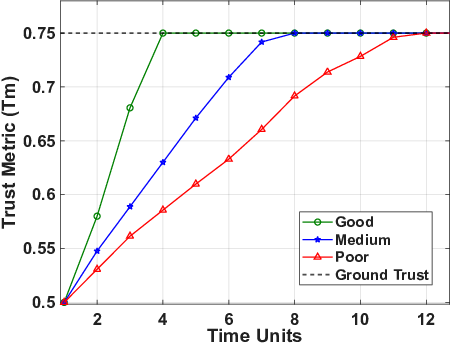
Figure 2: Tm convergence profiles for IIoT nodes under varying network conditions, demonstrating prolonged stabilization times with degraded channel quality.
Trust Convergence Acceleration (TCA) Framework
Architecture and ML Integration
The TCA module augments existing trust frameworks by quantifying network health via a unified parameter (netC), synthesizing normalized QoS metrics. A Random Forest ML model, pre-trained using labeled convergence times across network conditions, predicts required time units for trust stabilization. The framework dynamically adjusts Markov chain transition probabilities using a boosting factor (bf), computed from predicted convergence class and prevailing network quality, thereby accelerating trust convergence without sacrificing evaluation integrity.
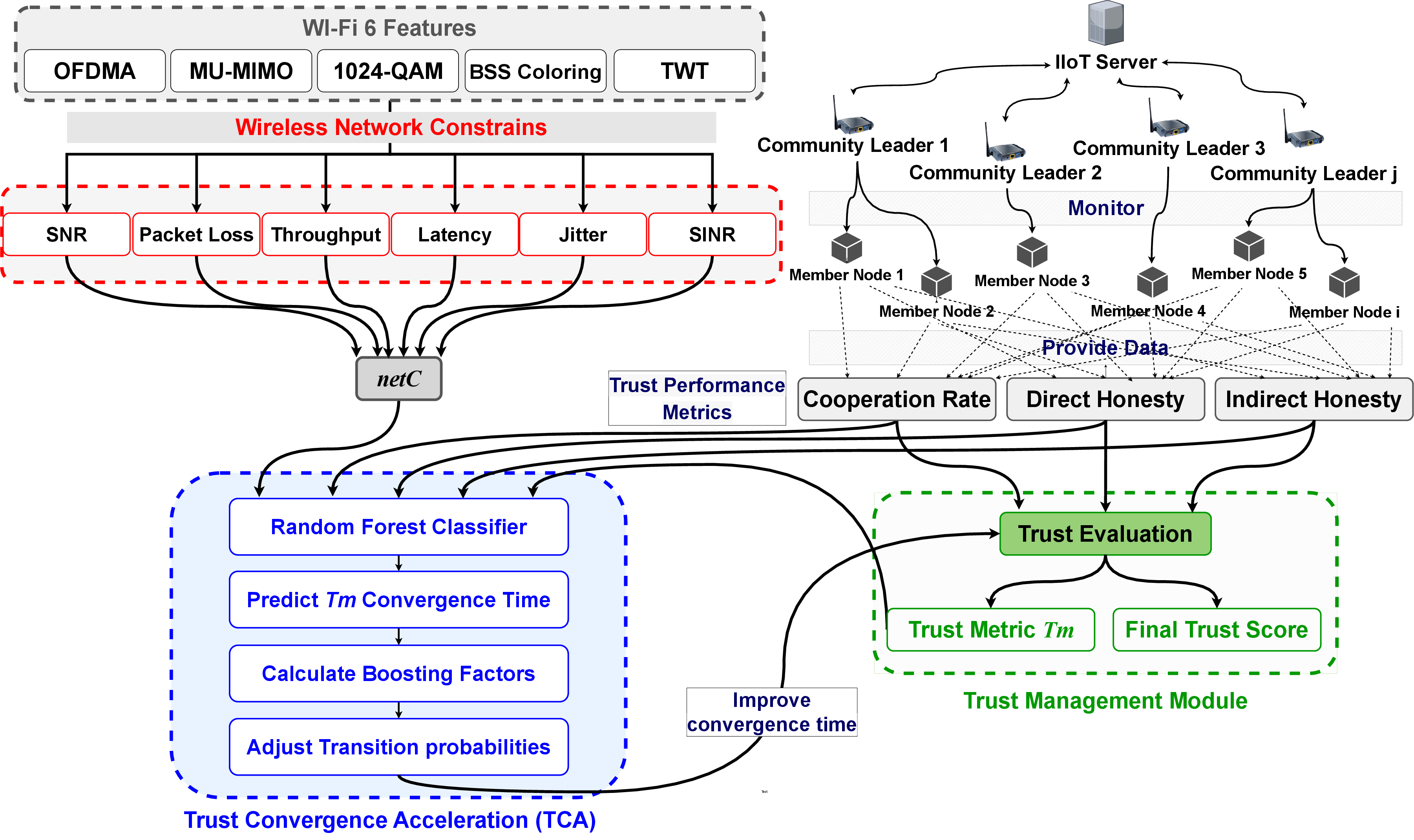
Figure 3: TCA solution architecture, integrating network condition quantification and ML-driven prediction for dynamic trust adjustment.
Dataset and Model Evaluation
A synthetic dataset comprising 35,000 samples—balanced to 6,000 instances across six convergence-time classes—underpins ML model training. Each sample encodes [netC, trust performance metrics, raw QoS indicators] as input, with convergence class as output. Comparative analysis demonstrates Random Forest outperforming XGBoost, SVM, and Logistic Regression, achieving accuracy and F1-scores exceeding 92%.

Figure 4: Input/output structure for dataset used in training Random Forest classifiers for convergence time prediction.
Empirical Results
Simulations on 200-node IIoT networks reveal that the TCA framework yields a 28.6% reduction in convergence time under poor conditions compared to baseline Tm-IIoT. Under medium scenarios, acceleration remains significant at 14.3%. Critically, robustness is validated under bad-mouthing attacks (up to 50% malicious MNs): TCA maintains superior convergence speed, with up to 30.77% faster stabilization and preservation of final trust accuracy.
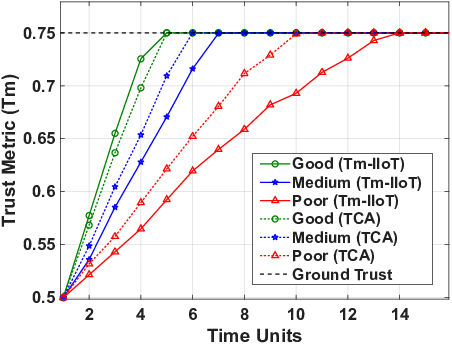
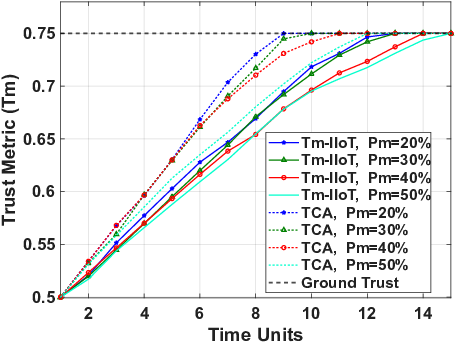
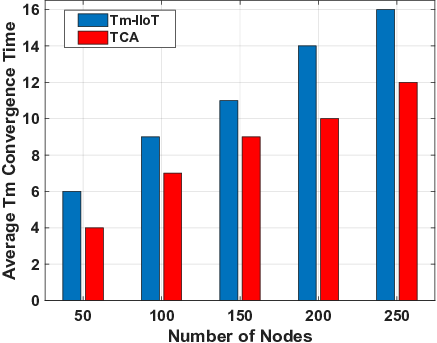
Figure 5: Comparative Tm convergence trajectories for Tm-IIoT versus TCA, highlighting improved convergence speed, especially in low-quality network scenarios.
Scalability analysis further confirms that the TCA mechanism remains effective as network size expands from 50 to 250 nodes, consistently delivering lower average convergence times.
Theoretical and Practical Implications
The introduction of ML-driven dynamic adjustment fundamentally enhances trust system resilience, enabling fine-grained discrimination between network-induced performance degradation and malicious behavior. The modular architecture ensures adaptability to emerging wireless standards and facilitates deployment as a network overlay. By minimizing real-time computational burden, TCA is suited for integration with constrained industrial devices, supporting scalable and robust operation in complex IIoT environments.
Future Directions
Prospective research will focus on real-world testbed validation, leveraging standards-compliant APs as CLs and commercial ESP32-C6 nodes as MNs. Extensions to deterministic networking paradigms and incorporation of advanced threat detection for multifaceted attack scenarios are anticipated. Integration with cellular and hybrid architectures will further broaden practical applicability.
Conclusion
The TCA ML-enhanced trust framework delivers adaptive, rapid trust convergence in IIoT environments with highly variable network conditions, outperforming conventional models in both convergence speed and resistance to adversarial manipulation. Its scalable and efficient design positions it as a viable solution for secure, real-time trusted operation in advanced industrial deployments.