Activation- and Influence-Aware Ranks (AIR): Function-Preserving SVD Compression for LLMs
Published 18 Jun 2026 in cs.LG | (2606.19993v1)
Abstract: We present Activation- and Influence-Aware Ranks (AIR), an SVD-based LLM compression framework that guides each weight matrix's low-rank approximation with a backward-signal influence metric. Starting from the activation-aware optimum of SVD-LLM(W), AIR runs a single closed-form alternating least squares (ALS) sweep that integrates influence element-wise under a monotone-descent guarantee. AIR is layer-local and composes orthogonally with end-to-end methods: alone it exceeds ACIP, and AIR+LoRA outperforms it further. AIR improves perplexity over SVD-LLM(W) by >18% at <=60% parameter retention, matches its quality with ~90% less calibration data, and turns parameter savings into FLOP, peak-memory, and per-token latency gains.
The paper introduces a novel AIR framework that integrates activation profiles and backward influence metrics for function-preserving SVD compression of large language models.
It employs a layer-local alternating least squares sweep to efficiently redistribute reconstruction error and achieve lower perplexity in compressed models.
Empirical results demonstrate that AIR outperforms activation-only methods by reducing calibration data needs while lowering GPU memory usage and inference latency.
Activation- and Influence-Aware Ranks (AIR): Function-Preserving SVD Compression for LLMs
Overview
This essay presents a detailed analysis of "Activation- and Influence-Aware Ranks (AIR): Function-Preserving SVD Compression for LLMs" (2606.19993), a framework introducing a novel singular value decomposition (SVD)-based methodology for compressing LLMs. AIR leverages both activation profiles from the forward pass and functional influence metrics derived from the backward pass to guide low-rank approximations of weight matrices. Crucially, AIR integrates element-wise influence in a monotone-descent, layer-local alternating least squares (ALS) sweep that preserves the network’s input-output behavior under aggressive compression, yielding superior perplexity and efficiency metrics relative to activation-only baselines and previous backward-pass methods.
Motivation and Context
Scaling laws dictate that LLM performance scales with parameter count and compute, creating strong incentives for post-training compression techniques adaptable to resource-constrained inference. While SVD and related low-rank methods yield efficient representations, vanilla SVD disregards the functional contribution of each parameter and degrades downstream performance, necessitating calibration data and function-aware objectives. Activation-aware SVD variants (e.g. SVD-LLM(W), ASVD) are locally optimal but lack predictive significance, while prior backward-signal approaches (FWSVD, ACIP) either underperform activation-based methods or require costly end-to-end retraining. AIR bridges this gap by integrating both activation and backward-signal influence at the matrix-element level, maximizing functional preservation under compression.
Technical Formulation
AIR’s approach begins with SVD-LLM(W)'s activation-profiling transformation, computing the weight matrix W′=WS for each layer, where S is the Cholesky factor of the second-order activation statistics. The backward signal is defined via an element-wise influence matrix I, derived from a spectrum of functional metrics including Weight×Gradient, Fisher information, and LRP-ϵ (gradient-free), with empirical results establishing signal-agnostic robustness.
AIR’s hybrid loss objective is:
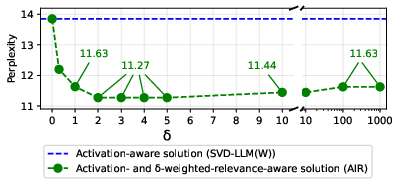
Lact,infl=1+δ⋅I⊙(W′−Uk′Σk′Vk′⊤)F2
where δ regulates the influence weight. Minimization proceeds via ALS: AIR starts at the activation-optimal SVD (from SVD-LLM(W)), and for each rank executes a closed-form update that redistributes reconstruction error away from high-influence elements. Importantly, for all backward signals satisfying basic functional criteria, AIR’s ALS sweep yields identical perplexity, centering the primary gains on mechanism integration rather than metric selection.
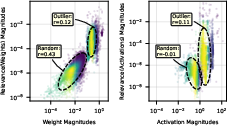
Figure 1: Weight (left) and activation (right) magnitudes vs. attributed relevance across all layers of LLaMA 7B; demonstrating poor correlation, emphasizing the necessity for functional metrics over naive magnitude heuristics.
AIR’s solution is theoretically guaranteed to monotonically descend the influence-weighted objective, and empirically a single backward sweep suffices due to orthogonality in the initialized SVD and limited cross-rank dependencies.
Experimental Evaluation
AIR is evaluated primarily on LLaMA 7B, with secondary generalization to Mistral 7B, Vicuna-7B, TinyLLaMA, LLaMA-2/3/30B. Main metrics include WikiText-2/C4 perplexity, average commonsense reasoning accuracy (OpenBookQA, ARC-E, WinoGrande, HellaSwag, PIQA, MathQA), parameter retention rates, and system-level efficiency.
Key empirical findings:
At 60% parameter retention, AIR reduces WikiText-2 perplexity by 18.4% and C4 perplexity by 36.4% relative to SVD-LLM(W), with the gap widening under higher compression rates.
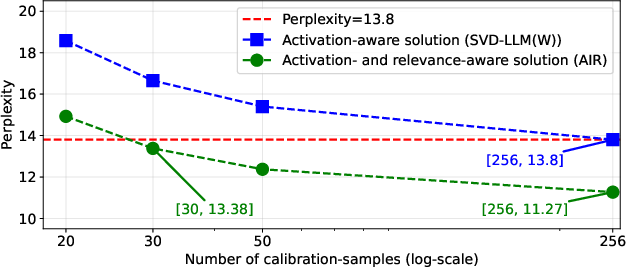
AIR achieves comparable performance with approximately 90% less calibration data.
Generalizes across model families, achieving lowest perplexity in all tested cases at 60% parameter rate.
Stackability: AIR adds orthogonally to LoRA fine-tuning and quantization—AIR+LoRA outperforms ACIP at all rates, with up to 59% lower perplexity at 20% retention.
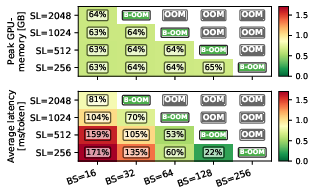
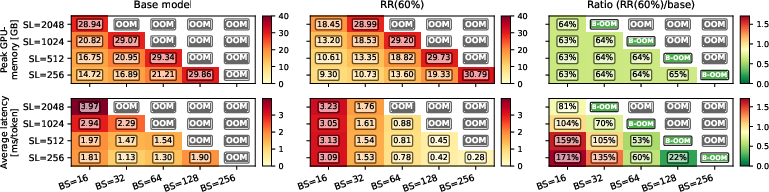
System-level metrics: At 60% retention, AIR translates to 64% peak GPU memory usage and 53% per-token latency on a 40GB A100, matching parameter reduction.
Figure 2: Runtime efficiency analysis: AIR at 60% parameter rate achieves uniform peak GPU memory and substantial per-token latency reductions across batch sizes and sequence lengths.
AIR’s ALS mechanism demonstrates that principled backward signals (LRP-ϵ, Weight×Gradient, Fisher) produce identical perplexity, underscoring the futility of naive heuristics (ones, raw weight magnitude) and the necessity of functional integration.
Figure 3: Data-efficiency analysis: AIR matches SVD-LLM(W) quality with only ≈10% of calibration samples, indicating robust forward-backward synergy.
AIR also offers structured gains over pruning baselines (SliceGPT, BlockPruner), with performance advantage increasing under tighter memory constraints.
Spatial and Influence Pattern Analysis
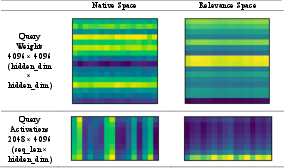
Spatial correlation analysis confirms that neither weight nor activation magnitudes reliably proxy the attributed functional influence—a disconnect most pronounced among outlier elements. AIR’s granular element-wise integration preserves high-influence, low-magnitude parameters that magnitude-based methods would discard, facilitating more aggressive retention with preserved quality.
Figure 4: Spatial heatmaps of attention weight and activation matrices: regions of high functional relevance diverge markedly from those of high magnitude.
Implementation Considerations and Efficiency
AIR’s efficiency gains in runtime and memory footprint are realized only with careful forward-pass design: sequential propagation, fused low-rank cache for values (KV cache optimization), RoPE pre-application, pre-allocated cache buffers. Without these, reductions in parameter count do not translate to latency or memory in real deployment. AIR’s optimizations achieve uniform memory savings and unlock larger batch-size and sequence-length operating points (Figure 2).
Extensive ablation confirms the additive nature of AIR, LoRA fine-tuning, and full retraining, demonstrating orthogonality in gains—a crucial insight for modular compression pipeline design.
Implications and Future Directions
Practically, AIR’s closed-form, layer-local SVD compression—with function-aware error redistribution—offers a robust paradigm for resource-adaptive LLM inference. Theoretically, AIR establishes that layer-local and end-to-end optimization are complementary: backward signal integration mechanisms dominate signal selection; principled metrics are transferable. The uniform rate per layer, while effective, motivates extension to dynamic rank allocation, token-level adaptation, and budget-conditional inference. Scaling AIR to >70B parameters, encoder-decoder structures, and mixture-of-expert architectures remains an open frontier.
Figure 5: Extended runtime efficiency: AIR(60%) expands the feasible batch-size×sequence-length grid, pushing the OOM boundary to enable larger configurations.
Conclusion
AIR closes the gap between activation-aware compression and costly end-to-end retraining by integrating functional-backward signals into local SVD through a monotone ALS sweep. Empirically, it sets new benchmarks across LLM compression rates for perplexity, memory, latency, and compositionality with existing fine-tuning and quantization methods. AIR’s framework is signal-agnostic, system-efficient, and modular—laying the groundwork for future LLM compression strategies leveraging granular function-aware objectives and system-level optimizations.