- The paper develops a covariant framework that reformulates EMSG corrections as an effective perfect fluid, yielding GR-like TOV equations.
- The effective fluid mapping and 1+1+2 formalism facilitate a phase-space analysis, revealing distinct dynamical behaviors across various equations of state.
- The results offer practical insights into stellar structure, mass-radius relations, and the matching of gravitational surfaces in modified gravity regimes.
Covariant Tolman-Oppenheimer-Volkoff Equations in Energy-Momentum Squared Gravity: A Technical Analysis
Introduction
The paper develops a rigorous formulation of static, spherically symmetric stellar equilibria in Energy-Momentum Squared Gravity (EMSG), employing the covariant $1+1+2$ semi-tetrad formalism. EMSG models represent a class of modified gravity theories incorporating nonlinear matter self-interactions via the invariant T=TμνTμν, with the gravitational action extended to F(R,T)=R+ηTn. The key technical advance is the demonstration that for perfect fluids, EMSG corrections can be recast as an effective perfect fluid, yielding hydrostatic equilibrium equations formally identical to the Tolman-Oppenheimer-Volkoff (TOV) equations of general relativity (GR), but expressed in terms of modified ("effective") energy density and pressure.
This effective-fluid interpretation, previously instrumental for cosmological scenarios in EMSG, is here extended to stellar structure, enabling a unified treatment of equilibrium and dynamical properties. The covariant approach facilitates a qualitative dynamical systems analysis, revealing how phase-space structure, critical points, and invariants in EMSG diverge from or replicate GR, depending on the regime and equation of state (EoS).
The EMSG field equations for action F(R,T)=R+ηTn are derived for static, spherically symmetric configurations. Two prevalent choices for the matter Lagrangian—Lm=p and Lm=−ρ—are considered, with their consequences for the algebraic structure of the corrections analyzed in detail. For perfect fluids, EMSG introduces new terms in the energy-momentum tensor, dependent on ρ,p,η,n, which can be absorbed into effective variables: ρeff=ρ+ρemsg(ρ,p;η,n),peff=p+pemsg(ρ,p;η,n)
with explicit expressions provided for all relevant cases.
By virtue of the Bianchi identities, the effective energy-momentum tensor is always conserved. The physical tensor, however, is not generically conserved, resulting in nonstandard source terms in the matter continuity equations. The effective variables enable the field equations to be recast in a GR-like form, paving the way to systematic analysis.
Adopting the $1+1+2$ splitting, variables are mapped onto a closed set of scalar propagation equations for the radial expansion (T=TμνTμν0), radial acceleration (T=TμνTμν1), and the sheet curvature (T=TμνTμν2). When written in terms of normalized variables (T=TμνTμν3), the system becomes: T=TμνTμν4
Given a closure relation T=TμνTμν5, these equations define an autonomous planar dynamical system. Otherwise, the dynamics requires full treatment in a higher-dimensional space.
Phase-space analysis identifies nullclines, fixed points, invariants, and generic global behaviors as functions of the effective EoS. Linear stability is computed for equilibria, with eigenvalues parameterized by EoS-dependent coefficients.
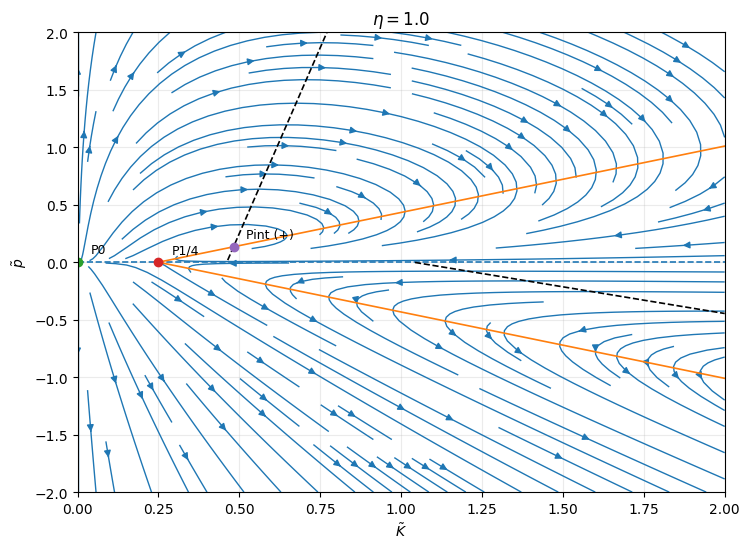
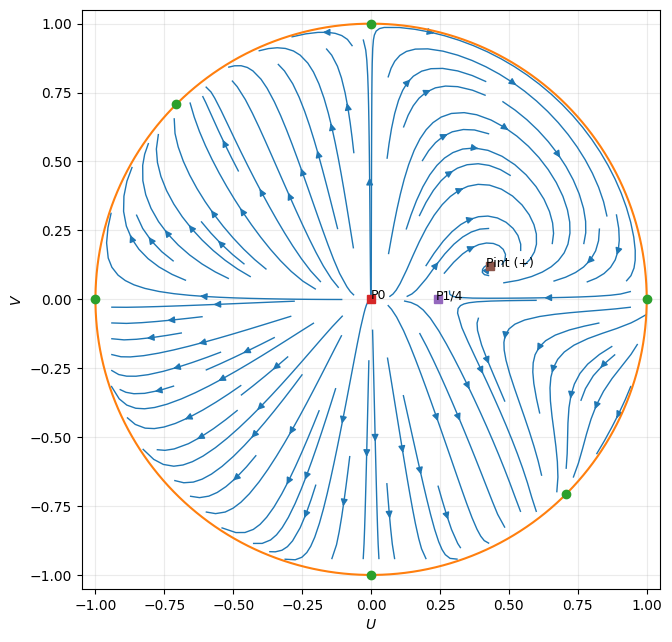
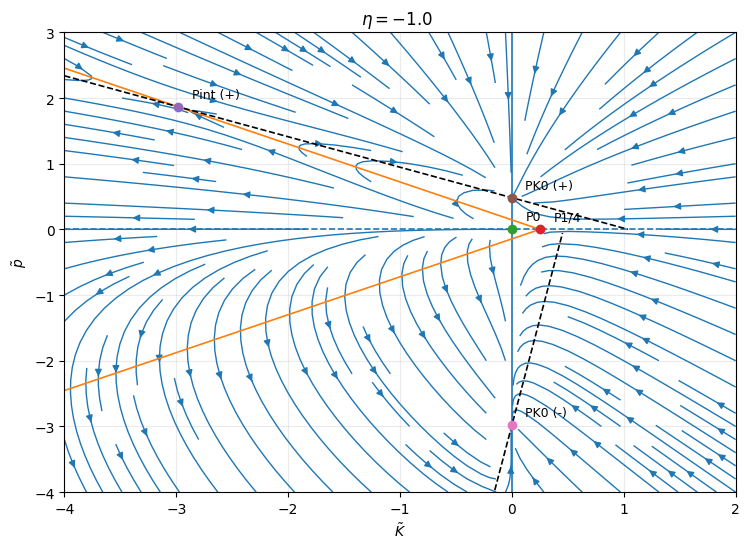
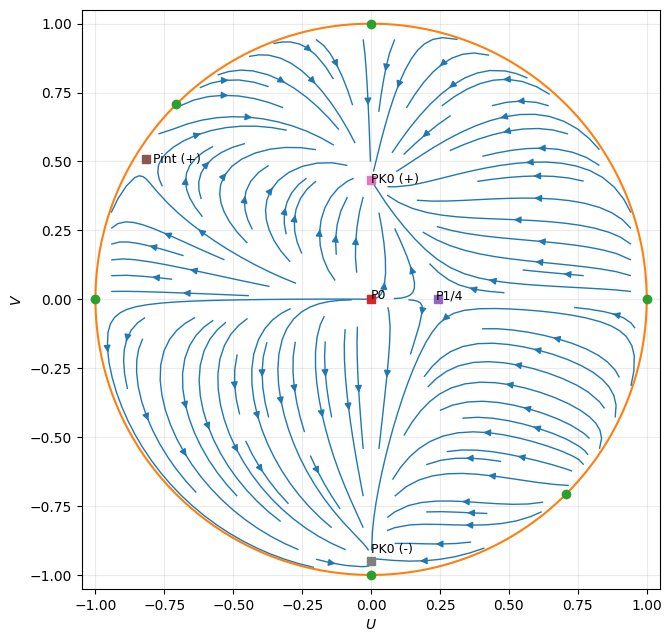
Figure 1: Radiation case in EMSG with T=TμνTμν6 and T=TμνTμν7, showing branchwise effective closure and phase-space equivalence to GR under slope replacement.
Specialization to Linear Equations of State
When the physical EoS is linear (T=TμνTμν8), various special cases arise:
- Radiation sector (T=TμνTμν9): The effective fluid exactly mirrors the physical fluid, so EMSG is globally equivalent to GR for radiation. Phase-space structure and critical points are identical; this sector serves as a benchmark for comparison.
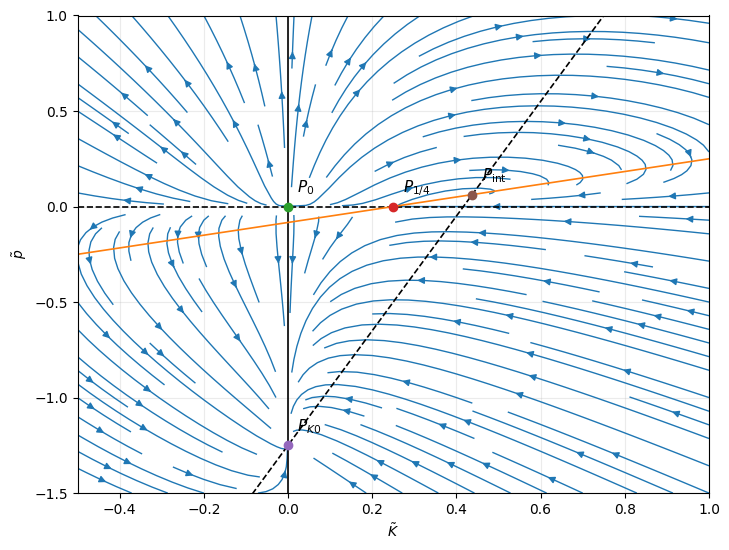
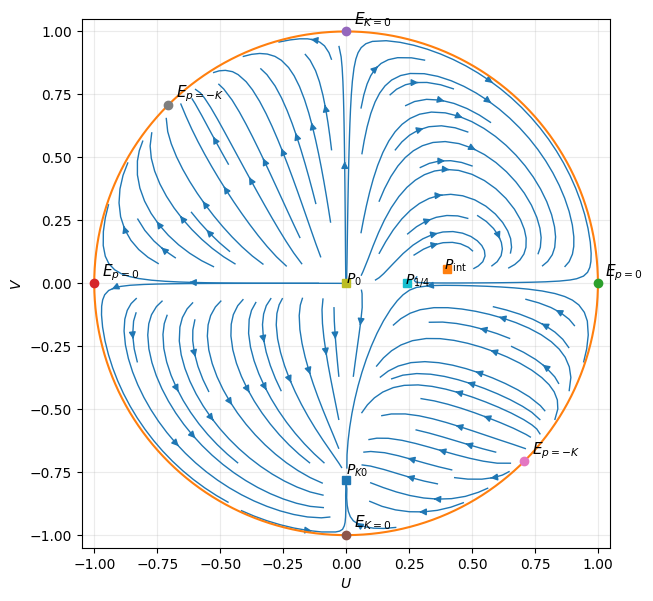
Figure 2: Radiation case in EMSG with F(R,T)=R+ηTn0 and F(R,T)=R+ηTn1, displaying phase-space nullclines and GR-equivalent dynamic structure.
- F(R,T)=R+ηTn2 sectors: The effective closure remains linear but becomes branch-dependent, with mapping between physical and effective variables potentially reversing orientation contingent on F(R,T)=R+ηTn3. This yields piecewise GR-like dynamics, but the identification of physical sectors in phase space must be performed carefully.
- Dust sector: EMSG endows pressureless matter with a non-trivial effective pressure, preventing planar reduction. Full three-dimensional analysis is needed, confirming the absence of static dust equilibrium outside vacuum.
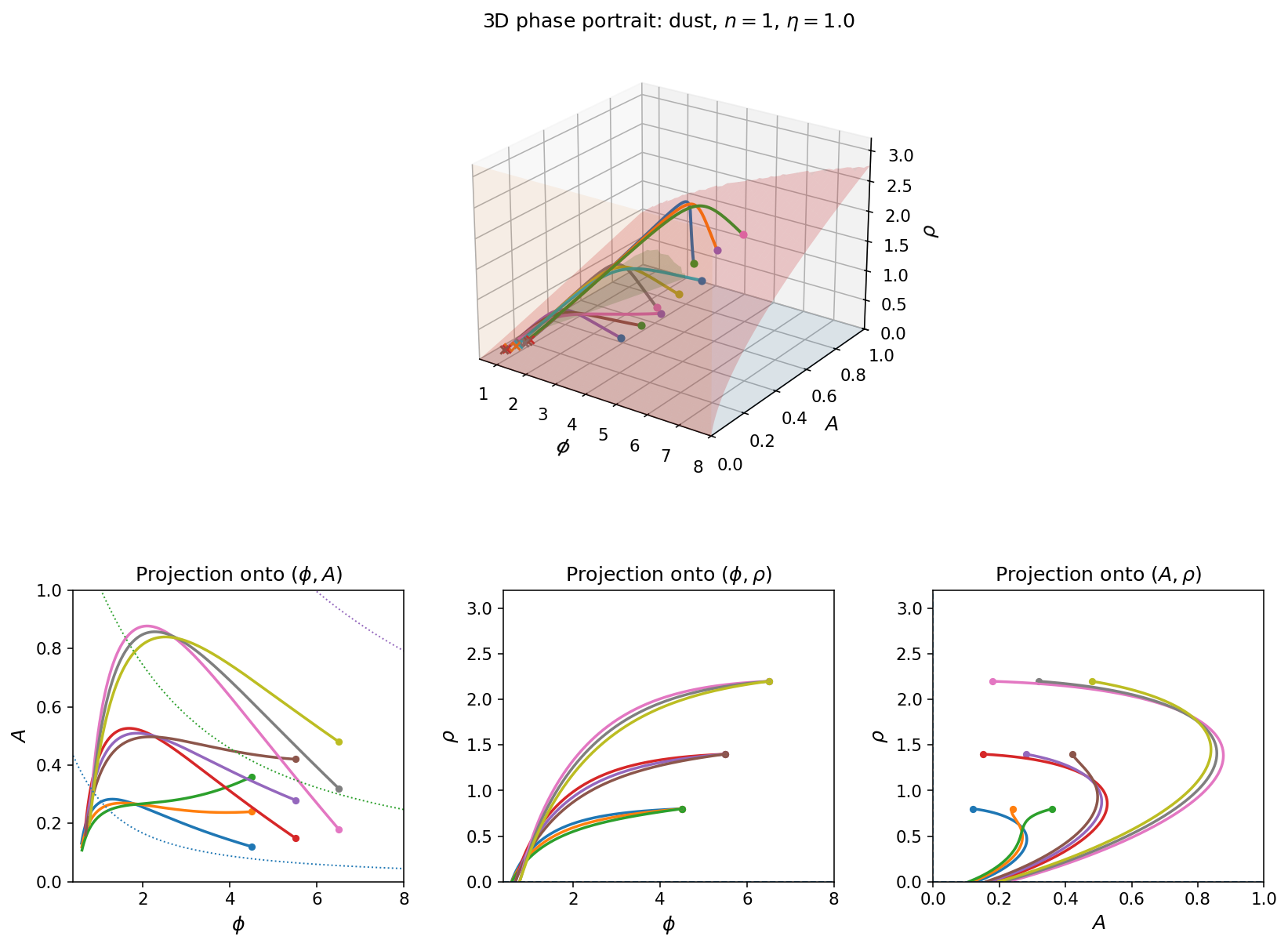
Figure 3: Dust sector in EMSG for F(R,T)=R+ηTn4 and F(R,T)=R+ηTn5, demonstrating orbits in the physically relevant sector and the monotonic depletion of density.
- Self-bound matter and matching: The locus F(R,T)=R+ηTn6 defines the gravitational matching radius; due to EMSG corrections, F(R,T)=R+ηTn7 may not coincide with F(R,T)=R+ηTn8, particularly for self-bound matter. This distinction is critical for mass-radius relations and stability.
Metric Interpretation and Practical Stellar Modeling
The relation between normalized variables and metric functions (F(R,T)=R+ηTn9) is provided, enabling reconstruction of the stellar profile in coordinate variables. The effective mass and pressure integrate algebraically over the physical density and pressure, with explicit coordinate mappings supplied: F(R,T)=R+ηTn0
The effective TOV equation for coordinate radius is identical to that in GR when written in terms of effective variables, allowing standard integration methods.
The surface-matching condition is unambiguously defined as F(R,T)=R+ηTn1. For models with self-bound matter, this may not coincide with F(R,T)=R+ηTn2. The Schwarzschild exterior persists in EMSG, as matter corrections vanish for F(R,T)=R+ηTn3.
Implications and Future Directions
The effective-fluid formalism sharply delineates the physical consequences of EMSG for stellar structure. For equations of state and parameter regimes where the effective closure is linear or piecewise linear, traditional GR-based methods suffice with simple modifications. For dust and other cases, EMSG introduces qualitatively new behavior, demanding full covariant analysis.
Implications for astrophysical observables are profound: maximum mass, compactness bounds, stability, and tidal deformability must all be reassessed using the effective variables. The distinction between gravitational and material surfaces in self-bound regimes may yield subtle discrepancies for observables.
The approach promises fertile ground for further exploration: extending to realistic EoSes, analyzing radial and dynamical stability, and constraining EMSG parameters via neutron stars, quark stars, and gravitational-wave signals.
Conclusion
The paper systematically constructs and analyzes covariant stellar equilibrium equations in EMSG, demonstrating the utility of the effective-fluid mapping for both phase-space and metric-level stellar modeling. The methodology preserves GR structure in many regimes but exposes genuinely new phenomena in others, especially dust sectors and self-bound matter. The precise identification of matching conditions and global dynamical behaviors enables robust theoretical and practical advances in the study of modified gravity and dense astrophysical objects.