- The paper presents a reformulation of the TOV equations using the 1+1+2 covariant formalism to derive autonomous dynamical systems for compact stars.
- It rigorously analyzes linear and polytropic equations of state, identifying critical points, invariant sets, and stability regimes in a unified framework.
- The study bridges covariant variables with metric functions, enhancing physical interpretability and streamlining the modeling of relativistic stellar equilibria.
Covariant Dynamical Systems Analysis of the Tolman-Oppenheimer-Volkoff Equations
Introduction
The paper "Covariant Dynamical Systems Formulation of the Tolman–Oppenheimer–Volkoff Equations" (2605.26187) presents a rigorous reformulation of the hydrostatic equilibrium problem for compact stars in General Relativity using the $1+1+2$ semi-tetrad covariant formalism. This approach exploits the local rotational symmetry in static, spherically symmetric spacetimes to cast the classic TOV system as an autonomous dynamical system for covariantly defined scalar variables. Through normalization and variable transformation, this yields a planar flow for barotropic linear equations of state (EoS) and a three-dimensional autonomous system for more complex EoS, such as the polytropic formulation. The analysis enables direct mapping between global phase-space structures and physical stellar configurations, and clarifies their geometric and dynamical character.
The $1+1+2$ formalism decomposes the spacetime with respect to a preferred spatial direction, yielding a set of scalar invariants: the radial acceleration A, 2-sheet expansion ϕ, electric Weyl scalar E, and matter variables ρ, p. Static, locally rotationally symmetric class II geometry reduces all vector and tensor degrees of freedom to scalars, permitting the TOV equilibrium equations to be recast as first-order ODEs in these covariant quantities. After suitable normalization, the system is parameterized by dimensionless variables: normalized curvature K~, pressure p~, density μ~, and gradient quantifications $1+1+2$0 and $1+1+2$1. When closed by a barotropic relation (e.g., $1+1+2$2), the system is reduced to an autonomous planar flow.
Linear Equation of State: Planar Dynamical Structure
For $1+1+2$3, the normalized variables allow exact closure: $1+1+2$4, reducing the system to quadratic planar ODEs for $1+1+2$5. Critical points are given analytically, including $1+1+2$6 (origin), $1+1+2$7 (curvature fixed point), $1+1+2$8 (interior physical equilibrium), and $1+1+2$9 (boundary). Linearization uncovers the stability regimes as functions of A0, with bifurcation structure controlled by the EoS parameter. Notably, for A1, the system is physically regular, and invariant quadrant boundaries (A2, A3) prevent unphysical orbit crossings. Asymptotic behavior, extracted via Poincaré compactification, reveals universal directions and stability at infinity. The unique separatrix connecting A4 to A5 corresponds to the Misner-Zapolsky analytic solution, with all other trajectories terminating at singularities or unphysical boundaries.
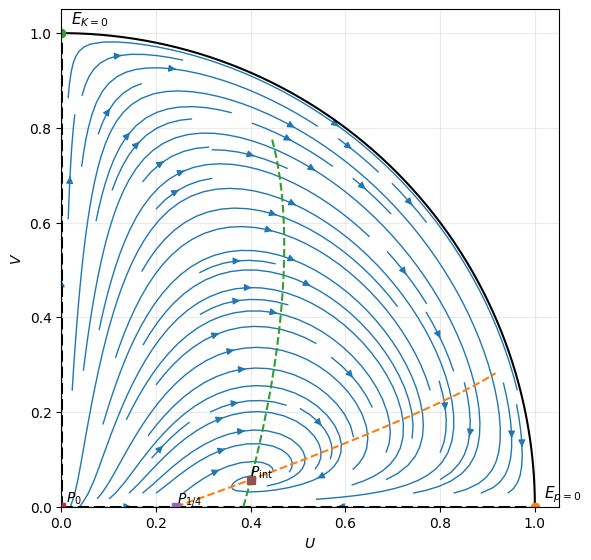
Figure 1: Radiation case (A6) phase portrait in compactified coordinates A7, with nullclines and finite/infinite equilibrium points delineated for the physically relevant sector.
Polytropic Equation of State: Three-Dimensional Autonomous Flow
The polytropic EoS, A8, introduces genuine functional inhomogeneity. The normalized formulation expands the system to three dimensions A9, where ϕ0 is dynamical. Nullclines in this regime become surfaces parametrized by ϕ1; fixed points exist only on a degenerate line corresponding to the vacuum boundary (ϕ2, ϕ3, with arbitrary ϕ4). The monotonicity of ϕ5 is strictly enforced in the physically relevant sector, eliminating periodic or recurrent orbits. Central density modulates excursion amplitudes in all variables, with the phase portrait retaining qualitative similarity to the linear EoS in ϕ6, while ϕ7 controls deviation from linearity. The absence of finite interior equilibrium points in this sector underscores the inherently higher-dimensional dynamical organization for realistic stellar models.
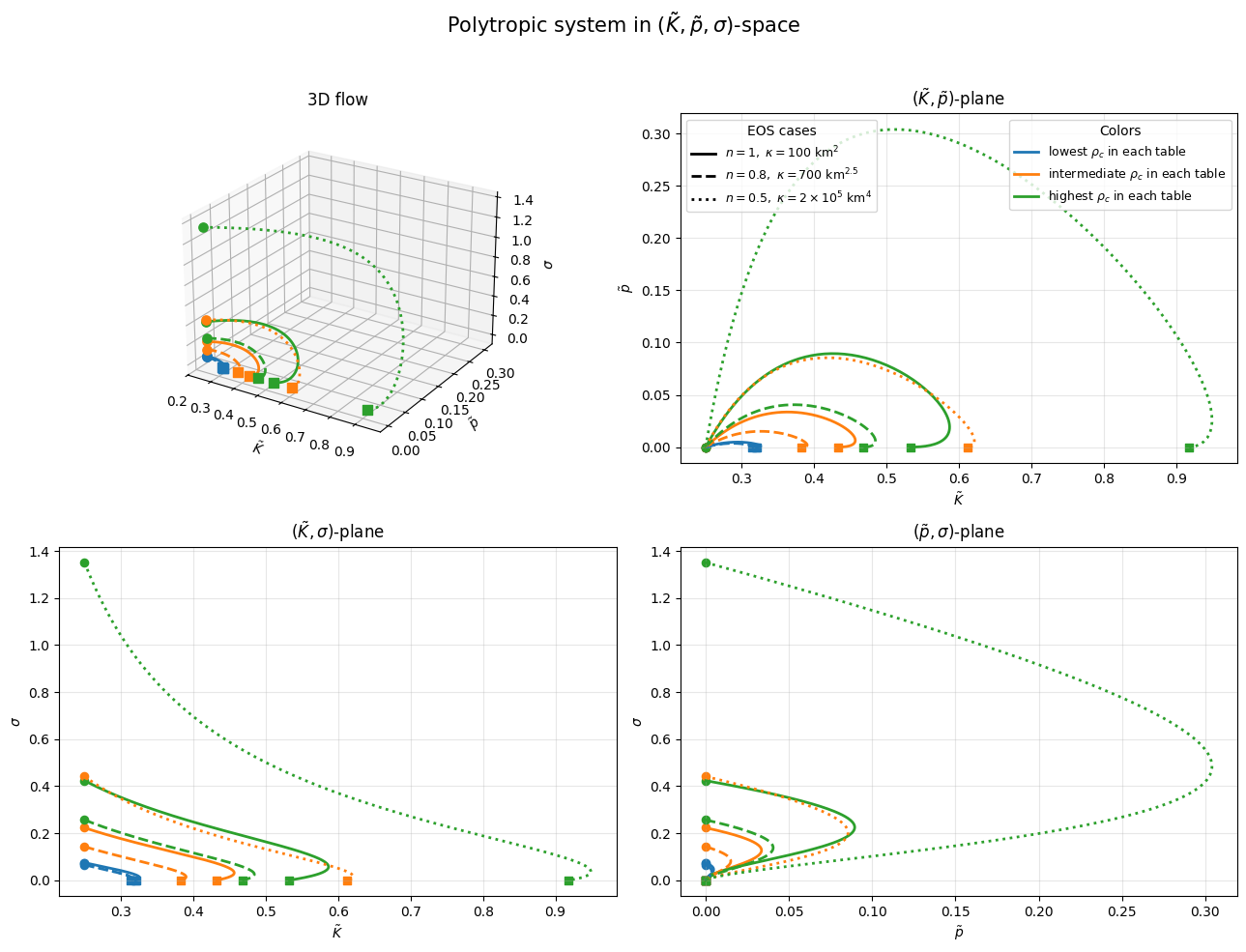
Figure 2: Polytropic EoS trajectories in ϕ8, illustrating center-to-surface evolution and nullclines for representative models from Kokkotas and Ruoff.
Physical Interpretation and Metric Correspondence
Physical interpretation is preserved through an explicit mapping between the covariant variables and the standard metric functions in Schwarzschild coordinates. ϕ9 and E0 relate to mass and gravitational potential gradients, while normalized variables capture compactness and pressure-to-density ratios relevant for global bounds. The dynamical analysis translates directly to stellar structure, with invariant sets corresponding to boundaries (surface, center), and critical trajectories reflecting analytic solutions or Buchdahl-type compactness constraints. This bridges qualitative dynamical analysis and conventional hydrostatic equilibrium, ensuring physical interpretability and facilitating the extension to more complex configurations or generalized gravity theories.
Implications and Future Outlook
The covariant dynamical systems formulation provides a compact, geometrically transparent foundation for analyzing relativistic stellar equilibria. For linear EoS, analytic tractability is achieved, revealing global phase-space structure and highlighting how singularities and physical solutions emerge from dynamical organization. The polytropic case demonstrates that realistic modeling demands higher-dimensional flows, yet retains strict monotonic properties that constrain admissible profiles. The framework admits immediate algebraic translation to metric-based structure equations, enabling connection to classical results (compactness bounds, analytic solutions) and facilitating extension to non-barotropic or anisotropic models.
Practically, this approach streamlines qualitative and numerical studies of compact objects, exposing invariant sets, critical surfaces, and monotonicity without reliance on coordinate-based integration. Theoretically, it enhances understanding of the geometric and dynamical origins of physical constraints, contributing to more general gravitational systems' analysis. Further developments may include extension to non-static, rotating, or multi-fluid systems, assessment of stability under perturbations, and adaptation to modified gravity scenarios with additional covariant degrees of freedom.
Conclusion
This paper achieves a formal, mathematically transparent reformulation of the TOV equations in a covariant dynamical systems framework, leveraging the E1 formalism to elucidate global geometric and dynamical structure in relativistic stellar models. The linear EoS regime is analytically solved within an autonomous planar system, while polytropic equations necessitate three-dimensional flows governed by monotonic invariants. The covariant variables maintain direct metric correspondence, ensuring physical interpretability. The analysis provides a foundational benchmark for further qualitative and quantitative studies of relativistic stellar equilibrium in GR and beyond, emphasizing the interplay of covariance, dynamical systems theory, and physical constraints.