- The paper finds that fixed one-dimensional gas metering fails to capture dynamic resource profiles and execution unpredictability in EVM workloads.
- It demonstrates significant state growth differences and quantifies state sensitivity affecting gas estimates across Ethereum L1 and Base L2.
- The study advocates for multi-dimensional fee markets and explicit storage pricing to mitigate mispricing and improve transaction scheduling.
Empirical Characterization of EVM Workloads and Gas Metering: Instabilities and Their Implications
Motivation and Research Questions
This paper systematically interrogates the foundational assumptions of gas metering and execution predictability in EVM-compatible blockchains, specifically contrasting Ethereum Layer 1 (L1) with Base, a high-throughput EVM Layer 2 (L2). The study aims to empirically quantify:
- The stability of resource mixes across and within chains, and how these affect gas metering.
- The magnitude and compositional diversity of persistent state growth.
- The extent of state sensitivity affecting transaction gas consumption, storage access, and execution success due to drift between submission and execution time.
Methodology
A large-scale trace-level empirical study was conducted throughout 2025, sampling 3,000 blocks per day per chain. Each transaction was decomposed into opcode-level execution gas, intrinsic gas, refunds, and persistent state change metrics (storage slots, contract bytecode, and account state). State sensitivity was quantified by re-executing transactions on progressively older blockchain states and recording shifts in gas usage, outcomes, and storage accesses. Address and transaction labeling enabled stratification by application category (e.g., MEV, DeFi, token, infrastructure).
Characterizing Resource Instability and Gas Metering
Gas metering traditionally collapses multi-dimensional resource consumption into a single scalar (gas) with fixed relative opcode prices. However, the observed resource mix is non-stationary:
- Base is read- and compute-heavy (29.2%/24.3% execution gas for storage reads/compute, respectively), while Ethereum L1 is more write-oriented (34.9% storage writes).
- Temporal shifts occur within chains: Doubling Ethereum's gas limit in 2025 measurably increased its compute intensity, converging toward Base's workload profile.
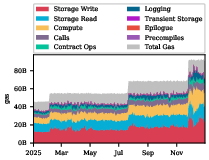
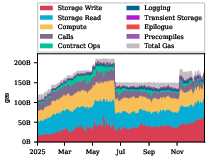
Figure 1: Daily gas composition evolution for Ethereum, illustrating measurable drift toward more compute-intensive workloads following gas limit adjustments.
The misalignment of fixed-pricing with dynamic resource profiles leads to chronic resource mispricing and under/over-utilization. The findings strongly support the transition to multi-dimensional fee markets, wherein compute, storage reads, storage writes, and calldata are priced separately to reflect real demand and burden [diamandis2023designing, angeris2024multidimensional, eip8011, (2606.19869)].
Persistent State Growth: Quantitative and Compositional Insights
State growth is substantial and highly variable:
- Base accumulated 456 GB of persistent state in 2025, compared to Ethereum's 38 GB, an order of magnitude difference exceeding expectations from throughput alone.
- Bytecode allocations constitute 24.2% of Base’s state growth; on Ethereum, account creation from simple transfers accounts for 45.7%.
- Daily state growth is bursty, varying by up to an order of magnitude due to concentrated events (e.g., highly active contracts, ecosystem changes).
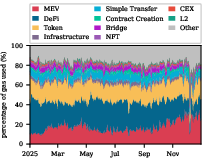
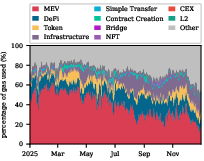
Figure 2: Quantification of persistent state growth, with Base exhibiting both higher absolute and compositional diversity relative to Ethereum.
Gas pricing currently treats persistent state writes as transient costs, neglecting their permanent burden on node operators and network scalability. Explicit storage pricing (rent or upfront deposits per byte) is required for rational protocol design [buterin2024purge, buterin2021verkle].
State Drift and Transaction Predictability
State sensitivity is systematically quantified via simulation-re-execution gaps:
- Gas estimates vary across historical states for 46.0% of Base transactions (mean coefficient of variation 6.88%), compared to 13.9% (mean 0.57%) on Ethereum.
- MEV and DeFi transactions exhibit the highest state sensitivity, both in gas and accessed storage slots.
- Storage access patterns diverge across lookbacks: On Base, only 66.7% (mean) of slots accessed for reads in the landed state overlap with those in the immediate pre-block state; value overlap for slots written drops to 67.8%.
- Even minimal simulation-execution gaps (lookback 0) result in substantial divergence for high-throughput chains.
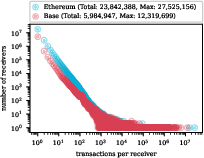
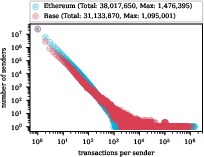
Figure 3: Heavy-tailed distribution of receiver addresses on Base relative to Ethereum, indicating activity concentration with consequent state growth impact.
This unpredictability directly impairs workload estimation, gas limit specification, effectiveness of access lists, and parallel execution strategies. For delayed/asynchronous and optimistic parallel execution, state drift between submission and execution time exacerbates penalties for incorrect gas estimation, impairs speculative caching, and renders statically declared access lists less effective.
Implications and Protocol Design Recommendations
Multi-Dimensional Gas Markets
- Transitioning to multi-dimensional gas markets is empirically justified, as drift in resource consumption cannot be automatically corrected in one-dimensional metering.
Explicit Storage Pricing
- Protocols must introduce explicit, byte-level pricing mechanisms (e.g., rent, deposits) for persistent state, rather than relying on transient gas rules.
Execution Design and User Experience
- Execution models with inherent submission-execution gaps (delayed execution, encrypted mempools, multiple proposers) will amplify unpredictability and overbilling risk.
- Refunds for over-declaration and branch-specific scheduling (prioritizing high-sensitivity transactions) are recommended mitigations for parallel execution strategies.
Stratified Scheduling
- Heterogeneity in state sensitivity motivates stratified schedulers: prioritize careful serial execution for MEV/DeFi, speculative parallelism for ERC-20 and simple transfers.
Conclusion
This work establishes, via large-scale empirical analysis, that neither the compositional stability of EVM resource consumption nor the predictability of execution outcomes in high-throughput and delayed-execution environments are upheld. Strong quantitative evidence is provided for the inadequacy of scalar gas metering, the necessity of explicit state cost accounting, and the criticality of state-sensitive scheduling in execution engines. These insights directly inform protocol parameterization, fee market design, and execution model development for future blockchain systems (2606.19869).
The results underscore the need for empirically grounded, multidimensional gas markets and persistent state pricing to address the dynamic conditions of modern EVM workload deployment, while highlighting the importance of state sensitivity stratification in transaction scheduling for parallel and asynchronous execution environments.

