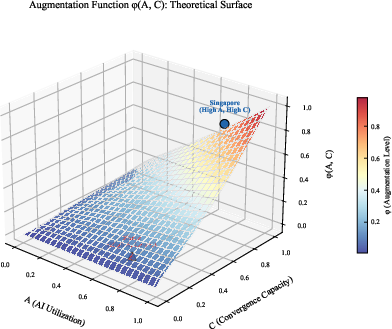
- The paper's main contribution is introducing the augmentation function φ(A,C) that integrates AI use with convergence capacity to drive productivity gains.
- Methodologically, it employs cross-national data from 20 OECD economies, showing that the AI×C interaction explains up to 86% of TFP variance compared to 31% by AI alone.
- Policy implications stress prioritizing cognitive development over mere AI deployment to overcome the productivity paradox observed in high AI-adoption contexts.
Forecasting AI-Era Productivity: The Intellectually Converged Human Framework and Production Function Theory
Introduction: Revisiting the AI Productivity Paradox
The paper "Forecasting AI-Era Productivity: The Intellectually Converged Human Framework and a Missing Cognitive Mediator in Production Function Theory" (2606.19794) addresses the persistent mismatch between increased AI investment and stagnating productivity gains across advanced economies. The authors rigorously critique prevailing production function models—especially the task-based framework typified by Acemoglu and Restrepo—which treat AI as a separable factor of production, and argue that such models systematically overlook the mediating role of human cognition in transforming AI outputs into productive value. The paper proposes a novel, human-centered production architecture based on an augmentation function ϕ(A,C), where A represents AI utilization intensity and C denotes "convergence capacity," a four-dimensional cognitive construct.
Evolution of Production Function Theory
The historical progression of production function modeling is delineated into five stages:
- Stage I: Labor-centric schema (Y=f(K,L)).
- Stage II: Solow’s inclusion of TFP residual (Y=AKαL1−α), acknowledging but not explaining exogenous productivity.
- Stage III: Endogenous growth (Y=f(K,H,Aexog)), where human capital (H) is treated as a homogeneous stock, still missing the nuanced interaction between cognition and technology.
- Stage IV: Task-based allocation, where productivity is theorized as an outcome of task reallocation between labor and capital, with AI automating tasks on cost advantage grounds.
- Stage V: The proposed Intellectually Converged Human (ICH) framework, which models effective productive capacity as H^=H⋅[1+ϕ(A,C)] and output as Y=F(K,H^), endogenizing the augmentation mechanism that links AI to productivity via convergence capacity.
The paper's central claim is that robust productivity gains require prior development of convergence capacity (C), a multi-faceted cognitive construct defined by:
- Embodied understanding (C1),
- Metacognitive calibration (C2),
- Temporal integration (C3),
- Integrative thinking (C4).
Convergence capacity is theoretically and empirically distinguished from absorptive capacity, dynamic capability, and human capital. The authors argue that AI, regardless of architectural innovation (e.g., Transformer or hyperbolic-space models), cannot serve as an independent production variable due to ontological constraints on symbol grounding, embodiment, metacognition, and temporal integration. Without adequate C, AI adoption produces mediated automation or marginal augmentation, not genuine productive gains.
Augmentation Function ϕ(A,C): Properties and Regimes
The augmentation function ϕ(A,C) exhibits several key properties:
- A0 as A1 for any A2—high AI adoption yields no augmentation absent convergence capacity.
- Non-monotonicity in A3; there is an interior optimum A4 beyond which over-automation leads to deskilling and productivity decline.
- A5 increases monotonically in A6, with no upper bound favoring maximum C development.
- Superlinear complementarity—AI and C are mutually reinforcing; marginal returns to AI are higher for high-C individuals.
Three production regimes are analytically defined:
Empirical Analysis: Cross-National Evidence and the Korean Paradox
The paper leverages cross-national data from 20 OECD economies to isolate the impact of convergence capacity. While AI adoption alone explains only 31% of TFP variance (C2), the C3 interaction explains 86% (C4). Korea, despite high human capital and aggressive AI adoption, manifests minimal TFP growth—a deviant case explicable only via low convergence capacity. The empirical analysis includes robustness checks (LOOCV, bootstrap, permutation test) and advances the claim that C-first policy sequencing outperforms AI-first strategies in driving productivity gains.
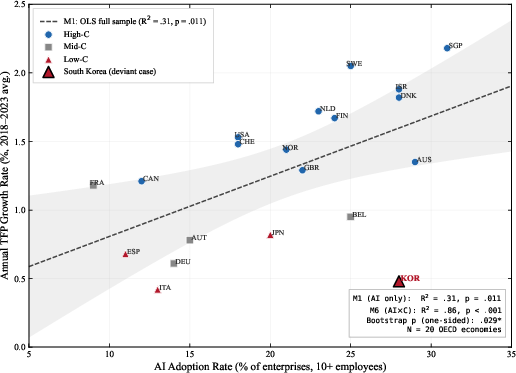
Figure 2: AI adoption versus annual TFP growth across 20 OECD and comparable high-income economies, highlighting the weak aggregate association and the pivotal role of the C5 interaction.
The differential correlation by convergence capacity tier further confirms the theoretical prediction: high-C economies exhibit significant positive association between AI adoption and TFP (C6, C7), whereas low-C economies show none (C8).
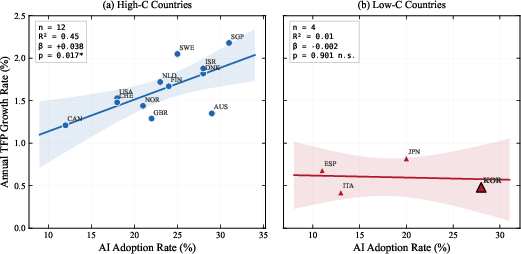
Figure 3: AI adoption versus TFP growth split by convergence-capacity tier; high-C economies display significant coupling while low-C economies (anchored by South Korea) do not.
Policy Architecture and Implications
Two divergent policy models are derived from the theoretical debate:
- Task-based policy prescribes maximizing AI adoption and infrastructure, whereas
- The ICH framework advocates investing in convergence capacity first, then calibrating AI deployment.
The practical implication is counterintuitive: slowing AI adoption in low-C environments can enhance long-run productivity more effectively than accelerated deployment. Policy interventions should prioritize metacognitive training, interdisciplinary curricula, and development of structural insight to build C.
The framework addresses the endogeneity of Solow’s residual, bridges the micro-macro gap in AI productivity research, and conceptualizes the productivity paradox as an investment-sequencing problem rather than a temporal lag or measurement error.
Research Agenda and Future Directions
The paper specifies three empirically testable propositions:
- P1 (micro): Individuals with higher C achieve superlinear productivity gains from AI holding H and A constant.
- P2 (meso): Organizations investing in C development before AI deployment observe higher TFP gains.
- P3 (macro): National C-levels predict AI-TFP coupling more robustly than adoption rates or human capital.
A falsifiable 10-year forecast is articulated: nations investing in convergence capacity will experience stronger AI-induced productivity growth, while those relying solely on AI adoption will see widening productivity gaps. The Vietnam case is proposed as a prospective test for the framework's generalizability.
Conclusion
The paper provides a rigorous theoretical and empirical foundation for reconceptualizing the role of AI in production models. The augmentation function C9 and the Intellectually Converged Human framework offer a parsimonious yet explanatory architecture that situates productivity gains within the quality of human-AI cognitive integration. The practical and theoretical implications are broad: future AI policy, organizational deployment, and educational design must center on developing convergence capacity as the binding constraint of augmentation. Operationalization of C via validated instruments is an urgent research priority, along with empirically testing the augmentation regimes across organizational and national contexts. The paradigm shift is clear: AI’s productive potential is contingent on human convergence capacity—getting the production function right is prerequisite for effective investment and sustained productivity in the AI era.