- The paper introduces a novel decomposition of human capital into physical-manual, routine-cognitive, and augmentable-cognitive factors, with AI substituting routine tasks and amplifying augmentable skills.
- It presents an LLM-based Augmented Human Capital Index, showing a 9.1% wage increase per standard deviation and significant positive interaction in formal sectors.
- Results indicate that AI augmentation premiums are concentrated among experienced, formal, high-wage workers, highlighting institutional factors in increasing wage inequality.
Augmented Human Capital in AI-Augmented Economies: Theory, Measurement, and Empirical Evidence from Colombia
Introduction and Theoretical Contribution
The paper "Augmented Human Capital: A Unified Theory and LLM-Based Measurement Framework for Cognitive Factor Decomposition in AI-Augmented Economies" (2604.01066) develops a unified theoretical and empirical framework for studying labor market dynamics in economies increasingly shaped by artificial intelligence, specifically generative models (LLMs). The central theoretical innovation is the decomposition of human capital into three orthogonal components: physical-manual (HP), routine-cognitive (HC), and augmentable-cognitive (HA). Unlike the classical scalar treatment of cognitive capacity (years of education, experience), this decomposition differentiates between cognitive factors that AI substitutes (HC) and those AI amplifies (HA).
A tractable firm production function is specified where AI capital interacts asymmetrically with these components: AI substitutes for routine cognitive labor but complements augmentable cognitive labor through a sector- and firm-level amplification function, ϕ(D). The resulting model yields direct predictions for wage dynamics: positive wage returns to HA increasing in AI adoption (augmentation premium), negative returns to HC (routine displacement), and institutional mediation of AI's rewards—specifically, that formal labor market status is a precondition for AI-driven complementarity benefits.
Measurement Framework: LLM-Based Cognitive Factor Index
The measurement challenge is addressed with comprehensive LLM-based scoring of occupational tasks. The author prompts Claude Haiku 4.5 to evaluate 18,796 O*NET task statements—covering 440 Colombian occupations—on their augmentation potential (aok), substitution risk, and augmentation type. This is mapped via an occupational crosswalk (SOC → ISCO-08 HC0 CIUO-08) onto the primary Colombian household labor survey (GEIH), integrating the results with 105,517 worker microdata observations.
The resulting Augmented Human Capital Index (AHCHC1) aggregates LLM-assigned augmentation scores for each occupation, weighted by O*NET task importance. Validation demonstrates strong convergent validity with Felten AI Occupational Exposure (HC2) and Eloundou GPT-4 exposure indices, and strong negative correlation with Frey-Osborne automation probabilities (HC3), confirming that augmentation and automation are opposed dimensions.
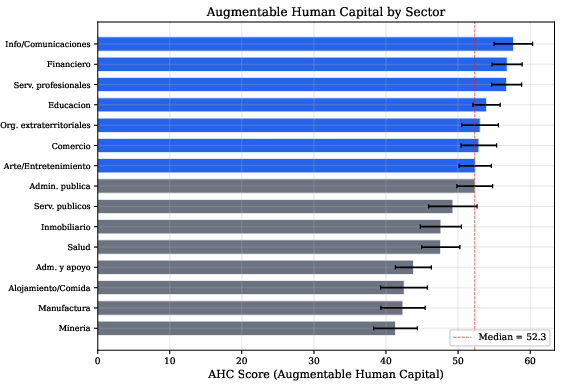
Figure 1: AHC scores by sector, blue denoting HC4-intensive sectors (e.g., Education, Professional Services), gray representing HC5 or HC6 sectors.
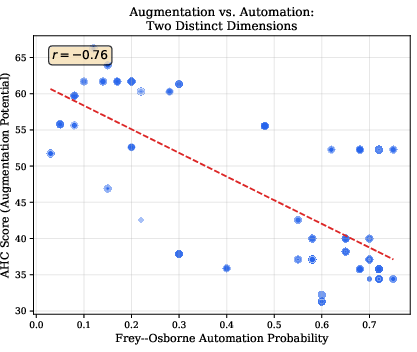
Figure 2: AHC vs. Frey–Osborne automation risk at the occupation level shows a strong negative association.
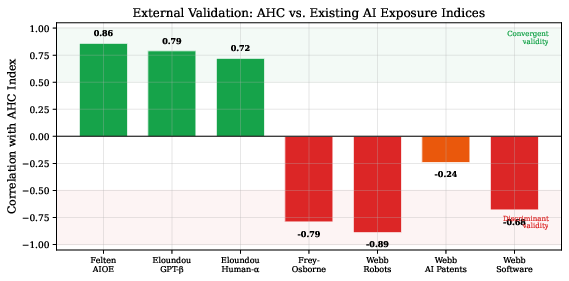
Figure 3: Correlation of AHC with seven AI exposure indices, establishing convergent and discriminant validity.
Econometric Analysis and Empirical Results
The empirical strategy augments the Mincer equation—log wage regressed on education and experience—with AHC (augmentable cognitive), HC7 (AI adoption proxy), their interaction, and controls. Identification relies on within-sector occupational variation, sector and occupation fixed effects, placebo tests, robust standard errors, and IV approaches using sector capital intensity.
The core findings are:
- AHC Level Effect: Each SD increase in AHC yields a 9.1% wage premium.
- Augmentation Premium: Interaction of AHC and sectoral AI adoption (HC8) yields a 5.1% premium in the formal sector (HC9), but a negative premium in the informal sector (−4.4%), with the triple interaction HA0 at +0.519 (HA1), underscoring a strict institutional boundary.
- Heterogeneity: The augmentation premium is highest for experienced workers (46–65), with health and education sectors showing the largest returns.
- Distributional Effects: Quantile regression indicates the augmentation premium is highly inequality-increasing: 19× larger at the 90th wage percentile than the 10th, indicating convexity in the wage–HA2 mapping.
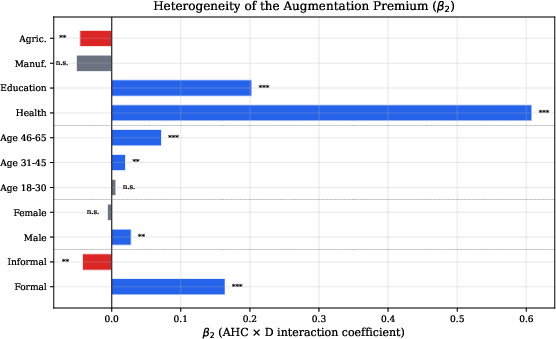
Figure 4: Heterogeneity of the augmentation premium; significant positive effects emerge in formal, older, health, and education subgroups.
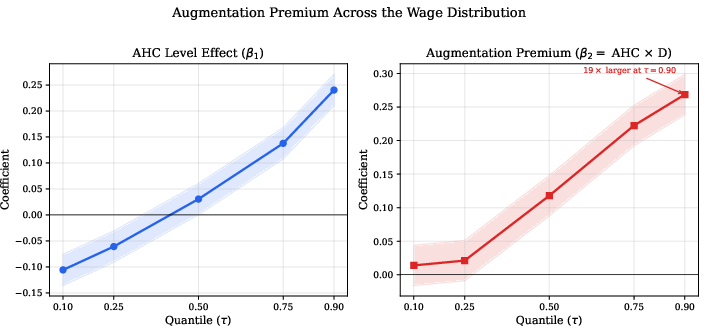
Figure 5: Quantile regression shows both the AHC level effect and especially the AHC×D interaction grow sharply at upper wage percentiles, driving AI-induced inequality.
Instrumental variables estimation supports a causal interpretation. The AHC measure is robust across alternative D proxies, placebo shuffles, subsample splits, and weighted regressions; the result is not driven by standard education or experience, but strictly by cognitive composition.
Practical and Theoretical Implications
This framework has multiple implications:
- Human Capital Theory: The standard Mincerian wage equation is misspecified in AI-augmented economies. Cognitive composition (not just education duration) is now a first-order driver of wage dispersion, leading to policy and theoretical reorientation toward skill content rather than length of schooling alone.
- Labor Market Institutions: In developing economies, formality—not technology access—is the binding constraint on benefiting from human-AI complementarity. Institutional exclusion is thus the main driver of distributional outcomes in the face of AI adoption.
- Education Policy: Curriculum and training interventions should prioritize judgment, creative synthesis, and complex communication rather than routine cognitive accumulation, given the structural devaluation of HA3.
- Distributional Dynamics: AI-augmentation is strongly inequality-increasing, multiplexing the skill premium and entrenching returns to high-AHC workers and incumbents.
Limitations and Future Directions
Key limitations include reliance on sector-occupation AI adoption proxies rather than direct firm-level AI deployment data, cross-sectional rather than panel design, and LLM-to-LLM variance in absolute augmentation level scores, though occupational rankings are robust. Future extensions could incorporate direct firm AI deployment measures, panel data for causal wage changes, and further cross-country validation with additional LLM annotators.
Conclusion
This research provides a formal framework and empirical measurement for the decomposition of human capital in the AI era, demonstrating that cognitive factor composition mediates wage inequality and that institutional arrangements—particularly labor market formality—mediate access to AI-generated wage premiums. The AHC index offers a reusable empirical instrument for further global studies of AI-driven labor market adjustment.
The results demand revision in both theoretical modeling and policy design: Mincerian wage models should incorporate cognitive decomposition, and labor market and education policy should simultaneously address cognate skill creation and institutional inclusion to ensure AI-driven growth is broadly shared.
(2604.01066)

