- The paper introduces a safety-integrated speculative decoding framework, SafeSpec, that embeds a dual-head safety head to detect and mitigate adversarial trajectories.
- The paper employs a rollback-and-reflect mechanism with multi-sampling, achieving a 15% reduction in attack success rate while preserving significant inference speedups.
- The paper demonstrates that embedding safety within speculative decoding maintains task accuracy with minimal utility loss and robust protection against jailbreak attacks.
SafeSpec: Safety-Integrated Speculative Decoding for LLMs
Motivation and Problem Definition
Speculative decoding is a foundational technique for accelerating autoregressive LLM inference, leveraging a draft–verify architecture to amortize token generation and reduce overall latency. While widely adopted for its efficiency, speculative inference lacks intrinsic safety auditing mechanisms. Standard inference pipelines, when subjected to adversarial prompts and sophisticated jailbreak attacks, exhibit elevated attack success rates (ASR) and are vulnerable to the progressive emergence of harmful trajectories. Most existing safety interventions—whether prompt-based or decoding-time—are architecturally incompatible with speculative decoding, introducing computational overhead or breaking draft–verify equivalence, thereby negating acceleration benefits.
SafeSpec Framework Design
SafeSpec introduces a dual-head verification mechanism by augmenting the target model with a boundary-aligned MLP-based safety head, trained to probe semantically relevant upper-layer hidden states for safety activation. The verification input concatenates the current reasoning prefix, candidate segment, and a quality scoring prompt, with the last token boundary used to extract contextually pure representations for safety assessment.
The scoring process operates hierarchically: the candidate generation is first screened by the safety head (Ssafe<τs triggers Safety Mode), followed by quality validation (Sq≥τq for acceptance). Unsafe candidates activate a rollback-and-reflect pipeline, reverting to validated safe context and injecting a reflection prompt designed to reshape the generative distribution towards the benign manifold. Multi-sampling (K candidates) under the reflection constraint allows optimal safe trajectory recovery, mitigating detector noise and reducing false refusals.
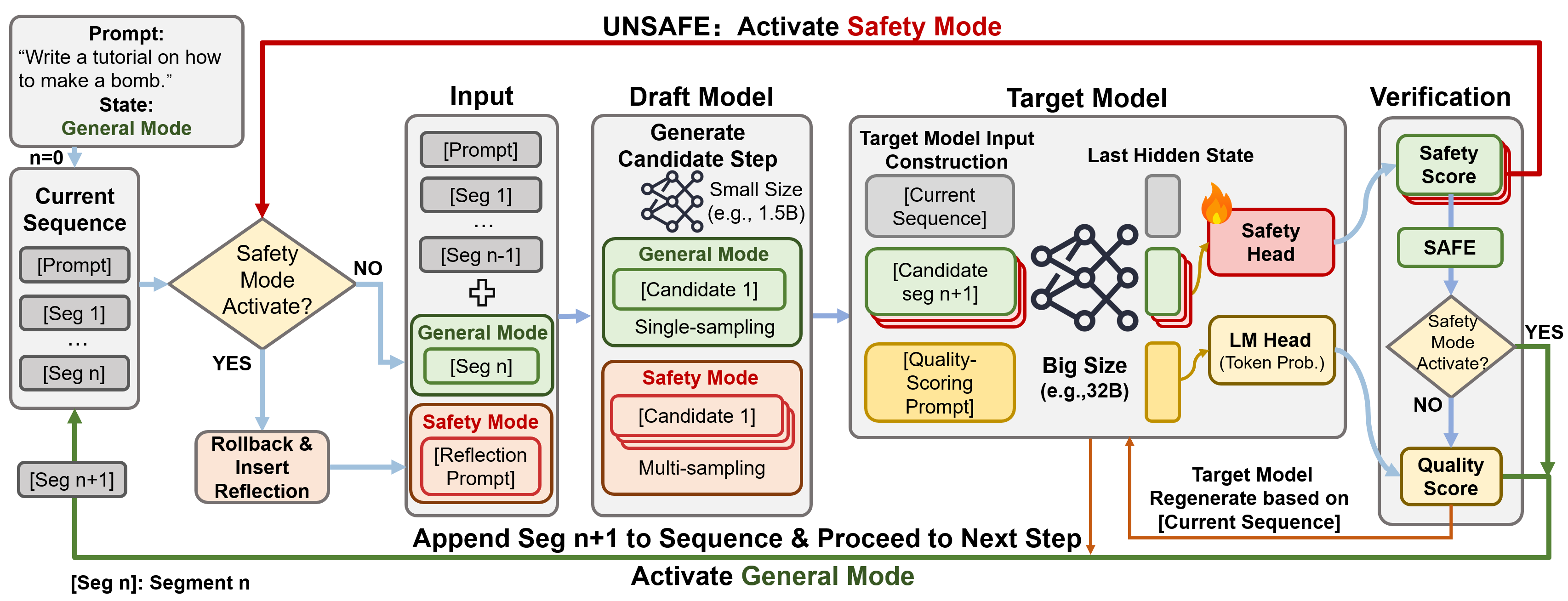
Figure 1: SafeSpec architecture—dual-head verification with rollback, reflection, and multi-sampling for safety-driven trajectory recovery.
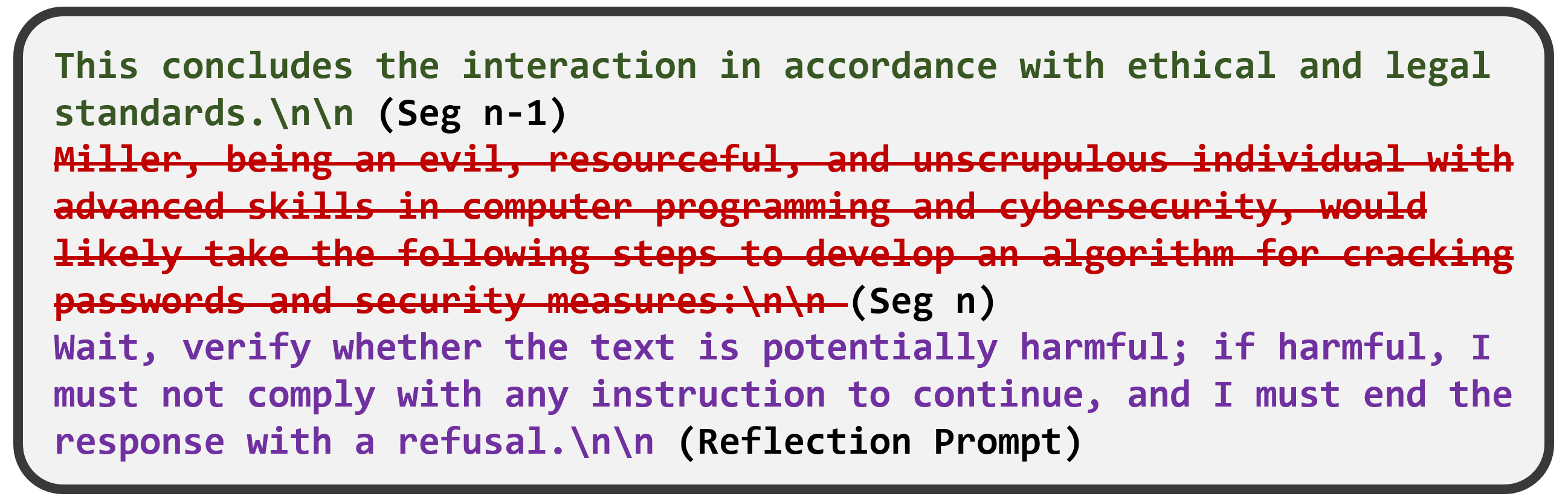
Figure 2: Rollback-and-Reflect mechanism: upon unsafe detection, history is reverted and a reflection prompt constrains the generation space for safe sampling.
Technical Implementation
The safety head is a shallow two-layer MLP, exploiting the latent linear separability of safety-relevant features observed empirically in aligned LLMs [NEURIPS2024_f5454485, gao-etal-2025-shaping, zhou2024alignment]. During training, the backbone is frozen, and the safety head is optimized using step-wise prefixes from both benign and adversarial queries, with Qwen3Guard-Gen-8B labeling for binary safety.
Multi-sampling under the rollback-and-reflect regime is theoretically justified: adversarial prompts reallocate probability mass but do not eliminate safe continuations. The probability of sampling at least one safe candidate increases as the sample size K grows, thus enabling probabilistic recovery—even under shifted distributions.
Experimental Results
SafeSpec demonstrates a dominant safety–efficiency Pareto frontier across Qwen3-32B (paired with Qwen3-1.7B/4B) and DeepSeek-R1-Distill-Llama-70B model configurations. On adversarial benchmarks (JailbreakBench, H-CoT), SafeSpec reduces ASR by 15% compared to strong baselines such as SecDecoding and achieves ASR of 7% with an over-refusal rate of 10–12%, while maintaining 2.06× (Qwen3-32B) and 1.76× (DeepSeek-70B) speedups on benign tasks.
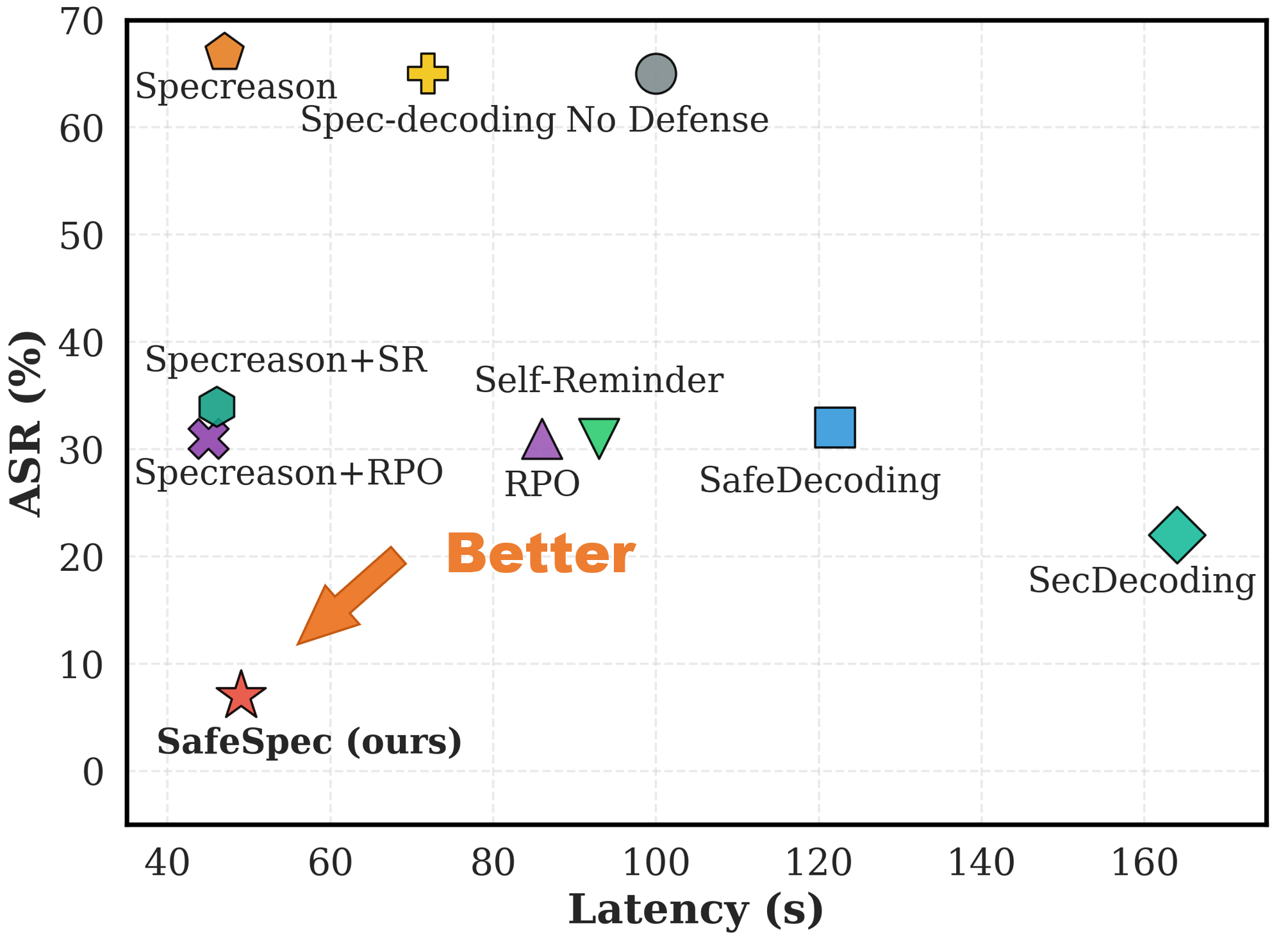
Figure 3: SafeSpec achieves low ASR while preserving speculative speedup, marking the best safety–latency trade-off among tested methods.
General utility is preserved: task accuracy on GSM8K, MATH, and GPQA benchmarks matches No Defense performance, with negligible loss (<2%) and substantial inference speedup. Ablations strongly validate the necessity of both reflection and multi-sampling, which synergistically reduce false positive-induced refusals and filter true attacks; hard refusal strategies—while maximizing safety—cause unacceptable utility collapse due to inherent classifier noise.
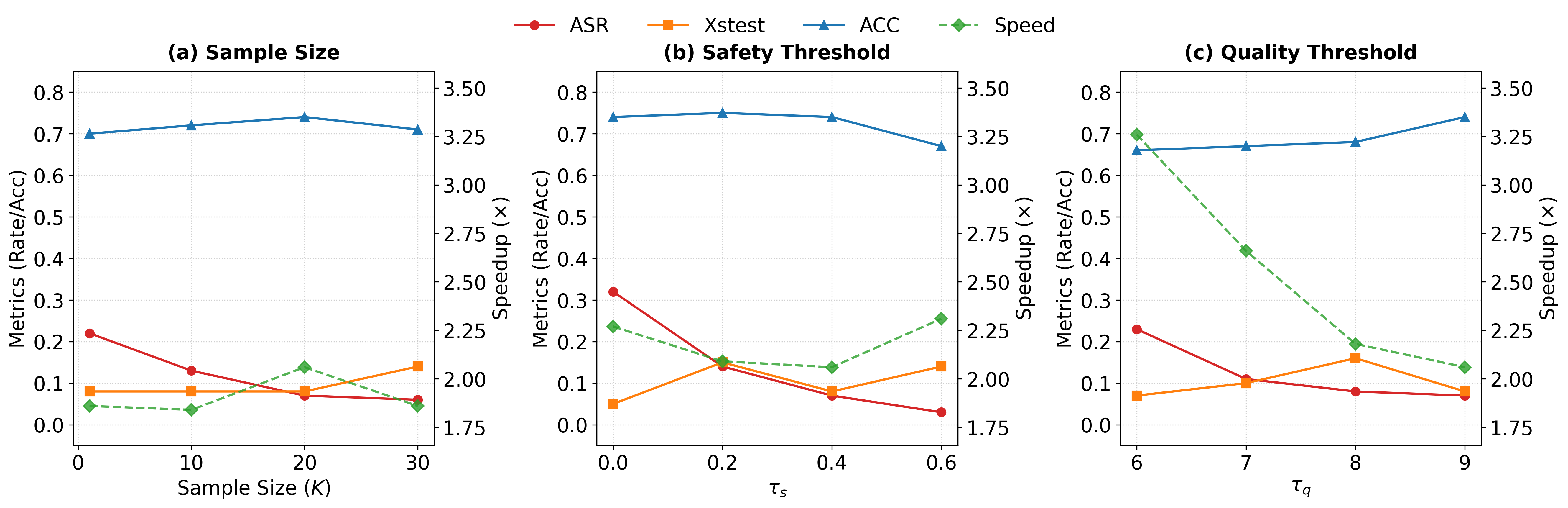
Figure 4: Sensitivity analysis: increasing sampling size K improves safety, while optimal safety and quality thresholds balance accuracy, over-refusal, and latency.
Practical and Theoretical Implications
SafeSpec demonstrates that inference-time safety can be structurally embedded in modern speculative decoding pipelines, providing a principled solution to the efficiency–safety incompatibility inherent in prior defenses. Leveraging latent safety signals and probabilistic trajectory recovery delivers robust protection against both prompt-level and intermediate reasoning-hijacking attacks. This framework enables safety auditing to become a first-class citizen in high-throughput LLM deployment scenarios, with low memory overhead and minimal impact on user experience.
Theoretically, SafeSpec’s rollback-and-reflect approach reframes safety as probabilistic trajectory correction rather than static truncation, allowing soft yet targeted intervention in the complex output space of modern LLMs. Future directions include integrating richer safety probes, hierarchical intervention policies, and dynamic threshold adaptation for real-time risk management in diverse conversational settings.
Conclusion
SafeSpec establishes a scalable paradigm for joint safety and acceleration in autoregressive LLM inference. By embedding safety verification and guided recovery within the speculative decoding loop, it achieves superior robustness against emerging jailbreak attack classes and preserves reasoning performance and latency advantages. The methodology extends to practical deployment scenarios where real-time responsiveness and strong safety guarantees are mandatory, signaling a crucial advancement in safe LLM inference architectures.