- The paper demonstrates reversible control of optical trapping, enabling switching between static confinement and persistent orbital states for single aerosols.
- It employs T-matrix modeling and Langevin simulations to quantify nonconservative optical force fields and the resulting orbital dynamics.
- Experimental validation shows that tunable orbit geometry and frequency serve as robust, size-sensitive observables for real-time aerosol sensing.
Alignment-Controlled Optical Orbital Trapping of Single Airborne Aerosols: Mechanisms and Sensing Applications
Dual-Beam Optical Trapping and State Control
The paper presents a comprehensive theoretical and experimental investigation of dual-beam optical trapping for single airborne aerosols, focusing on alignment-dependent control between static confinement and orbital motion. The system utilizes a 532 nm CW laser, split into two counter-propagating arms and focused within a quartz cell using high-NA objectives. The alignment is parametrized by axial (ΔD) and lateral (ΔR) focal offsets, which independently modulate the longitudinal and transverse components of the force landscape. This design enables reversible switching between stable confinement and persistent orbital states—a regime highly relevant for aerosol sensing, especially within the Mie scattering domain where particle diameter, beam waist, and trajectory amplitudes are all on the micrometer scale.
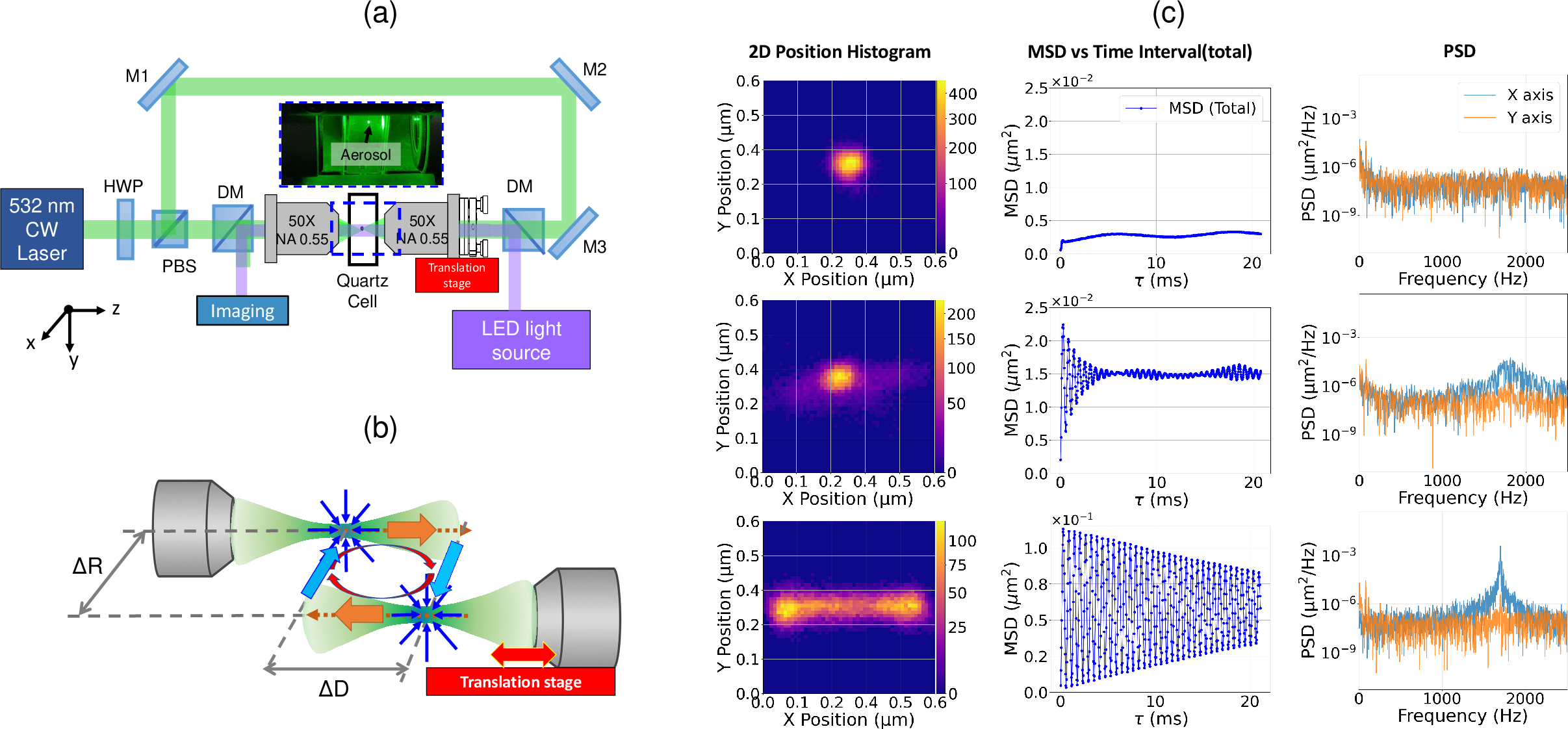
Figure 1: Overview of the dual-beam optical trap, alignment controls, and experimentally observed motional states, highlighting transitions from tight confinement to orbital trajectories via ΔD/ΔR tuning.
The tight confinement regime yields compact position distributions and plateauing MSDs, characteristic of Brownian diffusion in a local trap minimum. Increasing alignment perturbations induce elongated histograms and oscillatory MSDs, reflecting deterministic orbits with extended trajectories. The ability to dial in these states continuously demonstrates practical versatility in manipulating single aerosols.
Optical Force Landscape and Nonconservative Circulation
Theoretical modeling leverages T-matrix calculations for optical forces, appropriate for micron-scale aerosols in the intermediate Mie regime. The force fields are mapped on a Cartesian grid and used as deterministic inputs for inertial Langevin trajectory simulations. Importantly, these fields are nonconservative, containing closed-loop circulating components that sustain dissipative orbits.
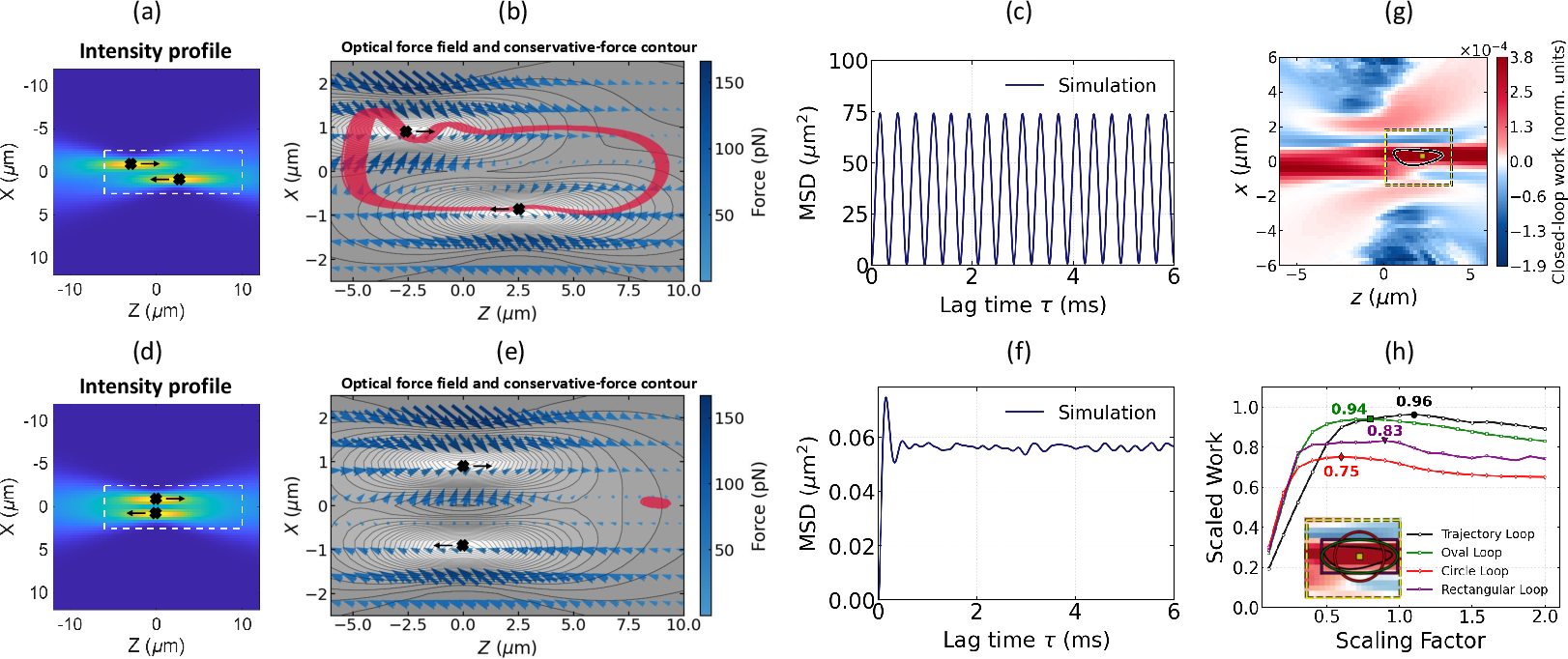
Figure 2: Calculated optical force fields reveal nonconservative circulation at finite axial offset, with simulated trajectories corresponding to orbital motion and positive net work along closed contours.
A key result is the quantification of net work ∮CFopt(r)⋅dr over representative trajectories. For conservative traps, this integral is zero; for the dual-beam misaligned case, significant positive values are observed, confirming that scattered-light imbalance drives orbiting. The orbit aligns with the strongest circulating region of the map, not with geometric broadening. This explicit work mapping is a rigorous demonstration of nonconservativeness underpinning the orbital states, which is further corroborated experimentally via MSD and PSD analysis.
Alignment Parameter Space and Orbital Dynamics
The paper systematically characterizes how ΔD and ΔR modulate both orbit size and rotation frequency. Simulation and experimental data show that increasing ΔR at fixed ΔD primarily enlarges orbit amplitude in the transverse direction and reduces rotation frequency—consistent with increased path length and weaker restoring forces.
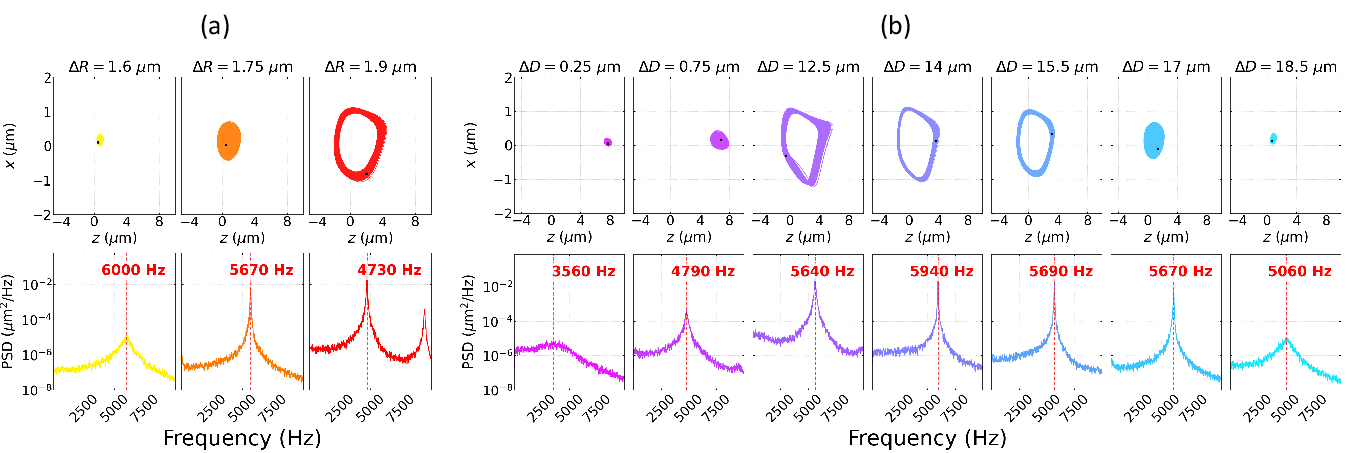
Figure 3: Simulated trajectories as functions of ΔD and ΔR0 demonstrate monotonic control over accessible orbit sizes and stabilization regimes.
Experimental frequency sweeps versus ΔR1 and ΔR2 validate these trends. Notably, finite ΔR3 is requisite for orbital activation; larger values eventually destabilize the orbit due to reduced confinement. Power scaling measurements reveal monotonic increases in rotation frequency with optical power, confirming that stronger forcing generates faster circulation. The controls are robust and reproducible: all orbital states observed are intentional via alignment tuning, not incidental misalignments.
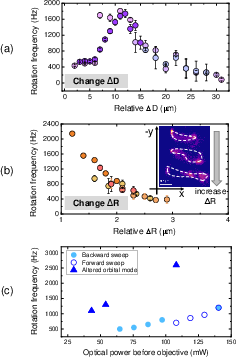
Figure 4: Experimental frequency scans as ΔR4, ΔR5, and optical power are varied, showing precise operational control and state transitions.
Orbit-Based Sensing and Size-Dependent Observables
Beyond trapping mechanics, the orbital state offers a dynamical channel for particle sensing. Direct imaging suffers from projection/defocus artifacts; thus, trajectory-derived metrics such as orbit amplitudes (ΔR6, ΔR7) and anisotropy ΔR8 provide robust alternatives. Across multiple alignment groups, ΔR9 decreases systematically with particle diameter—larger aerosols exhibit flatter gravity-axis projection, consistent with gravitational loading modulating optical force balance.
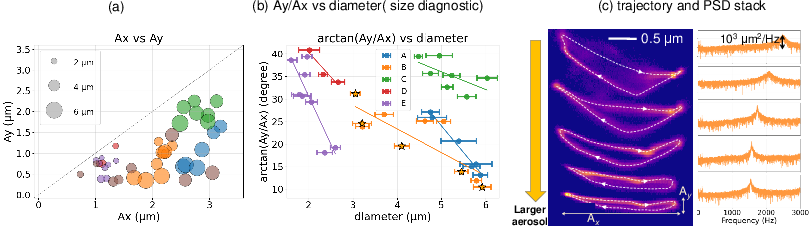
Figure 5: Correlation between orbit geometry/anisotropy and particle diameter, establishing ΔD0 as a reproducible, size-sensitive dynamical observable.
The orbit geometry is more reproducible than rotation frequency as a size indicator, due to its direct dependence on sampled force field and gravity, with less sensitivity to drag and drive scaling.
Time-Resolved Sensing and Dynamic Events
The orbital frequency is shown to function as a sensitive indicator for time-dependent changes, such as abrupt mergers of two particles. This is illustrated by a merging event where rotation frequency drops from ΔD1 to ΔD2, and the orbit geometry shifts anisotropically.
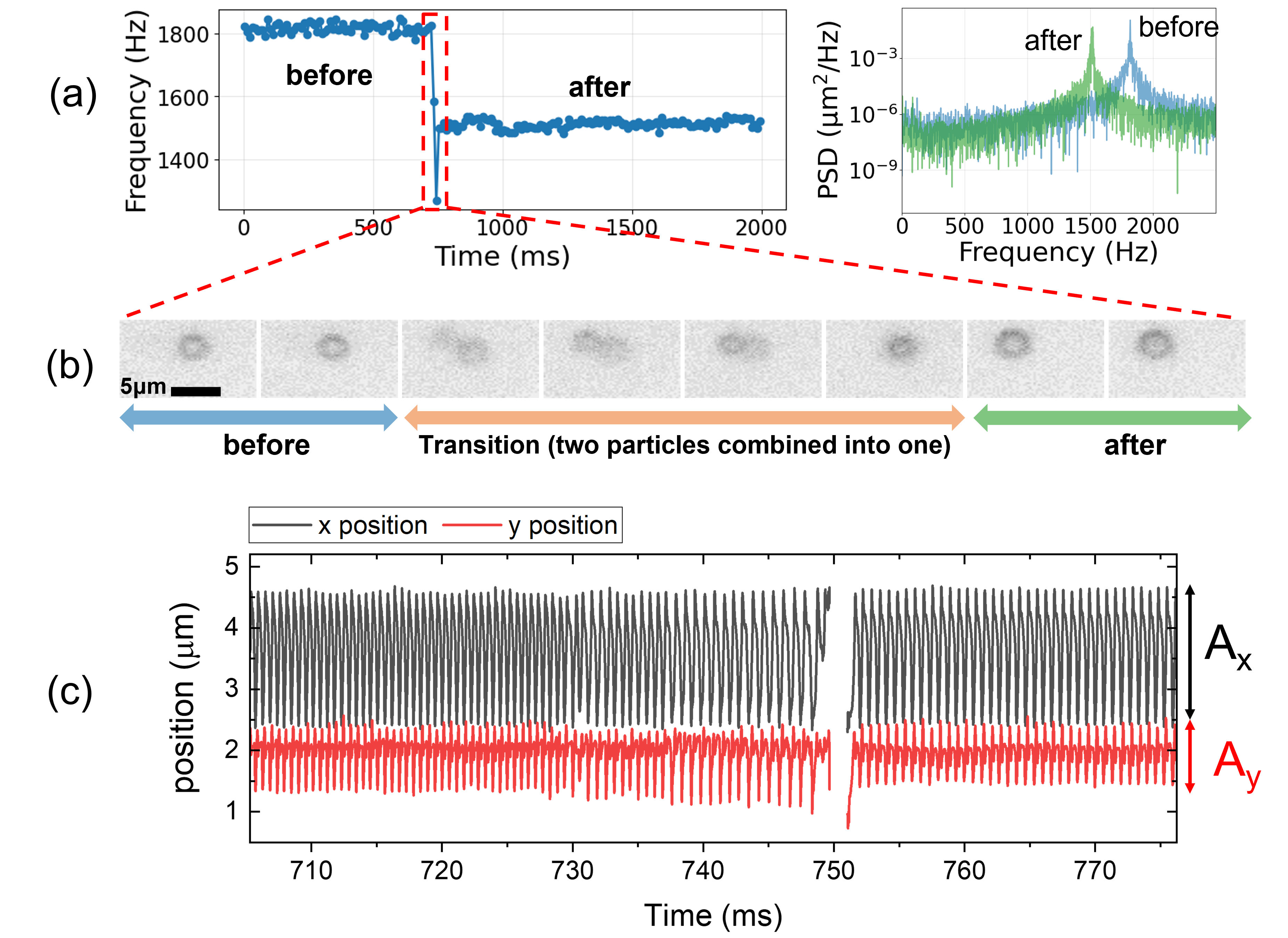
Figure 6: Real-time orbital response to a merger event, demonstrating dynamical readout of abrupt mass and size changes, with distinct sensitivity along gravity and transverse axes.
This capability underscores the utility of orbital trapping not only for particle size discrimination but also for tracking transient physical events and compositional transitions in airborne sensing.
Experimental Calibration and Trap Benchmarking
Rigorous beam characterization (knife-edge scans, Figure 7) and position stability benchmarking (Figure 8) confirm the system operates in the Brownian-noise-limited regime, with plateau MSDs around ΔD3 and trap stiffness scaling consistent with equipartition and force-field linearization. These calibrations substantiate the quantitative reliability of both trapping and orbital sensing modalities.
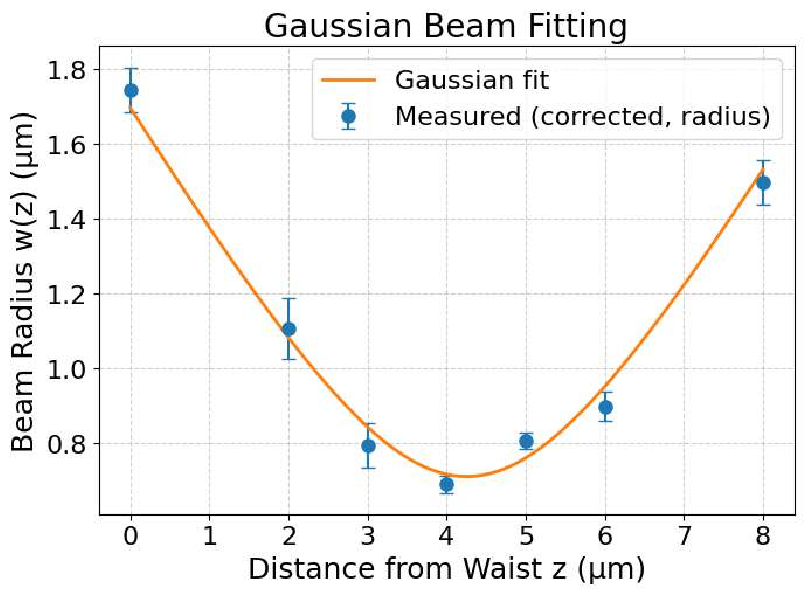
Figure 7: Knife-edge beam characterization establishes beam waist and optical focus precision for accurate force-field calculation.
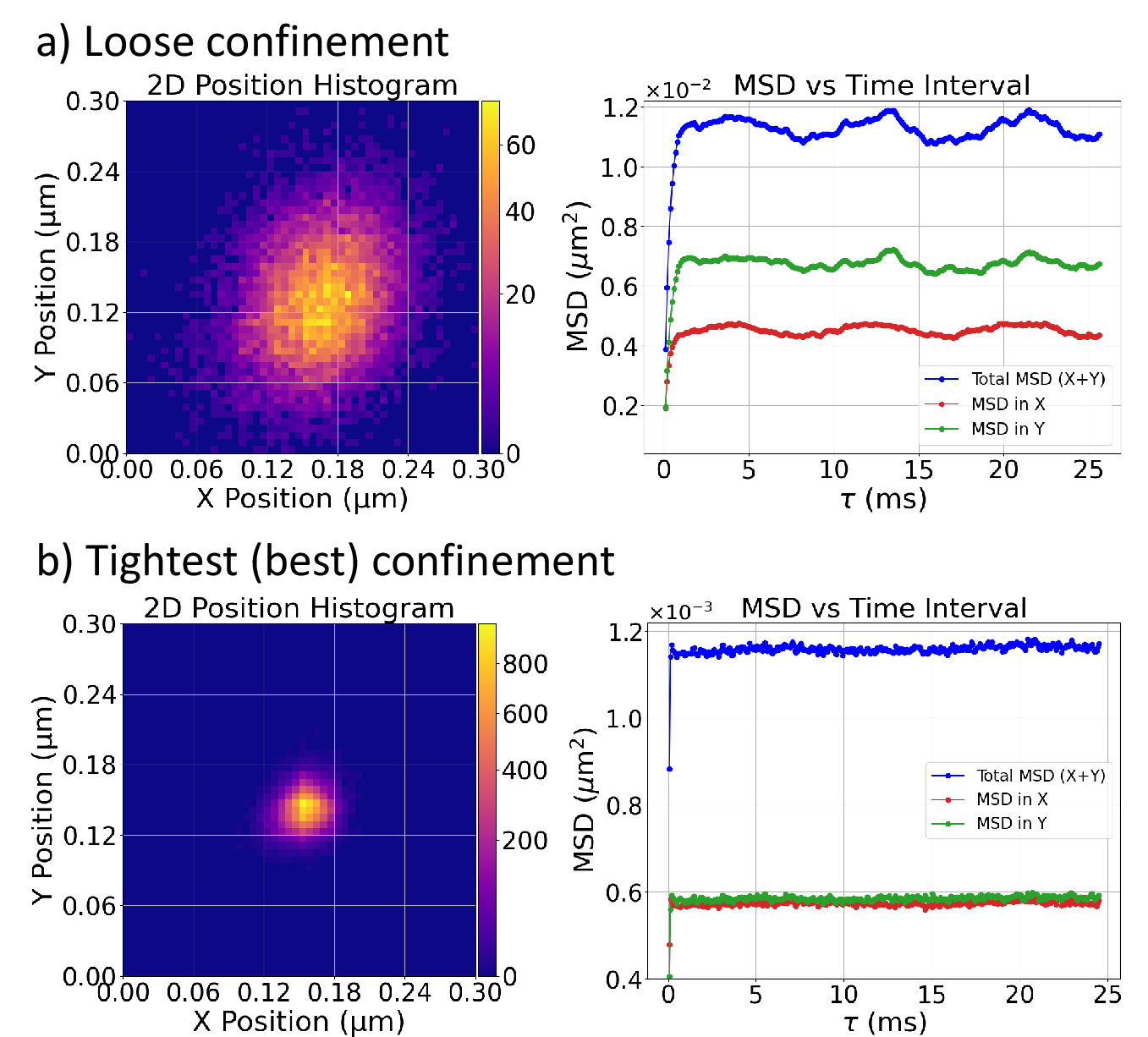
Figure 8: Position-stability benchmark attests to confinement quality and trapping reproducibility after iterative alignment optimization.
Implications, Limitations, and Prospective Developments
The dual-beam orbital trap offers a compact, low-power, substrate-free platform for alignment-tunable manipulation of single aerosols. The explicit link between orbit observables and particle properties establishes a trajectory-based sensing channel highly relevant for atmospheric science, single-particle chemical analysis, and optomechanical studies under ambient conditions. Limitations include the need for calibration across alignment groups, sensitivity to refractive index, and the restricted predictive power of reduced-dimensional modeling in compact-orbit regimes, where force-field topology is rapidly varying.
Future extensions may include real-time composition monitoring via photothermal/evaporation-induced changes, humidity control for matrix effects, and vacuum operation for enhanced limit-cycle stability. Integration with independent sizing protocols and multi-modal optical spectroscopy would enable quantitative aerosol sensors leveraging dynamical trajectory observables. The framework is readily generalizable to more complex particle morphologies and active feedback manipulation.
Conclusion
The study rigorously demonstrates the mechanism and practical control of nonconservative optical orbital trapping in dual-beam free-space geometry for single airborne aerosols (2606.19693). Independent tuning of ΔD4 and ΔD5 enables deterministic switching between stable confinement and sustained orbital states, with orbital motion driven by scattering-induced nonconservative circulation and closed by transverse restoring forces. Experimental and computational results establish the orbit geometry and frequency as robust, size-sensitive, and time-resolved dynamical observables, advancing both the fundamental understanding of optical force landscapes and the prospects for trajectory-based single-particle sensing in atmospheric science and optomechanics.

