- The paper introduces a geometric framework using Lie bracket analysis to identify latent confounding by examining local interventional vector fields.
- It presents the BRIDGE algorithm for Lie-based screening and the SKFM method for spectral inference, significantly reducing the candidate DAG search space.
- Empirical benchmarks highlight high recall and computational savings while also noting challenges in finite-sample guarantees and order-independence.
Latent-Confounded Causal Discovery via Lie Bracket Geometry
Overview
"Latent Confounded Causal Discovery via Lie Bracket Geometry" (2606.19610) presents a geometric and category-theoretic paradigm for causal discovery in the presence of latent confounders. Building on the Kan-Do-Calculus (KDC) formalism, the paper establishes a bridge between causal inference, information geometry, and categorical algebra. Two main algorithmic classes—BRIDGE and Spectral Kan-Do Flow Matching (SKFM)—are introduced, both designed to operate under latent confounding, departing fundamentally from combinatorial graph search by screening and extracting structure using local interventional geometry and Lie algebraic properties.
Geometric Causal Discovery and the Kan-Do Calculus Foundation
Causal discovery traditionally distinguishes between passive observational conditioning and active intervention. The KDC framework identifies interventions as left Kan extensions and conditioning as right Kan extensions, formalized in a bi-adjunction. This categorical adjunction acquires geometric content in smooth statistical models: Radon–Nikodym derivatives between observational and interventional measures induce local vector fields, and the failure of their Lie brackets to close within the observed span is interpreted as a witness to latent structure.
The presence of latent confounding is reframed—not as nuisance missing variables, but as a geometric obstruction that prevents integrability of the observed intervention flows. This yields a test for latent structure based on differential Frobenius integrability rather than combinatorial Markov equivalence or covariance constraints.
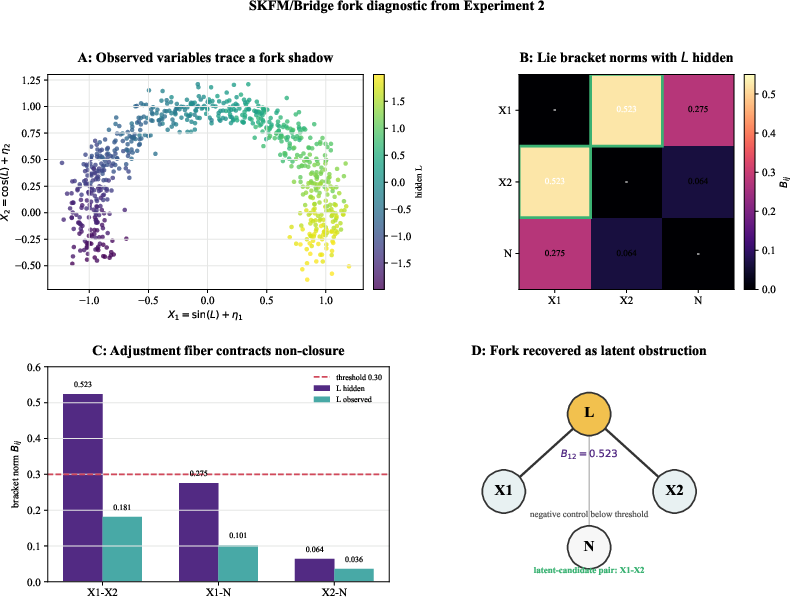
Figure 1: SKFM/Bridge fork diagnostic instantiated with nonlinear latent-fork data, revealing how non-closing Lie-bracket residuals serve as witnesses for hidden structure.
BRIDGE: Lie-Based Geometric Screening
The BRIDGE algorithm operates in two main steps: (1) estimation of local interventional vector fields (using e.g., normalizing flows or kernel estimators to extract calibrated Radon–Nikodym derivatives) and detection of non-commutativity in their Lie brackets, and (2) geometric screening of the candidate edge set, passing only directions with high geometric compatibility to downstream score-based or differentiable discovery routines (BIC, GES, TCES, DCDI, etc.).
This approach contrasts with global acyclicity constraints (e.g., NOTEARS), which optimize over the full adjacency matrix with trace-based regularization. BRIDGE exploits the information-geometric structure induced by interventions to aggressively reduce the candidate arrow family before applying any optimization over structures.
Key theoretical results formalize the high recall of the geometric screen: under suitable margin, consistency, and downstream scoring assumptions, the BRIDGE mask asymptotically contains all true visible edges and the true DAG is recoverable within the pruned family.
Lie Bracket Residuals as Diagnostics for Latent Confounding
The central diagnostic is the Lie bracket [vi,vj] of the local interventional vector fields. If intervention flows for any visible variable pair fail to commute (their Lie bracket does not project into the visible span), the residual is interpreted as evidence of hidden/latent confounding or unmodeled structure.
BRIDGE then marks such pairs as latent-sensitive and prunes the corresponding arrows from the candidate family. This geometric Frobenius anisotropy embodies a refined local-to-global test—removing the need for enumerating exponentially many DAGs or partial ancestral graphs and focusing statistical resources on the subspace where closure and compatibility are empirically supported.
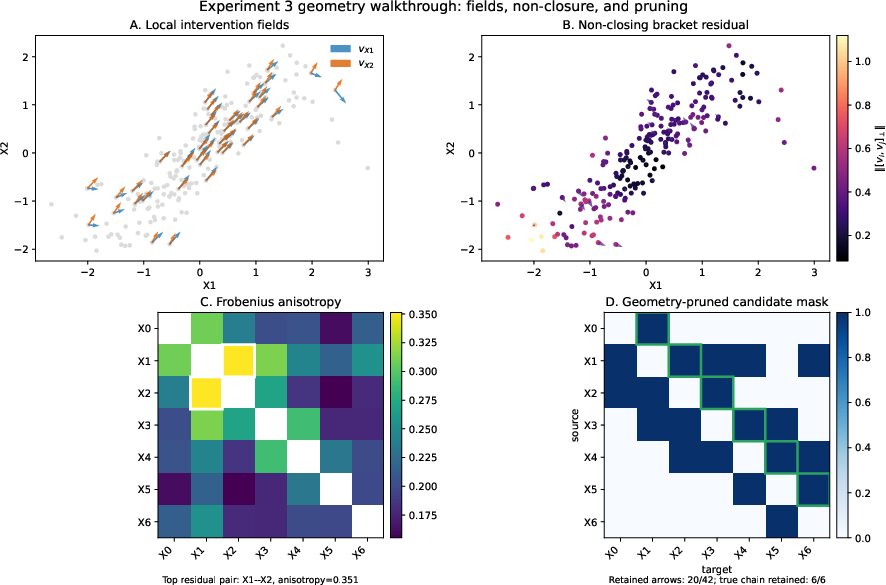
Figure 2: Bridge geometric processing on a 7-node latent-confounded chain, demonstrating learned intervention fields, Lie-bracket residuals, Frobenius anisotropy, and the candidate mask. Green outlines indicate correctly retained true visible arrows.
SKFM: End-to-End Geometric Inference
SKFM further extends the approach by amortizing intervention fields via conditional flow matching, explicitly modeling latent curvature spectrally and enforcing acyclicity through a solvable-Lie algebraic penalty. This pipeline absorbs the entire discovery process into the manifold of vector fields:
- Intervention vector fields are learned via flow-matching objectives—sidestepping ODE integration during training.
- The dimension and orientation of latent confounders are recovered from the spectrum of the Lie bracket Gram matrix.
- A soft penalty enforces solvable-Lie property, ensuring acyclicity relative to a (possibly learned) variable order.
- Direct extraction of an adjacency matrix from the learned field geometry eliminates super-exponential search.
The theoretical guarantees for SKFM, under strong assumptions (additive independent latents, ordering, and eigengap), include consistent latent rank identification and acyclicity certification via vanishing structure constants. However, general order-free graph extraction remains an open challenge, with downstream scorers still critical for non-chain or high-indegree graphs.
Numerical Benchmarks and Empirical Results
The pipeline is validated on synthetic and real-data evaluations:
- On nonlinear latent-confounded chains, the Bridge-pruned candidate family compresses the combinatorial search space by orders of magnitude while achieving high recall for the true visible arrows. Downstream BIC/TCES scoring achieves strong F₁ (∼0.86) on ten-node random DAGs after geometric screening.
- In motif benchmarks (diamond, collider/fork, multi-branch), spectral curvature rescue of the candidate mask addresses the failure of naive influence scoring under complex latent structure; perfect recall is achievable in some cases.
- SKFM recovers structural motifs with exact precision using continuity-regularized fields, latent contamination scoring, and transitive reduction.
- On real datasets (e.g., Sachs protein signaling), Bridge and SKFM expose limits of the method—continuity calibration is weaker, and real biological systems reveal the calibration frontier of geometry-driven approaches.
These empirical studies demonstrate the significant practical merit of geometric screening for narrowing the candidate space and focusing combinatorially intensive procedures, while also specifying the calibration-dependence and limits in real-system applications.
Theoretical and Practical Implications
This work fundamentally reframes causal discovery with latent confounding as a problem of geometric compatibility on statistical manifolds, replacing combinatorial search and conditional independence testing with integrability and Lie algebraic diagnostics. The categorical Kan adjunction serves as a unifying algebraic structure, with the Frobenius/closure constraint translating directly into computational screening. Explicit spectral factorization enables detection and partial isolation of multiple, overlapping latent confounders—a substantial improvement over local latent-sensitive methods (e.g., FCI, LiNGAM with limited scope).
Additionally, the introduction of optimal transport regularization (Wasserstein distance objectives) and amortized architectures addresses weak-support and scaling pathologies intrinsic to high-dimensional systems.
Limitations and Open Problems
Despite strong asymptotic guarantees under regularity and identifiability conditions, several critical problems remain open:
- Finite-sample guarantees: The convergence rate, required sample size, and breakdown under weak field calibration or non-smooth structure are unresolved.
- Order-independence: SKFM and spectral approaches still require an ordering, specific penalties, or enforced local acyclicity, with robust order-free extraction not systematically solved.
- Model misspecification and manifold mismatch: Complex feedback, weak-overlap regimes, and lack of calibration in observational/interventional flows limit applicability to many real-world domains.
- Extension to discrete or non-smooth models: The current geometric formalism requires differentiable structure for Lie bracket and spectral analysis.
Directions for Future Research
The paper identifies several high-impact directions:
- Natural-gradient and Riemannian optimization: Leveraging Fisher metric-based natural gradients in manifold-parameterized discovery.
- Latent discovery in language, large causal models: Integrating language-based causal extraction with geometric screening for world model building.
- Robustness to support divergence and optimal transport constraints: Deepening the connection to OT for high-dimensional, weak-overlap causal inference.
- Quantum generalization: Extending the formalism to non-commutative probability (quantum contexts) where Lie-algebraic non-closure plays an even more direct role.
Conclusion
This work establishes a rigorous and computationally promising framework for causal discovery under latent confounding, leveraging category theory, information geometry, and Lie algebraic structure to convert the combinatorial graph identification task into a differential geometric and spectral screening problem. The approach enables substantial computational savings, high recall on synthetic benchmarks, and theoretically principled diagnostics for hidden confounding. Its limitations, particularly regarding robust order-free extraction and finite-sample guarantees, motivate further development, but the categorical-geometric formulation provides a powerful lens for advancing both the theory and practice of causal discovery.

