- The paper introduces the LSNM-UV model that generalizes additive noise models by incorporating both location and scale dependencies with hidden variables.
- It establishes identifiability of bow-free ADMGs via rigorous theoretical proofs and regression residual tests, clarifying the link between noise patterns and graph structure.
- Empirical results demonstrate significant improvements in directed-edge F1 scores, showcasing the model's robustness compared to baseline methods under heteroscedastic conditions.
This paper addresses the identifiability and practical recovery of causal structures from observational data in the presence of both hidden variables and heteroscedastic (location-scale) noise—generalizing classical additive noise models (ANMs) by allowing the noise variance to depend on parent variables. The work introduces the LSNM-UV model and advances both theoretical and algorithmic tools for learning acyclic directed mixed graphs (ADMGs) under these challenging assumptions.
The data-generating process in the LSNM-UV framework extends prior additive-noise models by permitting both the location and the scale (variance) of the noise to depend nonlinearly on observed and hidden parents. Specifically, each variable vi is generated by:
vi=fi1(Ki)+gi1(Ki)fi2(Qi)+gi1(Ki)gi2(Qi)ϵi
where Ki and Qi are observed and hidden parent sets, fi1, gi1, fi2, gi2 are nonlinear functions, and ϵi are mutually independent exogenous noise variables. This class generalizes both the causal additive model with unobserved variables (CAM-UV) and causally sufficient location-scale models.
An overarching insight is that, conditioning on observable variables, the effect of all hidden ancestors can be summarized as an effective noise variable with a structured dependence pattern. This reduction enables a direct connection between properties of regression residuals (location-scale) and the underlying ADMG structure, even in the presence of unobserved confounding.
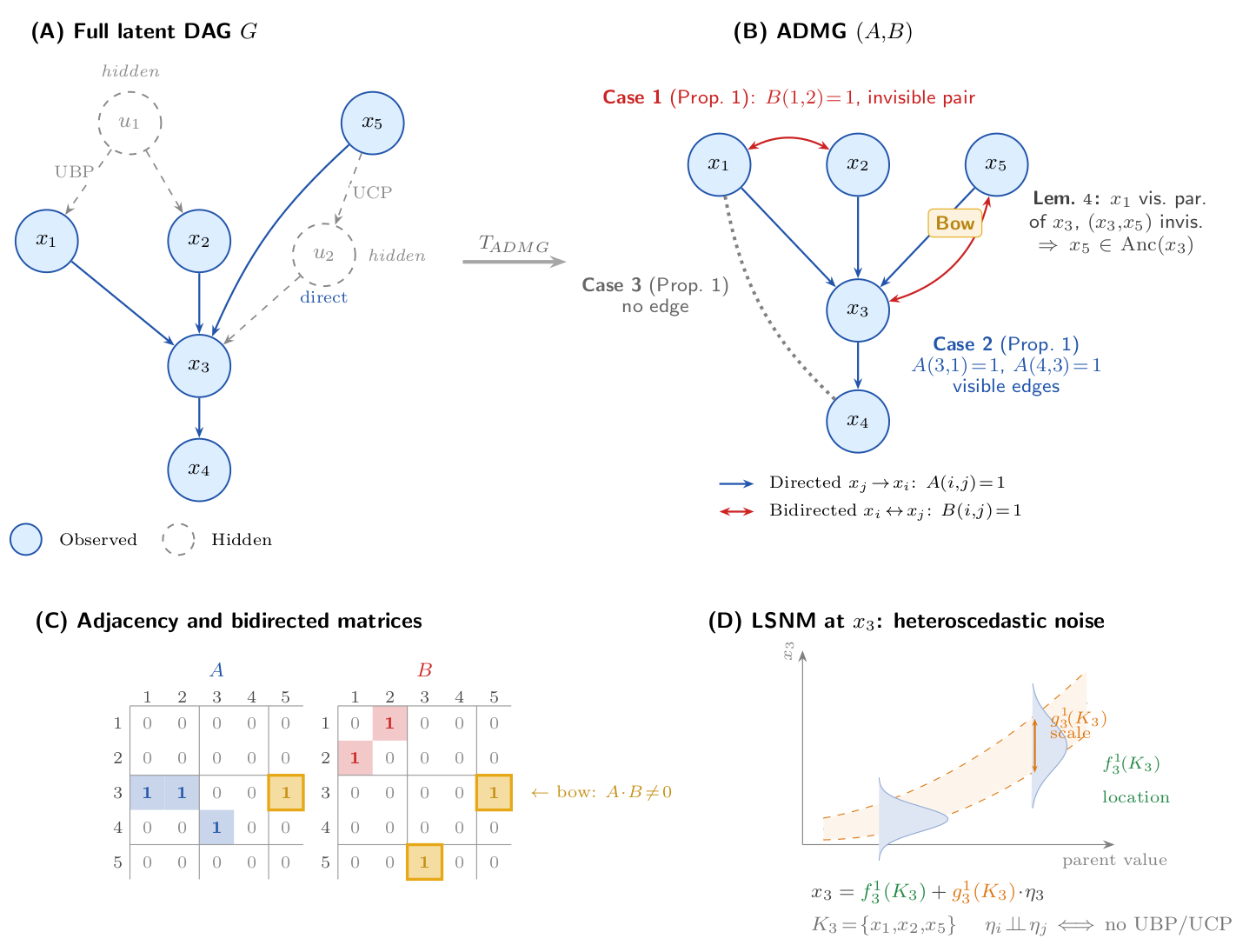
Figure 2: Overview of the LSNM-UV framework, showing the latent DAG, projected bow-free ADMG, and effective noise pathways connecting observed variables.
Main Theoretical Results
1. Identifiability of Bow-Free ADMGs
The paper formally establishes that under mild assumptions (acyclicity, a faithfulness-type residual condition, and bow-freeness), the projected ADMG among observed variables is identifiable using independence properties of location-scale regression residuals. The critical bow-free condition ensures that no pair of variables is simultaneously connected by both a directed and a bidirected edge, enabling a mutually exclusive mapping from statistical tests to graph structure.
2. Residual Independence Patterns and Graph Structure
Formal propositions precisely characterize how different graph relationships (directed edges, bidirected edges due to unobserved backdoor or causal paths, and non-edges) correspond to regimes of dependence and independence among location-scale residuals. Bidirected edges imply universal dependence of all residual pairs under any choice of regression sets, whereas direct edges yield a specific pattern: independence is achievable when regressing on the direct parent, but dependence persists when the parent is omitted.
3. Relaxing Bow-Freeness
A constructive sufficient condition is provided for inferring ancestral relations ("invisible paths") even when edges are not bow-free, leveraging the presence of certain "visible" parents as side-channels and exploiting the persistence of exogenous noise signals in residuals.
Oracle and Algorithmic Reductions
The identifiability proofs utilize an oracle formalism: if an oracle, operating solely on the observed data distribution, can always resolve the queried property (edge, non-edge, or bidirected/confounded pair), identifiability follows. The LSNM-UV model's structure enables such an oracle via tests of (in)dependence among regression residuals.
Algorithmic Implementation: LSNM-UV
The paper introduces a two-stage combinatorial algorithm for recovering the ADMG up to invisible pairs. The first stage systematically searches for parent candidates using regression on subsets and independence testing (via HSIC on GAMLSS residuals), identifying "sinks" and pruning non-parents. The second stage, analogous to the checkVisible routine in CAM-UV-X, re-examines ambiguous (invisible) pairs by searching for further dependencies that can resolve edge directionality or confirm bidirectedness.
The algorithmic pipeline is rigorously proven to be sound and complete for visible edges and non-edges; invisible pairs (i.e., confounded or unseparable by residual tests) are marked explicitly.
Empirical Results
Simulations are performed on synthetic DAGs with a controlled number of observed variables, unobserved common causes (UBPs), and hidden intermediates (UCPs). Highly nonlinear functional forms are used for both location and scale components, with exogenous noise drawn from standard Gaussians. The target causal graphs are explicitly bow-free in the main experimental setup.
LSNM-UV is benchmarked against CAM-UV, FCI, and BANG. Results demonstrate:
- Directed-edge F1 score: LSNM-UV achieves a marked improvement, with F1=0.68 at vi=fi1(Ki)+gi1(Ki)fi2(Qi)+gi1(Ki)gi2(Qi)ϵi0, precision vi=fi1(Ki)+gi1(Ki)fi2(Qi)+gi1(Ki)gi2(Qi)ϵi1, recall vi=fi1(Ki)+gi1(Ki)fi2(Qi)+gi1(Ki)gi2(Qi)ϵi2.
- Baseline performance: CAM-UV and constraint-based methods perform poorly in the heteroscedastic regime (e.g., CAM-UV directed F1 of vi=fi1(Ki)+gi1(Ki)fi2(Qi)+gi1(Ki)gi2(Qi)ϵi3 at vi=fi1(Ki)+gi1(Ki)fi2(Qi)+gi1(Ki)gi2(Qi)ϵi4).
- Bidirected (confounding) edge detection: LSNM-UV exhibits high precision but low recall, suggesting conservative (low false positive) but incomplete recovery for bidirected (confounded) relations.
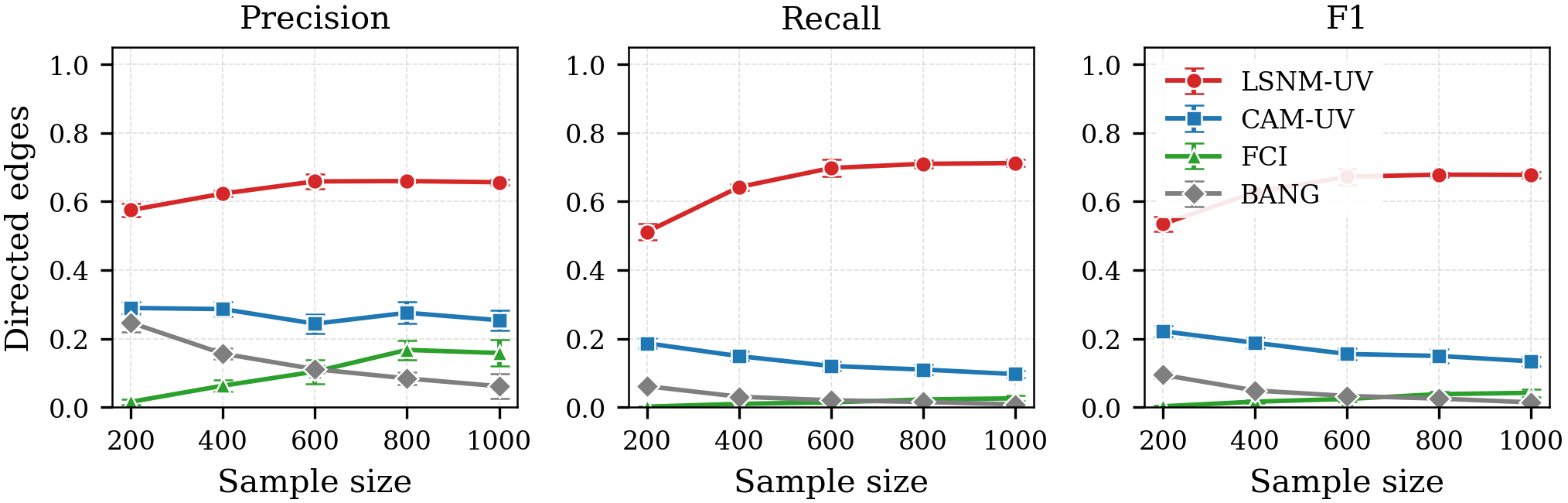
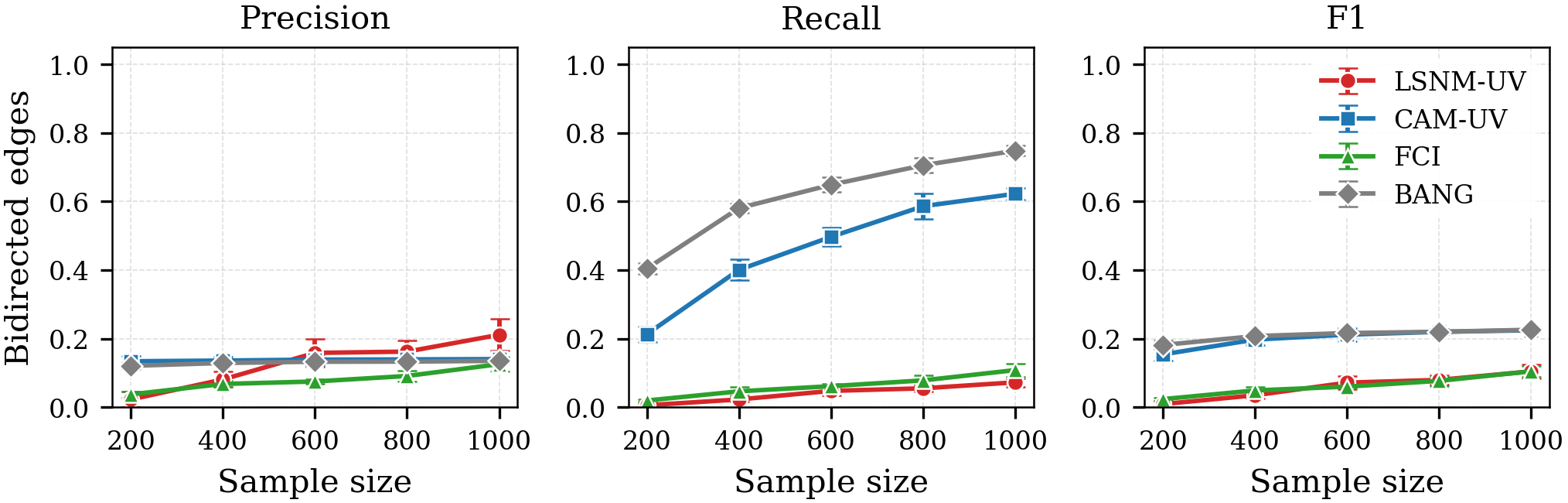
Figure 1: Precision, recall, and F1 for directed (top) and bidirected (bottom) edges across sample sizes, highlighting LSNM-UV's superior directed edge discovery under heteroscedastic data-generating processes.
Implications and Directions for Future Research
Practical Implications
The established identifiability results extend guarantees for graphical discovery beyond settings with additive noise and full observability, covering realistic systems with variance effects modulated by parents and hidden confounders. This significantly broadens the applicability of functional model-based causal discovery, including to domains such as genomics, econometrics, or environmental processes where noise scales are known to be parent-dependent.
Algorithmically, the framework supports a principled approach to demarcating what is learnable (visible edges, visible non-edges) and what is fundamentally ambiguous (bidirected edges) under the data-generating assumptions. As shown empirically, the method is robust to strong non-additivity, outperforming classical and modern baselines.
Theoretical Implications
By generalizing additive-noise identifiability results to the full class of location-scale models with arbitrary nonlinearities and hidden variables, the paper addresses a key open question in causal discovery theory. The utilization of residual independence not just for sufficiency, but also for necessity of graphical features, is especially strong.
Future Directions
- Relaxing Bow-Freeness: While sufficient identification conditions beyond bow-freeness are explored, a complete theory (especially for real-world graphs violating bow-freeness) remains open.
- Improving Bidirected Edge Recall: Current sensitivity for confounding paths (bidirected edges) is limited; enhancing the power and robustness of residual-based detection is a promising direction.
- Application to Real Data: Extending the framework to high-dimensional, noisy, and partially structured real-world data is critical for broader adoption.
- Alternative Independence Testing: Adopting more powerful (e.g., deep kernel-based) independence measures could improve both sensitivity and specificity in practical settings.
- Uncertainty Quantification: Incorporating methods for assessing the statistical certainty of graph features under finite samples.
Conclusion
This work provides a comprehensive extension of causal discovery methodologies to nonlinear, heteroscedastic systems with latent variables. It rigorously proves identifiability conditions for ADMGs under location-scale noise, develops a sound and complete algorithm for structural recovery, and empirically validates substantial gains over additive noise and constraint-based baselines. The methodology assigns clear learnable status to edges and confounded pairs, advances theoretical understanding of functional-model-based identifiability, and lays a foundation for more general and practically useful causal discovery frameworks in machine learning and scientific domains.
(2606.08196)

