- The paper demonstrates an efficient classical matrix product state representation that scales polynomially with active space size, greatly reducing the computational burden.
- It introduces a quantum state preparation protocol using symmetry-adapted techniques and sequential circuits, achieving gate complexity of O(d^3) through controlled rotations and Toffoli gates.
- The approach enables effective transformations between symmetry-adapted (UGA) and Fock bases, paving the way for advanced quantum chemistry algorithms on strongly correlated systems.
Efficient Classical Representation and Quantum State Preparation of Complete Active Space Wavefunctions
Motivation and Background
The challenge of quantum state preparation for strongly correlated electronic systems in quantum chemistry remains a fundamental bottleneck when leveraging quantum algorithms for electronic structure calculations. The Hartree-Fock (HF) state, despite its straightforward preparation, is insufficient for systems exhibiting strong correlation, with multi-reference states such as the complete active space (CAS) wavefunctions enabling a more accurate description. CAS states—defined as the superposition of all configuration state functions (CSFs) within an active space of d spatial orbitals and N electrons—are exponentially large and traditionally believed to be intractable for classical encoding and quantum circuit preparation.
Prior approaches, including selective configuration interaction (SCI) and density matrix renormalization group (DMRG), provide approximations or tensor network representations in the Fock basis. Critically, these methods suffer from exponential scaling in bond dimension or gate complexity when attempting to strictly represent CAS states, particularly in the half-filling regime (N∼d). The basis-dependent nature of the bond dimension underscores the importance of symmetry-adapted bases for improving scalability.
Paldus Duality and Symmetry-Adaptive Encoding
Central to this work is the exploitation of Paldus duality, which prescribes a decomposition of the antisymmetric N-particle Hilbert space under the action of U(d)×SU(2). This yields the Gelfand-Tsetlin (GT) basis, with states specified by particle number, total spin, spin projection, and a step vector describing transitions between orbital configurations via the Shavitt graph.
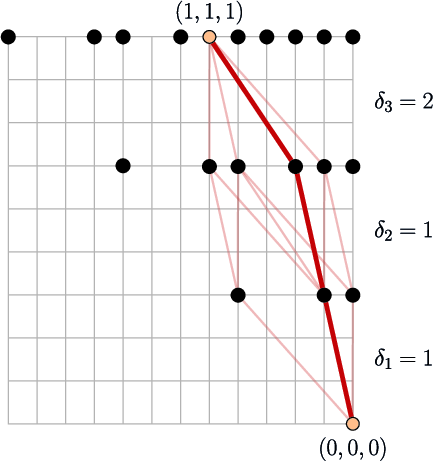
Figure 1: A particular walk on a Shavitt graph for d=3, encoding allowed transitions as triplets (a,b,c) corresponding to orbital occupancies.
CAS states are expressed as linear combinations of CSFs, themselves uniquely mapped to walks on the Shavitt graph, which are indexed by step vectors δ and associated triplets (ai,bi,ci). The authors formalize the constraints (via ΓN,S) that restrict valid walks and, hence, the support of CAS states in the unitary group approach (UGA) basis. This mapping results in a one-to-one correspondence between CSF parameters and UGA basis states, facilitating efficient indexing and manipulation.
Efficient Matrix Product State Representation
The primary contribution is the demonstration that CAS states, when expanded in the UGA basis, admit an efficient matrix product state (MPS) representation with bond dimension N0. This is an exponential improvement relative to prior representations in the Fock basis, where the bond dimension typically grows exponentially with system size.
The MPS construction leverages the inherent structure of walks on the Shavitt graph; virtual indices in the MPS correspond to triplets N1, and the sparsity induced by allowed transitions enables manageable storage and manipulation. The expansion coefficients N2 are decomposed into a contraction of site tensors N3, with the maximum Schmidt rank at any bipartition scaling polynomially.
Quantum State Preparation Protocol
The CAS MPS can be loaded onto a quantum computer via a sequential circuit, wherein site unitaries N4 introduce a new 2-qubit physical register per site and propagate bond/temporary registers. Critically, the circuit exploits QROAM for efficient angle loading and applies controlled N5, N6 rotations and adders with Toffoli complexity N7 per site, totaling N8 overall.
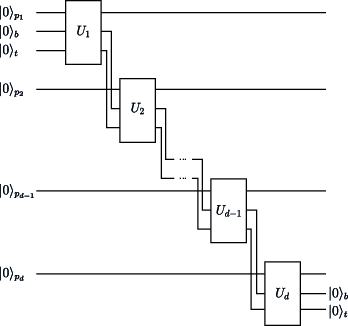
Figure 2: Sequential quantum circuit for preparing CAS MPS in the UGA basis, incorporating physical, bond, and temporary registers with uncomputation after the final unitary.
Upon preparation in the UGA basis, the inverse Quantum Paldus Transform (QPT) maps the state to the Fock basis, enabling standard quantum algorithms such as phase estimation and Hamiltonian simulation. The cost of the QPT dominates the total circuit complexity, but preserves polynomial scaling.
An additional result is the efficient conversion to first quantization, leveraging established transformation protocols to ordered orbital lists and antisymmetrization procedures. For N9, the conversion overhead remains subdominant.
Numerical Results and Claims
The paper quantifies gate counts and circuit depths:
- Gate complexity: N∼d0 Toffolis for full CAS state preparation.
- Bond dimension: N∼d1 in the UGA basis (vs. expected exponential growth in the Fock basis).
- Extension: Efficient support for both second and first quantization.
These results constitute an exponential improvement in classical representation and quantum preparation of CAS states. The method is immediately applicable to strongly correlated systems, where overlap with ground-state eigenvectors is paramount for quantum algorithmic efficacy.
Practical and Theoretical Implications
The approach enables full CAS state preparation on quantum computers, laying the groundwork for improved initial states in quantum chemistry algorithms. The polynomial scaling in active space size N∼d2 suggests practical applicability to previously intractable molecular systems, potentially facilitating end-to-end quantum simulations, ground-state energy extraction, and dynamic studies.
Theoretically, the compact representation in the UGA basis opens avenues for spin-adapted DMRG, optimization protocols for CASCI/CASSCF, and comparative studies of quantum algorithms operating in symmetry-adapted bases vs. traditional schemes.
Future research may focus on classical processing of UGA-based CAS states (e.g., energy computation, dynamics), refinement of the QPT cost, robustness analysis, and extensions to quantum-inspired protocols for classical simulation.
Conclusion
This work introduces an efficient classical and quantum representation of complete active space wavefunctions, exploiting symmetry-adapted bases and graph-theoretic walks to achieve exponential improvements in bond dimension and circuit complexity. The formal protocol demonstrates robust polynomial scaling, applicability to both quantization schemes, and direct relevance to strongly correlated systems in quantum chemistry. The methodology paves the way for practical quantum initialization, post-Hartree-Fock methods, and further algorithmic advances in the study and simulation of complex molecules (2606.19457).