- The paper demonstrates SAE-CAS, a novel encoding that exploits exact and CAS-induced symmetries to reduce qubit count beyond traditional JW mappings.
- It integrates Bravyi–Kitaev mapping via Clifford transformations, maintaining Hamiltonian equivalence while lowering circuit complexity.
- Numerical benchmarks on various molecules show improved VQE convergence, reduced operator counts, and elimination of sector leakage.
Symmetry-Adapted Qubit Encoding with Complete Active Space and Bravyi–Kitaev Mapping for Quantum Chemistry
Introduction and Theoretical Framework
The paper introduces Symmetry-Adapted Encoding with Complete Active Space (SAE-CAS), an efficient fermion-to-qubit mapping for quantum chemistry simulations on quantum computers. SAE-CAS is built on unifying exact symmetry exploitation (spin-parity and point group), approximate CAS-induced Z-symmetries (frozen core and virtual orbital projections), and flexible Clifford-based basis changes, integrating Jordan–Wigner (JW) and, crucially, Bravyi–Kitaev (BK) mappings.
The approach systematically encodes molecular symmetries as binary stabilizers on the qubit register, performing sector selection via affine Clifford transformations. The CAS treatment is formalized as imposition of approximate Z symmetries, projecting onto a subset of spin-orbitals and rigorously proved to yield a qubit Hamiltonian strictly equivalent to canonical CAS quantum chemistry methods, with all approximation error sourced solely from the chosen active space.
Through a series of algebraic results, the paper establishes that:
- Symmetry reduction via affine Clifford maps is not only compatible with but commutes with active space projection, ensuring modularity.
- The extension to the BK mapping is natural: BK is implemented as an additional Clifford acting only on the active space, leaving all resource savings and spectra invariant.
Affine Clifford Construction and Qubit Reduction
The technical backbone is the use of affine Clifford tableaux, enabling explicit encoding of both the symmetry constraints and CAS projections at the operator level. Each symmetry generator is mapped to a product of Z operators, and after row reduction and sector selection, the mapping reduces the number of qubits from n (full space) to n−k (active space dimension minus number of exploited symmetries), systematically removing redundancy at the encoding layer.
The circuit construction process is as follows:
- Identify Boolean symmetry generators (spin-parity, point-group irreps).
- Assemble the corresponding orbital symmetry matrix and encode the symmetry sector.
- Perform an affine Clifford change of basis, which diagonalizes all symmetry generators and projects onto the target subspace.
- Compose with the CAS projection, which is equivalently an approximate symmetry imposition over frozen and virtual orbitals.
- Optionally append BK mapping via a further Clifford transformation (for local operator reduction).
This process is algebraically shown, via explicit tableau calculation, to yield a minimal and symmetry-pure Hamiltonian on the reduced register.
Numerical Results: Resource and Convergence Analysis
The efficacy of SAE-CAS and its BK variant is benchmarked on nine molecules (e.g., H2O, C2H4, O2, CO, N2, CZ0HZ1), across both unitary coupled-cluster (UCCSD) and hardware-efficient shifted-circular-alternating (HE-SCA) VQE ansatzes. For each system, resource requirements and numerical performance are reported under multiple encoding strategies: JW, JW-CAS, JW-CAS with symmetry filtering, SAE-CAS, and SAE-CAS-BK.
The results demonstrate:
- Consistent reduction in qubit count: SAE-CAS deletes up to 3 symmetry qubits beyond JW-CAS, as illustrated in (Figure 1).
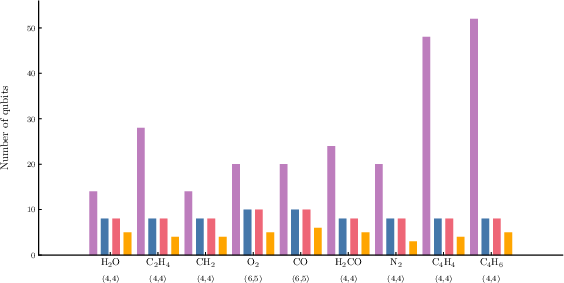
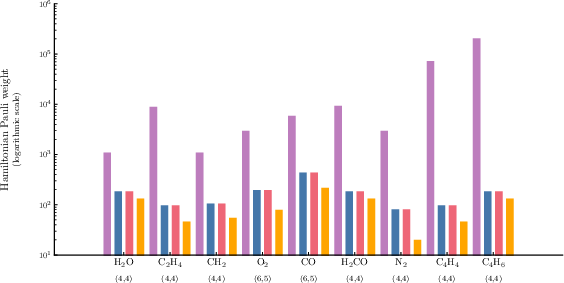
Figure 1: Qubit resource metrics—number of qubits and Pauli count—across encoding schemes, demonstrating the supremacy of SAE-CAS and its variants over JW baselines for all systems tested.
- Reduced operator complexity: Both Hamiltonian term count and maximal Pauli weight decrease systematically with symmetry-adapted encodings.
- Circuit complexity improvements: All circuit metrics (depth, CNOT count, number of variational parameters) are strictly improved or remain comparable after symmetry adaptation, validated for both ansatz types. Notably, HE-SCA circuits under SAE-CAS are markedly shallower and require fewer CNOTs compared to JW analogues as seen in (Figure 2).
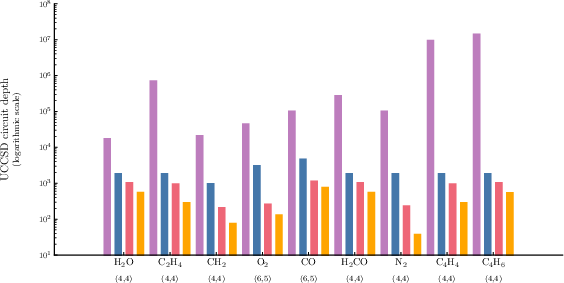
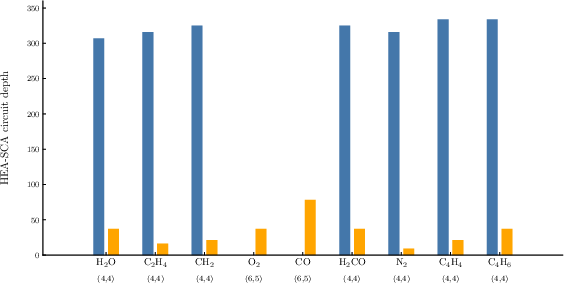
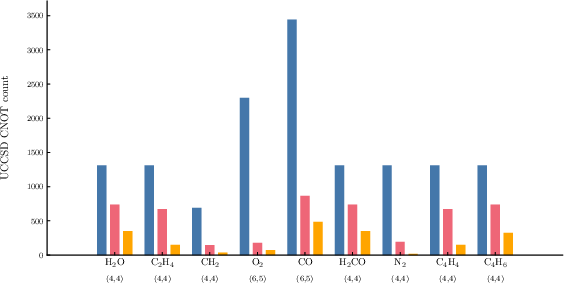
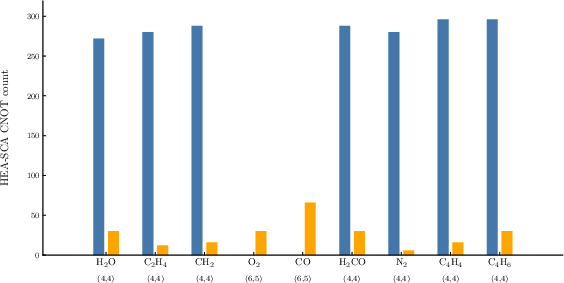
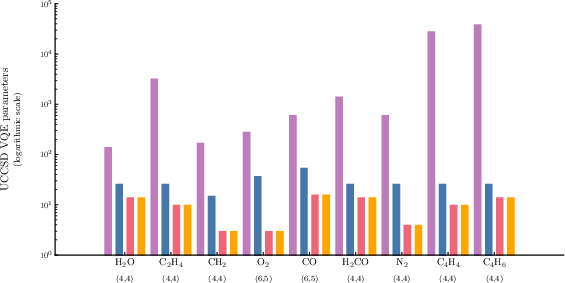
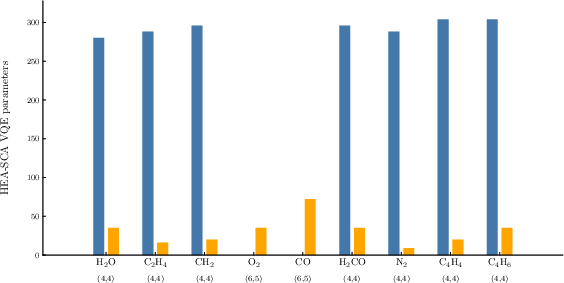
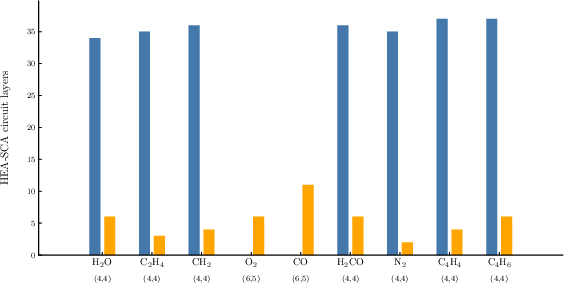
Figure 2: Circuit complexity metrics for UCCSD and HE-SCA ansatzes under various mappings, highlighting systematic depth and entangling-gate reductions with SAE-CAS schemes.
- Convergence characteristics: SAE-CAS substantially accelerates VQE convergence, with up to a 3-fold reduction in optimizer iterations for UCCSD, and achieves chemical accuracy with lower circuit layers in HE-SCA. The inability of JW-CAS HE-SCA to converge on five-orbital systems (notably OZ2, CO) is decisively resolved by symmetry-based qubit removal, which restricts the variational manifold and eliminates sector leakage and local minima traps. This is quantitatively evidenced in (Figure 3):
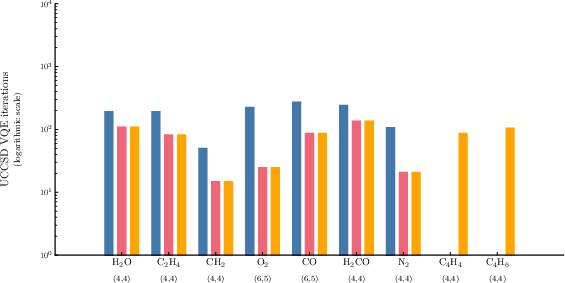
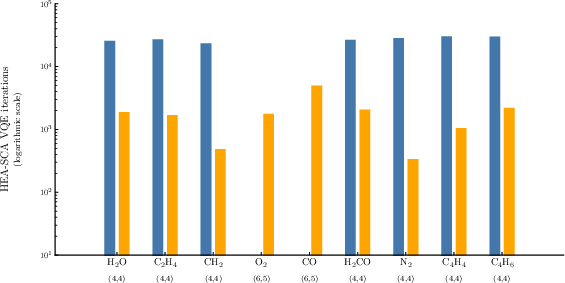
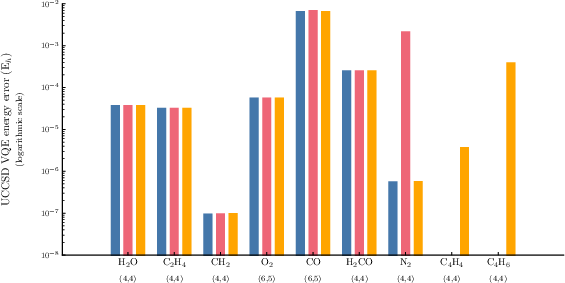
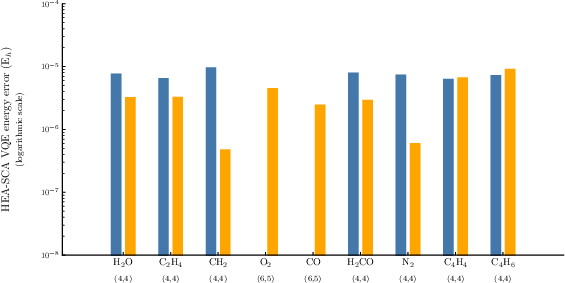
Figure 3: Optimisation and accuracy diagnostic metrics: VQE iteration counts and energy errors for UCCSD and HE-SCA. SAE-CAS and SAE-CAS-BK achieve lower error and faster convergence across all cases.
Comprehensive diagnostic studies (Appendix) reveal that HE-SCA convergence failures in JW-CAS are not due to vanishing gradients (barren plateaus), but originate from the ansatz straying into wrong-particle-number sectors, reinforcing the necessity of symmetry encoding at the Hamiltonian level.
SAE-CAS-BK: Unitary Equivalence and Circuit Tradeoffs
The SAE-CAS-BK encoding applies the BK basis change to the symmetry-adapted active space register. Empirically, both qubit and operator counts are invariant between SAE-CAS and SAE-CAS-BK, and VQE optimization performance (iterations and final energy) is indistinguishable to within numerical error, evidencing strict unitary equivalence. Circuit-level costs (depth, CNOT count) are nearly identical except in some cases (e.g., CO), where a mild increase of up to 20% in CNOT count is observed for SAE-CAS-BK. The anticipated Pauli weight reduction of BK is not yet realized for small active spaces, but is expected to manifest in larger simulations.
Theoretical and Practical Implications
This research cements the value of symmetry-exploiting encodings, providing a formal, modular, and resource-efficient pathway for encoding molecular Hamiltonians on quantum architectures, both in fault-tolerant and NISQ regimes. The algebraic machinery allows arbitrary combinations of point-group, spin, and CAS-induced symmetries, with trivial extension to parity or other Clifford-friendly mappings. The demonstration that active space projection can and should be composed with symmetry-adapted encoding (rather than circuit-level or post-selection enforcement) positions SAE-CAS as a superior pre-processing step.
Practical impact is expected in several dimensions:
- Immediate reduction of quantum hardware requirements for quantum chemistry, both in terms of logical qubits and circuit complexity.
- Improved convergence landscapes for VQE and other hybrid algorithms, eliminating sector leakage and local minima unrelated to the chemical problem.
- Combinability with advanced error mitigation, measurement reduction, and compact ansatz designs, due to reduced noise sources from smaller, shallower circuits.
Looking forward, as hardware progresses toward simulations involving larger active spaces and more complex symmetry situations, the asymptotic scaling improvements of this approach, particularly in the BK variant, will become increasingly important. The open-source implementation further facilitates integration into quantum computational chemistry workflows.
Conclusion
The paper delivers a comprehensive algebraic and computational treatment of symmetry-adapted qubit encodings, extending CAS methodology with exact and approximate symmetries, and rigorously connects these to both JW and BK mappings via affine Clifford construction. Through analytical proof and numerical evidence, it is established that SAE-CAS and its BK variant provide significant and consistent resource gains for quantum chemistry simulations without loss of target accuracy. The encoding eliminates redundant variational directions, sector leakage, and circuit overhead, offering a systematic route to hardware-efficient, symmetry-pure quantum algorithms for molecular electronic structure—readily composable with all major quantum simulation stacks.

