- The paper provides the first rigorous extraction of complete, scheme-independent dynamical tidal Love numbers using effective field theory matching.
- It employs both perturbative and frequency domain methods to quantify tidal effects across diverse neutron star equations of state.
- The findings show that enhanced dynamical tides significantly impact gravitational waveform phases at 8PN order, critical for next-generation detectors.
Introduction and Theoretical Framework
The dynamical tidal response of neutron stars plays a critical role in the late inspiral phase of compact binaries, providing a unique probe of supranuclear matter via gravitational wave (GW) observations. The work "Dynamical Tidal Response of Neutron Stars: from Effective Field Theory to Gravitational Waveforms" (2606.19446) addresses the relativistic description of the dynamical Love numbers (TLNs) of neutron stars using a rigorous matching between general-relativistic stellar perturbation theory and the worldline effective field theory (EFT) approach.
Within the EFT formalism, the neutron star is modeled as a point particle with internal structure parametrized by frequency-dependent response functions. The TLNs—static cE and dynamic cE˙—encode the response to external quadrupolar gravito-electric fields, arising in the finite-size expansion of the worldline action. Crucially, the matching to general-relativistic perturbation theory is performed at loop level, demanding dimensional regularization and renormalization to treat divergent contributions and to extract scheme-independent observables.
Numerical Extraction and Structure of Dynamical Love Numbers
The paper combines two independent approaches: a perturbative expansion in ω (orbital frequency) and a non-perturbative frequency domain approach, both for static, spherically symmetric perfect-fluid neutron stars spanning several nuclear-physics equations of state (EoS). This allows for a robust, gauge-invariant extraction of both cE and cE˙, directly relevant for waveform modeling.
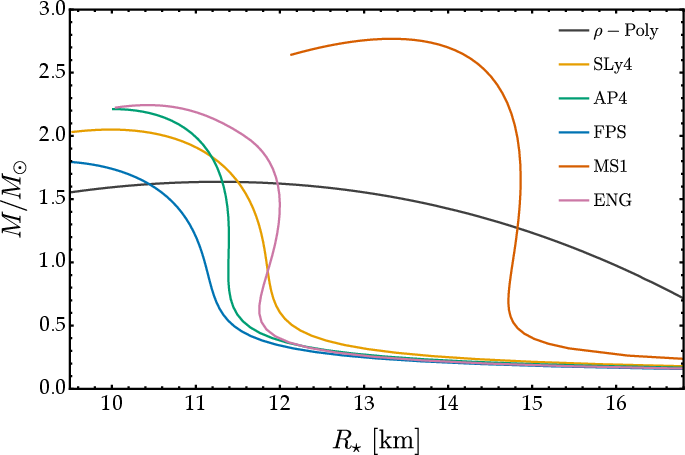
Figure 1: Mass-radius relations for neutron stars across several equations of state and a reference polytrope.
The computed TLNs exhibit several salient features:
- Both cE and cE˙ peak at moderate compactness and decrease toward both lower and higher compactness, with stiffer EoS yielding higher peak values.
- cE˙ possesses an explicit logarithmic dependence on the renormalization scale μ, reflecting the universal running with the EFT subtraction scale.
- At moderate-to-low compactness corresponding to typical neutron star parameters, cE˙ is significantly enhanced with respect to cE˙0, indicating a substantial dynamical tidal effect even though it formally enters GW phases at 8PN order.
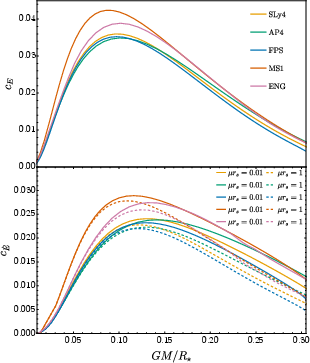
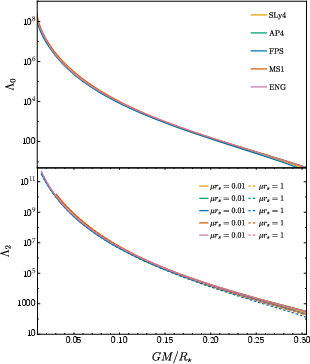
Figure 2: Static (cE˙1) and dynamical (cE˙2) TLNs as a function of stellar compactness for several EoS.
The running of cE˙3 manifests as a decrease in its value as the orbit shrinks (and cE˙4 increases), analogous to asymptotically free couplings in non-Abelian gauge theories.
Universal Relations and Mode Approximation
The analysis reveals robust approximate EoS-insensitive relations (universality) between the dimensionless tidal invariants cE˙5 and cE˙6 at fixed values of cE˙7. This mirrors the I-Love-Q relations and enables parameter reduction in GW parameter estimation analyses.
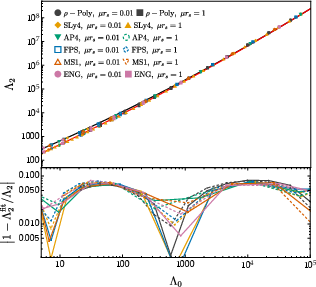
Figure 3: Approximate universal relations between cE˙8 and cE˙9 for various EoS and renormalization scales, demonstrating universality at fixed ω0.
A detailed comparison with ω1-mode resonance models establishes that the frequency scale entering the leading correction to tidal response (ω2) closely tracks the true fundamental ω3-mode of the star to within 5%, even in the relativistic regime and varying ω4. Nevertheless, the full response cannot always be captured by a single mode sum, particularly for highly compact stars, confirming a key qualitative departure from Newtonian expectations.
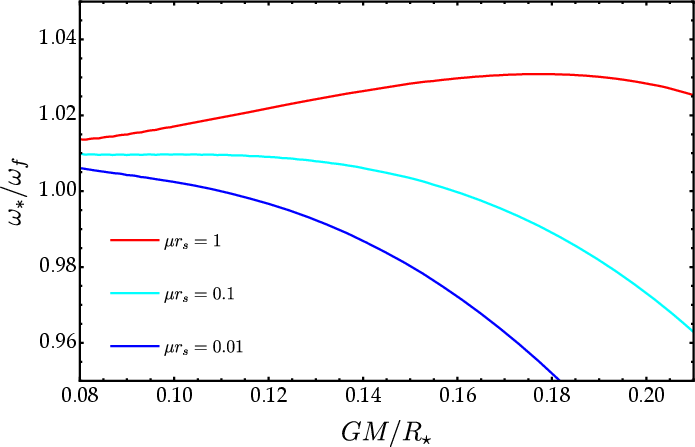
Figure 4: Ratio ω5 as a function of ω6 for rest-mass polytrope models, quantifying the ω7-mode approximation accuracy.
Post-Newtonian Waveform Incorporation
All tidal effects, including dynamical ones, are incorporated into the effective two-body Lagrangian. The static TLN enters at 5PN order in the GW phase, while dynamical corrections, characterized by ω8 and its running, first enter at 8PN, but are amplified by an additional ω9 inverse power of the stellar compactness:
cE0
The logarithmic running term provides a unique PN structure, but its amplitude is subdominant compared to the finite cE1 piece, which is enhanced by three orders of magnitude relative to cE2 for typical neutron star parameters.
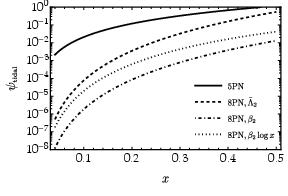
Figure 5: Tidal phase contributions from static and dynamical TLNs as functions of dimensionless binary frequency, highlighting the hierarchy between 5PN and 8PN terms.
Detectability and Data Analysis Implications
A rigorous parameter estimation study was carried out, with the following findings:
- Using Fisher matrix analysis, the 8PN dynamical tide is measurable by Einstein Telescope (ET) for neutron star masses cE3–cE4 (depending on EoS), with cE5 errors below 100%; for lighter stars, the precision improves to cE6.
- Finite-size effects associated with cE7 are unmeasurable with current LVK detector sensitivity, but will become systematically relevant for third-generation GW detectors.
- Mismatch analysis shows that omitting dynamical tide corrections can induce systematic biases in the inferred static TLN and, consequently, in EoS constraints, even when cE8 cannot itself be resolved at high significance.
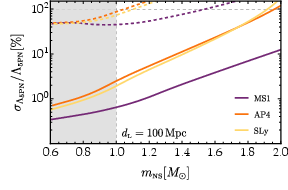
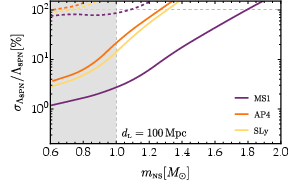
Figure 6: Relative cE9 uncertainties on static and dynamical TLN parameters for binary neutron stars, as a function of mass and EoS, for LVK O4 and ET.
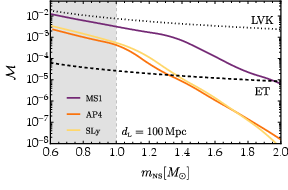
Figure 7: Template mismatch as a function of neutron star mass for different EoS, indicating regimes where neglecting dynamical tides biases GW parameter inference for ET.
Summary and Conclusion
This work offers a systematic, mathematically rigorous analysis of the fully relativistic dynamical tidal response of neutron stars, establishing a consistent bridge from relativistic stellar perturbation theory to worldline EFT and on to GW observables. The first explicit extraction of the complete, scheme-independent leading-order dynamical TLN—including its logarithmic running—has been achieved. The characteristic cE˙0 scaling enhances the observable signature of these effects by several orders of magnitude over the static case.
Approximate universality between static and dynamic TLNs is established, enabling parameter space reduction. The detailed GW phase corrections demonstrate that dynamical tides are a dominant subleading finite-size effect for third-generation GW detectors. Systematic modeling of these effects is essential for unbiased nuclear equation of state inference with future GW data.
This framework paves the way for robust inclusion of dynamical tides in next-generation waveform templates, joint constraint of nuclear physics through GW observation, and future extensions to incorporate spin, higher multipoles, and nonlinear tidal interactions. The formalism also sets a clear standard for resolving ambiguities in TLN definitions and ensures rigorous connection to observable GW signatures.

