- The paper develops a systematic effective field theory framework that matches scattering amplitudes from MST solutions to compute the frequency-dependent tidal response of neutron stars.
- It demonstrates improved alignment with resonant f- and g-modes and reduces systematic errors in gravitational-wave waveform modeling through gauge-invariant methods.
- The method enables direct incorporation of dynamical tidal effects into PN/EFT binary dynamics, advancing precision gravitational-wave astrophysics.
Dynamical Tidal Response of Neutron Stars via Scattering Amplitudes
Motivation and Theoretical Framework
The precise characterization of compact objects in gravitational-wave sources, particularly the distinction between neutron stars and black holes, hinges critically on modeling their tidal response. Unlike black holes, neutron stars exhibit non-vanishing static and dynamical tidal responses, with the former encoded in the Love numbers and the latter in frequency-dependent features such as tidal resonances. Dynamical tidal effects are crucial for probing the neutron-star equation of state (EOS), especially during late-stage inspiral when tidal interactions imprint themselves onto the gravitational waveform.
The paper presents a systematic approach to defining and calculating the dynamical tidal response of neutron stars within the worldline effective field theory (WEFT) framework. The dynamical tide is framed as a matching problem between scattering amplitudes computed in EFT and those derived from relativistic stellar perturbation theory, specifically using Mano-Suzuki-Takasugi (MST) analytical solutions in the stellar exterior. This construction delivers an explicit, gauge-invariant tidal response function that is both frequency-dependent and can be directly imported into the PN/EFT framework for binary dynamics and waveform modeling.
Perturbation Theory and Exterior Matching
The interior perturbation problem is formulated in the Regge-Wheeler gauge using the formalism of Detweiler and Lindblom [1985], with the perturbation variables reduced to a set of first-order ODEs. The background EOS and matter stratification are incorporated via the sound speed and thermodynamical conditions, allowing the excitation of gravity (g-) modes and fundamental (f-) modes during tidal forcing.
Exterior perturbations are recast into the Regge-Wheeler equation, and analytical MST solutions are employed to represent the metric perturbations outside the star. At the stellar surface, matching conditions relate interior and exterior perturbations, yielding a scattering phase shift whose frequency dependence contains detailed information about the tidal response.
The WEFT models the neutron star as a point worldline, supplemented by quadrupole degrees of freedom that encode finite-size tidal effects. The action incorporates mass, quadrupole-tide couplings, and gravitational recoil terms. The tidal response function F(ω) enters via the quadrupole propagator in the corresponding Feynman diagrams for gravitational Raman scattering.
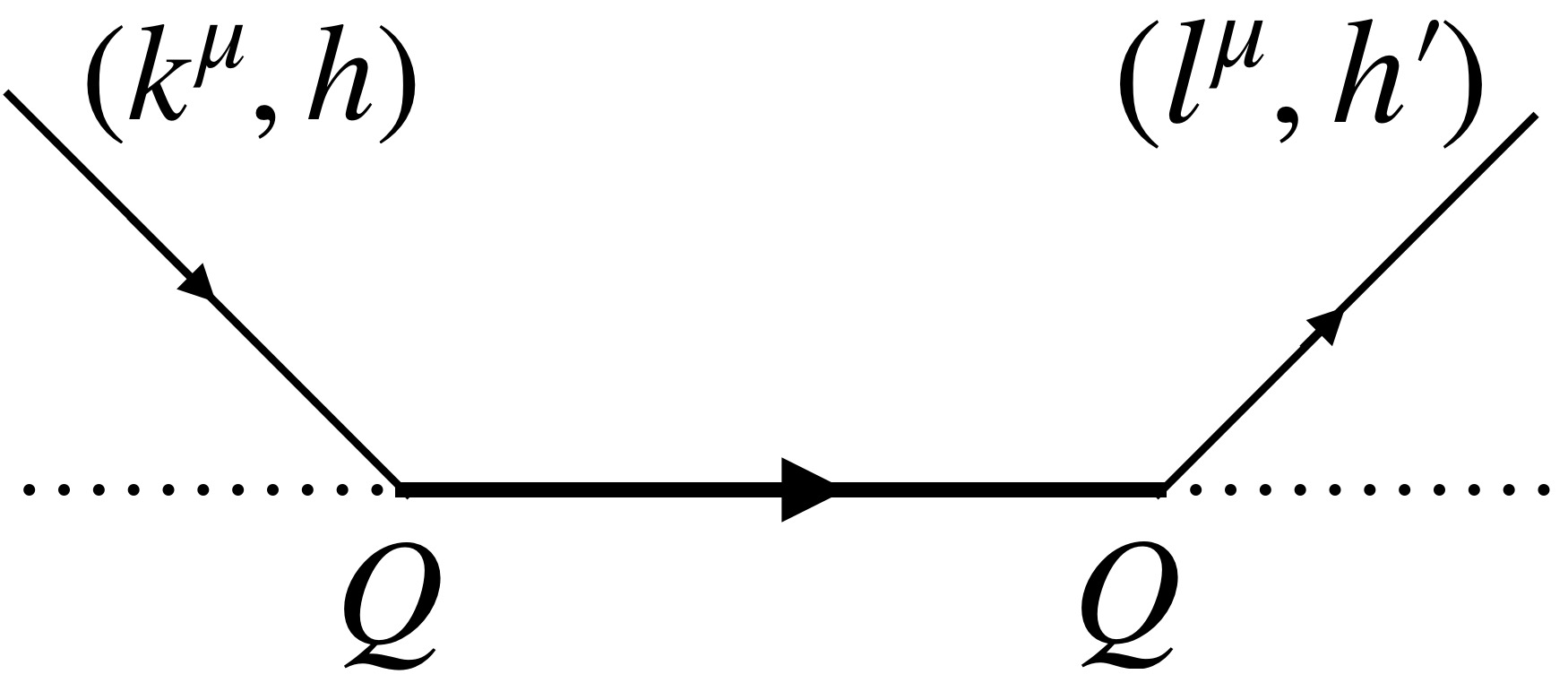
Figure 1: Tree-level, tidal contribution to Raman scattering, encoding the leading-order frequency-dependent tidal response via the quadrupole propagator.
Higher-order diagrams, including chains and loops involving mass insertions, are constructed to ensure unitarity and systematic inclusion of exterior spacetime effects. The prescription yields a tidal phase operator that isolates the tidal response by subtracting point-particle (black-hole) contributions from the neutron-star scattering amplitude.
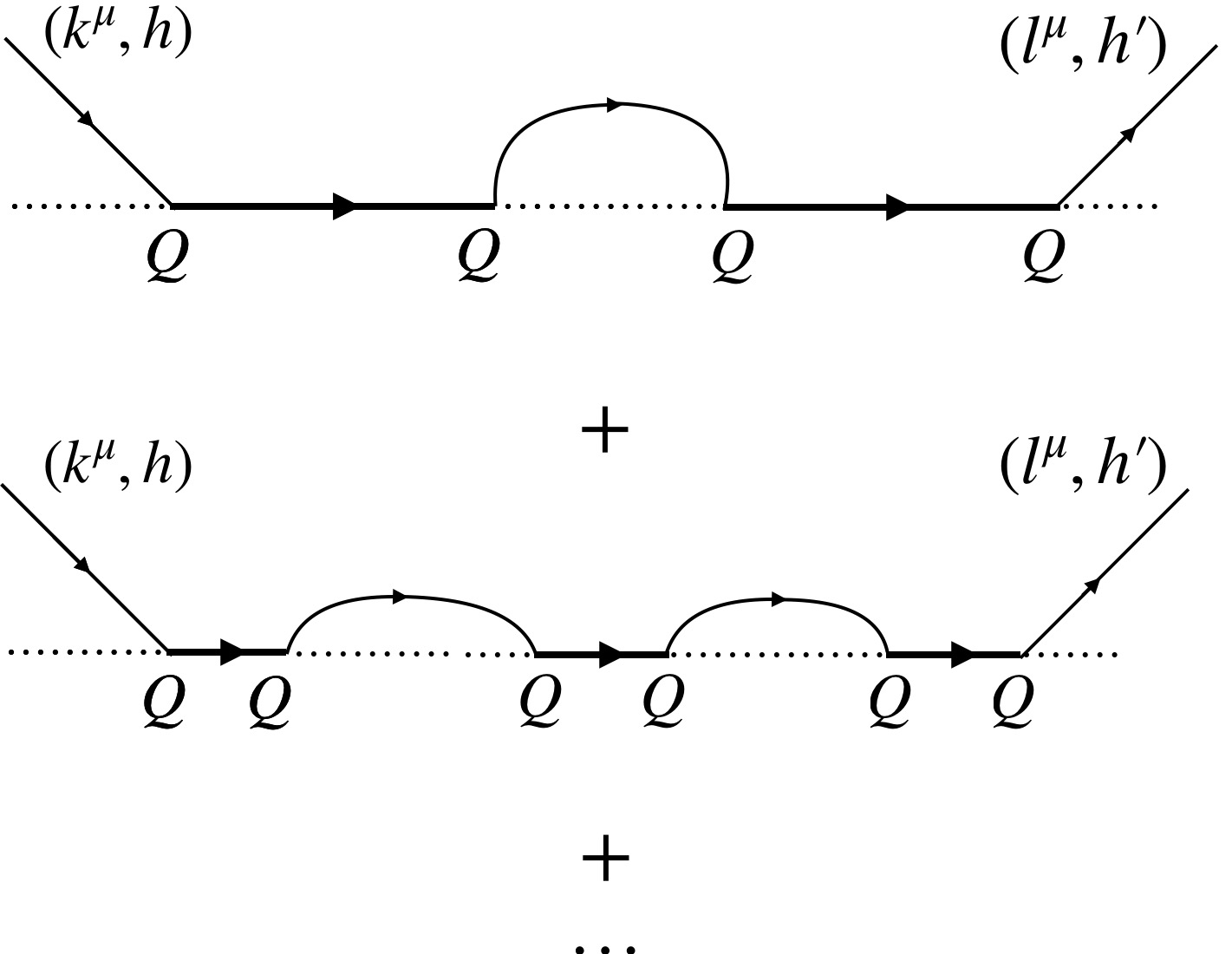
Figure 2: Additional tidal contributions to the scattering process that do not involve mass insertions, corresponding to resummations required for unitarity.
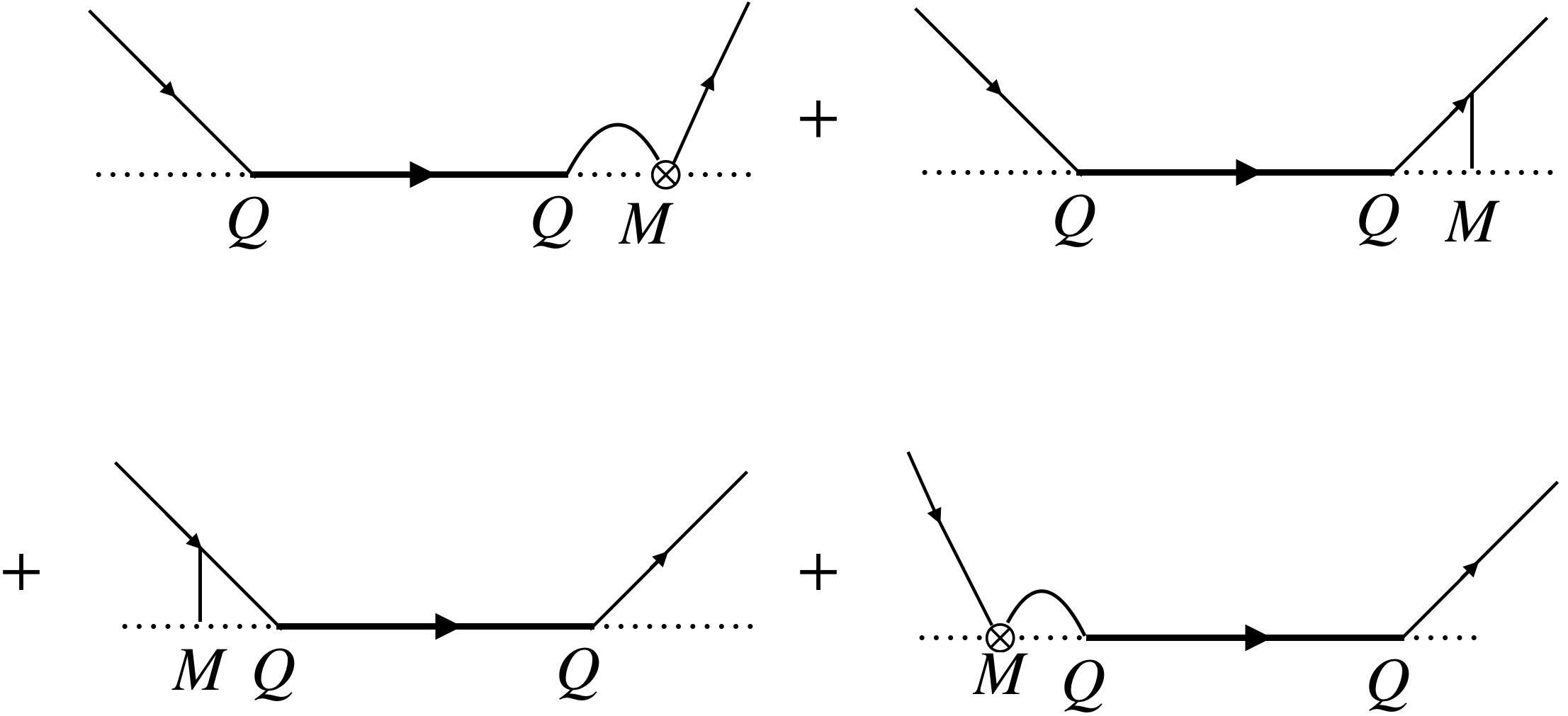
Figure 3: The simplest diagrams at linear order in M, including loop corrections, which introduce infrared divergences to be regularized.
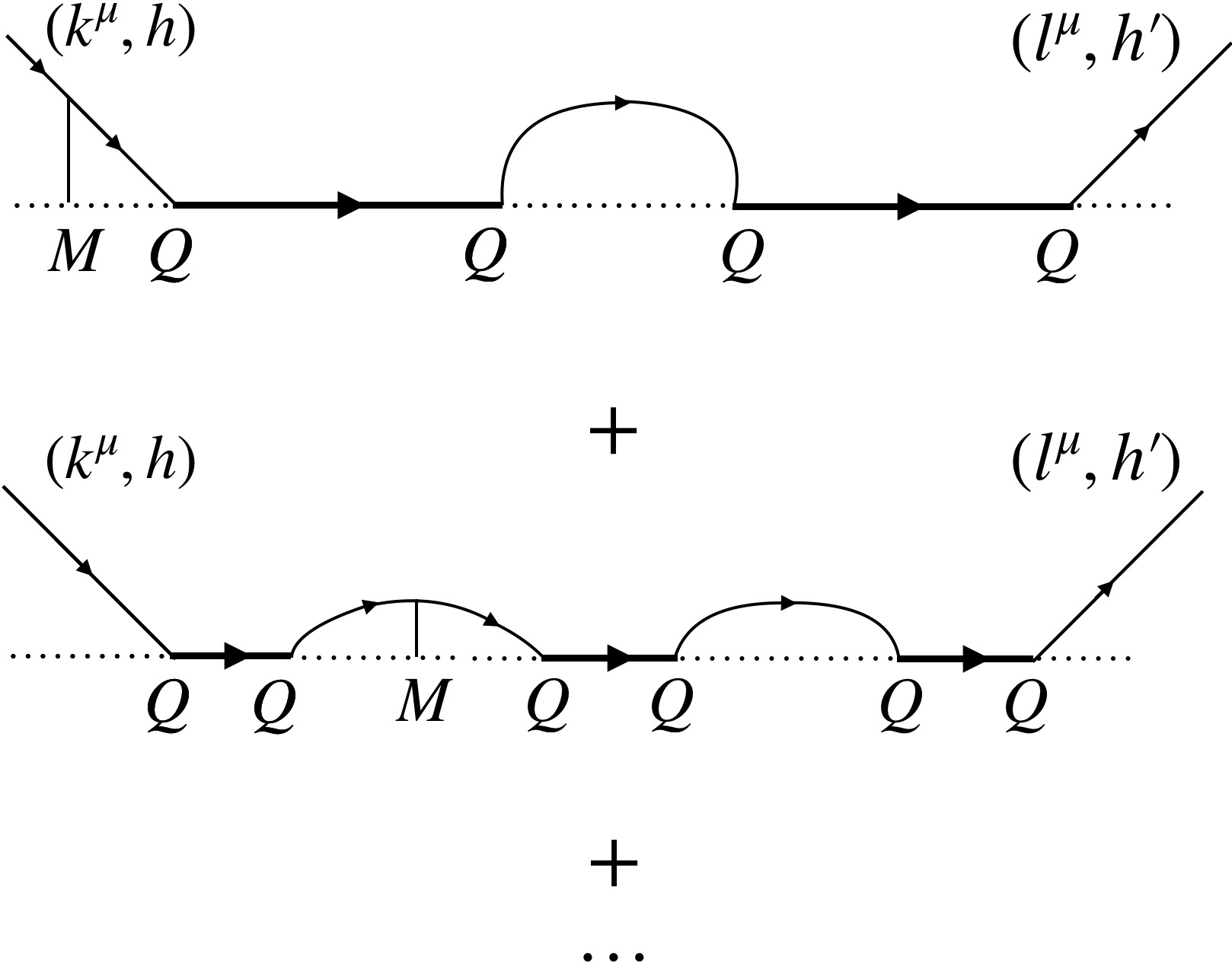
Figure 4: Higher-order contributions to the tidal response involving one mass insertion and resummed chains.
The formalism allows for systematic expansion in powers of M, yielding a unitary, gauge-invariant tidal response function suitable for directly matching with the physical scattering phase extracted from perturbation theory.
Numerical Results and Consistency Checks
The derived tidal response function is
k2EFT(ω)=4(Rω)5(1+2πM∣ω∣)15tanδℓωtidal,
where δℓωtidal is computed from the MST-based perturbation theory. This construction recovers known results in the static limit and accurately reproduces resonant features in the response near stellar eigenfrequencies.
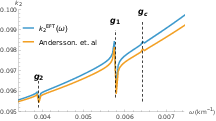
Figure 5: Dynamical tidal response near resonant frequencies for g-modes in a BSk model, comparing EFT-derived k2(ω) and previous approaches.
Both g- and f-mode resonances are closely reproduced, with modest corrections in the regime most relevant for gravitational-wave observations.
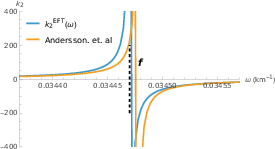
Figure 6: Detailed comparison of tidal response near the dominant f-mode; EFT results track the analytically determined QNM frequency closely.
For more massive neutron stars, the alignment with the expected QNM frequency improves further, mitigating systematic offsets observed in previous analyses.
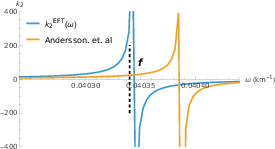
Figure 7: Comparison near f-mode for M=1.98M⊙, R=12.59 km, highlighting improved resonance alignment in the EFT model.
Low-frequency behavior demonstrates convergence to the static Love number and eliminates systematic deviations evident in older models.
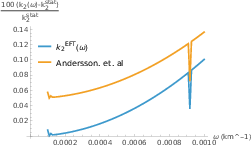
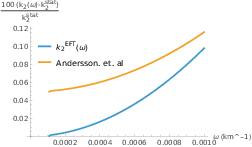
Figure 8: Low-frequency percent deviation of k2(ω) from static Love number for two stellar models; significant reduction of systematic error in EFT model.
A key numerical result is the robust extraction of the imaginary part of the f-mode from the resonance pole in the scattering phase. For three stellar models, the imaginary frequency matches direct mode solver results to within <0.002% error, representing a notable improvement over prior methods and validating the full matching construction.
Practical and Theoretical Implications
The framework allows for immediate import of the frequency-dependent tidal response into PN/EFT-based binary dynamics, yielding waveform models that can systematically incorporate dynamical tidal effects beyond the adiabatic approximation or single-mode assumption. It also provides explicit prescription for improving the response via higher-order diagrams, including tail and loop corrections. The formalism is adaptable for incorporating additional physics such as spin, viscous dissipation, exotic EOS, and even dark matter-admixed stars.
The results clarify the theoretical status of tidal response definitions in general relativity, avoiding gauge ambiguities and connecting directly with observable scattering phases. This advances precision waveform modeling and parameter inference for next-generation gravitational-wave detectors, with the potential to constrain dense matter physics and probe phase transitions or the existence of exotic compact objects.
Conclusion
The paper develops a gauge-invariant, systematically improvable frequency-dependent model for the dynamical tidal response of neutron stars within the WEFT framework, matched analytically and numerically to relativistic stellar perturbation theory via MST solutions. The construction recovers static and resonant responses accurately, reduces systematic modeling errors, and delivers a robust prescription for direct import into gravitational-wave binary models. The numerical results confirm improved alignment with expected quasinormal mode frequencies and excellent reproduction of damping rates. Future directions include incorporation of higher-order corrections, viscous dissipation, and spin effects, with implications for both precision theory and advanced gravitational-wave astrophysics (2606.14405).

