- The paper presents an enhanced SIDM simulation incorporating radiative dissipation to reveal a sub-linear, accelerated collapse in halo cores.
- It extends the fSIDM N-body scheme, validated with fluid models, to accurately capture the interplay of cooling and conduction in dark matter halos.
- Findings indicate that dissipative processes lower the required interaction cross-sections, impacting dark matter phenomenology and lensing signatures.
Gravothermal Evolution of Dissipative Self-Interacting Dark Matter Halos
Introduction and Motivation
The gravothermal evolution of self-interacting dark matter (SIDM) halos has taken on increased importance as both direct and indirect astronomical probes expose detailed properties of dark matter (DM) in astrophysical systems. A range of SIDM models predicts not only elastic self-interactions, leading to heat conduction within halos, but also radiative, energy-dissipating processes mediated by light dark-sector particles. The consequence of these processes—gravitational contraction, core formation, and catastrophic collapse—remains a central focus, especially given observational hints for compact halo objects, such as the lens perturber in JVAS~B1938+666. This work presents a systematic study of the interplay between cooling and conduction in isolated DM halos with both elastic and dissipative frequent self-interactions, extending both the N-body and fluid modeling tools for SIDM microphysics.
The central methodological development is the extension of the fSIDM (frequently self-interacting dark matter) N-body scheme to include radiative dissipation. This scheme, based on an effective drag and stochastic diffusion induced by frequent small-angle scatterings, is generalized to account for energy lost as radiation (e.g., dark photon bremsstrahlung or bound state de-excitation), leading to an enhancement of the drag term and incomplete kinetic energy restoration in each simulated collision. The dissipation is parametrized by a dimensionless rdiss>1, with the local cooling rate scaling as C(ρ,ν)∝σT/mχ(rdiss−1) and heat conduction as ∝σT/mχrdiss.
This formulation is implemented in OpenGadget3 and validated numerically in non-gravitating, homogeneous box tests, demonstrating sub-percent deviations from theoretical prediction in both cooling-only and cooling–conduction regimes.
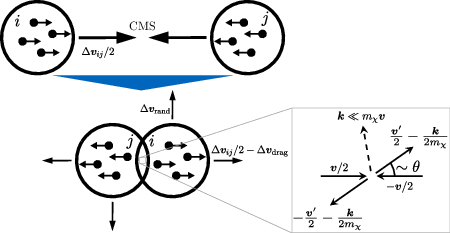
Figure 1: Schematic illustration of the numerical implementation of frequent, dissipative dark matter scattering, combining drag, stochastic kicks, and energy dissipation.
Gravothermal Evolution: Numerical Results
Isolated Navarro-Frenk-White (NFW) halos are simulated with a range of cross sections σT/mχ and dissipation parameters rdiss. Comparative runs at fixed initial cooling and fixed conduction are presented, together with supportive gravothermal fluid model calculations calibrated directly on non-dissipative N-body results.
Accelerated Collapse Under Dissipation
Introducing dissipation directly modifies the evolutionary timescales for core formation and collapse. For fixed heat conduction, increasing the cooling rate (i.e., increasing rdiss at fixed σT/mχrdiss) results in a rapid, sub-linear decrease in both core-formation and collapse times—by up to two orders of magnitude for the strongest dissipative models considered. This relationship is quantitatively described by a stretched exponential fit, substantiating that the timescales are far more sensitive to dissipation than to N0 alone.
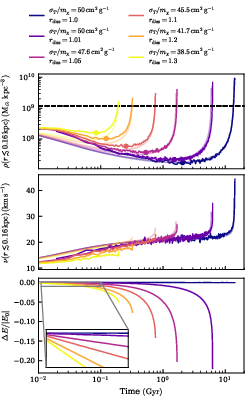
Figure 2: Time evolution of central density, velocity dispersion, and total dissipated energy for a set of halos with increasing dissipation strength.
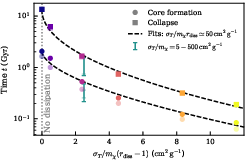
Figure 3: Collapse (squares) and core formation (circles) times as a function of dissipation strength, showcasing the steep, non-linear dependence on cooling rate.
Modification of Core Structure
The presence of dissipation qualitatively alters the character of the core. Even weak radiative losses suppress the formation of an isothermal core; as dissipation increases, the core remains colder, denser, and more compact, and the profile never achieves the isothermality characteristic of purely conductive SIDM. Dissipation-driven cores exhibit persistently positive velocity-dispersion gradients at the center, a robust identification signal for dissipative microphysics.
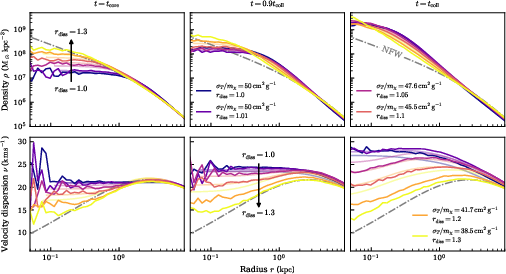
Figure 4: Density and velocity dispersion profiles at key evolutionary times for a range of dissipation strengths, highlighting increasingly compact and non-isothermal core structure with stronger cooling.
Interplay of Conduction and Dissipation
When the cross section is varied at fixed initial cooling, the evolution time exhibits a non-monotonic trend, rooted in the physics of heat conduction: conduction is maximized at intermediate N1, and either lower or higher cross section suppresses heat flow (LMFP and SMFP regimes, respectively). Increased heat conduction counteracts cooling, delaying collapse and producing a more extended, lower-density core. This is in stark contrast to the role of conduction in non-dissipative halos, where it triggers gravothermal collapse via core overheating.
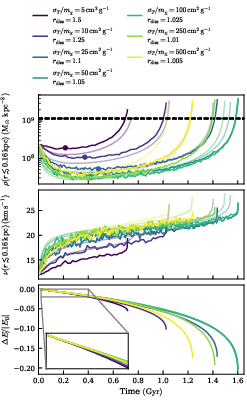
Figure 5: Central density, velocity dispersion, and energy histories for fixed cooling and variable cross section, displaying the subtler and non-monotonic schedule of collapse driven by thermal conduction efficiency.
Energy Transport and Projection to Observables
The physical origin of the dynamical changes is clarified by decomposing the energy flow within the halo into cooling, conduction, and mechanical work. In dissipative halos, dissipation always dominates the energy loss in the central region, and conduction acts as a compensatory inward flux rather than a driver of core expansion. In elastic SIDM, by contrast, conduction reverses sign to become an outward flow during the collapse phase.
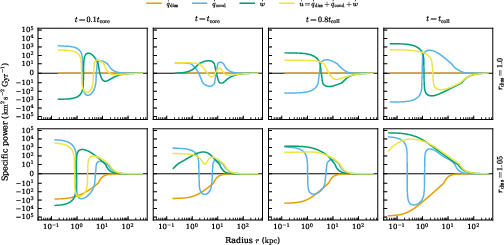
Figure 6: Radial profiles of specific power due to dissipation, conduction, and mechanical work for both elastic and dissipatively-evolving halos across different evolutionary phases.
The observable implications of this modified evolution are assessed through projected quantities relevant to strong lensing analyses, notably the enclosed 2D mass and the logarithmic surface-density slope. Dissipative halos generically maintain larger central mass concentrations over a broader range of radii and do not produce the characteristic "indentations" (mass deficits) between core and outer halo seen in the elastic case.
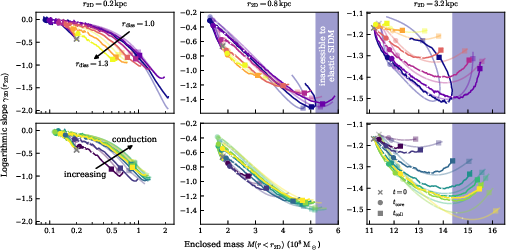
Figure 7: Evolutionary tracks in the plane of projected enclosed mass and surface-density slope at representative radii during halo evolution for varying dissipation and conduction.
Implications for Compact Lensing Objects
Applying this model to the mass profile inferred for the lens perturber in JVAS~B1938+666, the analysis demonstrates that both elastic and weakly dissipative SIDM scenarios can match the observed steep, compact mass distribution if appropriate initial concentration and evolutionary time are chosen. Dissipative evolution reduces the required self-interaction cross section and/or the needed halo concentration by a factor of up to two. The observed structure can thus be realized in smaller cross section parameter space or through shorter evolutionary times, relaxing constraints on the microphysics of DM.
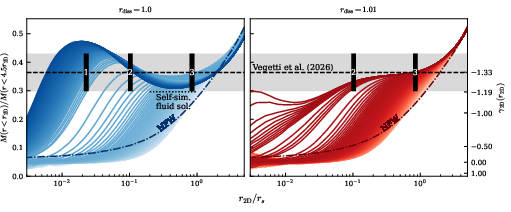
Figure 8: Ratios of projected enclosed mass as a function of scaled radius for simulated elastic and dissipative halos; compatibility with the lensing-inferred range for JVAS~B1938+666 is evident for a range of N2.
Theoretical and Practical Implications
The results underline the necessity of including dissipative processes in simulations and analytic treatments of SIDM with plausible radiative channels. The presence of even a weak dissipation rate qualitatively alters both the phenomenology and the mapping from microphysics to astrophysical observables. Classic fluid models suffice for approximate qualitative insight in most regimes but require calibration of conduction parameters from simulations, especially in dissipative or non-isotropic situations.
Practically, this implies that constraints on N3 derived from halo density profiles or lensing signatures may significantly underestimate the viable parameter space in the dark sector when neglecting dissipative effects. The formalism developed here is directly applicable to a wide range of dark-sector extensions, including atomic DM, mirror sector scenarios, or models with excited-state decay channels.
Theoretically, the work demonstrates that the morphology and evolutionary timescales of compact halo objects offer a sharp probe of dark-sector interactions and that nontrivial evolutionary tracks—lacking isothermal cores and outward mass redistribution—should be sought in both observations and simulations. The angular dependence of scattering, generally subdominant for the evolution of isolated halos, may become more important in cases involving mergers or substructure.
Conclusion
This study substantiates, through new algorithmic extensions and systematic simulation, that radiative dissipation strongly affects the gravothermal fate of isolated SIDM halos—modifying evolution times, core structure, and the signature in projected observables in a manner not directly degenerate with traditional conduction-driven scenarios. The results open new directions for both astrophysical modeling and the interpretation of compact halo, lensing, or stream perturbation data in the context of dark-sector microphysics. Cosmological simulations incorporating full dissipative SIDM dynamics will be essential for setting robust constraints on this parameter space and for elucidating the possible dark origins of observed compact lensing objects.
Reference: "Cooling, conduction, compact objects: Gravothermal evolution of dissipative self-interacting dark matter halos" (2606.19428)

