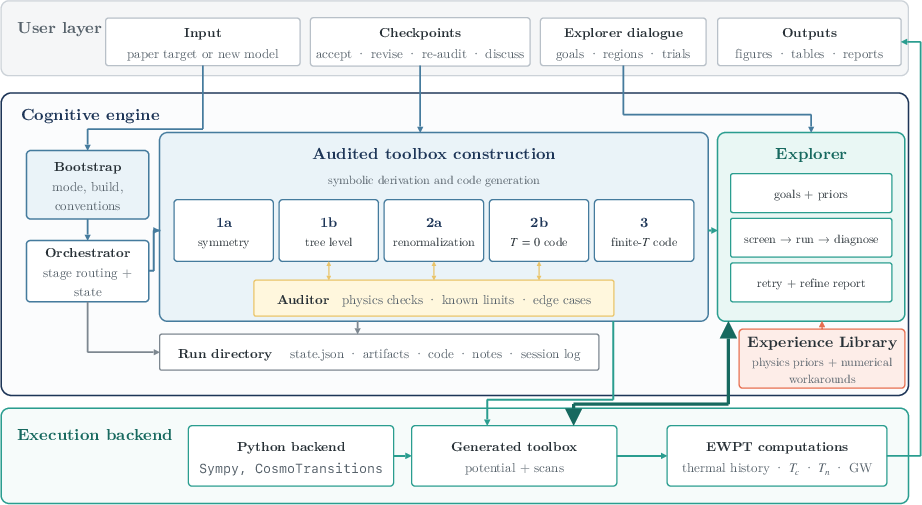
- The paper presents LeWRON, a novel agentic framework that automates EWPT computations from Lagrangian inputs to benchmark validations with reproducibility below 1% error on select models.
- The framework employs a dual-stage approach combining CAS-assisted symbolic manipulation with numerical exploration, supplemented by human-controlled checkpoints for analytic consistency.
- LeWRON supports both reproduction of known models and discovery of novel BSM scenarios, thereby strengthening tests of baryogenesis and gravitational-wave signature predictions.
Agentic Analysis Framework for Electroweak Phase Transitions: LeWRON
Motivation and Background
The electroweak phase transition (EWPT) is a pivotal cosmological process for connecting the Standard Model (SM) and Beyond the Standard Model (BSM) extensions with baryogenesis and gravitational-wave signatures. Analysis of EWPTs encompasses complex, convention-sensitive, and model-dependent computational workflows, from deriving finite-temperature effective potentials and mass spectra, through bubble nucleation and tunneling calculations, to predictions for gravitational-wave observatories. Unlike collider phenomenology, where standardized tools (e.g., run-card-based simulators) streamline processes, EWPT computations remain fragmented and demand extensive manual intervention, particularly for novel BSM scenarios.
Architecture and Design Principles
LeWRON (Learning ElectroWeak phase tRansitiON) is introduced as a domain-specialized, agentic framework capable of orchestrating EWPT analyses from an input Lagrangian to computational and visualization outputs. The architecture is organized into audited toolbox construction (for symbolic and analytic derivations) and an Explorer module (for numerical scans and phenomenological exploration). The design enforces:
Computational Pipeline and Physics Ingredients
LeWRON's core pipeline decomposes EWPT analysis into:
- Background field identification and tree-level physics: Automatic elimination of nonphysical directions (e.g., gauge-fixed Goldstones, charge-breaking sectors) and derivation of mass spectra, analytic parametrizations, and constraint enforcement (bounded-from-below, global minimum, non-tachyonic conditions).
- Zero-temperature one-loop effective potential: Implementation of Coleman-Weinberg corrections with automated counterterm derivation, ensuring consistency of vacuum and mass conditions at one-loop.
- Finite-temperature analysis: Incorporation of thermal masses and user-selectable resummation schemes (default: Parwani, optional: Arnold-Espinosa, improved Parwani, partial-dressing). Crucially, LeWRON maintains reproducibility across these conventions, detecting and reporting implementation subtlety (e.g., IR divergences, symmetry-protected directions).
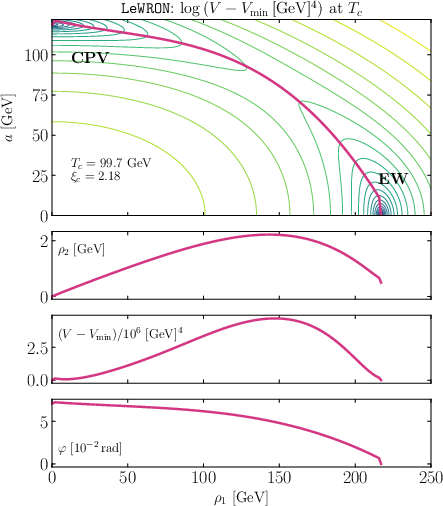
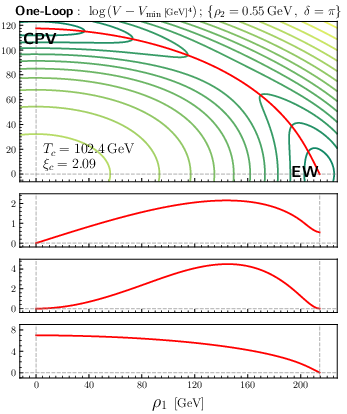
Figure 2: LeWRON's reproduction of benchmark potential analysis as cross-validation against literature, illustrating consistency and convention translation capabilities.
Validation Examples and Numerical Benchmarking
LeWRON was systematically validated in both reproduction and discovery modes:
- Reproduction mode: LeWRON successfully recovers nucleation temperatures and critical parameters for Z2-symmetric singlet scalar models and complex multi-Higgs scenarios (e.g., 2HDM+a) with agreement to published values at or below 1% error. Residual discrepancies are traceable to missing parameter details in referenced works.
- Discovery mode: LeWRON demonstrates fully agentic analysis of models not available in previous literature, such as the ALP-Higgs scenario and 2HDM+S extension. In the ALP-Higgs case, LeWRON automatically enforces correct renormalization prescriptions and computes tunneling actions even for numerically challenging, MeV-scale ALPs. In 2HDM+S, it enables comparative thermal history analysis under different resummation schemes, revealing qualitative differences in phase transition structure.
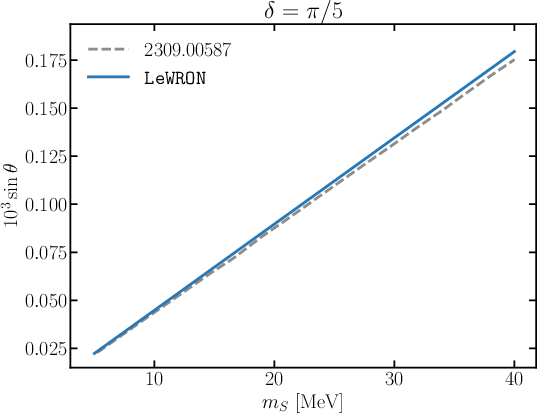
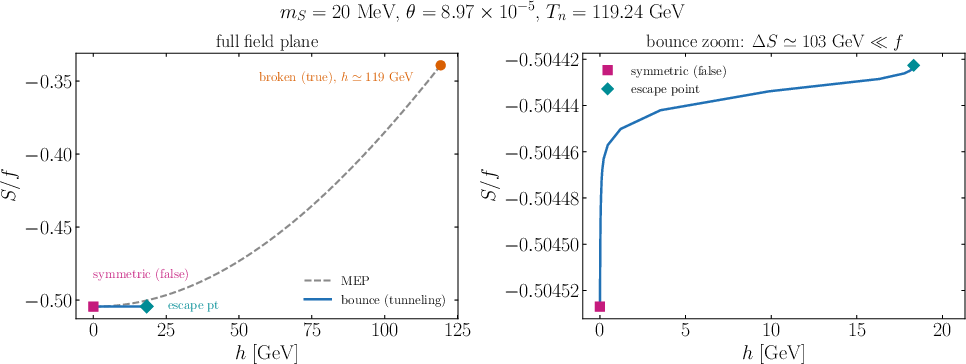
Figure 3: Tunneling action and parameter space scans for the ALP-Higgs model; agentic derivation enables reliable nucleation boundary computation and direct path visualization.
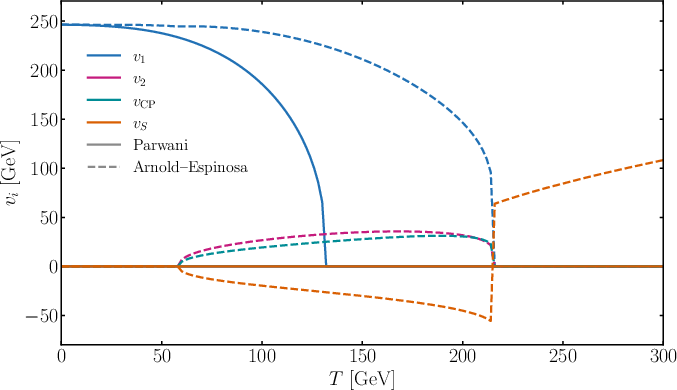
Figure 4: Thermal history traces of 2HDM+S with both Parwani and Arnold-Espinosa resummation, demonstrating the agent's sensitivity to physics conventions and automatic scenario disambiguation.
Implications, Limitations, and Outlook
Practically, LeWRON provides a reproducible, agent-audited pathway for EWPT analysis, minimizing stochastic convention drift and enabling interactive or automated exploration of BSM landscapes. Theoretical implications include more robust testing of baryogenesis scenarios, gravitational-wave signatures, and cross-model comparisons via standardized workflows. Agentic checks embedded in intermediate artifacts enhance physics transparency and reproducibility, which are critical for downstream observational validation.
Current limitations include the absence of bubble-wall velocity computation (an open field with significant analytic and numerical challenges), restriction to four-dimensional one-loop effective potential, and coverage limited to SM Higgs-driven EWPTs. Expansions to left-right symmetric, supersymmetric, and dark-sector scenarios are delineated as future directions, contingent on extension of the agentic workflow and inclusion of more generalized effective-theory frameworks.
Conclusion
LeWRON constitutes a modular, agentic toolkit that harmonizes analytic, symbolic, and numerical stages of EWPT analysis. Its architecture facilitates convention consistency and model-specific reproducibility, validated across both benchmark reproduction and novel discovery tasks. The system is released as a public Python package and command-line tool, supporting modular incorporation into external pipelines and interactive physics checkpoints. Its future development will address broader model classes and analytic extensions beyond four-dimensional one-loop effective potentials, opening new avenues for automated, reproducible cosmological model analysis.