- The paper introduces RNG-Bench, a benchmark isolating belief-state tracking challenges in non-Markov interactive tasks.
- It employs two diagnostic games—Matching Pairs and 3D Maze—to quantify how memory demands and forgetting affect MLLM performance.
- Experiments reveal that external memory interventions and explicit action traces significantly improve outcomes in complex, memory-dependent tasks.
Evaluating Multimodal LLMs in Controllable Non-Markov Games: RNG-Bench
Motivation and Benchmark Regime
RNG-Bench addresses the critical gap in assessing multimodal LLMs (MLLMs) for interactive, closed-loop tasks where historical evidence, no longer observable, must be reconstructed to inform current actions. Prior benchmarks either expose the full state, conflate hidden-state reconstruction with exploration and planning, or test recall only post-episode. The regime targeted here is fundamentally non-Markov: action selection is causally dependent on in-context memory, and forgetting earlier observations propagates through episode dynamics (Figure 1).
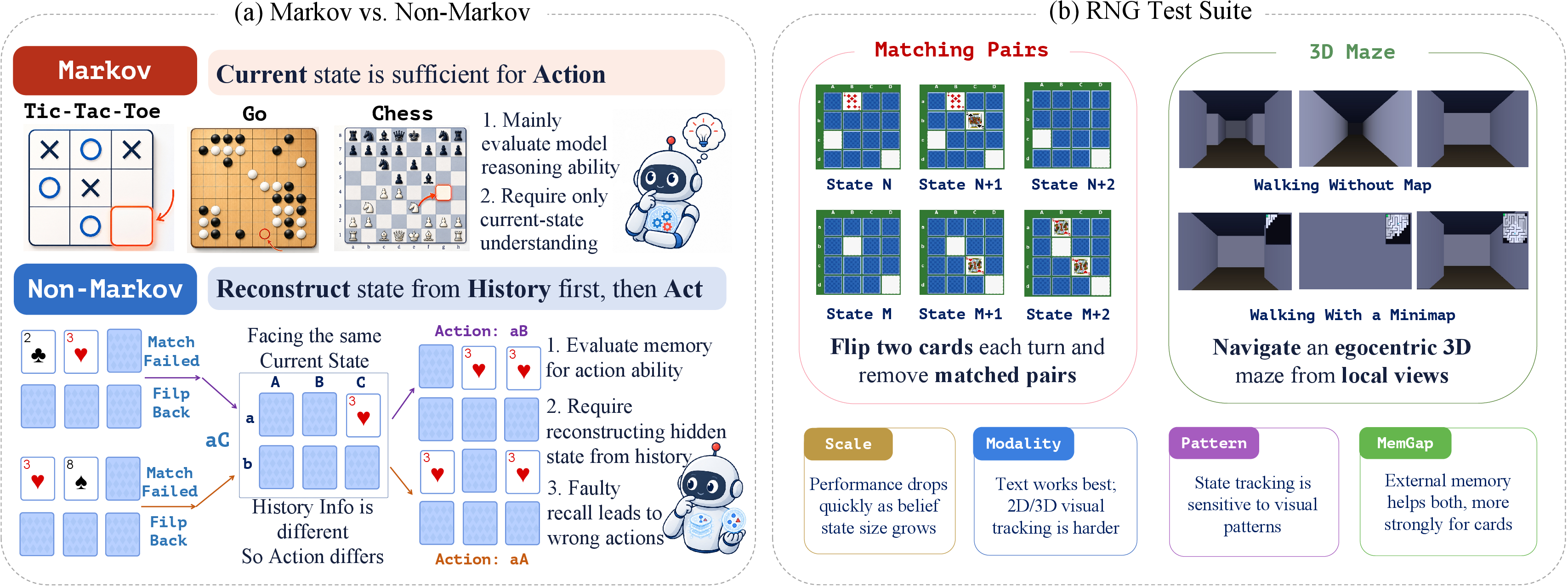
Figure 1: Markov games versus RNG-Bench; the latter requires history-dependent reasoning and exposes evaluation along scale, visual pattern, and modality, plus a Memory Gap diagnostic.
Benchmark Design: Controlled Non-Markov Games
RNG-Bench instantiates two complementary diagnostic environments for belief-state tracking:
- Matching Pairs: A grid-based card matching game, where each card identity is revealed once then hidden, creating a static, categorical hidden state. The agent must remember identity-location bindings from prior turns.
- 3D Maze: An egocentric navigation task, requiring integration of sequential views to infer the global layout, demanding ongoing spatial belief updates.
Both games are evaluated under a unified framework with controlled axes: grid/map size (hidden state scale), visual pattern, and observation modality (text/image/3D). Rules and formatting are fixed, localizing difficulty to memory demands rather than perception or rule comprehension (Figure 2).
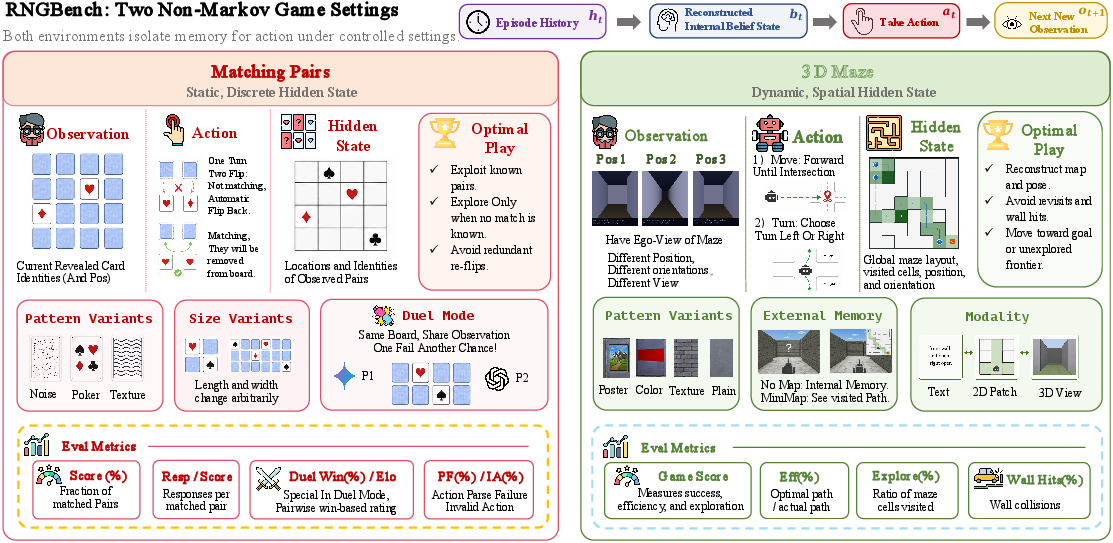
Figure 2: Matching Pairs isolates static memory; 3D Maze isolates dynamic spatial belief construction. Both environments provide fine-grained control and diagnostics for hidden-state tracking.
To disentangle forms of error, a Memory Gap metric is introduced, quantifying the difference in performance between standard and oracle (ground-truth state-injected) conditions. This distinguishes failures in belief-state maintenance from action selection or planning.
Experimental Results and Diagnostic Analyses
Main Findings
- Performance Headroom and Bottleneck Localization: Frontier MLLMs (GPT-5.4, Gemini-3.1-Pro, Qwen3.5-397B) exhibit substantial unsaturated headroom. GPT-5.4 achieves 62.3% matched pairs at 10×10 in Matching Pairs, Gemini-3.1-Pro attains 50% success rate (SR) in 13×13 3D Maze, with others trailing (Figure 3).
- Action Selection vs. Forgetting: The Memory Gap analysis consistently attributes residual errors to forgetting previous observations rather than suboptimal actions given the correct latent state.
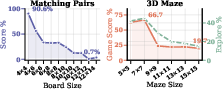
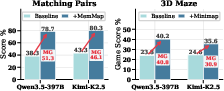
Figure 3: Scores fall sharply as hidden state grows; matching pairs decline from 4×4 to 12×14, and maze performance decays at larger scales, localizing the bottleneck to memory.
- Modality and Visual Pattern Effects: Text-only modalities dominate image-based settings (Table: Tab.~\ref{tab:rq2_modality}); visual recognition capacity is a limiting factor. Matching Pairs with symbolic text yields near-perfect scores, whereas noise-pattern images induce sharp decline.
- Action Trace as Belief Carrier: Removing explicit action-history text collapses Matching Pairs performance to near random choice, despite board images encoding all changes. This highlights that explicit textual traces function as essential, load-bearing channels for belief-state updates.
Ablative and Intervention Analyses
- External Memory Interventions: Supplying oracle memory maps nearly doubles Matching Pairs scores, but recovers less in 3D Maze, further implicating spatial navigation as coupling memory with planning (Figure 4).
- Minimap and Ask-Output Prompting: 3D Maze success rate improves with minimap and explicit map-output asking, but benefit is model-dependent and not uniformly observed.
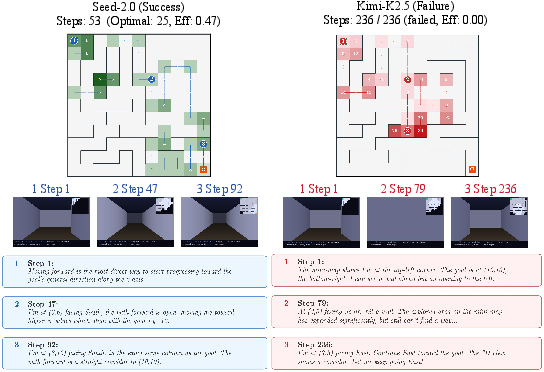
Figure 4: External memory interventions substantially reduce the Memory Gap in Matching Pairs but are less effective for 3D Maze, indicating additional planning or spatial reasoning constraints.
- Duel Protocol Robustness: Match outcomes differ from single-agent ranking; Gemini-3.1-Pro leverages opponent-revealed information more efficiently, confirming strategic robustness.
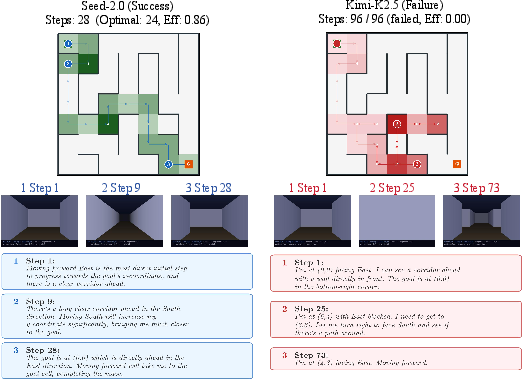
Figure 5: Contrasting successful spatial grounding to failure modes in baseline 3D Maze trajectories; spatial drift and oscillation dominate unsuccessful runs.
Supervised Fine-Tuning and Cross-Benchmark Transfer
Fine-tuning Qwen3.5-9B on optimal-policy rollouts and filtered demonstrations yields measurable gains in RNG-Bench performance and shows transfer to external episodic memory and spatial benchmarks. Notably, general multimodal capability persists without regression (Table: Tab.~\ref{tab:qwen9b-external-transfer}). The rollout component augments recovery states absent from mistake-free oracle trajectories.
Implications for MLLM Architecture and Evaluation
Theoretical Implications: The results concretely demonstrate that long-horizon, non-Markov environments expose the capacity of MLLMs not just for recall, but for belief-state construction and maintenance. Memory bottlenecks sharply limit performance even at moderate latent state scales, and success is contingent on a model's explicit action-history encoding and robust visual binding.
Practical Implications: Deployment of MLLMs for embodied control or sequential tool-use must account for in-context state tracking failure modes. Architectural improvements for visual perception, spatial reasoning, and belief-state grounding are necessary. Evaluation benchmarks must include interactive, closed-loop non-Markov settings rather than static recall or fully observable games.
Future Directions: Prospects include broader game genres with controllable visual/perceptual complexity, richer modalities (audio/video), more sophisticated intervention protocols (e.g., external memory, scratchpads, recoverable belief modules), and hierarchical state tracking. Integration of RL-based adaptation and verifiable reward modeling may also improve performance on tasks requiring dynamic memory access.
Visualizations and Case Studies
Single-player and duel trajectories demonstrably reveal belief-state dynamics: plateaus and late jumps in Matching Pairs indicate integration of memory; spatial drift and oscillation in 3D Maze are diagnostic of failed spatial belief construction (Figures 7 and 8).
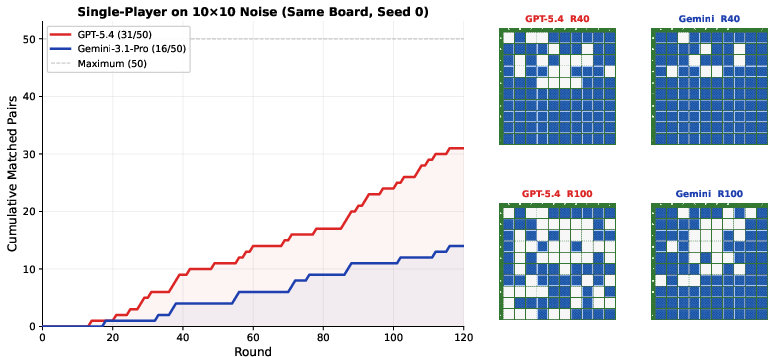
Figure 6: Single-player Matching Pairs trajectories demonstrate late-stage belief-state consolidation by GPT-5.4 versus plateaued performance by Gemini-3.1-Pro.
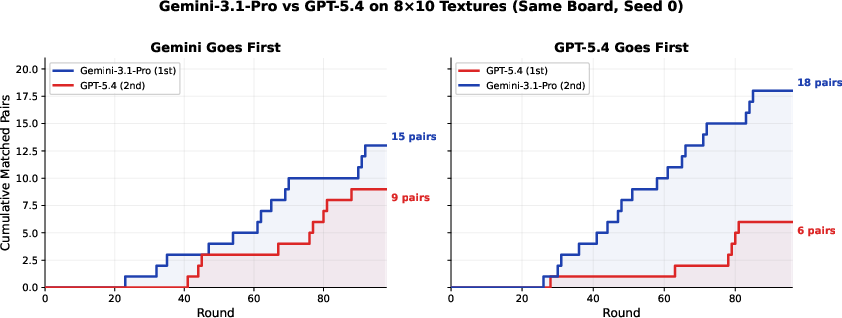
Figure 7: Duel trajectories confirm robust memory use by Gemini-3.1-Pro across both player orders, exploiting opponent-exposed card identities.
Conclusion
RNG-Bench rigorously isolates belief-state tracking as a central bottleneck in multimodal LLMs for non-Markov, interactive tasks. The suite establishes performance baselines, diagnostic protocols, and actionable intervention pipelines, showing that model capacity collapses with hidden-state scale and visual complexity. External memory or action traces are necessary but not sufficient for robust performance. Fine-tuning strategies offer partial mitigation and transfer, but architectural innovation is needed to advance latent state reasoning in future MLLMs.