- The paper demonstrates that anchored feature parameterizations decouple landmark linearization from the unobservable subspace, leading to more consistent EKF-VINS.
- Monte-Carlo and real-world experiments show that anchored approaches yield lower RMSE and controlled error growth compared to global representations.
- Consistency methods like FEJ and RI-EKF effectively manage navigation state linearization, reducing estimator divergence under high noise conditions.
Observability and Consistency with Anchored Feature Parameterizations in Visual-Inertial Navigation
Introduction
Visual-inertial navigation systems (VINS) play a pivotal role in state estimation for robotics and autonomous platforms operating in GPS-denied contexts. Ensuring estimator consistency—where uncertainty estimates reflect the true estimation error—is critical for both reliable navigation and for downstream tasks such as SLAM, motion planning, and data association. The research analyzes the observability and consistency properties of EKF-based VINS employing anchored feature parameterizations, elucidates their impact on the filter's unobservable subspaces, and presents practical implications for estimator design.
Mathematical Analysis of Observability
The fundamental insight of the analysis is that the unobservable subspace of a VINS employing anchored feature parameterizations is independent of the landmark state. This is in contrast to global feature parameterizations, where the unobservable subspace depends explicitly on the feature states. The nullspace characterization, derived through local observability matrix construction, demonstrates that anchored parameterizations mitigate spurious information gain resulting from landmark linearization point changes. However, the navigation state linearization point can still perturb the true unobservable subspace, necessitating additional consistency enforcement.
Anchored representations define feature positions relative to an anchoring camera pose rather than in a global frame. The measurement Jacobian structure and the propagation of state and feature covariances reflect this locality, as demonstrated in the detailed block matrix derivations of observability.
Consistency Methods for Anchored Representations
The paper contrasts two principal classes of consistency-improving techniques in this context:
- First-Estimate Jacobian (FEJ): In the anchored setting, FEJ need only be applied to navigation states, since the unobservable subspace loses dependence on landmark linearization points. This enables more accurate, flexible linearization of landmark-related Jacobians, particularly beneficial under poor feature initialization and high observation noise.
- Right-Invariant EKF (RI-EKF): The right-invariant approach, which defines errors on the matrix Lie group, can fully decouple the effect of changes in the estimated state from unobservable directions—rendering the estimator fundamentally consistent when using anchored features.
This theoretical development establishes that for anchored feature representations, even an unmodified EKF exhibits significantly improved consistency relative to global feature formulations, restricting most inconsistency to residual effects of navigation state linearization.
Monte-Carlo Simulation Results
Extensive Monte-Carlo simulations are performed on multiple trajectories and across varying pixel noise levels. The simulations demonstrate:
- Anchored feature representations consistently yield lower RMSE and ATE across all noise regimes compared to global representation variants.
- At high observation noise (σp=4 px), global parameterizations (Std-G3D) result in catastrophic estimator breakdown, whereas all variants of anchored inverse-depth (AID) maintain controlled error growth.
- The NEES metric, critical for quantifying estimator consistency, shows that Std-AID nearly matches FEJ-AID and RI-AID for shorter durations and controlled noise, and only marginally degrades on very long trajectories, retaining much better consistency than Std-G3D.
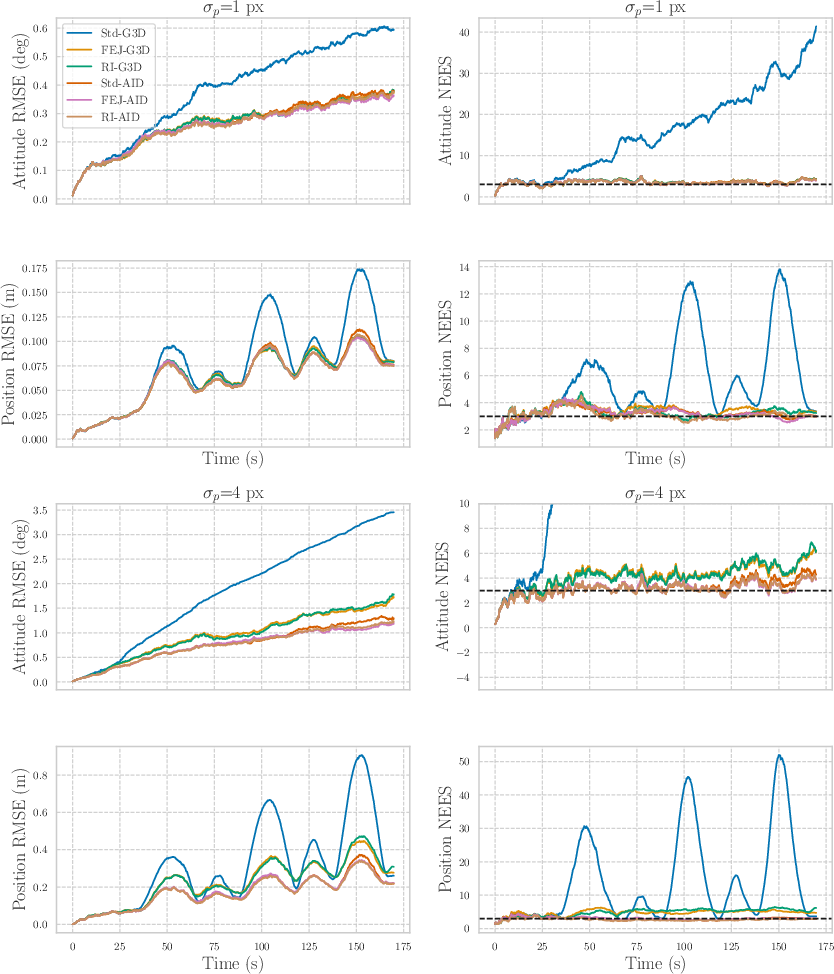
Figure 1: Orientation and position RMSEs and NEES over time averaged over 50 Monte-Carlo trials for each estimator and noise level.
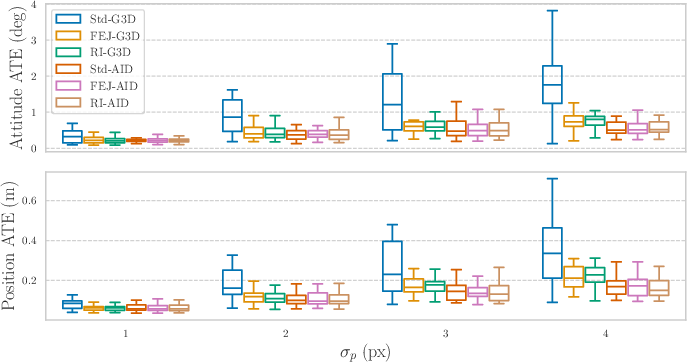
Figure 2: Distribution of position and orientation ATEs per estimator on simulated trajectory across noise levels.
Real-World Experimental Validation
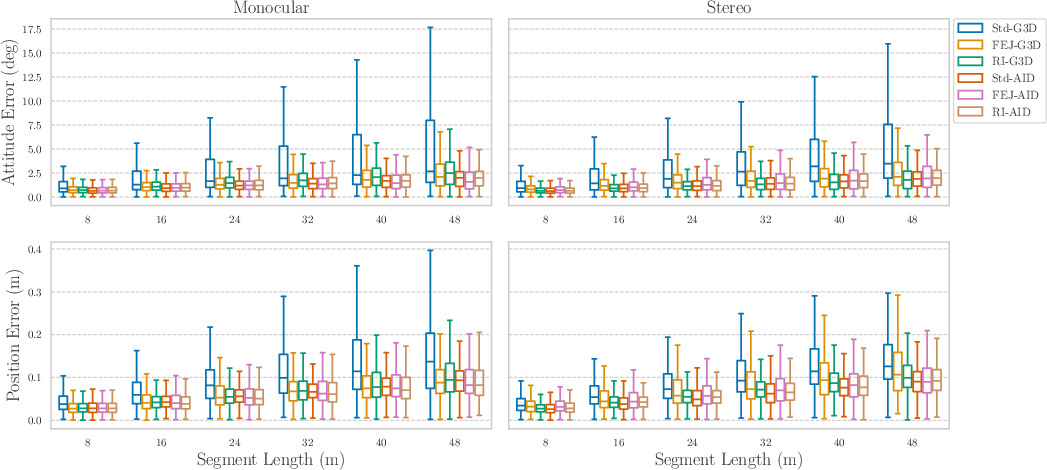
Validation on sequences from the TUM-VI dataset—covering both monocular and stereo configurations and various scene complexities—corroborates simulation results:
Implications for Estimator Design
The results have several implications for the design and deployment of resource-efficient, consistent VINS:
- Anchored feature parameterizations should be the default design choice in filtering-based VINS, particularly in scenarios with poor feature initialization or high measurement noise.
- Consistency improvement techniques such as FEJ and right-invariant error definitions offer marginal additional gains in the anchored setting. In practice, their application can be restricted to the navigation block, simplifying filter implementation and reducing computational overhead.
- The analysis indicates that, for global parameterizations, inconsistency predominantly arises from landmark linearization mismatch. Anchored representations effectively neutralize this, isolating the navigation state as the remaining source of inconsistency.
Theoretical and Practical Impact
The theoretical characterization of unobservable subspaces supports robust estimator design, offering a principled approach to avoid overconfidence and estimator divergence. Practically, the findings enable more flexible VINS deployment, especially in low-SNR or high-drift contexts, such as planetary robotics, search-and-rescue, or miniature embedded platforms.
Anticipated directions for future work include:
- Extending observability and consistency analysis to optimization-based VINS with anchored features, which promises even further accuracy improvements under challenging operating conditions.
- Systematic evaluation of other non-Euclidean anchor parameterizations for higher-level SLAM and multi-sensor fusion.
Conclusion
This work provides a definitive analysis of observability and consistency in filter-based VINS with anchored landmarks, demonstrating substantial and robust gains in estimator reliability. The independence of the unobservable subspace from feature states removes the necessity for frequent and possibly inconsistent relinearization of landmarks, yielding estimators with improved accuracy and reliable uncertainty quantification. These findings directly inform the next generation of VINS and related estimation architectures for robust autonomy.