- The paper introduces AGDN, which integrates a MixScore transition matrix with anisotropic graph diffusion to enhance TSP solution quality.
- It employs multi-hop, direction-aware propagation that overcomes common GNN limitations like over-smoothing and over-squashing.
- Empirical results demonstrate up to an 82% reduction in optimality gap and faster inference across various TSP benchmarks.
AGDN: Anisotropic Graph Diffusion Networks for Combinatorial Optimization on TSP
Introduction
The paper presents Anisotropic Graph Diffusion Network (AGDN), a novel graph neural network (GNN) framework designed for high-performance learning-based solutions to the Traveling Salesman Problem (TSP). Key deficiencies of prior GNN approaches on TSP are analyzed, particularly their reliance on sparsification of fully connected TSP graphs. This process often results in the disconnection of node pairs belonging to the optimal tour, thus impeding representation learning pertinent to global solution quality. AGDN introduces an informative topological prior via a MixScore transition matrix and an anisotropic graph diffusion mechanism, enabling multi-hop and direction-aware information propagation. This architecture circumvents the standard trade-offs of over-smoothing and over-squashing, supporting effective learning without discarding critical long-range information.
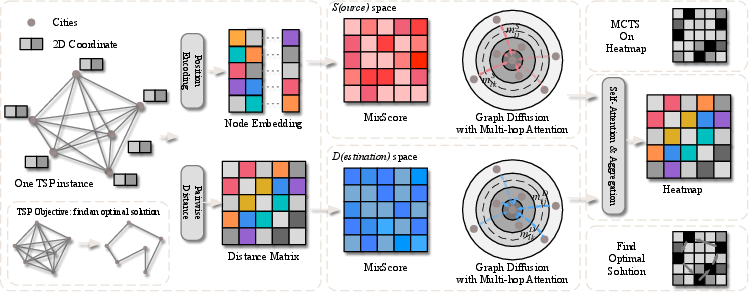
Figure 1: Overview of the AGDN pipeline, including MixScore computation, anisotropic information propagation, directional node embedding, and MCTS-based solution retrieval.
Methodology
MixScore Transition Matrix
AGDN fundamentally departs from classical GNNs by employing a fully connected, distance-aware transition matrix, encoding both node similarity and Euclidean distances. The MixScore matrix incorporates learned incoming and outgoing node embeddings, capturing directionality and structural affinity between nodes. The formulation integrates a normalized row-stochastic matrix and MLP-projected node features from distinct directions, producing a directional, continuous-valued propagation kernel. Unlike binary adjacency after k-NN sparsification, the MixScore matrix enables smooth multi-scale aggregation and dense retention of high-capacity structural priors. Empirically, this results in continuous-valued edge weightings rather than brittle, binary sparsified graphs.
Anisotropic Multi-hop Graph Diffusion
The core message passing is based on spectral diffusion, with multi-hop attention controlled by learnable PageRank-inspired coefficients. AGDN applies anisotropic graph diffusion: incoming and outgoing transitions are decoupled and learned separately, providing node representations that are sensitive to directionality in edge traversals. This approach supports parallel propagation of higher-order neighborhood information in a single layer, directly addressing the inefficiencies observed in stacking many shallow GNN layers, which is common in prior architectures. The model's architectural design thus substantially increases granularity and capacity for modeling routing structures.
Directional node embeddings from both anisotropic spaces are fused using self-attention, forming final node representations. Edge probabilities are then predicted through an attention mechanism and a shallow MLP, resulting in an n×n edge heatmap. This heatmap indicates the likelihood of each edge participating in the optimal tour. Monte Carlo Tree Search (MCTS) is executed on the heatmap to retrieve high-quality TSP solutions, decoupling the neural generative process from explicit tour construction.
Theoretical Properties
The paper provides a formal analysis of the diffusion distances under anisotropic MixScore—showing that simultaneous forward and backward gradient steps along these transition matrices contract the diffusion distance between relevant nodes. This analysis leverages extensions of spectral graph theory and directional propagation, establishing that bi-directional gradient-based updates promote rapid merging of related node representations, thus accelerating and stabilizing long-range dependency learning.
Empirical Results
AGDN is benchmarked against a comprehensive suite of optimization routines including exact solvers (Concorde, LKH-3), classical and advanced GNNs (GatedGCN, Att-GCN, DIFUSCO), and leading neural combinatorial optimizers (DIMES, UTSP, POMO+EAS-Emb, etc.) under both supervised and unsupervised learning regimes. Datasets span Euclidean TSPs of size n=100 to n=1000, with extensive checks for generalization across varying node counts, distributions (Uniform, Cluster, Explosion, Implosion), and on real-world TSPLIB benchmarks.
AGDN exhibits superior optimality gap (often less than 1% from ground truth on TSP-1000), and—in all evaluated unsupervised and supervised regimes—produces best or nearly-best results among all learning-based models. The performance gap versus GatedGCN is substantial, e.g., 1.28% vs 7.26% gap on TSP-1000. The framework shows robust generalization to out-of-distribution node setups and large-scale instances and outperforms prior models on TSPLIB real-world graphs.
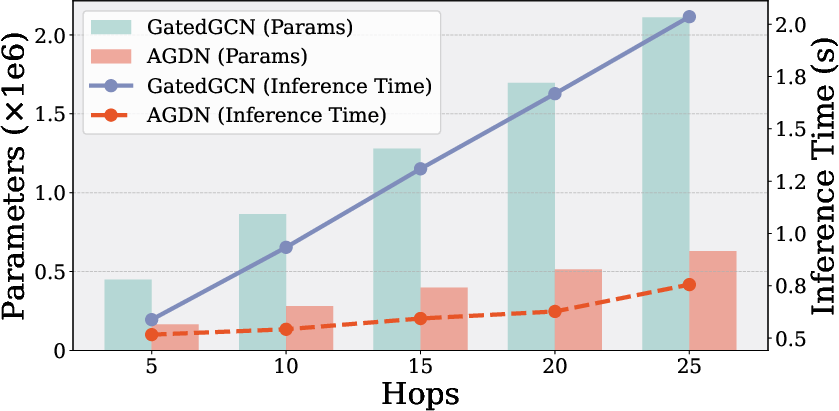
Figure 2: AGDN demonstrates lower parameter count and faster inference compared to GatedGCN across increasing hop counts for information aggregation.
Efficiency analysis reveals AGDN's parameter count and inference time scale much better with increasing receptive field—due to multi-hop aggregation within a single layer and the avoidance of deep stacking. The model delivers up to 82% reduction in optimality gap compared to GatedGCN and reduces inference latency substantially, especially as problem size increases.
Practical and Theoretical Implications
Practically, AGDN establishes a strong foundation for integrating continuous structural priors into neural combinatorial optimization—circumventing the brittle nature of sparsification and shallow message passing. The anisotropic, multi-hop design has direct applicability to other combinatorial tasks on dense graphs and can potentially be integrated into differentiable or hybrid neural/meta-heuristic pipelines where efficient, high-fidelity structure aggregation is required.
Theoretically, AGDN provides a concrete demonstration that directional, learnable diffusion improves long-range information propagation. The explicit connection between anisotropic gradient contraction and spectral properties of the MixScore matrix lays groundwork for analyzing expressivity in direction-aware GNNs.
Future Trajectory
Potential extensions include adaptive sparsification strategies that retain the efficiency advantages of AGDN while further reducing memory usage, application to asymmetric/TSP variants, integration with large-scale reinforcement learning-based solvers, and cross-problem adaptation for broader classes of combinatorial optimization problems (VRP, CVRP, etc.). The clear improvements in multi-hop propagation and parameter efficiency also imply possible applicability to routing, scheduling, and network design where high-order dependencies are critical.
Conclusion
AGDN delivers a technically rigorous solution to central limitations of GNN-based TSP solvers by leveraging the MixScore transition matrix and anisotropic multi-hop diffusion, resulting in both strong empirical optimality and state-of-the-art efficiency in learning-based combinatorial optimization. The introduced framework is robust across graph sizes, distributions, and demonstrates practical viability for large-scale and real-world TSP instances, motivating further research into directionally aware, fully connected GNN architectures for combinatorial problems.