- The paper introduces a constant-time TOG model (GCNGrasp-v2) that couples grasp evaluation with per-point affordance field prediction for real-time inference.
- It leverages an affordance-guided view planner (Affordance-VP) to target task-relevant regions, ensuring rapid grasping even under occlusion.
- Results demonstrate superior grasp accuracy and reduced latency, outperforming traditional reconstruction-based methods with evaluation times under 0.1 s.
Affordance-Guided View Planning for Efficient Task-Oriented Grasping: The GCNGrasp-VP Framework
Introduction
Task-oriented grasping (TOG) remains a fundamental problem in robotic manipulation, especially when occlusions or arbitrary viewpoints render task-relevant regions invisible during initial perception. Existing approaches largely rely on passive perception and exhibit degraded performance under occlusion, lacking mechanisms for active, task-aware scene exploration. The presented work, "GCNGrasp-VP: Affordance-Guided View Planning for Efficient Task-Oriented Grasping" (2606.19091), proposes an efficient and real-time framework that leverages neural affordance field estimation to drive next-best-view selection for robotic grasping, thus tightly coupling perceptual inference with closed-loop action under task constraints.
Overview of the GCNGrasp-VP Framework
GCNGrasp-VP comprises two major innovations: (1) GCNGrasp-v2—a constant-time TOG model that performs both grasp evaluation and per-point affordance field prediction, and (2) Affordance-VP—a view planner that exploits the affordance field as a dense, task-semantic information gain metric. By eschewing explicit scene-level reconstruction, the method achieves millisecond-level inference while focusing exploration specifically toward task-relevant object regions.
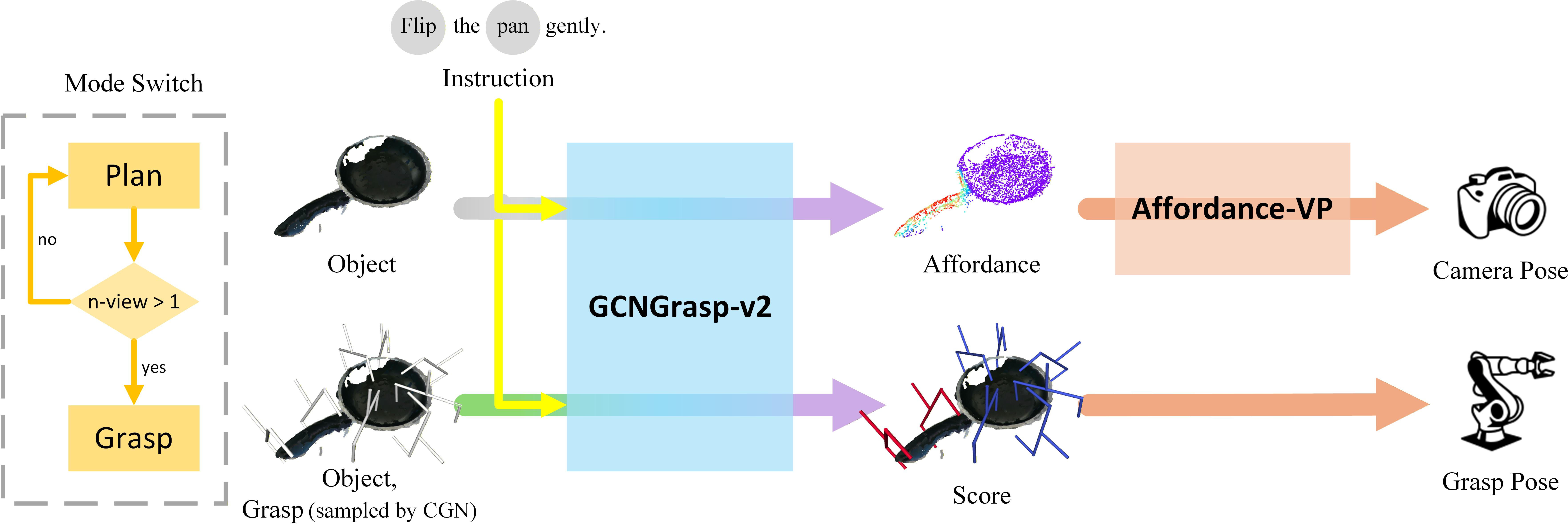
Figure 1: System-level architecture: GCNGrasp-v2 delivers real-time affordance fields and grasp evaluation, which are integrated into the affordance-guided view planning loop.
Advances in Task-Oriented Grasp Modeling
GCNGrasp-v2 is a segmentation-style network that decouples object-task embedding from grasp pose analysis, in contrast to the candidate-centric, classifier-style design of GCNGrasp-v1. This architectural shift enables direct affordance field inference and allows for grasp compatibility scoring over arbitrary sets of candidate poses at constant computational cost.
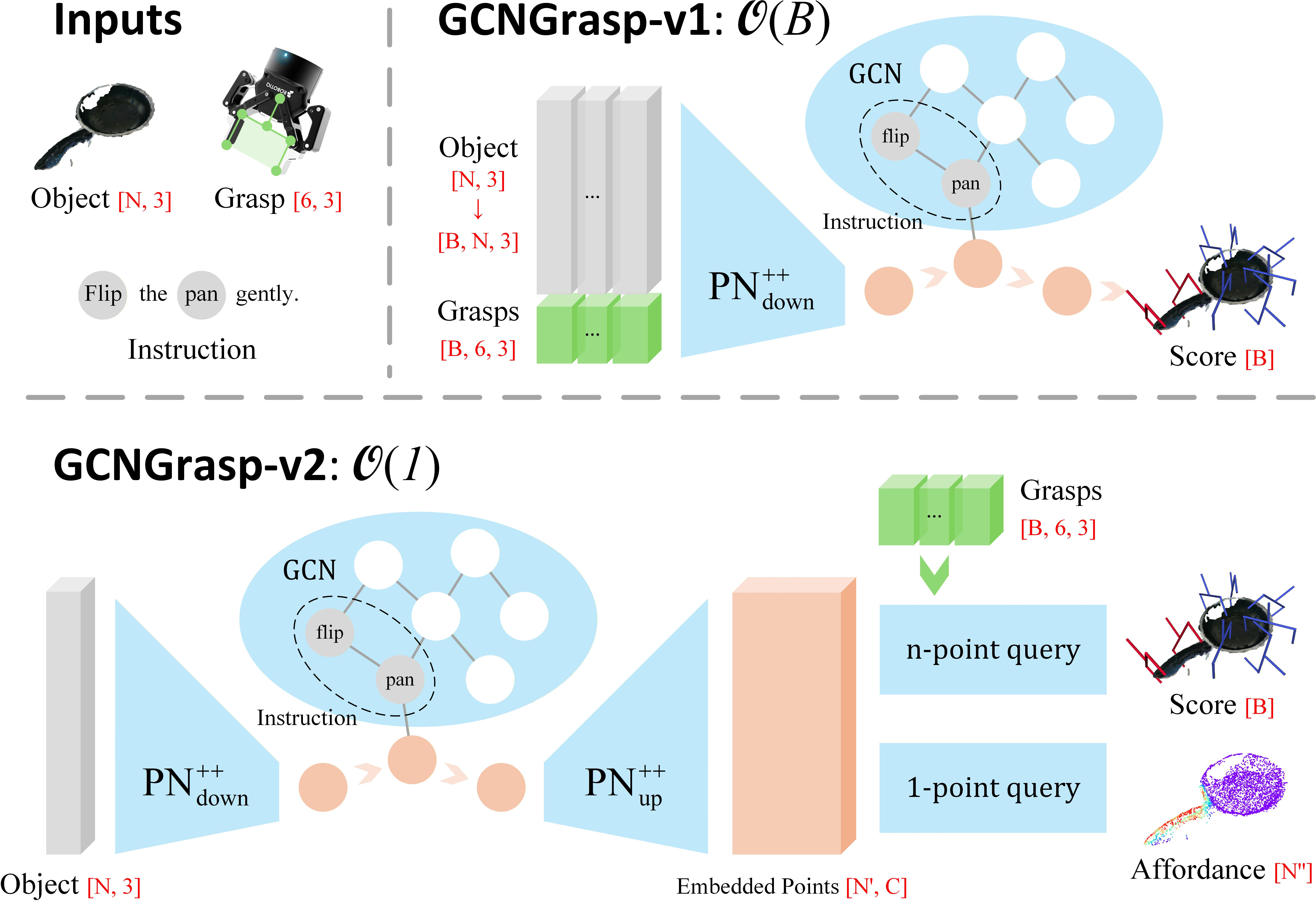
Figure 2: Comparison of GCNGrasp-v1 (top) and GCNGrasp-v2 (bottom): decoupling of object-task representation in v2 leads to parallel per-point affordance and constant-time grasp evaluation.
GCNGrasp-v2 uses a PointNet++ backbone for geometry extraction, followed by graph convolution networks (GCN) for task-semantic integration. The global object-task embedding is projected down to per-point space via upsampling, and the affordance field is generated by a per-point MLP decoding head. Grasp scoring for each proposal is computed via multi-point query and aggregation operations. Supervision aligns the affordance peak with a representative task-relevant region, thereby enforcing localization for view planning.
Affordance-Guided View Planning: Methodology
Affordance-VP receives the predicted affordance field and directs the camera towards maximally informative, task-relevant regions, avoiding the overhead of full 3D reconstruction. The next-best view is computed by optimizing for target region visibility subject to several losses: orientation (alignment to affordance cluster), occlusion (estimated visibility via projected distances), and elevation (preventing degenerate top-down poses). Candidate views are sampled on a hemispherical workspace and scored efficiently, leveraging the millisecond inference capability of GCNGrasp-v2.
The planner clusters high-affordance points via DBSCAN, identifies the largest cluster as the view target, and selects the camera pose that optimally satisfies the loss criteria above. This method can robustly disambiguate between visually salient but task-irrelevant regions and those critical for the grasp task.
Experimental Results
The proposed framework is evaluated on the TaskGrasp dataset and a multi-view object-task dataset, with task generalization and object instance generalization as test scenarios. Strong quantitative claims are demonstrated:
- GCNGrasp-v2 attains or surpasses state-of-the-art mean AP in both TOG prediction and affordance localization relative to baselines (GCNGrasp-v1, GraspGPT).
- Inference cost is dramatically reduced: inference time per grasp is constant, with total evaluation and planning latency under 0.1 s, compared to 0.5 s–9 s for reconstruction-driven baselines.
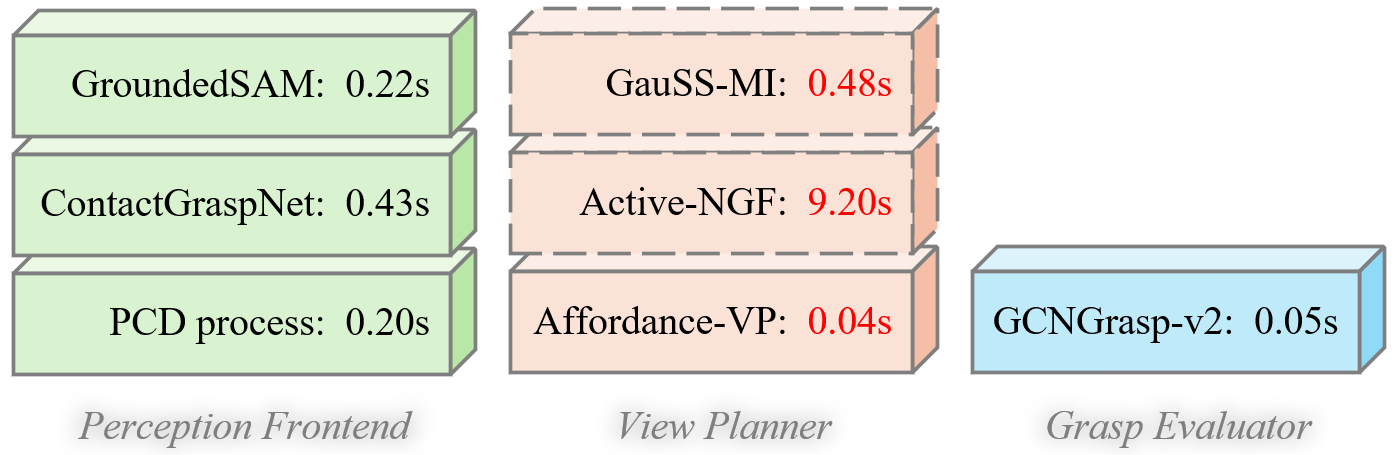
Figure 3: Modular pipeline diagram with inference latency breakdown for each module; GCNGrasp-VP achieves real-time execution.
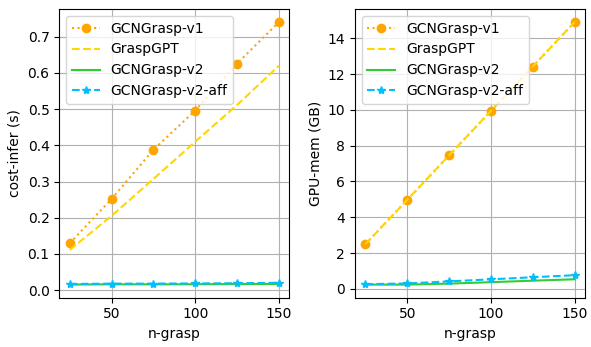
Figure 4: Grasp evaluation scalability—GCNGrasp-v2 inference time and memory usage remain flat as the number of grasp candidates increases, unlike candidate-based architectures.
View planning experiments show that Affordance-VP achieves saturated grasp prediction accuracy after a single view adjustment, while uncertainty-based planners (e.g., GauSS-MI, Active-NGF) require more views and often focus on task-irrelevant object parts (e.g., bristles vs. handle on a brush). Affordance field-driven selection directly targets the task semantics (e.g., handles for drinking, pouring), yielding the highest real-world grasp success rates across diverse tasks and objects.
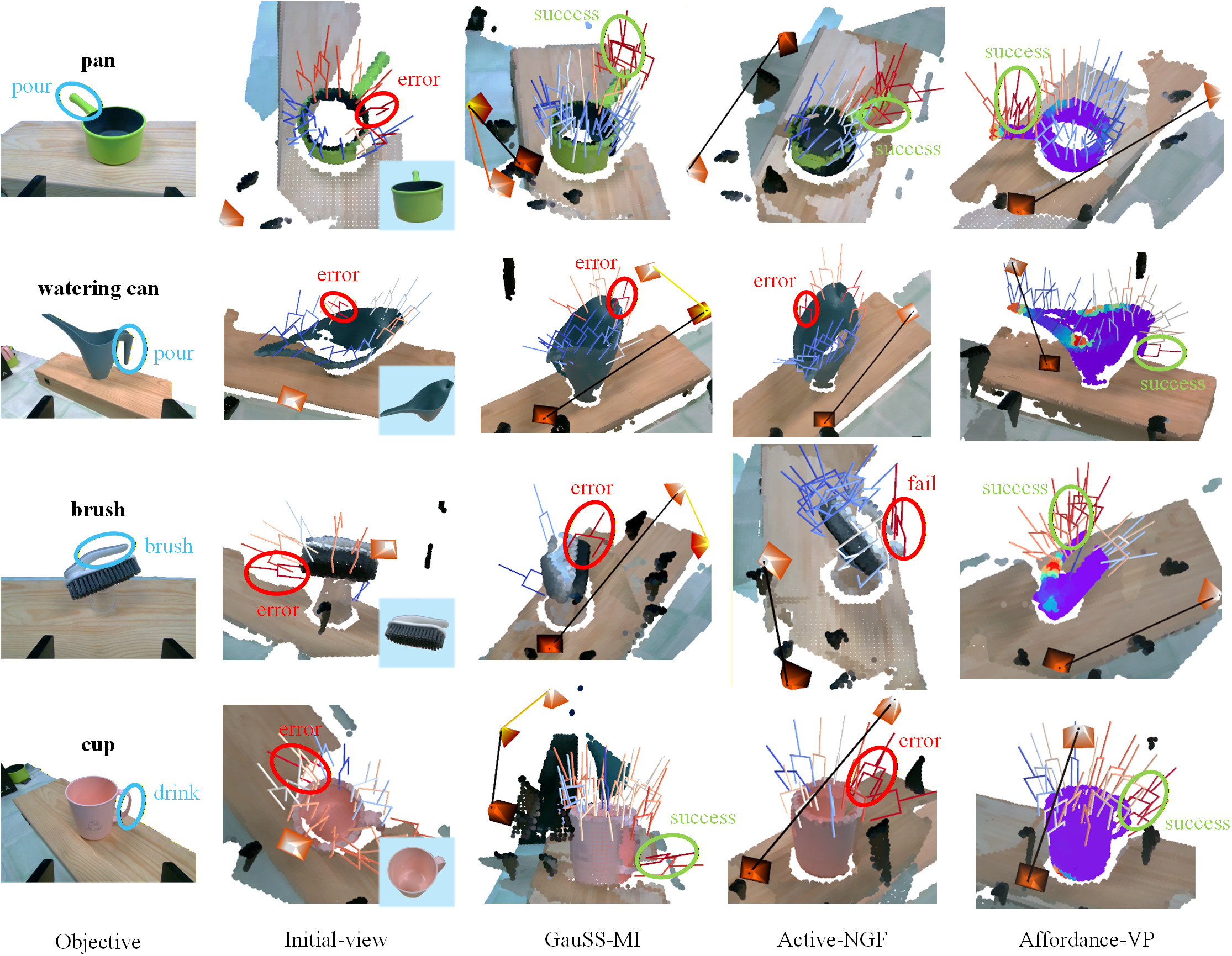
Figure 5: Qualitative comparison—Affordance-guided planning consistently reveals and exploits task-relevant regions, as shown by grasp confidence and execution outcomes after view adjustment.
Theoretical and Practical Implications
GCNGrasp-VP demonstrates how dense, task-informed affordance signals can guide sensory actions in real time, sidestepping global scene uncertainty estimation and heavy geometric reconstruction. The architectural decoupling yielding constant-time inference is significant, directly supporting active, closed-loop perception required in robot manipulation under tight latency and compute budgets.
On the practical side, the technique is readily deployable on single-GPU platforms, supports rapid prototyping for modular manipulation systems, and can be integrated as a plug-in grasp module or perception frontend for higher-level robotic planners. The affordance-centric planning paradigm also offers a pathway to scalable, semantically grounded active perception across a variety of embodied AI systems.
Limitations and Future Directions
Observed limitations include failure modes under severe occlusion where no visible surface supports inference of the (hidden) task-relevant region, leading to affordance estimation error and misdirected view selection. Further, reliance on the quality of the affordance field supervision constrains robustness to geometric incompleteness and task ambiguity. Future work should target robust affordance learning with improved supervisory signals, stronger data augmentation, or incorporation of open-vocabulary models and retrieval-based memory architectures for few-shot or zero-shot setting generalization.
Conclusion
GCNGrasp-VP sets a paradigm for affordance-driven, real-time active perception for task-oriented robotic grasping. The framework yields state-of-the-art grasp prediction and execution success rates while achieving exceptional computational efficiency, enabling active planning with minimal view adjustments and no scene reconstruction. By tightly coupling affordance learning and closed-loop observation selection, this approach provides a practically viable and theoretically principled advance in embodied robot intelligence and active task-driven perception.