- The paper introduces a training-free, centroid-based routing method that assigns lightweight adapters based on input embedding geometry.
- It demonstrates robust performance with 85% adapter selection accuracy and 97.44% task performance recovery, even as adapter libraries scale.
- The method is model-agnostic and computationally efficient (≈22 ms per decision), making it suitable for on-demand inference in production environments.
ARIADNE: Agnostic Routing for Inference-Time Adapter Dynamic Election
Motivation and Positioning
Parameter-efficient fine-tuning (PEFT) paradigms, notably LoRA and its variants, have engendered adapter-centric model ecosystems where a single foundation model is augmented by numerous lightweight, task-specific adapters. As adapter libraries scale, the key deployment challenge is dynamic selection: determining, for any unlabeled input, which adapter is optimal without access to task labels, additional router training, or privileged adapter internals.
Prior routing schemes either require retraining on labeled data, or exploit spectral decompositions of LoRA weight matrices, the latter tying their applicability exclusively to LoRA and suffering performance degradation when tasks are semantically similar. ARIADNE introduces a fundamentally agnostic, training-free routing methodology predicated on latent input geometry rather than adapter weights, compatible with any PEFT architecture, and scalable across arbitrary task pools.
Centroid-Based Routing: Approach and Architecture
ARIADNE reframes adapter routing as input-space classification, operationalizing the assumption that embeddings from a frozen text encoder encode task-discriminative geometry. For each adapter, centroids (prototypical representations) are computed via clustering over embeddings from its training data. At inference, an input is embedded, and the adapter is selected by maximal cosine similarity to any centroid in the pool. This technique generalizes across model families and adapter types, sidestepping architecture-specific weight analysis.
ARIADNE incorporates multi-centroid representations per task, capturing intra-task variance. Empirical ablation demonstrates that multi-centroid configurations outperform global prototypes and KNN approaches, especially for adversarial or heterogeneous task datasets. Adapter selection scales linearly with the number of adapters, with negligible inference overhead (~22 ms per routing decision).
Experimental Evaluation
ARIADNE is instantiated on Llama 3.2 1B Instruct and Qwen2.5 3B Instruct, with adapters trained on diverse NLP benchmarks spanning NLI, QA, Similarity, and Reasoning. The frozen embedder used is intfloat/e5-large-v2, selected via empirical evaluation against alternatives for maximal discriminability across task centroid-test sample pairs.
Adapter Selection Accuracy (SA) and Task Performance (TP) relative to an Oracle (perfect adapter assignment) are computed across 23 tasks. ARIADNE achieves average SA of 85% and TP recovery of 97.44% Oracle performance. Performance is highest in Similarity and Reasoning, and lowest in NLI where task-proximate semantic overlap induces graceful degradation rather than catastrophic failure.
Comparative benchmarks against spectral routing methods Arrow and SpectR on overlapping tasks show ARIADNE consistently achieving superior SA, notably outperforming Arrow/SpectR where spectral routing approaches degrade to random selection due to task similarity.
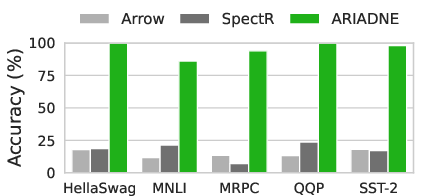
Figure 1: Adapter SA comparison between ARIADNE and spectral routing methods Arrow and SpectR. ARIADNE consistently outperforms both across all tasks.
Routing performance is stable under scalability stress tests, maintaining 89.7% average SA as the adapter pool is extended to 44 tasks, with degradation plateauing beyond ~20 adapters due to semantic clustering.
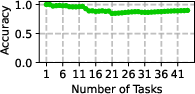
Figure 2: SA trend for up to 44 tasks.
Failure Modes and Graceful Degradation
Failure analyses reveal three principal modes: domain overlap (e.g., SQuAD V1 misrouted to SQuAD V2), adversarial intra-task variance (e.g., ANLI datasets), and reasoning ambiguity (e.g., MultiRC often routed to QA adapters). Critically, errors are concentrated within clusters of semantically related tasks; quantitative metrics show high TP recovery even at low SA, demonstrating robustness in practical deployment.
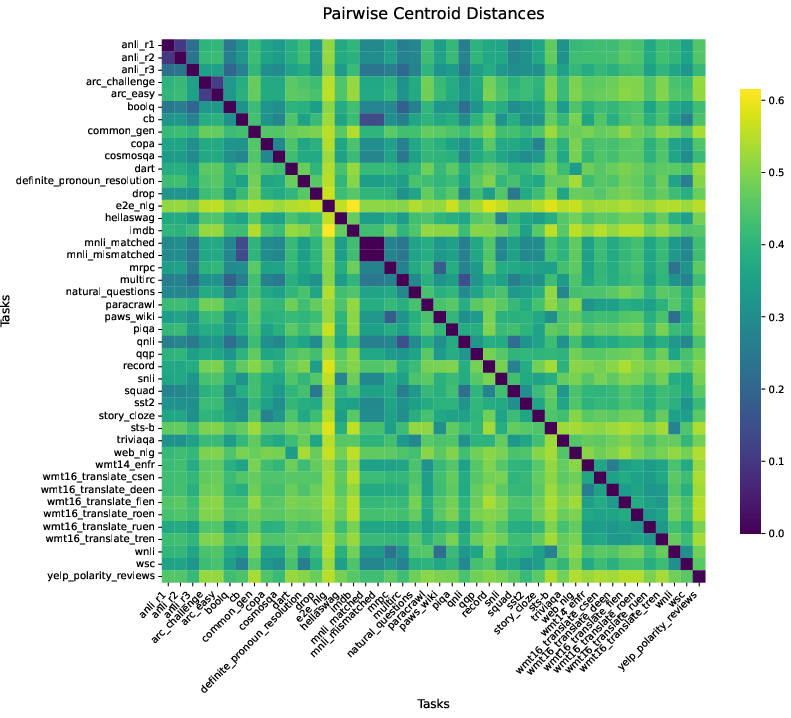
Figure 3: Pairwise distances between different tasks centroids. Visual interpretation of the Graceful Degradation.
A t-SNE visualization of embeddings underscores task clustering fidelity, confirming that input geometry is an effective source of discriminative information.
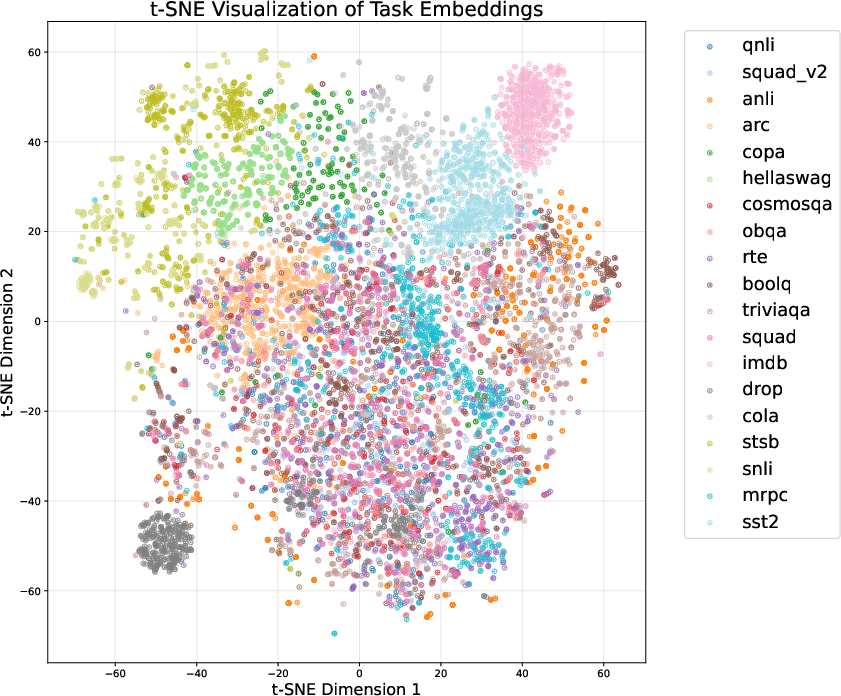
Figure 4: T-SNE analysis of the tasks embeddings. Note that this visualization includes tasks from the full 44-task pool used in the scalability study.
Robustness and Sample Efficiency
ARIADNE is resilient to reduction in available training samples per centroid; selection accuracy remains high (>77%) even with only 2% of original samples. Optimal SA is achieved with 500 samples per centroid.
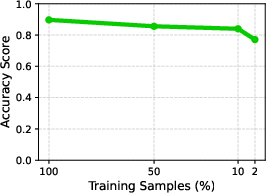
Figure 5: SA trend with less training samples. The best performance is achieved with 500 samples, as reported in the main paper. Here, we show that even with a small fraction (2\%) of training samples we can still achieve good SA performances.
Theoretical and Practical Implications
By decoupling routing from adapter architecture and relying exclusively on input embeddings, ARIADNE offers universal applicability across PEFT methods, enables frictionless addition of new adapters (merely requiring centroid computation), and supports model-agnostic deployment. The graceful degradation property ensures robustness in real-world scenarios with ambiguous inputs or overlapping task boundaries. Adapter selection is computationally efficient, suitable for on-demand inference in production environments.
From a theoretical perspective, the methodology leverages properties of frozen encoders for task discriminability, suggesting avenues for further exploration in representation learning for cross-task and domain generalization. Error concentration within semantic clusters opens research directions on label propagation, hierarchical routing, and cluster-level expert selection in adapter libraries.
The primary limitation is dependency on access to training data for centroid construction. Future work, as proposed, could involve extracting fingerprints directly from adapters to enable data-free routing, preserving the adapter-agnostic philosophy.
Conclusion
ARIADNE advances PEFT adapter routing with a training-free, input geometry-based approach, achieving near-oracle performance and robust generalization across large, heterogeneous task libraries. Its architecture and empirical substantiation demonstrate scalability, adaptability, and resilience to routing errors induced by semantic proximity. ARIADNE sets a benchmark for universal, zero-shot dynamic adapter selection in modular LLM ecosystems, grounding future developments in model-independent routing and representation-based task discrimination (2606.19079).

