Correcting Sensor-Induced Distribution Drift with Wasserstein Adversarial Learning
Published 17 Jun 2026 in cs.LG and cs.AI | (2606.18561v1)
Abstract: The quality of recorded data depends on the stability of the sensor system that acquires it. Sensor motion and aging can degrade the performance and stability of downstream data-driven methods. We present a Wasserstein-GAN-inspired approach for unsupervised inference of physically interpretable transformation parameters that map a changed detector response distribution back to a nominal reference distribution. In contrast to standard generative modeling, the generator is used as a learnable calibration transformation whose trainable weights represent the sought parameters, while the critic provides a distributional distance signal via the Wasserstein objective. We validate the approach on a tracking-detector toy model with controlled layer shifts and demonstrate its application on high-granularity Geant4-simulated calorimeter data with cell-wise aging effects. The method recovers aging coefficients for individual cells with correlation to ground truth and improves agreement between calibrated and reference energy-sum distributions, while exhibiting the expected degradation at increasing channel-to-channel noise levels. These results indicate that adversarial distribution matching can serve as a data-driven component of calibration strategies in settings where direct labels for degradation parameters are unavailable.
The paper presents an unsupervised calibration method using a Wasserstein-GAN framework to correct sensor-induced drift without requiring labeled data.
It demonstrates sub-micron accuracy in tracker alignment and effectively recovers calorimeter aging effects in high energy physics experiments.
The framework exploits adversarial training to infer physically interpretable transformation parameters, offering a scalable solution for nonstationary sensor degradation.
Correcting Sensor-Induced Distribution Drift with Wasserstein Adversarial Learning
Motivation and Framework
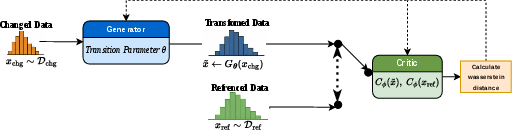
This paper presents an unsupervised calibration paradigm for sensor systems subject to nonstationary degradation, focusing on high energy physics (HEP) detectors. The methodology leverages adversarial learning, specifically a Wasserstein-GAN (WGAN)-inspired architecture, to infer physically interpretable transformation parameters—such as geometric shifts and per-channel attenuation coefficients—without event-level correspondences or supervised labels. The generator is repurposed as a learnable, deterministic transformation whose parameters are updated to minimize the Wasserstein distance between a distribution of "damaged" detector responses and a reference (nominal) data distribution. The critic quantifies distributional discrepancy, enabling stable optimization and providing a direct signal for parameter recovery.
Figure 1: Architecture of the proposed WGAN-inspired adversarial parameter-search framework.
Technical Formulation
The framework operates by drawing minibatches from reference and changed datasets (e.g., undamaged and damaged sensor readings), applying a deterministic transformation Tθ to one set, and optimizing θ to align the two distributions via adversarial training. The critic network, enforced to be 1-Lipschitz, estimates the Wasserstein-1 distance (Earth Mover’s Distance) between distributions. This enables learning parameters with direct physical significance. For tracking detectors, the transformation recovers spatial offsets. For calorimeters, it infers cell-wise multiplicative calibration coefficients. The core approach is robust to lack of supervision and does not rely on explicit likelihoods.
Validation: Tracker Alignment
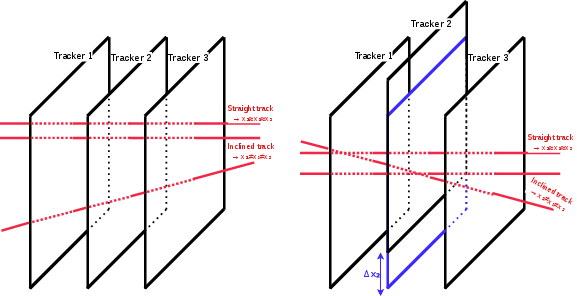
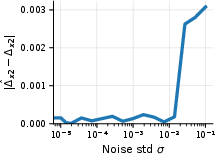
A toy model with three tracking planes is simulated. A spatial misalignment is injected by shifting the second plane, creating a distributional distortion in hit coordinates. The generator is a single-parameter offset model; adversarial optimization recovers the misalignment in a fully unsupervised manner, matching the corrected hit distribution to the reference. Numerical results indicate sub-micron accuracy in estimated shifts under moderate noise. As noise increases and approaches the scale of the injected shift, estimation degrades rapidly, reflecting loss of geometric information.
Figure 2: Tracker toy model with injected misalignment, resulting in altered residual distributions.
Figure 3: Absolute error of the estimated tracker shift ∣Δx∣ as a function of Gaussian noise standard deviation, demonstrating robust recovery under low noise regimes.
Validation: Calorimeter Aging
Using Geant4 Monte Carlo simulations, a high-granularity calorimeter is exposed to single-meson events. Aging is modeled as cell-wise attenuation, with coefficients generated via a monotonic decay function and Gaussian noise. Events are represented as multi-dimensional tensors of cell depositions. The generator consists of learnable calibration coefficients per cell, aiming to invert the aging transformation. The critic constrains the corrected distribution to align with the undamaged reference.
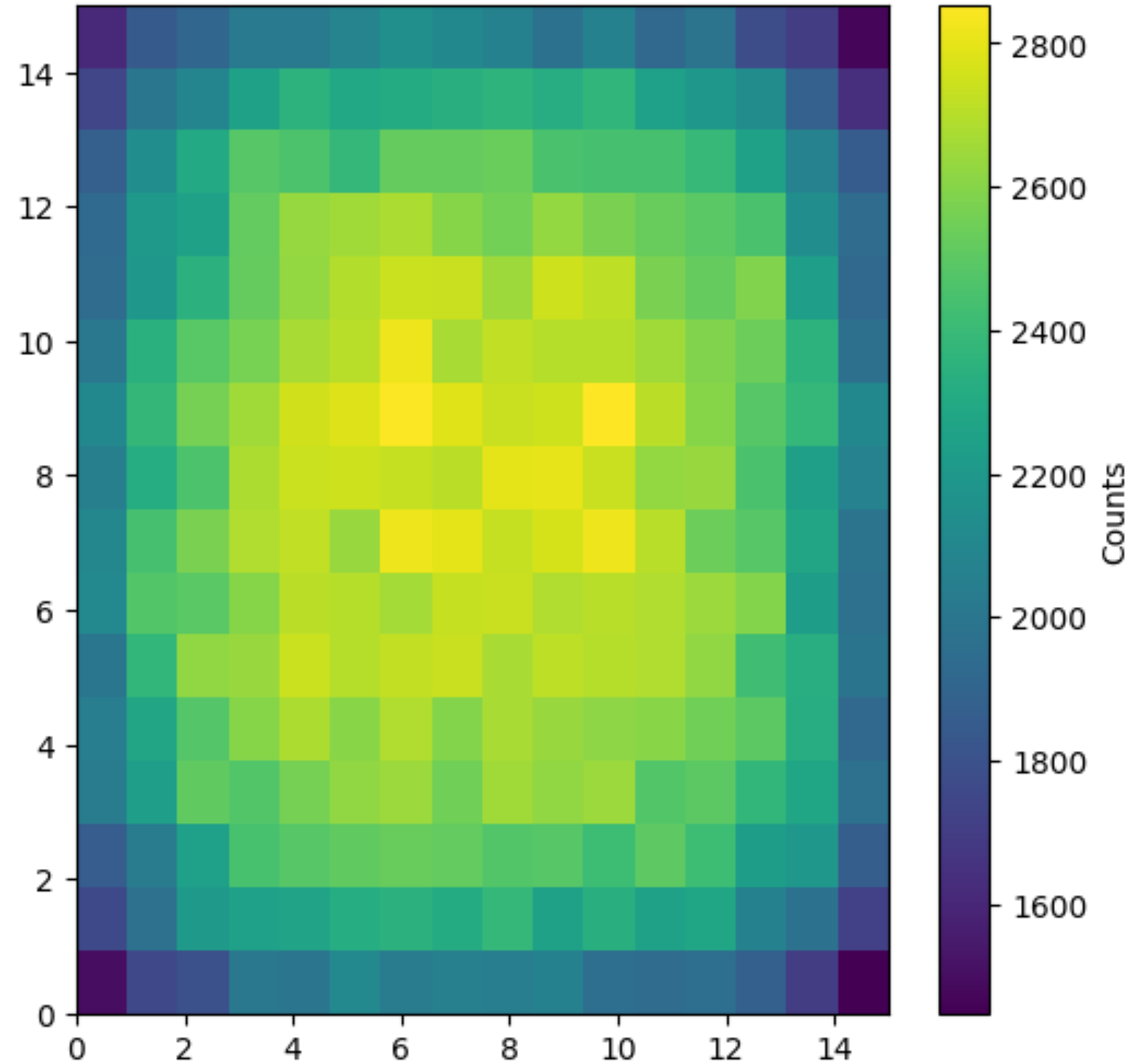
Figure 4: Hit activity map for the central 16×16 calorimeter region, showing aggregate shower spatial structure.
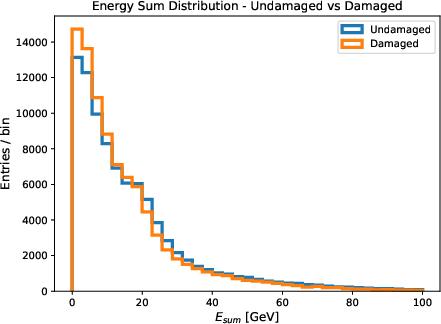
Figure 5: Distribution of total deposited energy per event contrasting undamaged and aged calorimeter responses.
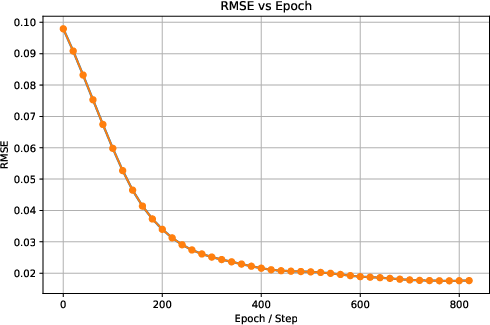
Figure 6: RMSE between inferred and injected aging coefficients as a function of training epoch, illustrating convergence and plateau.
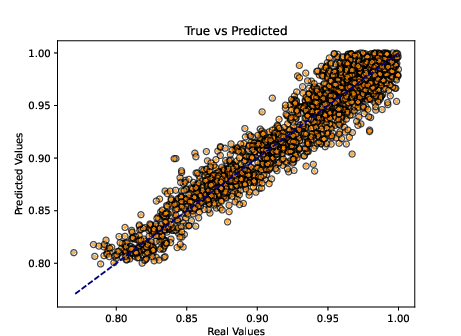
Figure 7: Cell-wise comparison of true and inferred aging coefficients, indicating high correlation except for strongly attenuated, noisy channels.
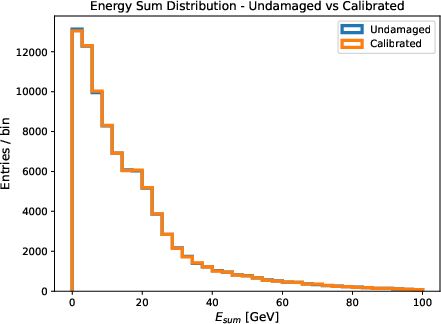
Figure 8: Energy-sum distributions for undamaged and calibrated calorimeter responses, demonstrating restoration of global energy scale post-calibration.
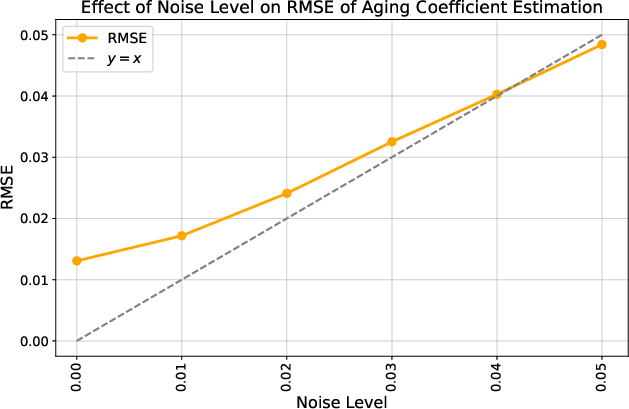
Figure 9: Effect of stochastic coefficient noise ϵ on the RMSE of aging-coefficient estimation, quantifying degradation of identifiability under increased per-channel noise.
Discussion
Empirical results demonstrate that the proposed adversarial parameter-search framework yields strong quantitative agreement between learned and injected calibration parameters, notably achieving mean RMSE <0.018 and R2≈0.9 for per-cell aging coefficients under realistic detector geometry and noise. The method outperforms per-cell mean ratio baselines, evidencing advantage in exploiting high-dimensional, distribution-level information. Application to damaged data effectively restores global observable distributions, such as total energy sum. However, identifiability deteriorates as random fluctuations in attenuation dominate aggregate response statistics, underscoring limitations for fine-grained parameter inference in highly stochastic environments.
Implications and Future Directions
The approach validates adversarial distribution matching as a scalable, interpretable method for sensor calibration and alignment, directly applicable to large-scale HEP experiments where direct supervision is infeasible and detector conditions evolve continuously. The formalism is agnostic to the dimensionality and physical interpretation of the calibration parameters, and could in principle be extended to composite transformations encompassing both geometric and response corrections. Potential future research directions include adaptation to time-dependent drift, integration with real-time readout systems, hybridization with conventional calibration workflows, and deployment on online (streaming) sensor arrays in experimental settings. The framework may also inform broader machine learning strategies for unsupervised domain adaptation and calibratable generative modeling, providing quantitative and physically grounded diagnostics for nonstationarity in complex environments.
Conclusion
The paper introduces a formal adversarial learning scheme for the recovery of sensor-induced distribution drift parameters, reinterpreting the generator as a calibration transformation rather than a sample synthesizer. The methodology demonstrates strong numerical agreement in alignment and calibration tasks for both low-dimensional and high-granularity detector models, operating entirely in an unsupervised manner. Despite intrinsic limitations with high stochasticity, the results underscore the utility of data-driven, distributional calibration techniques as complementary components for maintaining detector fidelity. The implications extend to broader domains where measurements are subject to systematic, nonstationary drift, motivating further investigation into hybrid calibration strategies and online deployment scenarios.
“Emergent Mind helps me see which AI papers have caught fire online.”
Philip
Creator, AI Explained on YouTube
Sign up for free to explore the frontiers of research
Discover trending papers, chat with arXiv, and track the latest research shaping the future of science and technology.Discover trending papers, chat with arXiv, and more.