- The paper introduces ADA, a novel method that bridges simulation and experiment by aligning generative models with real-world observable distributions using a dual adversarial framework.
- The paper leverages KL regularization and Wasserstein objectives to update pretrained simulation models using multiple, high-dimensional experimental observables.
- The paper demonstrates ADA's superior performance with theoretical guarantees and empirical evaluations on synthetic, molecular, and protein structure datasets.
Adversarial Distribution Alignment for Bridging the Simulation-to-Experiment Gap
Problem Setting and Motivation
Bridging the simulation-to-experiment gap is a central challenge in computational science, particularly in physical sciences such as atomistic modeling, molecular dynamics, and protein modeling. Simulations provide fully observed but approximate data due to computational and model limitations, while experiments yield partial yet accurate observations of real-world phenomena. This paper introduces Adversarial Distribution Alignment (ADA), a data-driven framework to align generative models trained on simulation data with distributions of real-world experimental observables, even when those observables are partial and potentially high-dimensional.
ADA leverages a base generative model, pretrained on simulation data, and updates it to match multiple, possibly correlated, partial experimental observables. The approach addresses the fundamental under-constrained nature of aligning full state distributions from only partial observations. By regularizing the solution with a KL-divergence to the base model and using an adversarial (min–max) Wasserstein objective over observables, ADA incorporates simulation as a prior while aligning to the true observable distributions.
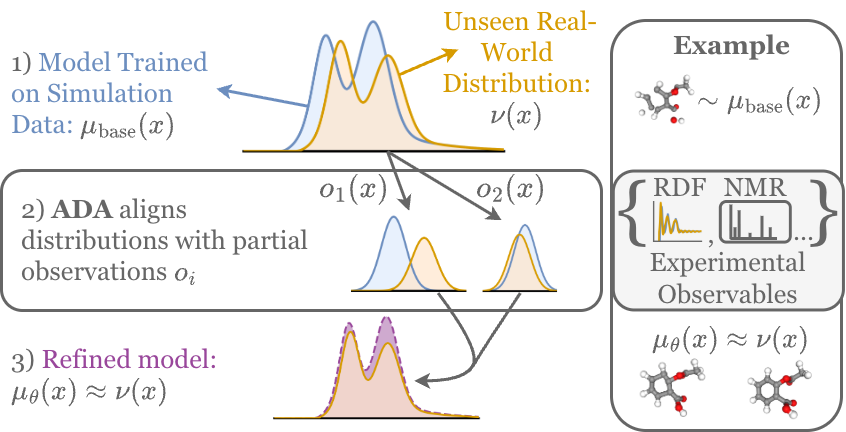
Figure 1: ADA aligns generative models trained on approximate simulation data with the real world by leveraging partial experimental observations.
Methodological Framework
ADA formulates the alignment as a minimization of KL-divergence subject to observable constraints. Observables are any function o(i) of the system state x, and the algorithm seeks generative models whose pushforward distributions through these observables match the empirical distributions from experiments. As multiple partial observables may be correlated, the objective is under-constrained, hence regularization with the base simulation prior is critical.
The alignment is realized via a dual adversarial optimization: ADA parameterizes discriminators as neural networks for each observable, tasked with learning Wasserstein distances between generated and real observable data. The generative model is updated through maximizing the KL regularized Lagrangian, while discriminators are trained to minimize it, enforcing distributional alignment over observables. For differentiable observables, ADA employs diffusion models and adjoint matching to optimize generative parameters efficiently.
Comparison with Expectation Alignment and Conditional Generation
Conditional generative modeling is not viable for practical multi-observable settings where only marginal distributions are available. Expectation Alignment (EA), which matches observable means or finite sets of moments, is theoretically equivalent to distributional alignment only as the number of enforced moments approaches infinity—a computationally intractable situation for high-dimensional, multimodal distributions. ADA’s adversarial approach directly matches full observable distributions without requiring unwieldy moment expansions.
Theoretical Guarantees
ADA is supported by strong theoretical results:
- Existence and Uniqueness of Optimal Aligned Distribution: Under mild conditions (compact state space, full support of the base distribution), ADA’s mini-max optimization admits a unique saddle-point solution.
- Asymptotic Convergence: Increasing the relative weight on observable Wasserstein distances guarantees convergence such that generated observables match the experimental references in Wasserstein distance.
- Constraint Satisfaction in the Limit: Weak limit points of ADA’s sequence of solutions satisfy the observable constraints, achieving pushforward distributions equal to those from experiments.
These guarantees apply even for multiple correlated partial observables, without imposing independence, and require only continuous mappings with finite KL-divergence between the base and target measures.
Empirical Evaluation
ADA is benchmarked on synthetic distributions, molecular conformational spaces, and protein structure datasets, demonstrating superior alignment compared to ED-style moment matching and robust transfer from simulation priors to experimental data.
Synthetic Multimodal Mixture-of-Gaussians
ADA is compared to EA on a synthetic mixture-of-Gaussians aligned via correlated 2D projections. ADA achieves substantially lower ℓ1 residuals on induced observable pdfs, directly recovering the target distribution, whereas EA fails even with higher-order moment matching, reflecting the intractability of moment-based approaches in multimodal, correlated settings.
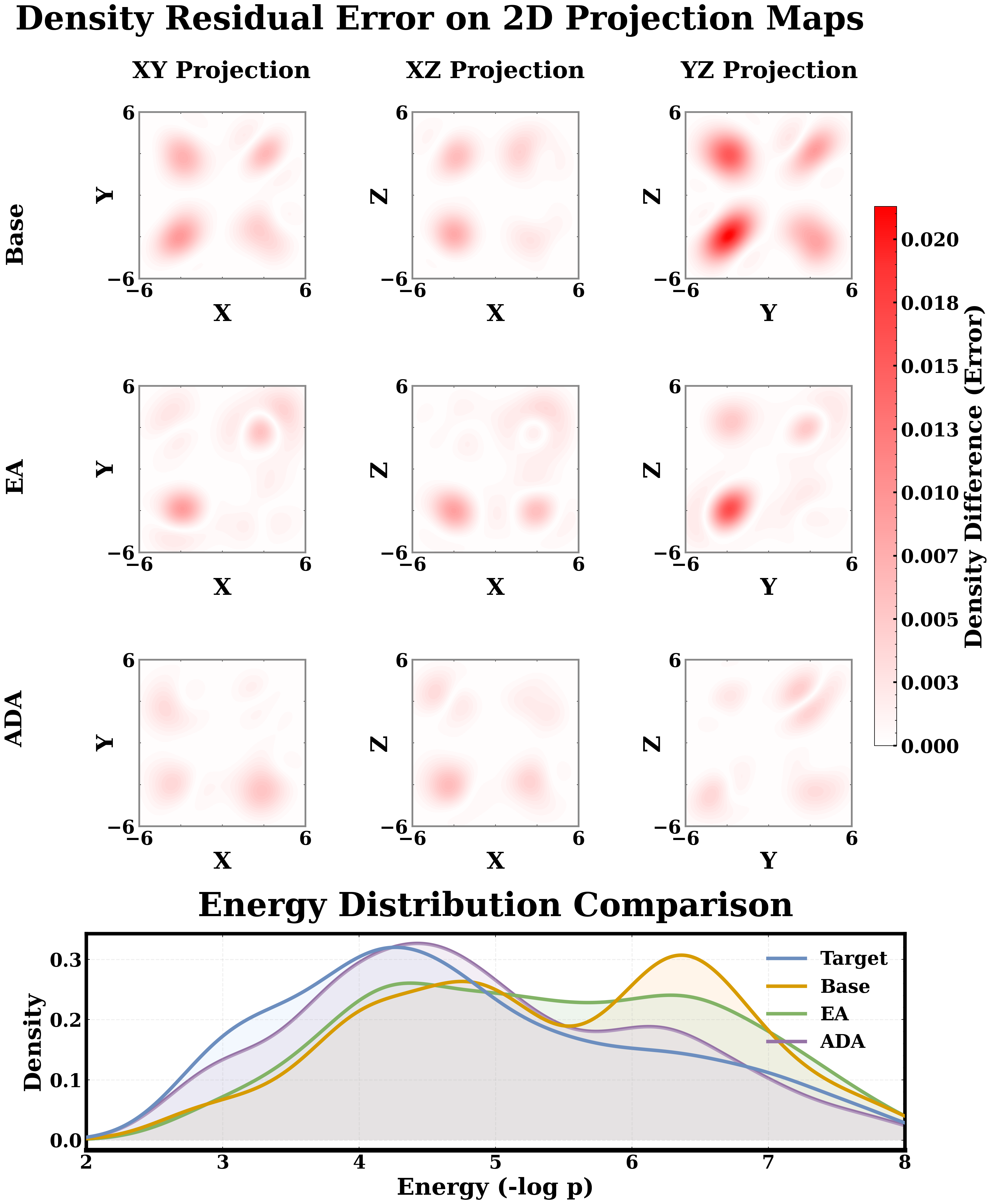
Figure 2: ADA achieves larger reductions in distributional error on multidimensional observables than EA, even with multiple moments, on synthetic multimodal benchmarks.
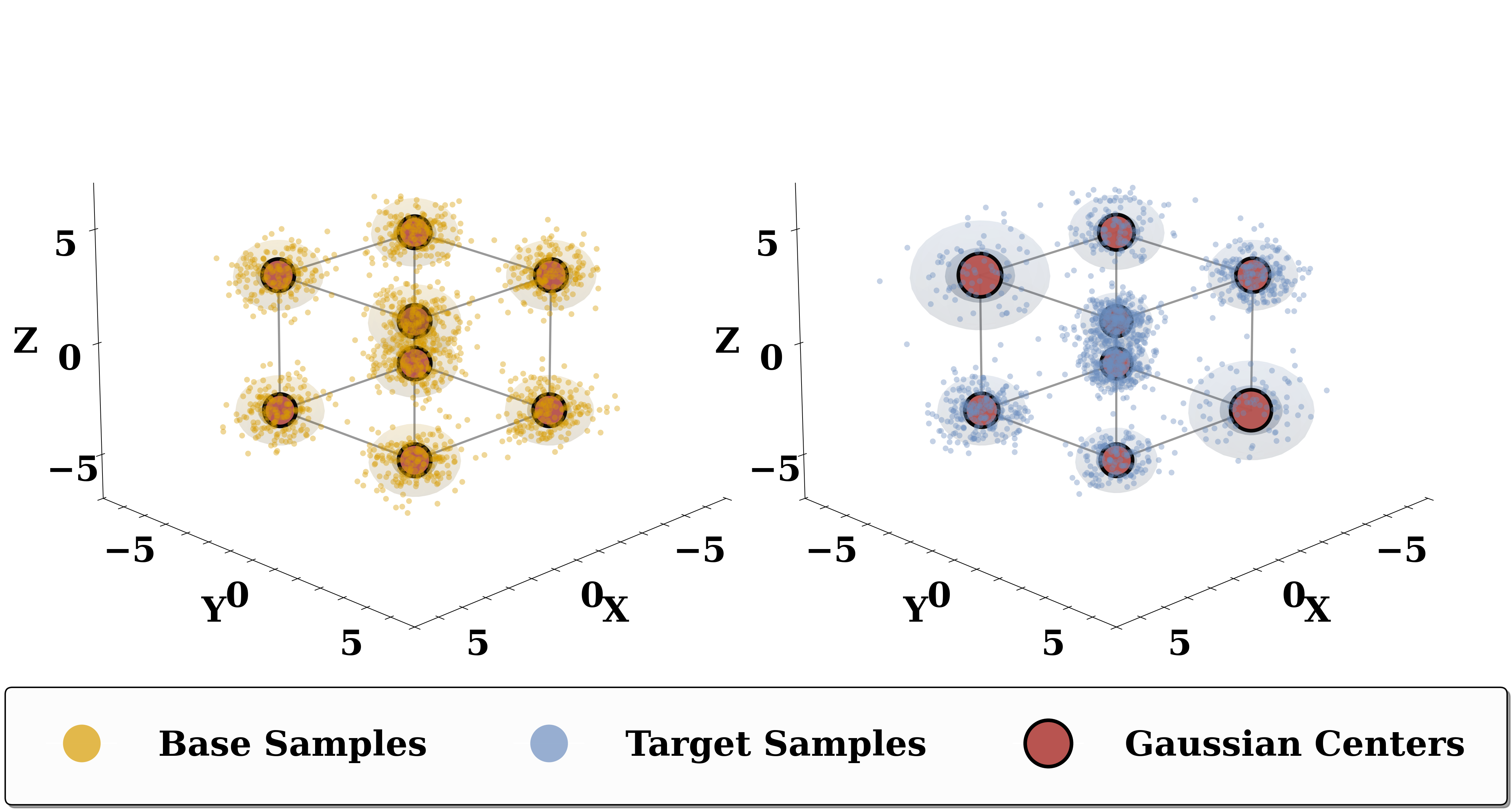
Figure 3: Visualization of base and target synthetic mixture-of-Gaussians distributions used in evaluating ADA's alignment.
Small-Molecule Structure: Observables Ablation
ADA is applied to the MD17 aspirin system, aligning a generative model trained on a semi-empirical potential to distributions from higher-fidelity DFT calculations. Structural observables—including mean interatomic distance, radius of gyration, bond lengths, H-bond distances, and functional group separations—are progressively added as constraints.
ADA consistently achieves lower Wasserstein-1 distances for observable marginals and reduced Jensen-Shannon divergence on joint free energy surfaces, both for in-domain and held-out observables, highlighting its ability to preserve and recover complex molecular correlations.
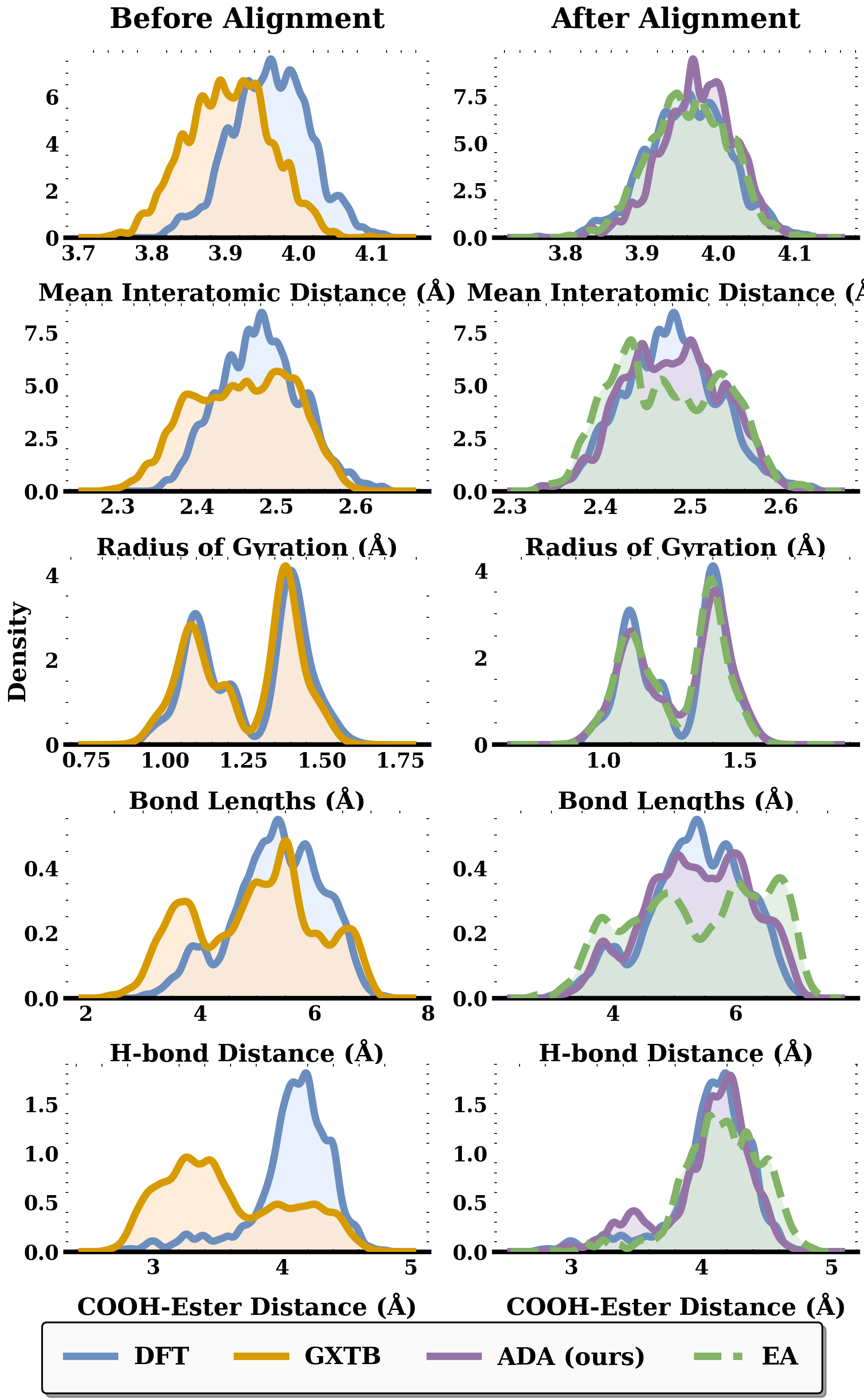
Figure 4: ADA more accurately captures higher-order structure in aspirin, yielding closer agreement with the full target observable distributions versus EA.
Protein Structure Alignment Using High-Dimensional Cryo-EM Observables
ADA is used to align a generative model for protein amino acid positions, trained on classical MD simulations, with experimental distributions inferred from noisy, high-dimensional cryo-EM images (128×128 pixels). The algorithm leverages only the cryo-EM partial observables to reduce the simulation-to-experiment gap.
ADA’s model produces structural distributions with significantly improved agreement in radius of gyration and mean interatomic distances, as well as reduced maximum Kabsch-aligned RMSD to experimental amino acid positions, even as the noise in cryo-EM images is increased.
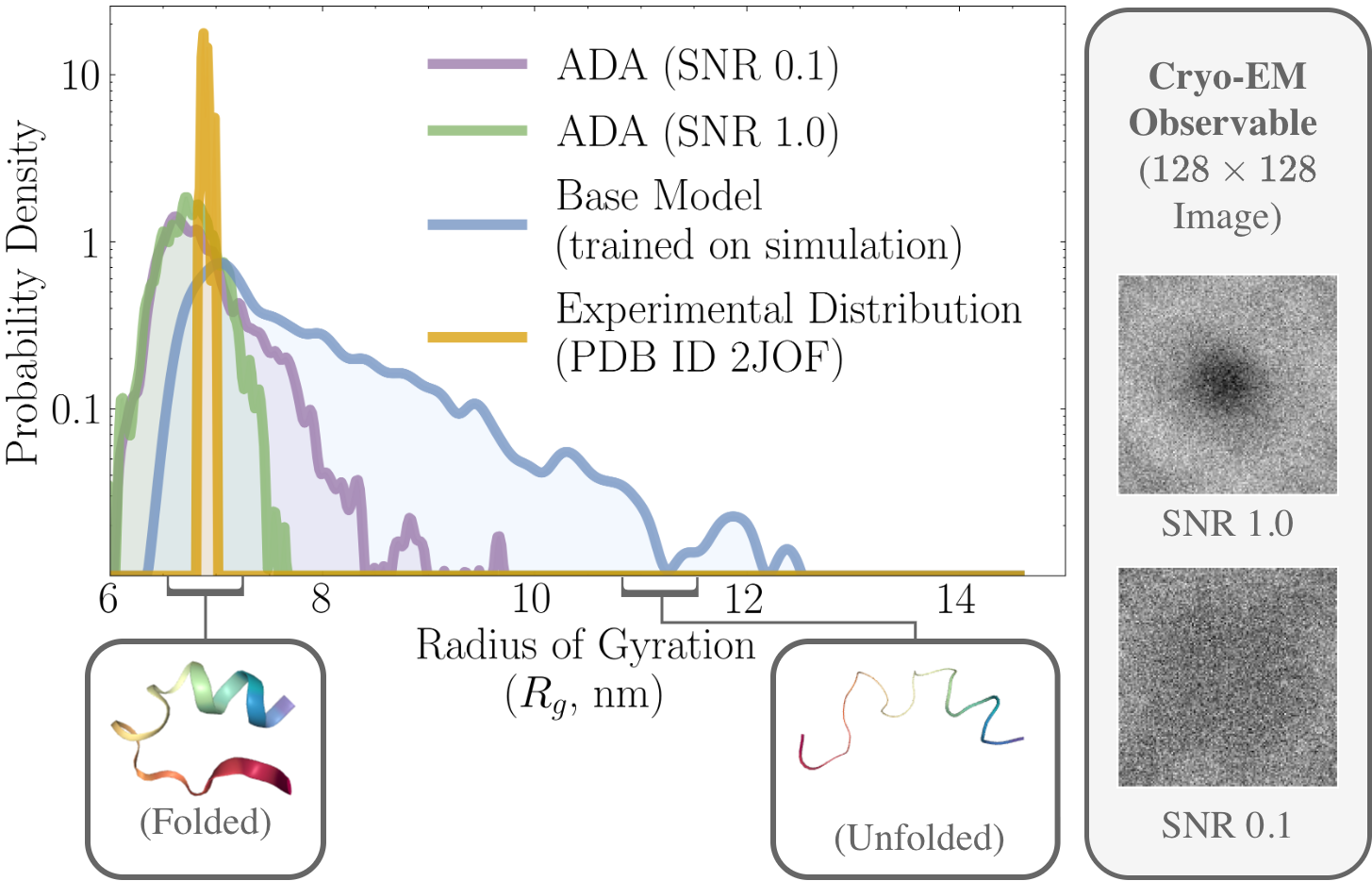
Figure 5: ADA shifts the simulated protein distribution to align with experimentally measured Trp-cage structures using high-dimensional cryo-EM images.
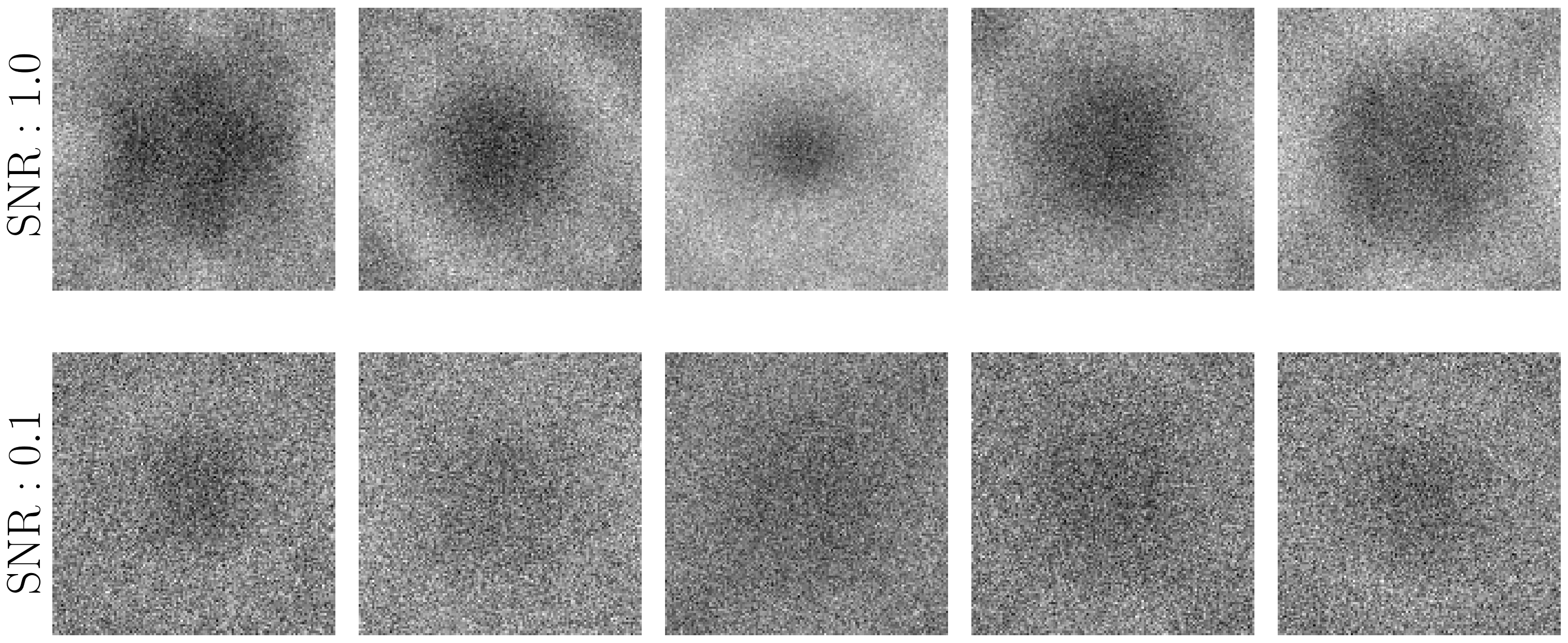
Figure 6: Example cryo-EM images of Trp-cage used as partial observables for ADA alignment.
Implications and Prospects
The ADA framework generalizes across domains by supporting alignment of models to distributions over multiple correlated partial measurements, not limited to structural observables. ADA’s improvements scale with the number and diversity of experimental observables, suggesting practical benefits for model calibration in high-throughput materials and drug discovery, biomolecular structure determination, and other fields where simulation-experiment discrepancies are substantial.
Furthermore, ADA’s algorithmic structure (min–max with KL regularization on simulation prior and adversarial Wasserstein alignment in the observable space) is inherently adaptable: its extension to dynamic observables (such as time-dependent autocorrelation functions) and non-differentiable settings is feasible via entropy-regularized RL and other adversarial optimization techniques.
Theoretically, ADA reinforces the power of adversarial learning for distributional matching beyond limited moment constraints, and supports scalable, principled fusion of imperfect simulation data with rich but partial experimental measurements—a step towards generative models faithfully reflecting true physical systems.
Conclusion
ADA provides a theoretically grounded and empirically validated framework for aligning generative models trained on simulation data with experimental observable distributions, even when observations are partial, correlated, and high-dimensional. Compared to expectation alignment approaches, ADA achieves stronger distributional fidelity, supports multi-observable alignment, and improves as more observables are incorporated. The approach holds promise for scaling to increasingly complex systems and experimental datasets, offering practical advantages in computational science and model calibration. ADA’s formal guarantees and domain-agnostic nature represent a robust mechanism for reconciling simulation priors with real-world data, advancing the fidelity and utility of generative modeling in scientific applications.