- The paper’s main contribution is the introduction of a noncyclic geometric phase in a three-level Ramsey interferometer, enabling enhanced phase sensitivity through geodesic closure transitions.
- It employs projected internal-path interference and a geometric shortcut protocol that amplifies the local phase response while balancing the tradeoff between sensitivity and visibility.
- The study outlines practical metrological improvements applicable to quantum sensors, with potential integration of nonclassical states for advanced clock, magnetometry, and other sensing applications.
Noncyclic Geometric Phase in Three-Level Ramsey Interferometry for Enhanced Metrology
Introduction and Motivation
The paper "Noncyclic geometric phase in three-level Ramsey interferometry for enhanced metrology" (2606.18443) defines a new operational paradigm for quantum sensors based on three-level Ramsey interferometry. Conventional two-level Ramsey interferometers accumulate signal phase linearly over interrogation time, and their optimization focuses on coherence extension, ensemble expansion, noise mitigation, and systematic shift control. This work investigates how a multilevel architecture, specifically a three-level configuration with projected internal-path interference, produces a noncyclic geometric phase response that can yield significant phase sensitivity enhancement. Metrological improvements arise from the remodeling of the signal-to-readout mapping, resulting in amplified response at geodesic-closure transitions.
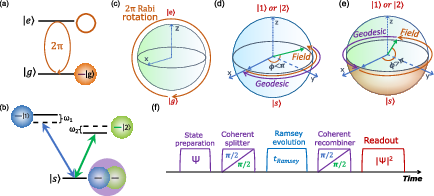
Figure 1: Schematic depiction of the geometric phase in a three-level Ramsey interferometer, highlighting the noncyclic transition and geodesic closure.
Three-Level Geometric Phase Dynamics
The geometric phase in Ramsey interferometry is classically exemplified by the π phase acquired in a full 2π Rabi cycle for two-level systems. In the three-level scheme, the shared state ∣s⟩ couples coherently to two states ∣1⟩ and ∣2⟩, accumulating distinct transition phases ω1 and ω2. Their interference, projected onto ∣s⟩, generates a noncyclic geometric phase through geodesic closure on the Bloch sphere, switching branches at ϕ=π and causing a sharp readout-phase transition.
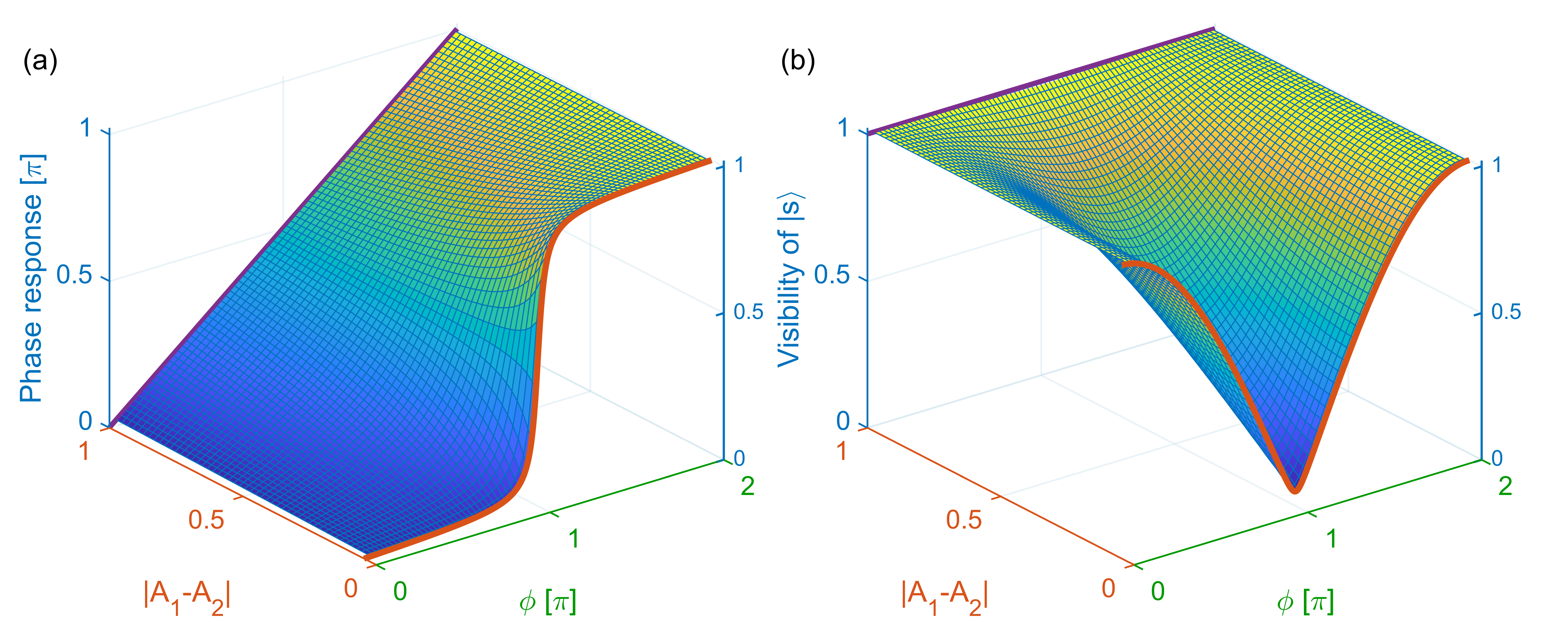
Figure 2: Landscape demonstrating the geometric phase amplification and visibility tradeoff over pathway imbalance and accumulated phase.
This structure is not limited to V-type level ordering; ladder and Λ-type configurations, given proper phase conventions, all exhibit the described projected interference mechanisms. The effective signal observed is governed by the complex amplitude 2π0 with 2π1 encapsulating the pathway imbalance.
Amplification–Visibility Tradeoff and Sensitivity Enhancement
Crucially, as 2π2 approaches zero (nearly balanced pathways), the readout-phase response becomes sharply nonlinear near 2π3, with the projected slope of the phase response scaling as 2π4. At the same point, projected visibility drops to 2π5, enforcing a strict tradeoff between slope enhancement and noise penalty rooted in reduced visibility.
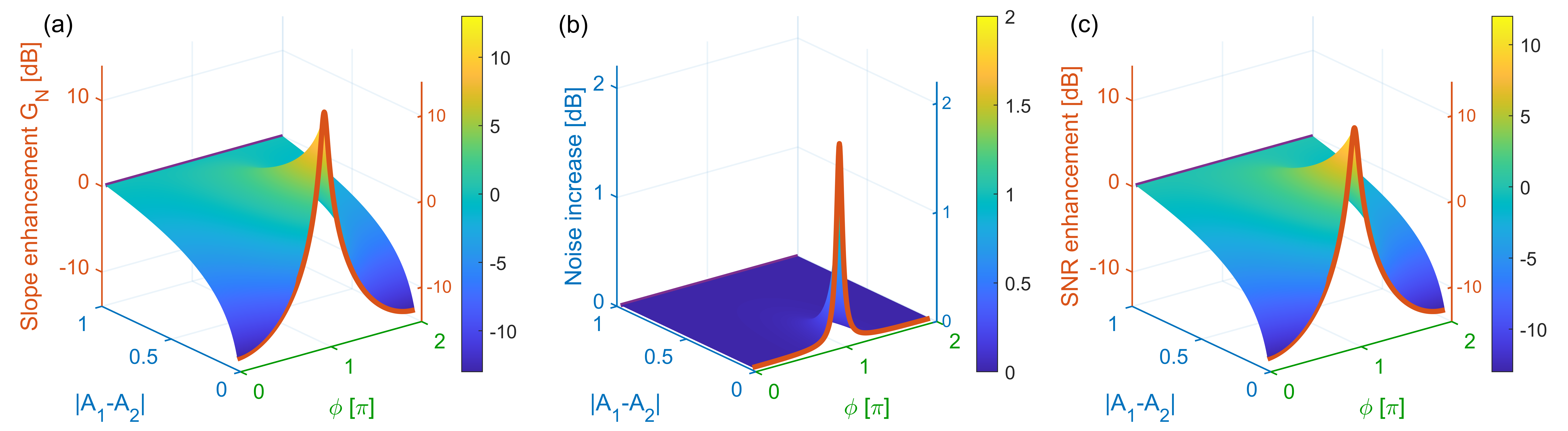
Figure 3: Composite sensitivity landscape showing phase-response gain, visibility-induced noise, and net SNR enhancement as a function of accumulated phase and pathway imbalance.
Quantitatively, the inferred signal-phase uncertainty is
2π6
where 2π7 represents visibility, 2π8 is sensor number, and 2π9 reflects additive classical phase noise. The slope gain can suppress effective technical noise, creating a finite window where the SNR is enhanced relative to standard Ramsey operation.
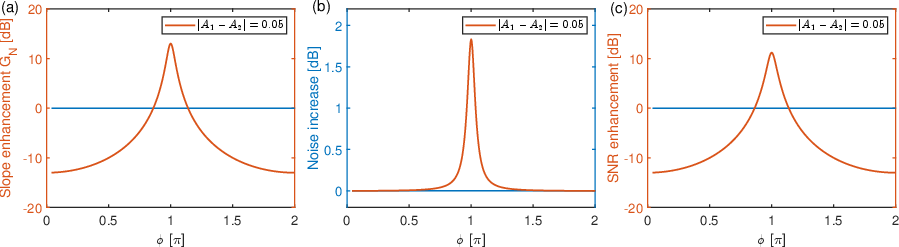
Figure 4: Linecut analyses, highlighting metrological enhancement zones in the geometric-response regime, where phase gain overcomes the visibility penalty.
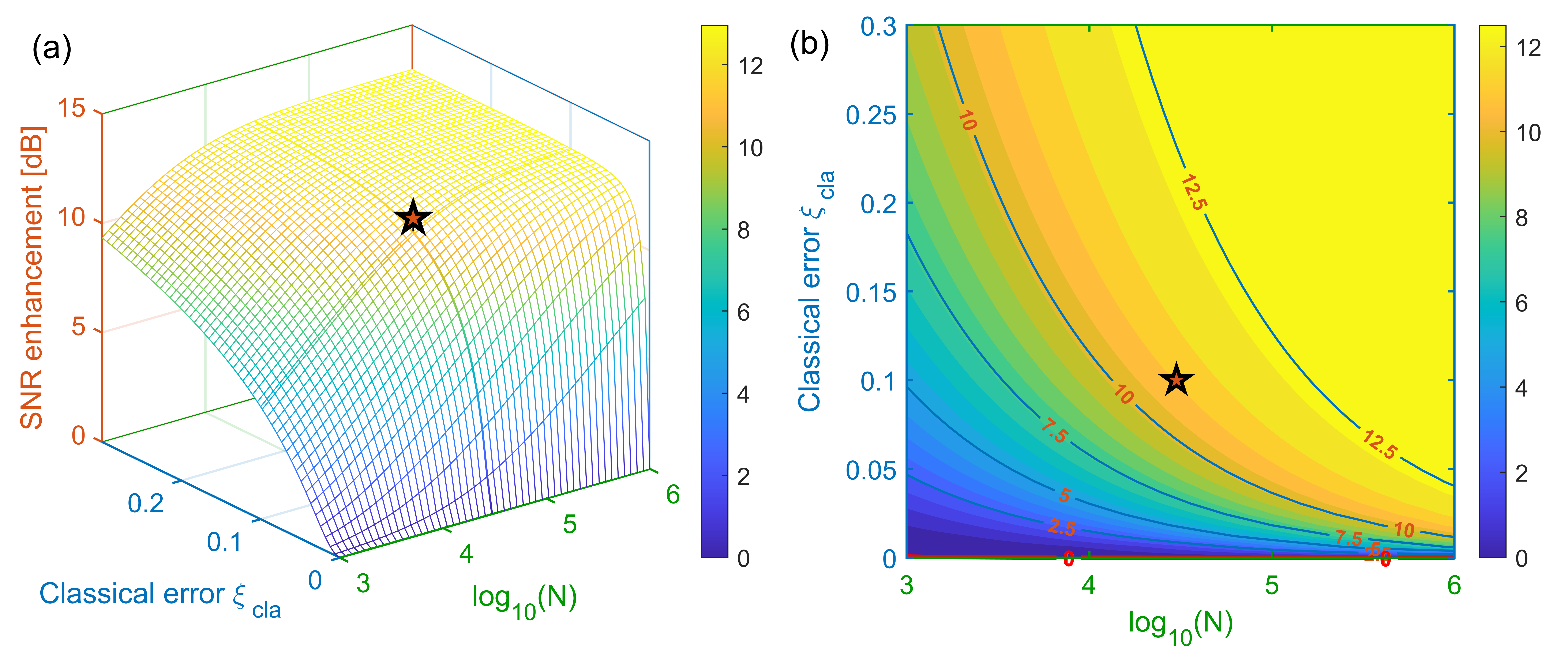
Figure 5: SNR enhancement vs atom number and classical phase noise, indicating strategies for maximizing sensitivity.
Geometric Shortcut Protocol and Stability Implications
The geometric shortcut protocol exploits phase offset control: by presetting the initial Ramsey phase near the critical geodesic-closure point, the high-slope window is accessed with a small additional signal phase, enabling rapid sampling and short-cycle operation without sacrificing local response gain. This approach was shown to yield a projected stability improvement of up to ∣s⟩0 in the noisy regime, with further gains possible via finer imbalance tuning.
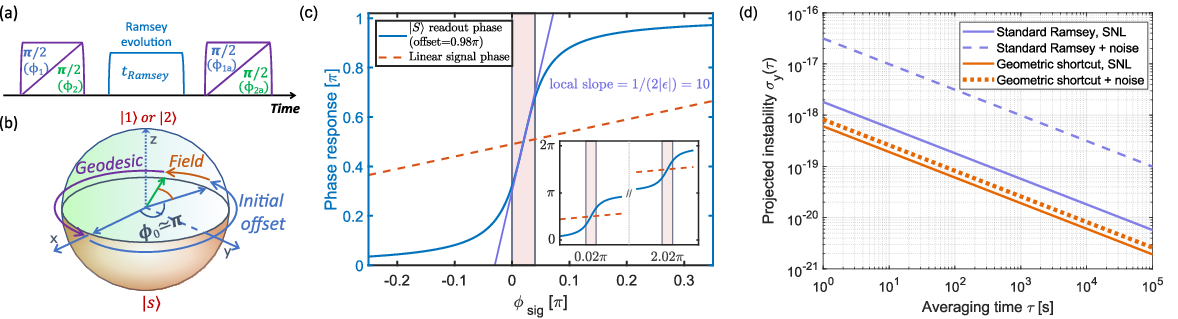
Figure 6: Illustration of the geometric shortcut protocol, offset-controlled phase response, and fractional instability improvements.
Robustness, Practical Considerations, and Future Directions
The three-level geometry delivers genuine multilevel interference, not merely auxiliary state control as in prior three-level schemes. This makes it broadly applicable to systems with accessible multilevel internal structure, such as NV centers in diamond, neutral atoms, and ion platforms. By amplifying local phase response and extending useful averaging regimes, it offers a powerful lever for technical-noise-limited sensors, especially where ensemble scaling is viable and classical noise is dominant.
The geometric response is fundamentally compatible with nonclassical input states (entanglement, squeezing), potentially compounding gains when integrated with quantum-enhanced metrology. Practical optimization requires balancing pathway imbalance, coherence time, duty cycle, and technical floor, especially given density- and ensemble-dependent shifts.
Theoretically, the results generalize geometric phase concepts to noncyclic Ramsey protocols, offering a new framework for mapping signal-phase accumulation to controllable, enhanced local sensitivity, with implications for clock performance, magnetometry, and fundamental tests of relativity and quantum mechanics.
Conclusion
The paper provides a comprehensive framework for noncyclic geometric phase engineering in three-level Ramsey interferometry. By leveraging projected internal-path interference, the protocol reshapes the phase-to-readout mapping, enabling amplified local sensitivity and effective suppression of classical phase noise within a finite window. Offset control yields geometric shortcuts to enhanced stability with faster cycles, positioning multilevel Ramsey sensors as highly tunable, robust platforms for advanced quantum metrology and sensing. The approach invites both practical deployment and theoretical expansion, including synergy with nonclassical states and optimized protocol design.