- The paper introduces an adiabatic Ramsey interferometry approach that leverages symmetry-breaking and adiabatic evolution to measure weak nonlinearities with super-Heisenberg scaling.
- The method employs the quantum Rabi model with motion squeezing to amplify signals, yielding uncertainty scaling as n^(-k/2) for k-th order nonlinearities.
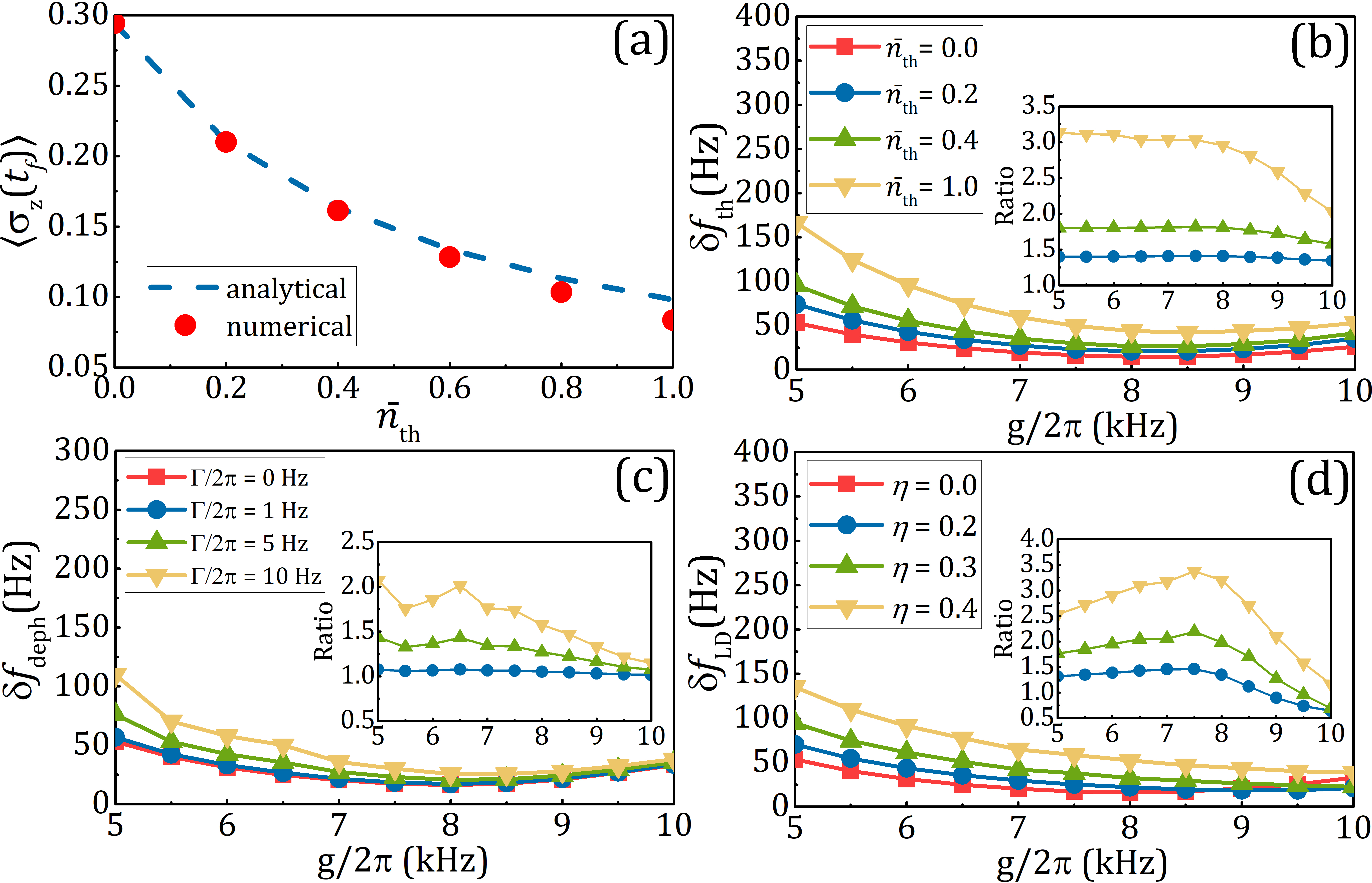
- The protocol demonstrates robustness against thermal noise, spin dephasing, and deviations from the Lamb-Dicke regime, enhancing its practical utility in quantum metrology.
Adiabatic Ramsey Interferometry for Super-Heisenberg Precision Measurement of Weak Nonlinearities
Overview and Motivation
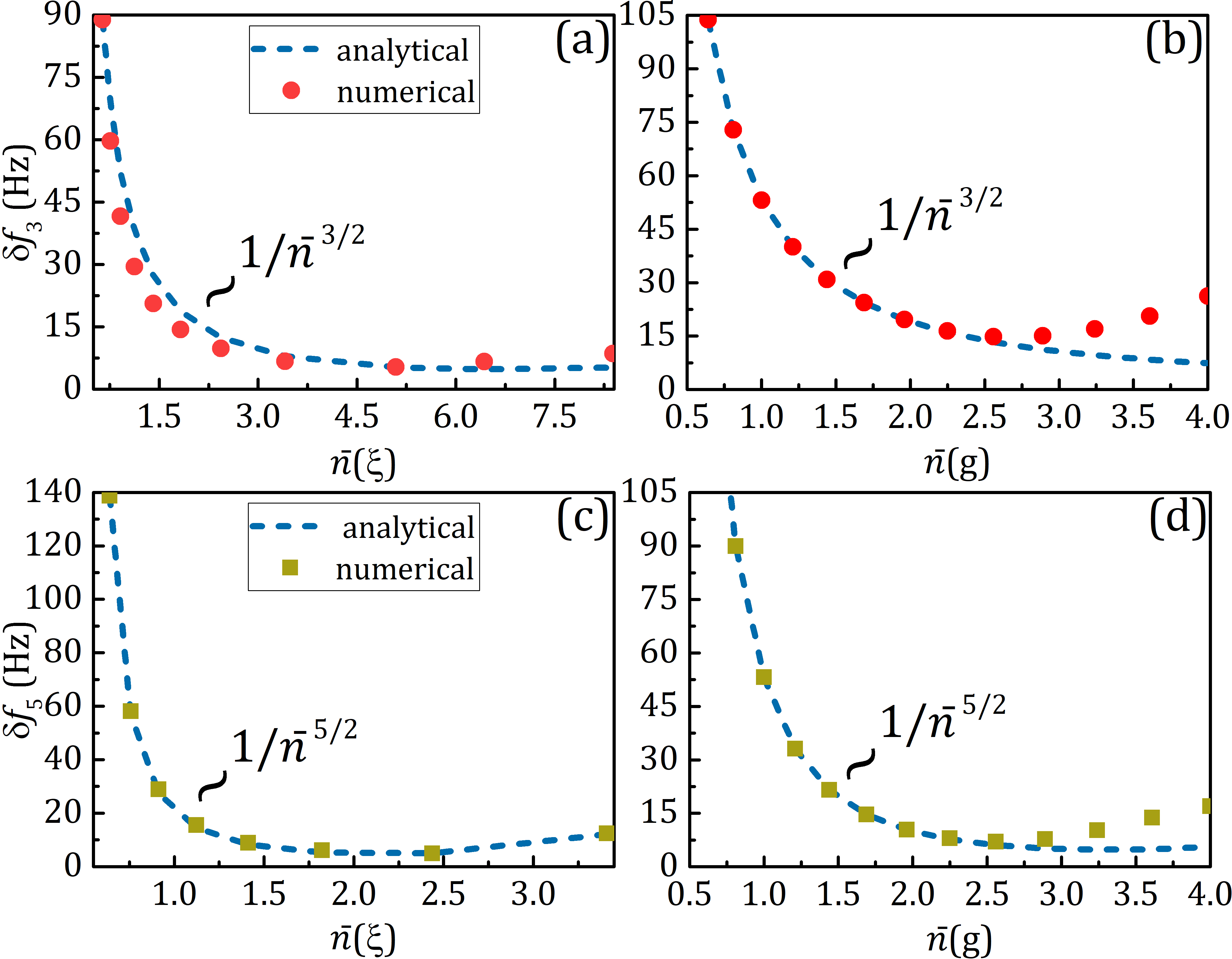
The paper "Adiabatic Ramsey Interferometry for Measuring Weak Nonlinearities with Super-Heisenberg Precision" (2603.29574) introduces an adiabatic Ramsey interferometry protocol targeting precision measurement of weak nonlinearities in trapped ion systems. The methodology employs the quantum Rabi model as a sensor, leveraging adiabatic quantum evolution combined with symmetry-breaking perturbations to amplify the signal of interest. Unlike previous approaches bound by the Standard Quantum Limit (SQL) or Heisenberg Limit (HL), this protocol achieves super-Heisenberg (SH) scaling, where statistical uncertainty scales as δφ∼nˉ−k/2—nˉ is the mean number of phonon excitations and k the order of nonlinearity. This scaling is maintained without intricate entangled state preparation, even with initial thermal states or in the presence of spin dephasing, and is applicable outside the Lamb-Dicke regime.
Quantum Rabi Model Framework
The primary probe is the quantum Rabi model augmented with a motion squeezing term. The Hamiltonian is:
H^(t)=ℏωa^†a^+2ℏΩ(t)σx+ℏgσz(a^†+a^)+ℏξ(a^†2eiθ+a^2e−iθ)
where a^ and a^† are phonon creation/annihilation operators, Ω(t) is the time-dependent Rabi frequency, g the spin-phonon coupling, ξ the squeezing strength, and θ the squeezing phase (nˉ0). The parity symmetry breaking term nˉ1 is introduced to probe nonlinear couplings.
The protocol starts with preparation in the ground state of the Rabi model, followed by an adiabatic ramp-down of nˉ2 resulting in a Schrödinger cat state entangled with the probe's nonlinear parameter. In presence of symmetry-breaking perturbation, the Bloch vector rotates, and the final spin state probabilities encode the nonlinear parameter.
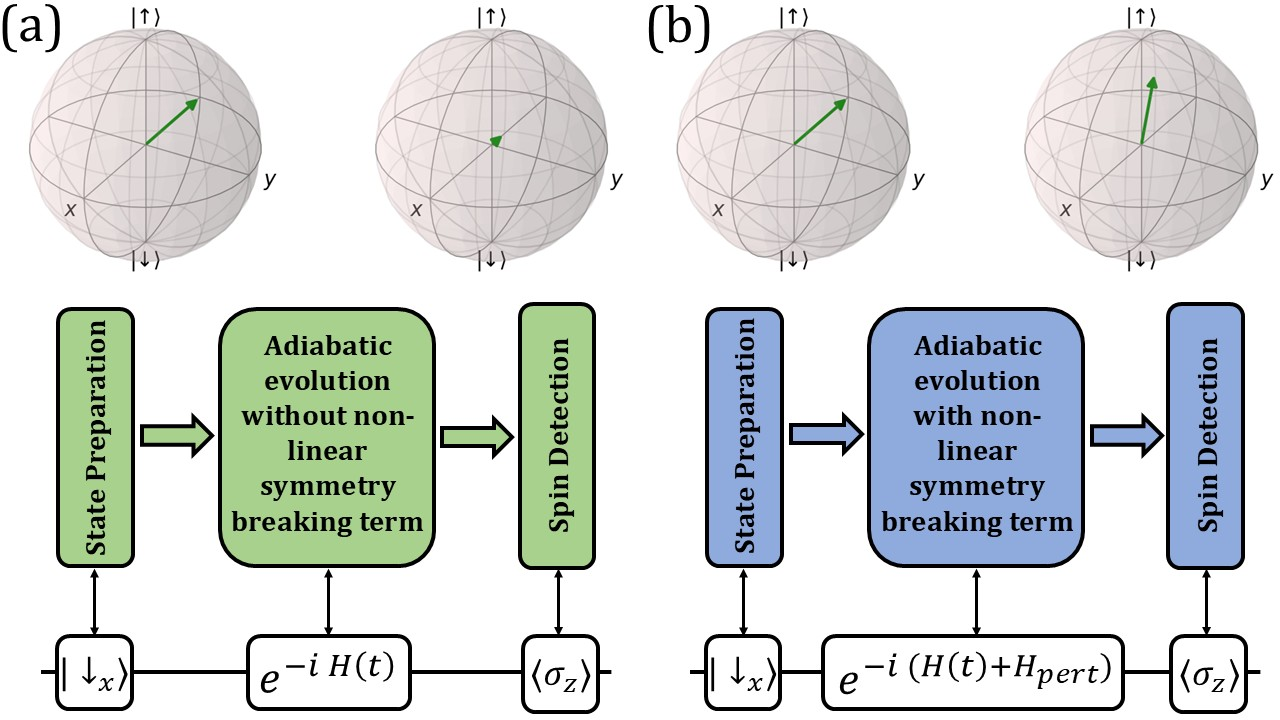
Figure 1: Nonlinear adiabatic Ramsey sequence: symmetry-breaking induces rotation in the Bloch vector, altering final spin expectation nˉ3.
Scaling and Measurement Precision
The statistical uncertainty for estimation is governed by error propagation and quantum Fisher information (QFI):
nˉ4
For a symmetry-breaking term of nˉ5-th order, such as nˉ6, the amplification effect by the phonon excitations enables super-Heisenberg scaling:
The protocol shows this enhancement does not saturate with entanglement complexity and is robust to imperfections, including thermal state initialization and decoherence.
Multi-Mode Nonlinearities
Extension to multi-mode nonlinear couplings (e.g., k1 for two modes, k2 for three modes) results in statistical uncertainties scaling as products of mean phonon numbers in each mode, offering a generalized SH regime. Initial coherent states or motion squeezing can further amplify sensitivity.
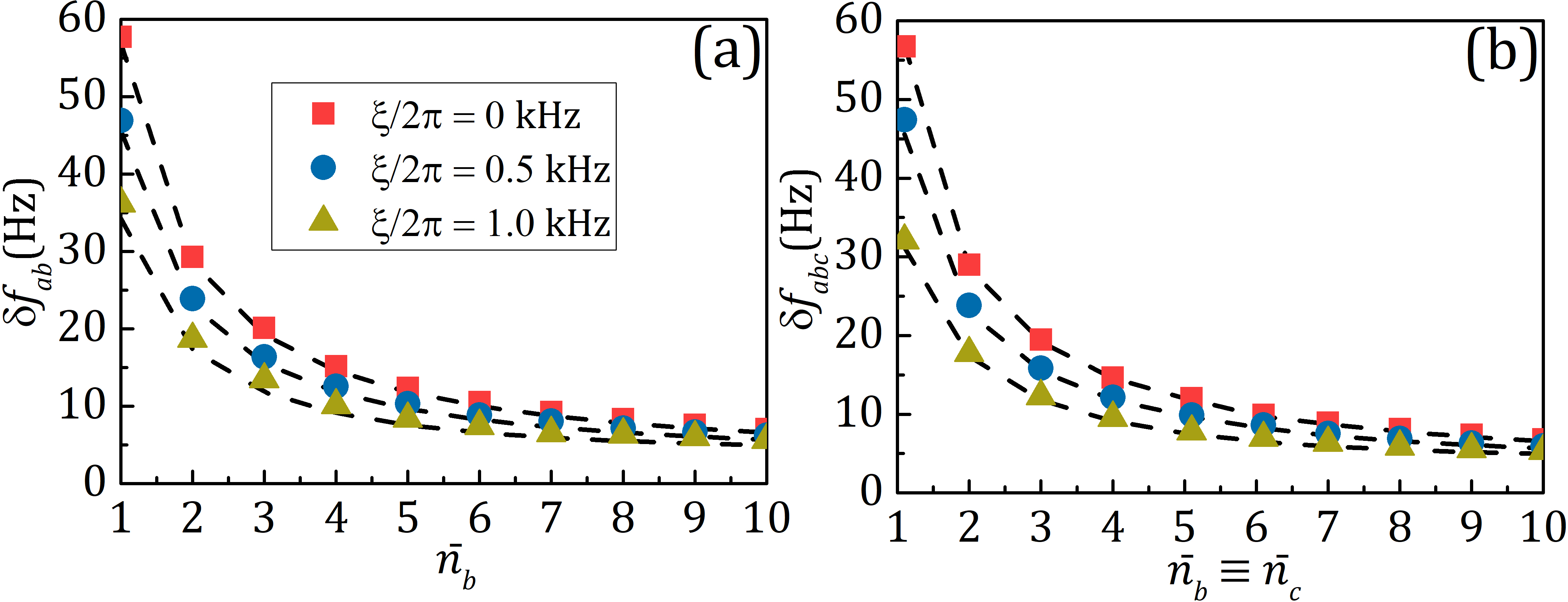
Figure 3: Parameter estimation precision for two-mode (k3) and three-mode (k4) nonlinear couplings; scaling improved with higher initial phonon amplitudes in each mode.
Experimental Robustness
The authors detail the protocol's robustness against typical laboratory imperfections:
Practical and Theoretical Implications
Practically, this protocol empowers quantum metrology with single-spin measurement (no entanglement engineering), high sensitivity (super-Heisenberg regime), and applicability to noisy or non-optimal state preparation environments—a compelling advancement for force, frequency, and nonlinear coupling sensing in trapped ions and other quantum platforms (cavity/circuit QED).
Theoretically, it expands the operational regimes where SH scaling is achievable, demonstrating that high precision is not constrained by particle number or entanglement, but can be leveraged via bosonic mode excitations and adiabatic processes in symmetry-breaking landscapes.
Conclusion
The adiabatic Ramsey interferometry outlined provides a robust, high-sensitivity quantum metrology tool for detecting weak nonlinearities, achieving super-Heisenberg precision scaling through amplified spin signals from phonon excitations. The technique is resilient to experimental imperfections and adaptable beyond the trapped ion platform, underpinning next-generation quantum sensors in precision measurement applications.