- The paper demonstrates efficient ground state preparation for random SK Hamiltonians using TETRIS-ADAPT-VQE, achieving >99.9998% fidelity up to 18 qubits.
- The method uses a symmetry-informed operator pool and gradient thresholding to dynamically build the ansatz and reduce circuit complexity.
- For SYK models, both dense and sparse variants exhibit exponential resource scaling, driven by volume-law entanglement in the ground states.
Ground State Preparation of Random All-to-All Hamiltonians Using ADAPT-VQE
Context and Motivation
This work investigates the variational quantum preparation of ground states for models governed by random, all-to-all Hamiltonians, focusing on the quantum Sherrington-Kirkpatrick (SK) model and both dense and sparse formulations of the Sachdev-Ye-Kitaev (SYK) model. These systems are characterized by their volume-law entanglement structure and non-local interactions, posing significant challenges for classical simulation methods such as tensor networks and neural quantum states (NQSs), especially in regimes relevant to black hole physics, quantum chaos, and disordered systems. Preparation of highly entangled ground states with quantum algorithms could provide practical quantum advantage, but circuit expressivity and resource scaling remain critical bottlenecks.
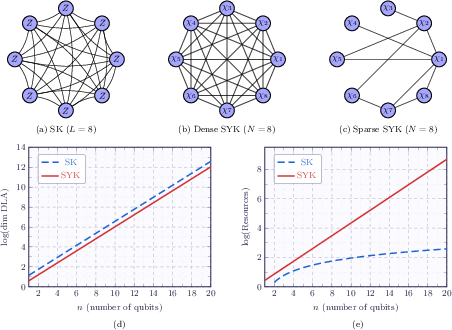
Figure 1: Schematic representations of the SK and SYK models, illustrating all-to-all random couplings. Panels (d) and (e) highlight the dynamical Lie algebra scaling and resource requirements with increasing qubit number for SK (dashed blue) and SYK (solid red).
Methods: ADAPT-VQE and Operator Pool Construction
Ground state wavefunctions were variationally constructed using the TETRIS-ADAPT-VQE algorithm, which dynamically builds the ansatz from a pool of symmetry-respecting Pauli operators. The operator pool pruning leverages parity and time-reversal symmetries for SK, and parity symmetry for SYK, ensuring only relevant generators are considered. Reference states are chosen to reside in the correct symmetry sector, and circuit parameterization is guided by gradient selection thresholds.
The SK model is mapped directly to qubits with random all-to-all ZZ interactions and a transverse X field. The SYK Hamiltonian, formulated in terms of Majorana fermions, is encoded using the Jordan-Wigner transformation, requiring n=N/2 qubits. Both dense and sparse SYK variants are considered; the sparse model is defined by a tunable parameter ks that reduces the number of Pauli terms without fundamentally altering the entanglement structure for ks≳1.
Results for Quantum SK Model
ADAPT-VQE efficiently produces ground states for the quantum SK model up to L=18 qubits, achieving fidelities ≥99.9998%. The circuit depth and CNOT count scale polynomially, even across the critical point Γ/J=1.5, where state complexity increases.
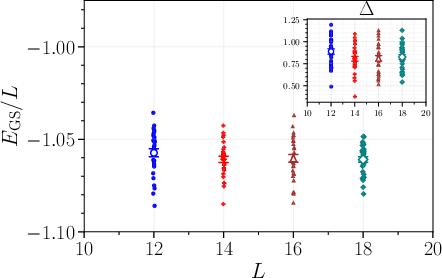
Figure 2: Exact diagonalization results for ground state energy and spectral gap Δ of the quantum SK model for up to 18 qubits.
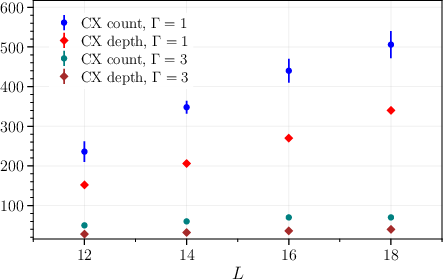
Figure 3: CX count and depth required for unitary circuit ground state preparation of the SK model, for both Γ=1 and X0.
Notably, circuit resource requirements decline for larger X1 (paramagnetic phase), indicating that ground state entanglement structure directly impacts variational complexity. The symmetry-informed operator pool provides an efficient parametrization, as evidenced by modest parameter scaling and rapid convergence.
Results for SYK Models: Dense and Sparse
For the SYK models, TETRIS-ADAPT-VQE constructs ground states with X2 Majorana fermions (10 qubits), achieving fidelities X3. However, the circuit depth and parameter count scale exponentially, both for dense and sparse (X4) SYK. Sparsification reduces the number of Pauli terms but does not alleviate entanglement-driven resource explosion.
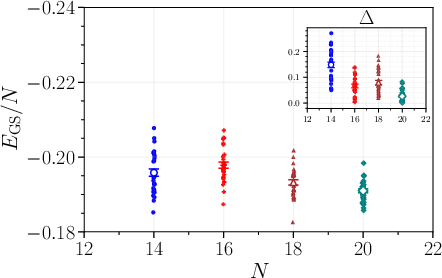
Figure 4: Exact diagonalization of ground state energy and spectral gap X5 for the dense SYK model up to X6.
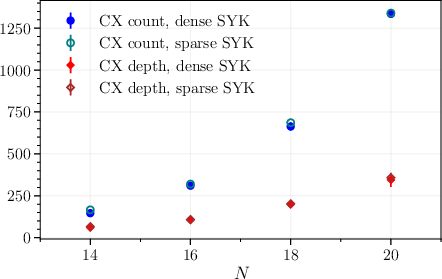
Figure 5: CNOT count and circuit depth for ADAPT-VQE ground state preparation of dense and sparse SYK, averaged over disorder realizations.
This is further corroborated by bipartite von Neumann entanglement entropy calculations:
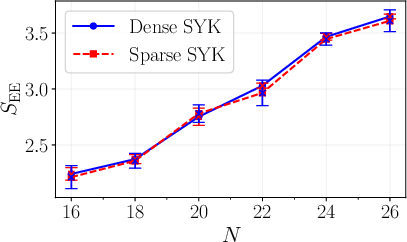
Figure 6: Bipartite von Neumann entanglement entropy showing volume-law scaling for dense and sparse SYK models with X7, for X8 in [16, 26].
Both variants exhibit extensive entanglement with nearly identical coefficients, demonstrating that ground state complexity is determined by entanglement properties rather than the Hamiltonian sparsity parameter for X9. Only for extreme sparsification (n=N/20) do Hilbert-space fragmentation and qualitative changes in complexity emerge.
Analysis of Reference State and Pool Robustness
Extensive tests using highly entangled Clifford and stabilizer configuration interaction (SCI) reference states, as well as pools containing higher-weight Pauli operators, did not improve resource scaling or convergence for SYK models. The inefficiency appears intrinsic, rooted in entanglement and spectral gap characteristics, rather than algorithmic hyperparameter choices.
Implications and Future Directions
The findings establish that ADAPT-VQE provides efficient ground state preparation for random SK Hamiltonians, with favorable scaling and high fidelity suitable for quantum hardware. For SYK models, both dense and moderately sparse, the exponential scaling persists, underscoring the empirical separation between models in terms of quantum algorithmic tractability. The evidence suggests that entanglement structure (volume-law) is the principal determinant of complexity, not merely the number of Hamiltonian terms or operator pool architecture.
Practical consequences include the suitability of quantum SK ground state preparation as a benchmark for near-term quantum advantage, and the need for fundamentally new algorithms or techniques to address SYK-type models. Potential avenues include AVQITE, eigenvector continuation, or tailored Hamiltonian sparsification. Investigation of the sign problem, stoquasticity, and spectral gap dependencies may yield further insight into algorithmic barriers.
Conclusion
This study demonstrates resource-efficient ground state preparation for the quantum SK model using ADAPT-VQE while revealing exponential scaling for SYK-type models driven by extensive entanglement. These results elucidate the limits of current variational quantum algorithms for strongly entangled random Hamiltonians and motivate exploration of alternative methods and foundational questions concerning entanglement-driven quantum advantage and algorithmic complexity for many-body systems.

