Uncertainty Quantification for Flow-Based Vision-Language-Action Models
Published 16 Jun 2026 in cs.RO and cs.LG | (2606.18043v1)
Abstract: Vision-language-action models (VLAs) combine vision-language backbones with expressive generative action heads trained via flow matching on large-scale robotic datasets. Despite their strong empirical performance in robotic manipulation, VLAs lack mechanisms to quantify confidence in their predictions and to detect when their actions may be unreliable. This presents a critical limitation for real-world deployment in non-stationary environments, where models inevitably encounter scenarios outside their pretraining distribution and may fail without warning. To address this, we derive an efficient method for quantifying epistemic uncertainty in flow-matching models by leveraging velocity-field disagreement (VFD) across a small ensemble. We successfully use this uncertainty estimate for failure detection during deployment and active fine-tuning of flow-based VLAs. To this end, we propose SAVE, a framework for uncertainty-guided active multitask fine-tuning that reduces the number of costly expert demonstrations required to adapt VLAs to new tasks. Through extensive experiments on the LIBERO benchmark, we demonstrate that VFD yields better-calibrated uncertainty estimates predictive of downstream performance, that VFD achieves strong performance in detecting failures, and that uncertainty-guided data acquisition with SAVE requires at least 22% fewer samples than baselines. In summary, our work shows that quantifying epistemic uncertainty in flow-based VLAs improves both failure awareness and adaptation. Project website: tum-lsy.github.io/uq_vla/.
The paper introduces the Velocity Field Disagreement (VFD) method to quantify epistemic uncertainty in flow-based Vision-Language-Action models.
It mathematically derives VFD from pairwise KL-divergence and demonstrates efficient uncertainty estimation with minimal ensemble models.
The SAVE framework leverages VFD for active fine-tuning, reducing expert demonstration requirements by up to 50% while improving failure detection.
Uncertainty Quantification for Flow-Based Vision-Language-Action Models
Introduction
"Uncertainty Quantification for Flow-Based Vision-Language-Action Models" (2606.18043) rigorously addresses the integration of epistemic uncertainty estimation into flow-matching-based Vision-Language-Action Models (VLAs), specifically for robotic manipulation domains. Flow-matching models constitute the state-of-the-art in generalist VLA policy design, but suffer from overconfidence and lack explicit mechanisms to quantify when their actions might be unreliable—creating a substantial bottleneck for out-of-distribution (OOD) robustness, safety, and efficient adaptation. This work mathematically characterizes epistemic uncertainty in flow-matching VLAs, introduces the Velocity Field Disagreement (VFD) uncertainty estimate, and demonstrates the utility of VFD in real applications: runtime failure detection and Sample-efficient Active fine-tuning via Velocity field Epistemic uncertainty (SAVE)—a multi-task active adaptation framework minimizing the cost of expert demonstration queries.
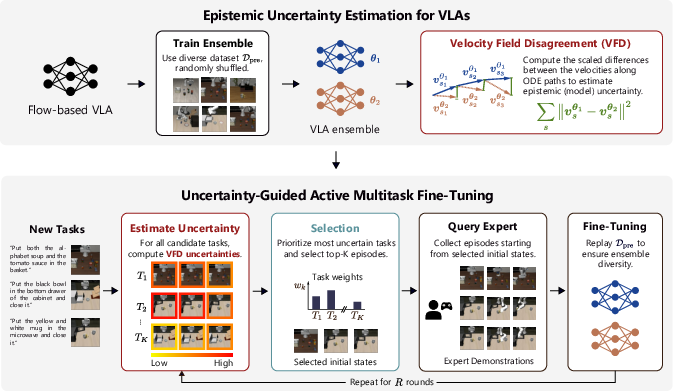
Figure 1: Top: VFD quantifies epistemic uncertainty by measuring scaled differences between ensembled velocity fields. Bottom: SAVE uses VFD to prioritize tasks and observations for demonstration collection, enabling data-efficient multitask adaptation.
Epistemic Uncertainty in Flow-Based Generative Policies
Mathematical Foundation
Traditional uncertainty quantification differentiates between aleatoric (irreducible) and epistemic (knowledge-related, reducible) components. For conditional generative models parameterized by neural networks, epistemic uncertainty corresponds to the mutual information between parameters and outputs, typically estimated using model ensembles.
The paper establishes a tractable surrogate for epistemic uncertainty using ensembles of flow-matching models. Deriving from first principles, it shows the pairwise KL-divergence upper bounds the epistemic uncertainty—and further, for flow-matching networks, this divergence reduces to a (weighted) expected squared difference between their predicted velocity fields. Thus, Velocity Field Disagreement (VFD) is introduced: ue(y;V)=M(M−1)Ns1Ex0∼p0i=j∑ℓ=0∑Ns−1κsℓvsℓ(i)(xsℓ(i),y)−vsℓ(j)(xsℓ(i),y)22,
where vsℓ(i) is the velocity field of the ith model at time sℓ, and κsℓ weights later timesteps more heavily, reflecting the greater informational value near the (less noisy) data distribution.
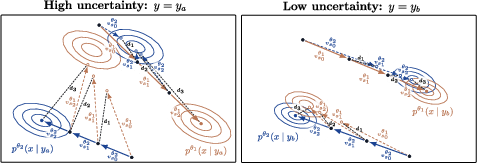
Figure 2: Visualization of VFD computation for two conditioning inputs with different levels of epistemic uncertainty.
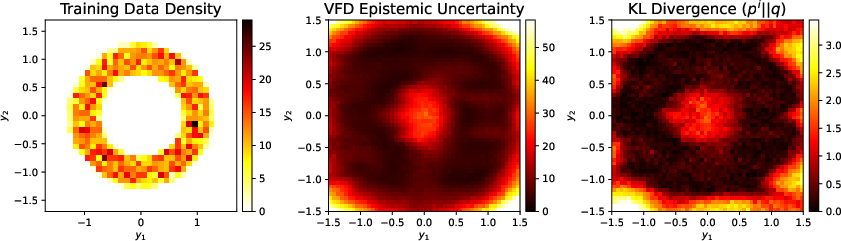
Figure 3: 2D toy example: VFD uncertainty is highest for OOD inputs and closely tracks the KL divergence between model and ground-truth conditional distributions.
Notably, VFD can be estimated efficiently via lightweight two-member ensembles, and is more computationally tractable than full likelihood or divergence-based alternatives.
The SAVE Framework for Active Multi-Task Adaptation
The work further introduces SAVE (Sample-efficient Active fine-tuning via Velocity field Epistemic uncertainty), a method for data-efficient adaptation of pre-trained VLAs to new tasks/environments. SAVE leverages VFD to make two key decisions during active fine-tuning episodes:
Task Prioritization: Aggregate mean VFD per-task to construct a (possibly temperature-skewed) sampling distribution favoring tasks where epistemic uncertainty is highest—allocating demonstration budget where the VLA is least confident.
Initial State Selection: Within each sampled task, select the candidate observation with highest VFD, thereby requesting demonstrations that resolve maximal epistemic uncertainty.
The policy ensemble is fine-tuned iteratively on a mixture of newly collected data and pre-training data (to prevent catastrophic forgetting), updating the VFD metric after each round.
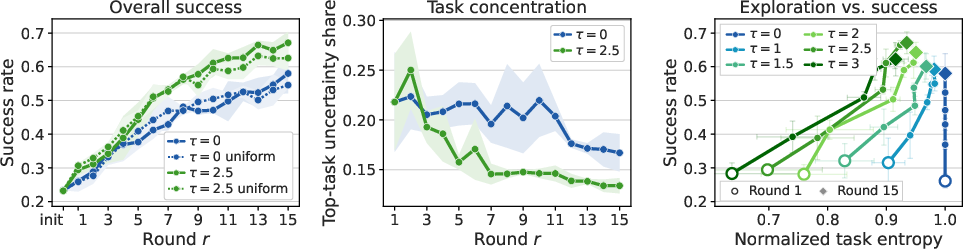
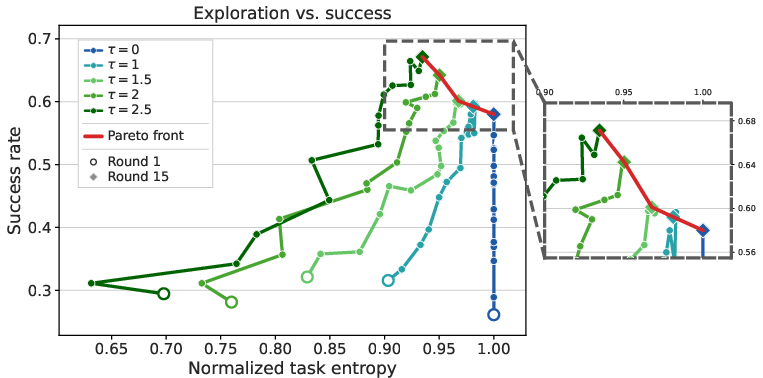
Figure 4: Influence of sampling temperature τ on SAVE. Higher τ biases demonstration selection toward high-uncertainty tasks but trades off against exploration. Both task and observation-level uncertainty guidance are beneficial.
Figure 5: Pareto front visualizing tradeoff between exploration (uniform task coverage) and exploitation (success rate), parameterized by temperature τ.
Empirical Evaluation
Uncertainty Estimation and Calibration
The paper provides strong evidence that VFD delivers superior calibration and practical informativeness compared to existing alternatives:
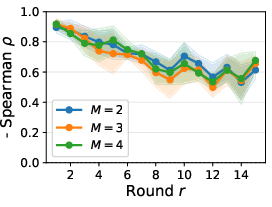
VFD achieves the highest (absolute value) negative Spearman and Pearson correlation between uncertainty and success rate among all tested methods. Notably, the method remains robust with only two ensemble members, offering a favorable compute/accuracy tradeoff.
Figure 6: Increasing the VLA ensemble size beyond two members yields little further improvement—enabling computationally efficient VFD estimation.
VFD demonstrates sound calibration across both visual and language perturbations, indicating that it properly captures model knowledge gaps for diverse input modalities.
Sample-Efficient Multi-task Active Fine-tuning
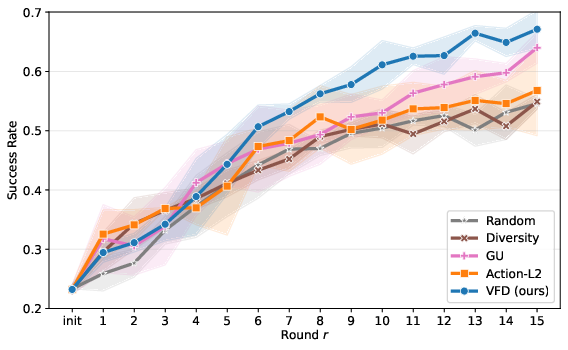
SAVE with VFD uncertainty delivers strong sample efficiency: for challenging multi-task adaptation in the LIBERO-10 benchmark, it requires at least 22% fewer expert demonstrations to achieve the same success rate as the best alternative uncertainty-estimation baselines, and up to 50% fewer samples compared to random or diversity-based selection. The final success rate reached is up to 67%, outperforming all competitors under fixed demonstration budgets.
Figure 7: Learning curves for active fine-tuning. SAVE with VFD uncertainty rapidly achieves high success rates with fewer demonstrations.
Task-level uncertainty prioritization provides most of the gain, though both levels of uncertainty guidance provide additive benefit. The temperature τ for task selection mediates a practical exploration/exploitation trade-off.
Failure Detection
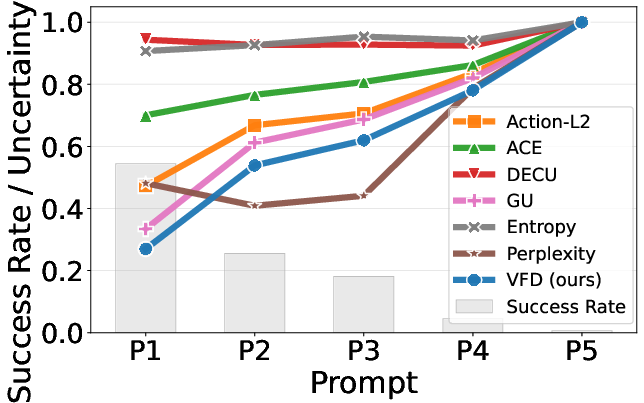
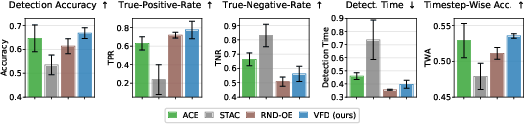
The VFD score, evaluated during policy deployment, is highly predictive of imminent policy failures, outperforming recent baselines on detection accuracy and early identification (timestep-wise accuracy):
Figure 8: Detailed failure detection results. VFD achieves the highest timestep-wise accuracy for prompt and reliable failure detection during deployment.
This supports VFD as an actionable runtime reliability signal for safe deployment of generalist VLAs.
Implications and Outlook
Practical and Theoretical Impact
This work formally integrates epistemic uncertainty quantification into state-of-the-art flow-matching VLAs—a key requirement for trustworthy deployment in OOD environments and sample-efficient real-time adaptation. VFD provides computationally tractable, ensemble-based model uncertainty, and the SAVE framework leverages this to minimize human demonstration costs for real-world continual robot learning.
Strong accuracy and calibration results suggest that VFD can supersede more naïve action-space or entropy-based uncertainty signals in both safety filtering and data selection. The reliability of a small, efficiently trained ensemble is particularly valuable for foundation VLA architectures, where full Bayesian inference or high-capacity ensembling is often infeasible.
Open Challenges and Future Directions
Beyond Episodic Demonstration Queries: The current framework does not quantify informational dependencies across tasks; incorporating explicit Bayesian design or maximally informative demonstration selection across tasks could enhance efficiency.
Reducing Ensemble Dependence: While two-member ensembles are efficient, further research into single-model proxies (e.g., hypernetworks, last-layer Bayesianization, or Riemannian posteriors) could broaden deployment feasibility.
Closed-Loop RL and Model-Based Integration: Combining VFD-based metrics with video world models, online reinforcement learning, or uncertainty-aware runtime safety mechanisms could yield further robustness and autonomy improvements for generalist robots.
Conclusion
This work establishes a rigorous mathematical and algorithmic foundation for epistemic uncertainty quantification in flow-based VLAs, introduces the VFD metric, and demonstrates its efficacy for failure detection and data-efficient multi-task adaptation. Experimental results showcase that VFD and the SAVE framework provide reliable, well-calibrated, actionable uncertainty signals—improving safety, robustness, and sample efficiency for robotic policy deployment and adaptation in complex real-world environments (2606.18043).