- The paper introduces a conceptual framework that models LLM agents' behavior using classical utility theory and behavioral economics.
- It employs NLP experiments to compare model-driven decision-making, revealing stable yet prompt-sensitive preferences in LLMs.
- The study highlights that agentic market dynamics can reduce consumer heterogeneity and pose challenges for ethical market design.
Introduction
LLM Consumer Behavior Theory provides a systematic framework for investigating consumption decisions executed by LLM-based agents acting as proxies for human users. By consolidating microeconomic utility theory, behavioral economics, and methodologies from NLP, the paper delineates how individual human preferences are expressed, instantiated, and operationalized by autonomous agents, and how these agent-level decisions propagate to market-scale phenomena. The conceptual mapping foregrounds emergent questions of alignment, rationality, demand aggregation, and market dynamics under the regime of agentic decision-making.
Individual Choice: Utility Theory and Behavioral Foundations
The theoretical core is grounded in established microeconomic models—the rational choice model posits utility-maximizing consumers bounded by constraints such as prices and budget limits. This is formalized as U(x)=V(x)+ε, where observable and unobservable (random) components are partitioned as in random utility theory. Modern NLP experiments mirror these setups, evaluating LLM decision regularities and mapping revealed preferences through discrete choice methodologies. Evidence demonstrates that larger LLMs exhibit more stable and interpretable preferences compared to their smaller counterparts, and that their choices can be parameterized within classical economic models.
Behavioral economics is leveraged to interrogate the layers of (ir)rationality in LLM decision-making. While the models can demonstrate aspects of economic rationality—such as consistent transitivity and orderability—empirically they often fail information grounding and exhibit context-sensitivity, making their rational actor status tenuous and highly prompt-dependent. Notably, LLMs manifest systematic behavioral biases: elevated discount rates in dynamic tasks, susceptibility to framing and nudges, and non-trivial risk attitudes. The magnitude and direction of these biases are highly model-specific, and efforts at remediation (e.g., multimodal integration or additional alignment layers) offer only partial improvements to rationality benchmarks.
User-Agent Alignment: Principal-Agent Dynamics and Personalization
In agentic commerce, LLMs function as agents within a principal-agent framework, inheriting—imperfectly—the preferences of human users. Misalignment arises from incomplete preference transmission, developer priors, and the limitations of persona-driven context instantiation. The canonical protocol of “persona assignment”—prompting LLMs to act as simulacra of user profiles—shows efficacy for simple tasks but suffers from inconsistency for edge-case or minority preferences, and can lead to excessive stereotyping and behavioral extremities.
Model personalization via in-context or fine-tuning based on user's historical choices offers a path to improved alignment, yet full-scale per-user fine-tuning remains intractable at market scale due to data and computational inefficiencies. Innovations such as low-rank reward modeling (e.g., LoRe) reduce resource demands and enable modular preference aggregation, but systematically resolving alignment for large, diverse populations remains unsolved.
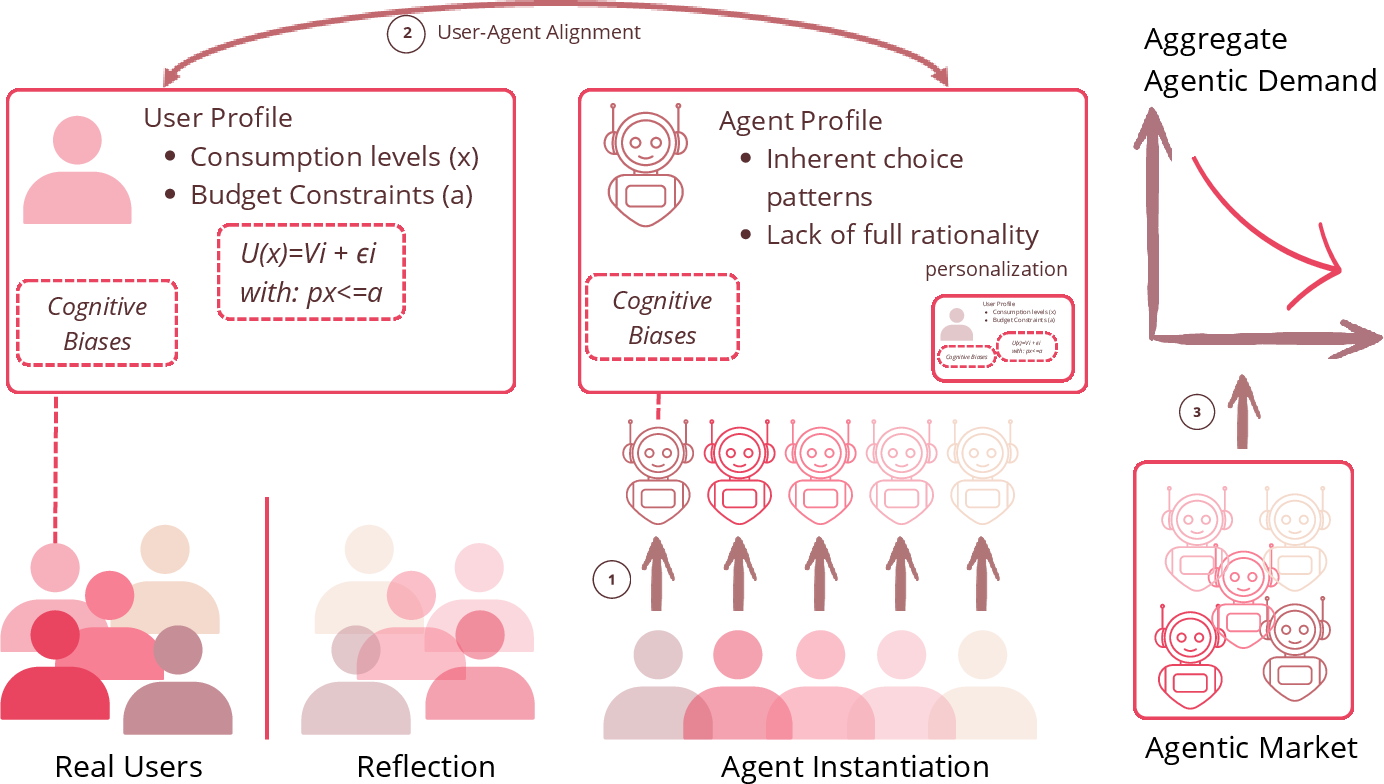
Figure 1: The LLM Consumer Behavior Theory schema, where individual preferences are instantiated as agent profiles; these aggregate to define agentic market demand.
Aggregation and Market-level Dynamics
At the population level, the shift from human-driven to agentic markets introduces structural changes in demand heterogeneity. Whereas classical market demand merges a broad distribution of individual willingness-to-pay valuations, agentic markets display a tendency toward homogenization. This arises from two interlocking factors: the statistical centrality of LLM pretraining corpora (favoring modal, high-frequency behaviors) and the convergence of architectural, fine-tuning, and alignment paradigms in deployed LLMs.
Empirical evidence already indicates reduced heterogeneity: LLM-agent populations default to more uniform preference structures, concentrate demand on a limited subset of options, and display instability across model updates. These effects have extensive implications for market dynamics, including susceptibility to sudden market share shifts, a flattening of differentiated demand, and potential systemic risks from concurrent agent-based adaptations.
Mechanisms for reintroducing heterogeneity encompass both model-level interventions (e.g., model architecture diversity, increased temperature settings) and user-level alignment (fine-grained persona differentiation). There are early indications that, when carefully tuned, LLM agents can reproduce household-level diversity and yield macro-level consumption patterns coherent with traditional economic theory.
Implications, Open Questions, and Future Research Directions
Theoretical Implications: LLM Consumer Behavior Theory calls for a re-evaluation of fundamental assumptions in consumer economics. The locus of autonomy is repositioned from the human subject to the user-model dyad. Economic rationality becomes a function of both model design and user alignment procedures, while market-level equilibrium and welfare analyses must account for the algorithmic mediation of preferences.
Practical Implications: As agentic markets grow, the efficacy of personalization, robustness to manipulation (through prompt steering or adversarial nudging), and resilience of demand diversification become critical for policy and industry. Risks of preference collapse, emergent collusion through monoculture LLM systems, and loss of minority representation become prominent. Questions of accountability, user consent, and transparency in agentic decisions emerge as central in both regulatory and ethical discourse.
Key open research questions include:
- What are the limits of agentic personalization, and what minimum data or architectural complexity is required for robust user alignment?
- How do biases or idiosyncratic model failures propagate from agents to aggregate market outcomes?
- In hybrid human-agent markets, how are prices, equilibria, and welfare distributions shifted compared to classical expectation?
- What regulatory and ethical interventions are needed to safeguard diversity, transparency, and user autonomy?
Conclusion
LLM Consumer Behavior Theory constitutes a foundational contribution to the formal analysis of AI-mediated consumption. By synthesizing economic theory and LLM alignment science, it enables diagnostic and predictive reasoning about agentic market operations, user-agent interactions, and the macroeconomic impact of large-scale agent deployment. The delineated framework and its identified open questions will catalyze both theoretical advances and empirical investigation into the evolution of consumer markets under pervasive agentic automation.