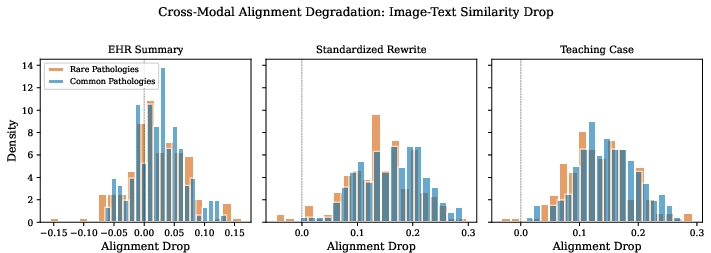
- The paper quantifies degradation in LLM-rewritten radiology reports, revealing up to 51.4% entity loss and significant cross-modal misalignment.
- It employs controlled experiments on 450 stratified chest X-ray reports using scispaCy for entity extraction and BiomedCLIP for measuring image-text alignment.
- The study demonstrates that standardization techniques, though preserving some content, trigger the 'slop paradox' by decoupling clinical detail from diagnostic images.
The Slop Paradox: Synthetic Standardization Erodes Clinical Uncertainty and Cross-Modal Alignment in AI-Rewritten Radiology Reports
Introduction
This work presents the first systematic quantification of information degradation in LLM-rewritten radiology reports, focusing on three distinct contamination vectors: EHR-focused summarization, standardized rewriting for NLP, and teaching case reformulation. Through controlled experiments on 450 stratified chest X-ray reports from the Indiana University dataset, the paper measures three axes of degradation—entity loss, hedging language collapse, and image-text alignment drop. The central discovery is a strong dissociation between the severity of information loss and the loss of cross-modal (image-text) fidelity: the more LLM rewriting is optimized for "clean" or standardized downstream text (presumably to improve model training), the more it ironically disrupts alignment between clinical images and their paired text, a phenomenon termed the “slop paradox.”
Methodological Overview
The methodology leverages stratified sampling across rare, common, and "normal" pathologies. Each report is rewritten in three contamination scenarios with a Gemini 2.5 Flash LLM. For each synthetic report, medical entity retention is measured via scispaCy NER. Hedging language, significant in radiological communication, is mined via regexes covering 18 canonical uncertainty markers. Cross-modal alignment is rigorously quantified using BiomedCLIP’s image-text cosine similarity, reflecting the core dependency of medical VLMs on accurate pairing.
Metrics are analyzed with statistical hypothesis testing for rare-versus-common pathologies and effect sizes. Notably, all synthetic rewirings are single-step generations, isolating direct information loss and alignment drift from recursive data contamination or model collapse.
The Slop Paradox
The most salient result is the paradoxical effect of different rewriting objectives:
This dissociation, the slop paradox, establishes that "data cleaning" through LLM-based restyling to fit perceived NLP or VLM prerequisites is counterproductive for preserving clinically relevant image-text correspondence.
Entity Erosion and Hedging Collapse
Entity retention is inversely proportional to the compression imposed by summarization. Aggressive EHR summarization truncates reports to ~68% of their original length, removing much of the specific detail required for medical reasoning. Standardized rewriting and teaching cases generate longer reports, but increased verbosity predominantly inflates format and explanatory filler, not clinical substance.
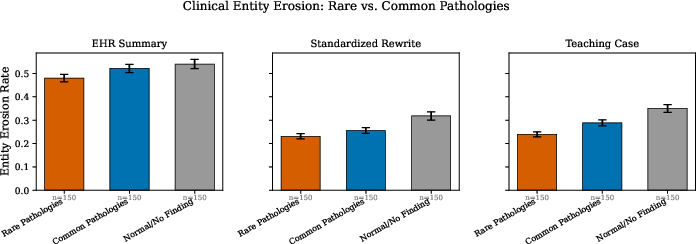
Figure 2: Entity erosion by pathology group and contamination type. Erosion shows no preferential effect on rare conditions; if anything, the common and normal groups erode slightly more. EHR summarization causes the highest erosion due to aggressive compression.
Hedging language, a critical marker of uncertainty and diagnostic caution, is non-negligibly destroyed in all synthetic variants (26–44% collapse). The effect is most severe in "normal" reports, where uncertainty language is compressed into generic findings, erasing subtle distinctions in clinical interpretation.
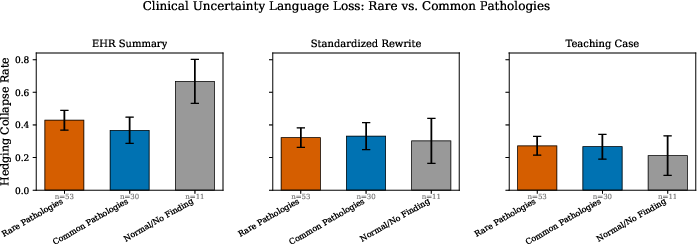
Figure 3: Hedging collapse by pathology group and contamination type. Only reports with hedging in the original are included (n = 94). Normal reports show the highest collapse rate.
Compression ratios further elucidate the mechanism by which summarization drives entity erosion—the more drastic the text reduction, the greater the loss of discrete clinical entities.
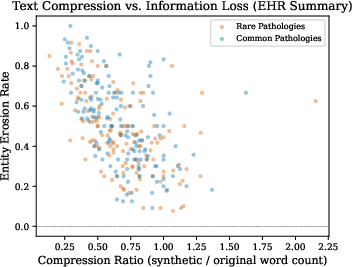
Figure 4: Compression ratio (synthetic/original length) vs. entity erosion for EHR summaries. Lower ratios, indicating more aggressive shortening, are associated with higher entity erosion; the trend holds across pathology groups.
Pathology Rarity and Visibility of Contamination
Contrary to prior hypotheses that rare clinical findings would be most vulnerable to model-based contamination (as observed in recursive model collapse literature), single-step rewriting does not preferentially degrade rare pathologies. Across all metrics and conditions, no significant differential effect survives multiple-comparison correction, and nominal trends (entity erosion, alignment drop) run in the opposite direction (greater loss for common pathology reports). The implication is substantial: performance monitoring at the condition level will not reveal LLM-induced dataset contamination.
Discussion
The practical and theoretical ramifications are sharp. First, tasks aimed at standardizing data for improved downstream model performance can destroy the multimodal training signal by decoupling image and text representations. For medical AI, this means that heuristic "cleaning" of clinical text using LLMs is likely detrimental when constructing paired datasets for VLM or multimodal retrieval training. For clinical audit trails, LLM rewriting erases clinically essential uncertainty markers, introducing critical patient safety risks if summaries are integrated into the medical record without rigorous content validation.
The absence of rare pathology vulnerability in single-step rewriting reflects the uniform compression strategy of LLMs and the relatively terse nature of the underlying dataset. However, the preconditions for recursive information collapse remain: substantial entity and alignment erosion in the ground-truth-synthetic pairings will, if uncorrected, propagate and amplify with further model retraining on contaminated data.
Governance Recommendations and Future Directions
The study stipulates actionable governance guidelines:
- Entity retention audits must be mandatory for clinical documentation workflows using LLMs.
- LLM-driven standardization or teaching-case rewriting should be avoided for dataset curation unless direct measures of cross-modal degradation are incorporated into curation protocols.
- Data provenance for clinical text must record and expose synthetic transformation events, safeguarding downstream transparency and model interpretability.
The research underscores the need for future retraining studies measuring the cumulative impact of recursively contaminated datasets on clinical VLMs and the refinement of stratification schemes for nuanced monitoring of differential information loss across pathology classes and clinical complexity. Augmenting synthetic text generation with retention-preserving constraints and uncertainty-aware decoding is a viable avenue for research in document generation for clinical domains.
Conclusion
This study provides definitive evidence that LLM-based rewriting of radiology reports causes a statistically and clinically significant erosion of critical clinical and multimodal information. The degree of degradation is driven by the type of synthetic rewriting, with practices oriented toward dataset “cleaning” inflicting the greatest cross-modal damage while failing to reliably protect or reveal rare condition data. These findings demand a re-examination of LLM usage in both clinical documentation workflows and multimodal AI dataset preparation, and they introduce new, testable constraints for responsible data governance in medical AI systems.