- The paper presents the first divertor exposure experiments using renewable boron pebble aggregates in DIII-D, highlighting an exponential increase in recession rates with heat flux.
- The paper employs advanced diagnostics, including spectrometry and IR imaging, to quantify erosion, dust generation, and impurity transport under extreme conditions.
- The paper finds that mechanical detachment dominates mass loss with only about 50% of boron being locally recovered, suggesting key material and design optimizations for future applications.
Divertor Exposure of a Renewable Boron Pebble Aggregate in DIII-D
Introduction
This study presents the first exposure of a renewable boron pebble aggregate as a plasma-facing component (PFC) to the divertor plasma of a tokamak, specifically targeting the high-heat-flux environment of the DIII-D device. The motivation is rooted in the limitations of fixed solid PFCs (e.g., tungsten) for handling the extreme steady-state (∼40 MW/m2) and transient divertor heat loads projected for future fusion power plants. The renewable pebble aggregate concept seeks to address erosion, slag accumulation, tritium retention, and operational robustness by enabling local replacement and recovery of PFC material in high-flux regions without the drawbacks of liquid metals or full wall coverage.
The study focuses on boron—a low-Z material with favorable tritium retention and radiation characteristics—fabricated as sintered amorphous pebbles and bound with a carbon-based binder. The experimental campaign assesses emission, recession mechanisms, dust generation, and material recovery under single-rod, high-flux divertor exposures. These findings establish key performance boundaries for boron aggregates and guide directions for future material and engineering development.
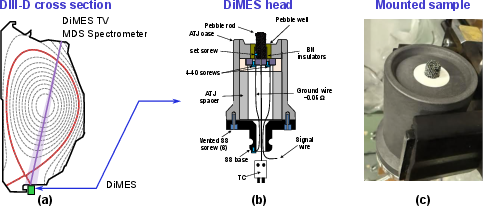
Figure 1: Experimental geometry for boron pebble aggregate exposure using DiMES in DIII-D.
Experimental Methodology
Boron pebble aggregates (1 cm diameter rods, with 2 mm sintered boron pebbles and a carbon binder) were installed in DiMES holders and inserted into the DIII-D lower divertor. Each rod was exposed to L-mode plasmas with parallel heat fluxes up to 80 MW/m2, far exceeding typical steady-state reactor loads due to the single-rod geometry. Diagnostics included:
- Mass change by pre- and post-exposure weighing
- Local emission (B-II at 412 nm) via absolutely calibrated MDS spectrometer and DiMES TV imaging
- Core B5+ and C6+ via CER
- IR and visible imaging for pebble temperature, dust trajectories, and emission plume morphology
- Modeling with EDGE2D-EIRENE for impurity transport and source strength benchmarking
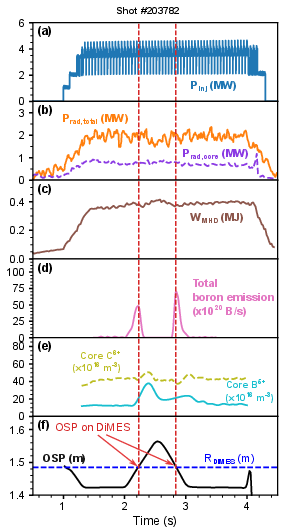
Figure 2: Temporal evolutions of power, core parameters, boron emission, and strike point position during a boron rod exposure.
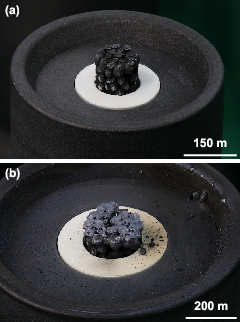
Figure 3: Boron pebble rod pre- (a) and post- (b) exposure, showing surface melting and pebble detachment.
Results and Analysis
Erosion and Dust Generation Mechanisms
Exposure led to significant surface wear, dust emission, and material loss dominated by mechanical detachment and ablation of pebble-bound fragments rather than atomic sputtering or evaporation. The experimental conditions induced severe local melting and agglomeration, visible both in situ and post-mortem. Net recession rates increased exponentially with incident heat flux, conforming to
ν=ν0exp(q/qc)
with ν0=0.06±0.06 mm/s and qc=12±1 MW/m2. This scaling is commensurate with laser bench studies at lower fluxes, indicating similar recession phenomenology for both normal and grazing incidence loads.
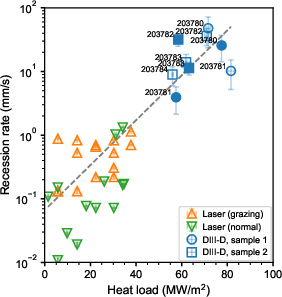
Figure 4: Aggregate recession rate as a function of heat load: both DIII-D exposures and laser tests display similar exponential scaling.
Material partitioning analysis showed that only around 50% of the lost boron was recovered locally as mm-scale fragments, with the remainder presumed lost as fine dust into the vacuum system or plasma. Blackbody and line emission imaging identified strong filamentary plumes associated with dust ablation, supporting the assertion that dust release dominates the boron ionization source in the outer strike point (OSP) region.
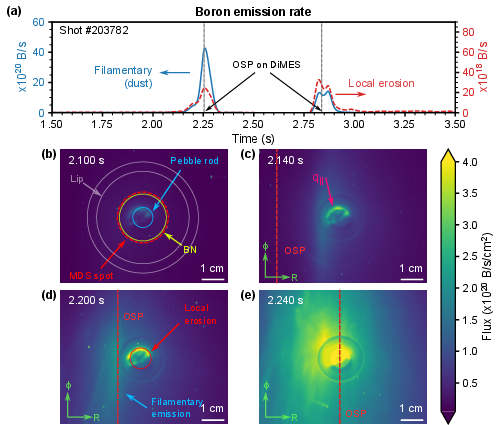
Figure 5: B-II emission spatially resolves local (sputtered) and distant (dust ablation) source morphology, the latter dominating total B influx.
Recovered dust from plasma exposures—primarily in mm-scale non-spherical chunks—contrasts with sub-100 20m, predominantly spherical dust formed in bench tests, consistent with differences in thermal history and agglomeration in the plasma versus the controlled bench environment.
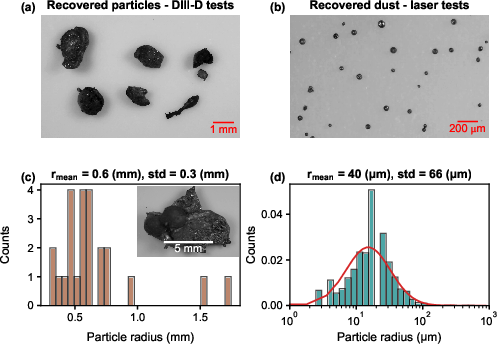
Figure 6: Recovered boron dust particles and corresponding size distributions from DIII-D exposures and laser bench tests.
Impurity Transport and Core Response
Despite large local boron influxes (integrated dust ablation accounting for 10–12% of the total mass loss), increases in core B21 concentration were transient and did not significantly perturb stored energy, radiated power, or core C22 levels. This outcome aligns with EDGE2D-EIRENE impurity transport modeling, which accurately reproduced core B23 and OSP brightness profiles within a factor of two, albeit under steady-state assumptions and without direct modeling of the dust component.
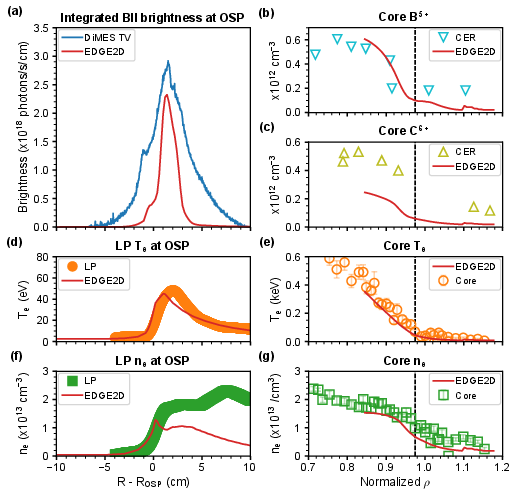
Figure 7: EDGE2D modeling reproduces key emission and impurity transport signatures observed via DIII-D diagnostics.
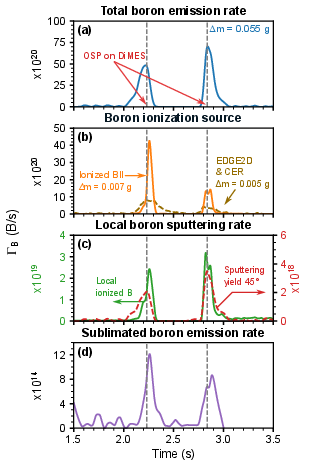
Figure 8: Time-resolved comparison of boron emission rates from various mechanisms, illustrating dominance of dust/ablation sources over sputtering or evaporation.
Sputtered atomic B emission, as inferred from both imaging and SDTrimSP simulations, was over two orders of magnitude lower than the dust/ablation component, and boron evaporation was effectively negligible, six orders smaller than total emission.
Dust Plume Kinetics
Analysis of dust streaks in near-IR imaging yielded a typical dust ejection velocity of 2440 m/s, with particle trajectory modeling indicating that approximately half of emitted dust would escape the divertor plasma prior to ionization, contributing to both local wall loading and remote contamination.
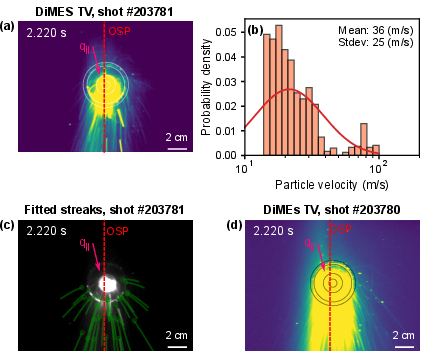
Figure 9: Dust trajectory determination via IR imaging combined with ion drag modeling, showing curved paths consistent with plasma flow.
Implications and Future Directions
The results confirm the feasibility of boron pebble aggregates as a renewable PFC concept for high-heat-flux regions from a plasma compatibility perspective; core plasma performance showed resilience to substantial boron dust release under L-mode conditions. The dominant mass loss pathway is mechanical, with negligible contributions from physical sputtering and evaporation. However, the present implementation—amorphous sintered boron pebbles with a carbon binder—is not optimal, as excessive dust formation and inadequate local material recovery defeat closed-loop operation goals.
The findings direct future research toward:
- Pebble fabrication: Transition from amorphous to harder crystalline boron forms to mitigate dusting, despite manufacturing challenges.
- Binder design: Optimization of binder characteristics for controlled pebble detachment below melting thresholds, reduction of carbon content to minimize tritium retention.
- Material recovery strategies: Engineering for higher local recapture efficiency of ablated/eroded boron, possibly adapting pebble geometry, binder properties, and recovery well design.
- Scale-up and system integration: Validation with multi-rod exposures to approach reactor-relevant distributed heat flux and dynamic pebble replenishment.
- Plasma scenario extension: Assessment under H-mode, ELM, and transient loads, and long-pulse/steady-state operation.
Conclusion
The inaugural tokamak exposure of a renewable boron pebble aggregate demonstrably supports the fundamental viability of this PFC pathway for high-heat-flux divertor environments. Boron, as the working material, maintains core performance integrity even under intense localized dust ablation. However, critical material engineering challenges remain—particularly the mitigation of dust generation and the enhancement of aggregate structure and binder chemistry for reactor-relevant deployment. These results benchmark key failure modes and success criteria for ongoing development of renewable granular plasma-facing technologies.
(2606.17375)

