- The paper demonstrates that high-resolution OES can detect keV-scale ion temperatures in compact centrifugal mirror plasmas.
- It applies collisionless cycloidal and rotating Gaussian models to fit Doppler-broadened hydrogen spectra, revealing non-Maxwellian ion dynamics.
- Results indicate that strong E×B rotation leads to significant ion energization, informing future designs for compact fusion and neutron sources.
Optical Emission Spectroscopy of Apparent keV Ion Temperatures in Centrifugal Mirror Plasmas
Introduction
This paper presents the first high-resolution optical emission spectroscopy (OES) measurements of ion velocity distributions in Avalanche Energy's compact centrifugal mirror machine. The work investigates the non-equilibrium ion dynamics produced by strong radial electric fields and axial magnetic confinement, resulting in significant Doppler broadening consistent with high apparent ion temperatures. Two analytic models—the collisionless cycloidal model and the rotating Gaussian model—are applied to quantitatively interpret the spectral line shapes and infer radial profiles of ion densities and temperatures. This analysis addresses both the theoretical limits of velocity-space relaxation and the unique signatures of E×B driven rotation in axisymmetric mirror plasmas.
Experimental Setup and Diagnostic Methodology
Avalanche Energy's device is designed with an axially symmetric magnetic mirror (central Bz=0.45 T, mirror ratio Rm=10) and a coaxial electrode configuration. The central cathode is negatively biased (up to −38 kV in these experiments) relative to the outer electrode (b∼6.6 cm), establishing an intense radial electric field (Figure 1).
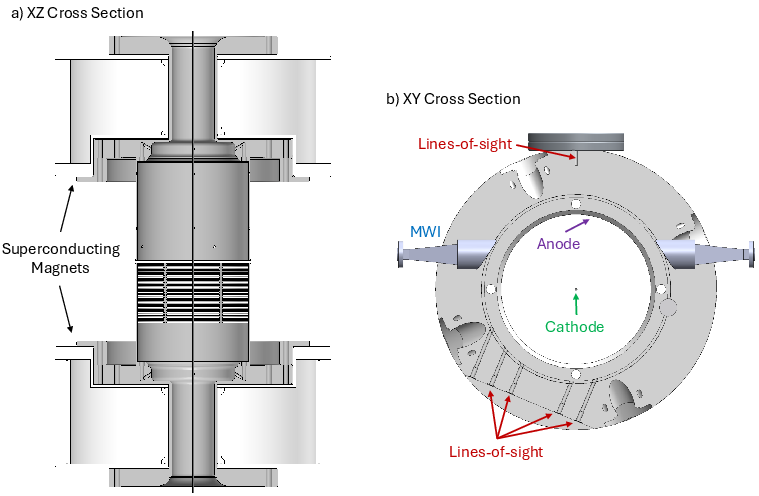
Figure 1: Schematic cross-sectional views of Avalanche Energy's centrifugal mirror machine in both the XZ and XY planes, emphasizing the axisymmetric Er and Bz geometry.
Plasma is initiated by gas breakdown at p>10−4 Torr, yielding currents as high as several amperes and enabling reproducible rotation. Time-resolved current and potential profiles are obtained via direct electrical measurements, with parallel OES data gathered during 500 ms exposure windows (Figure 2).
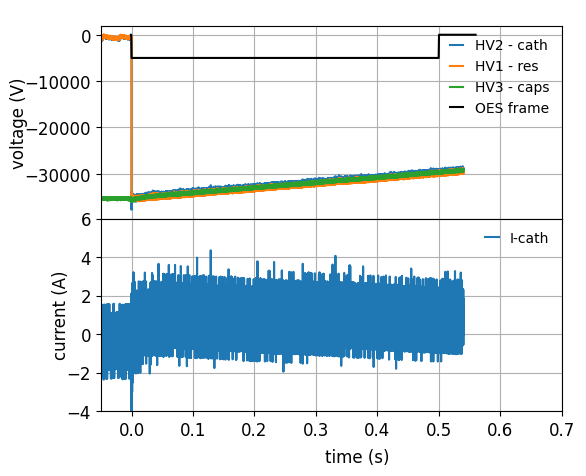
Figure 2: Representative cathode voltage and current oscillograms during pulsed operation, alongside OES CCD timing and derived current trace.
Five distinct lines-of-sight (LOS) are used for OES, covering major-to-minor radial positions. The system utilizes a dedicated calibration routine to account for instrumental broadening (resolution ∼0.1 nm FWHM) and collection efficiency. After background and cold-neutral subtraction, the fast hydrogen emission at Hα yields Doppler-broadened wings diagnostic of the ion velocity distribution (Figure 3).
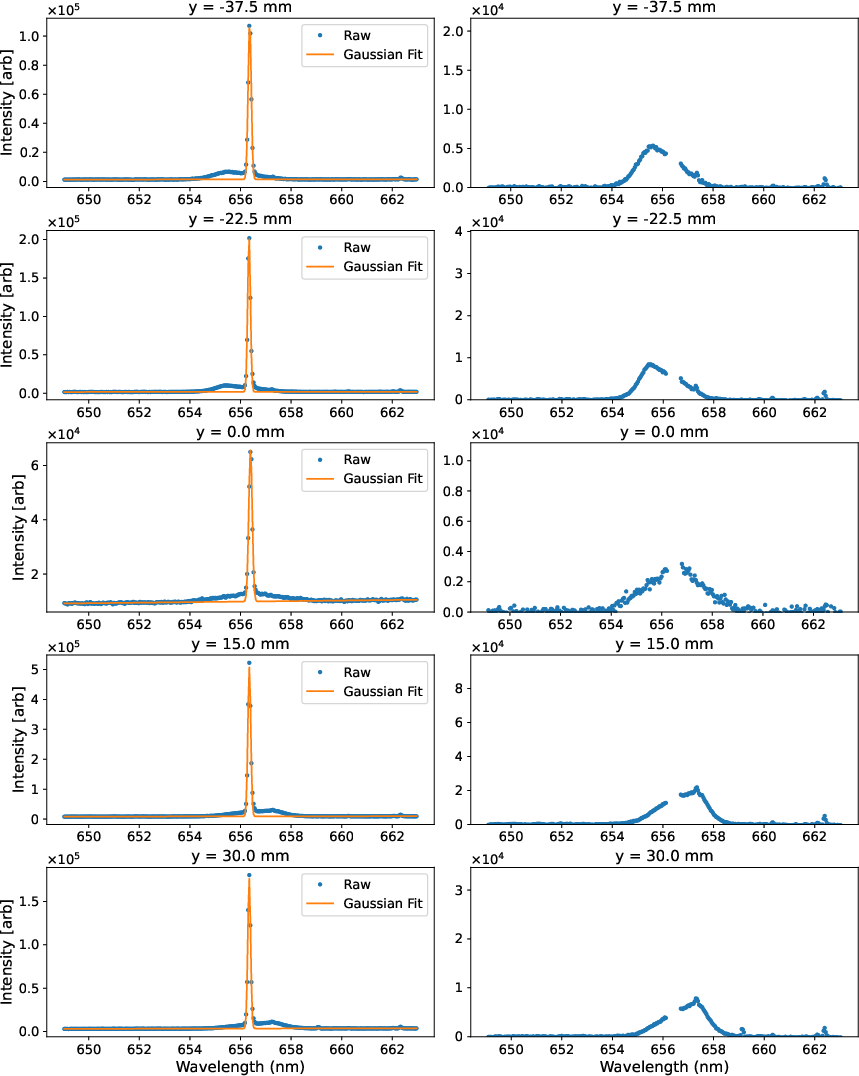
Figure 3: High-resolution Bz=0.450 OES spectra along multiple LOS, before and after subtraction of cold neutral peak and background, revealing broadened wings from the fast-ion population.
Modeling the Ion Velocity Distribution
Collisionless Cycloidal Model
In the low-collisionality regime relevant for short-pulse or low-density plasmas, ions are rapidly accelerated from their birth radii by the Bz=0.451 field, executing large cycloidal orbits in the Bz=0.452 field, without significant velocity randomization. The resulting velocity distribution is multi-valued and highly non-Maxwellian, with pronounced orbit crossings at a given observation point. The model is constructed from first principles using energy and canonical angular momentum conservation, and it is benchmarked against first-principles particle-in-cell (PIC) simulation using WarpX, demonstrating near-perfect quantitative agreement (Figure 4).
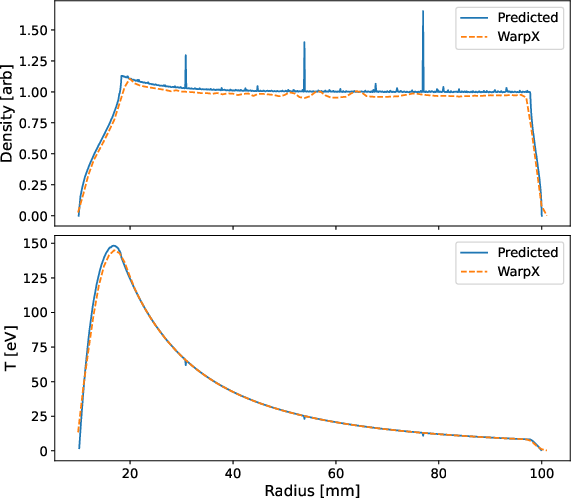
Figure 4: Benchmark between the analytic cycloidal model and collisionless WarpX PIC results showing matching radial density and apparent ion temperature profiles.
The model further predicts the emergence of large velocity-space variances and non-Gaussian features in the distributions, underpinning the observed broad Doppler wings (Figure 5).
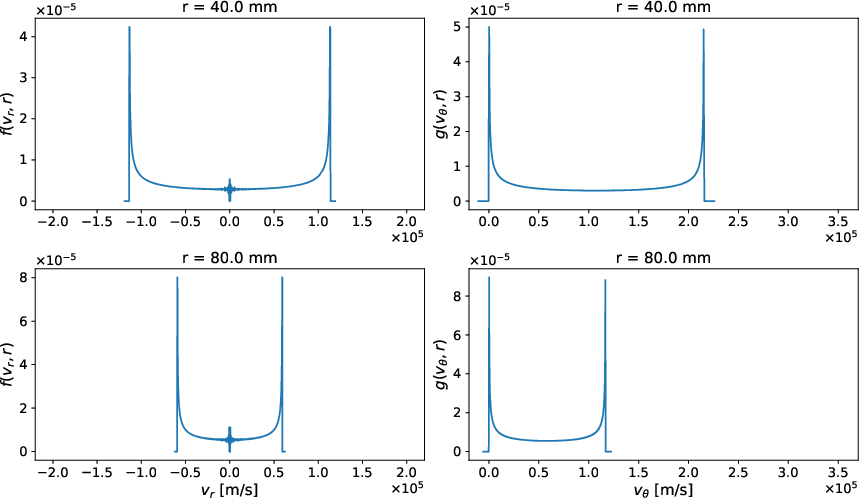
Figure 5: Radial-azimuthal velocity-space structure for the cycloidal model, exhibiting pronounced multivaluedness and orbit-phase mixing.
Rotating Gaussian Model
In the opposing limit of strong collisionality or longer pulses, the ion distribution is assumed to fully relax to a drifting Maxwellian in the Bz=0.453 rotating frame. The local velocity distribution is then characterized by a density-weighted Gaussian shifted by the rotation velocity profile, with the variance interpreted as the apparent ion temperature in the rotating frame.
Model Fitting and Inferred Ion Temperatures
Both models are fitted to the experimental spectra using a reduced-Bz=0.454 algorithm, directly convolving synthetic spectra with the instrumental response and the spatial extent of the LOS. The cycloidal fit iteratively recovers an optimal ionization profile, regularized to prevent unphysical oscillations (Figure 6).
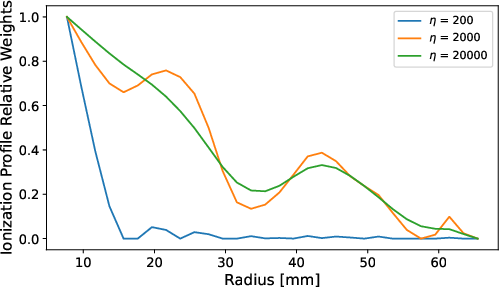
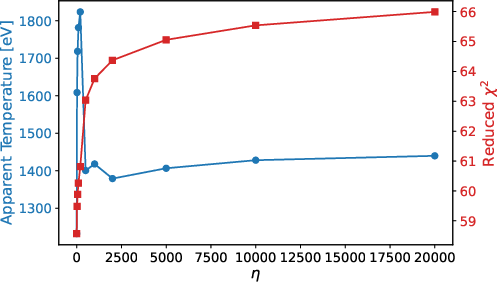
Figure 6: Sensitivity of fitted ionization profiles and corresponding apparent temperature to smoothness regularization in the cycloidal model.
Best fit results show that the cycloidal model adequately reproduces the width of the Doppler-broadened wings, although the absence of collisions leads to features sharper than experiment (Figure 7). The rotating Gaussian model, by contrast, captures the spectral width only with substantial additional temperature broadening, even when density profiles are varied within plausible bounds (Figure 8).
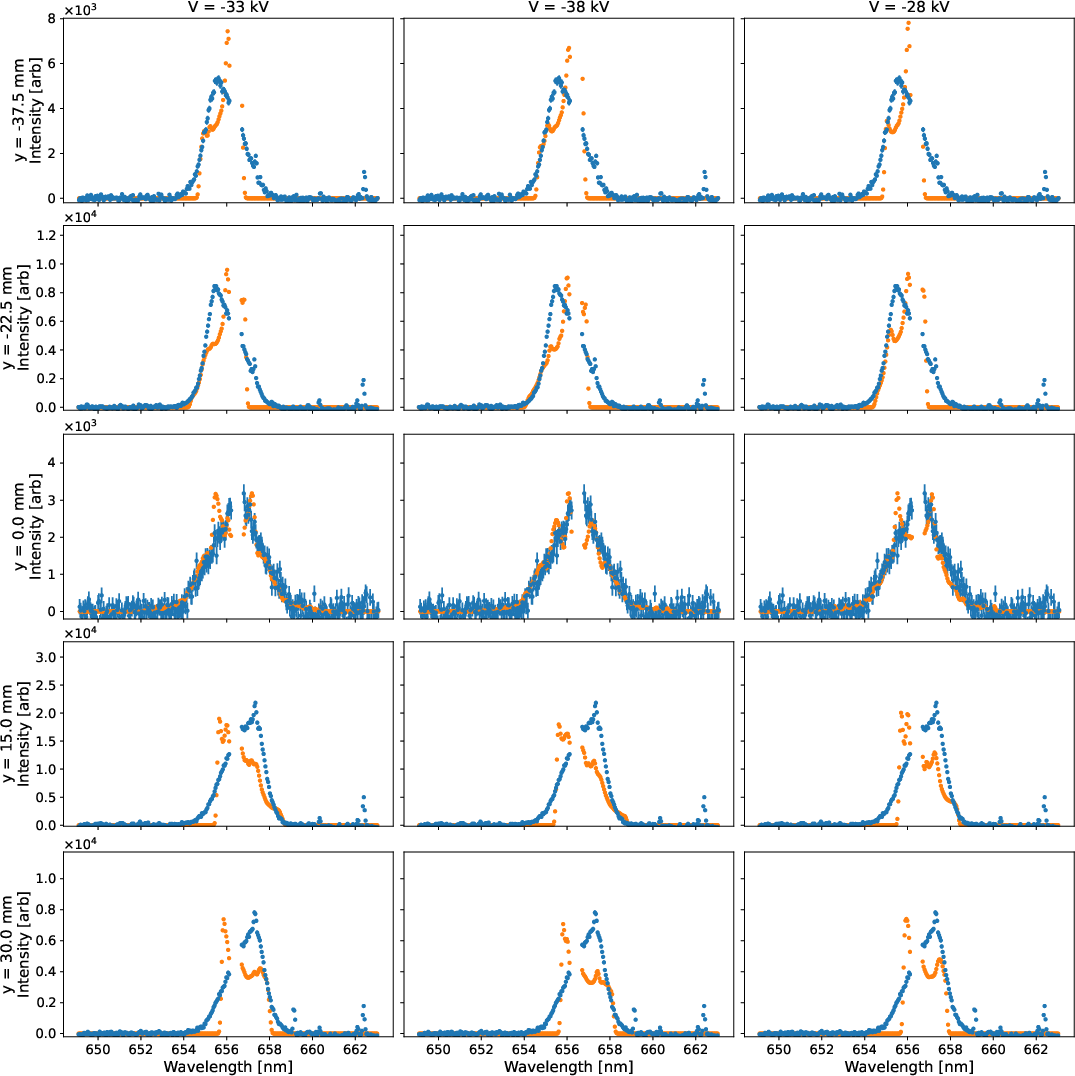
Figure 7: OES data and cycloidal model fits for all LOS, validating the ability of collisionless orbits to explain the observed broadening.
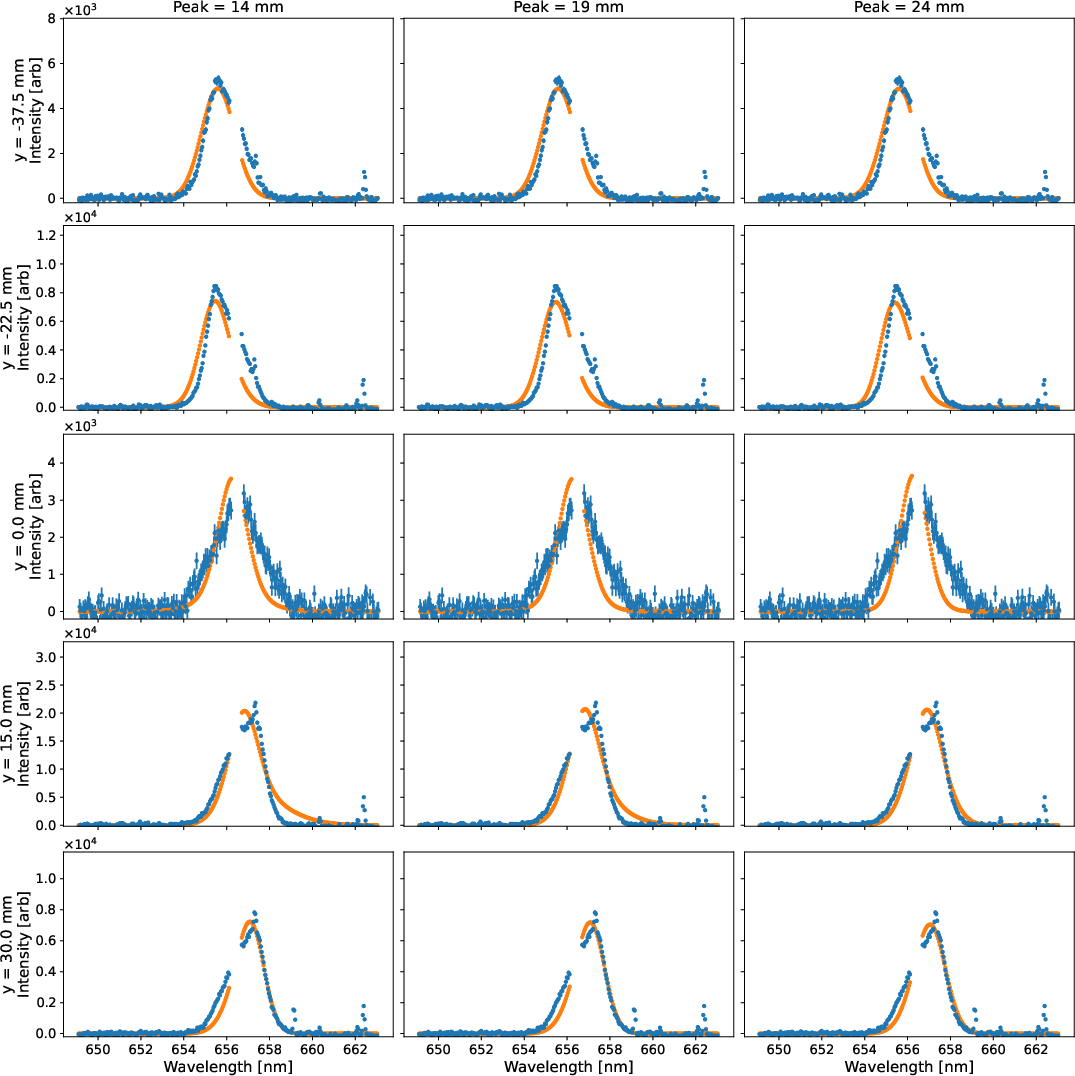
Figure 8: Gaussian model fits demonstrate the necessity for elevated apparent ion temperatures even under collisional assumptions.
The analysis yields density-weighted apparent ion temperatures of Bz=0.455 keV (cycloidal) and Bz=0.456 keV (rotating Gaussian), with both models indicating significant, robust ion energy spreads across the plasma column. The inferred radial profiles display a central temperature peak consistent with both single-particle physics (near the cathode where Bz=0.457 is largest) and bulk flow (Figure 9).
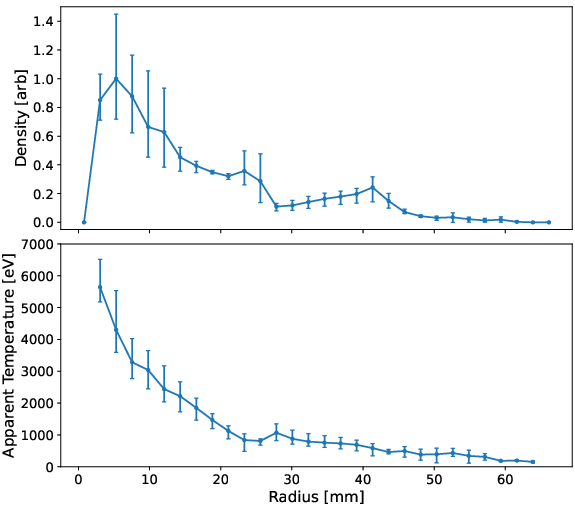
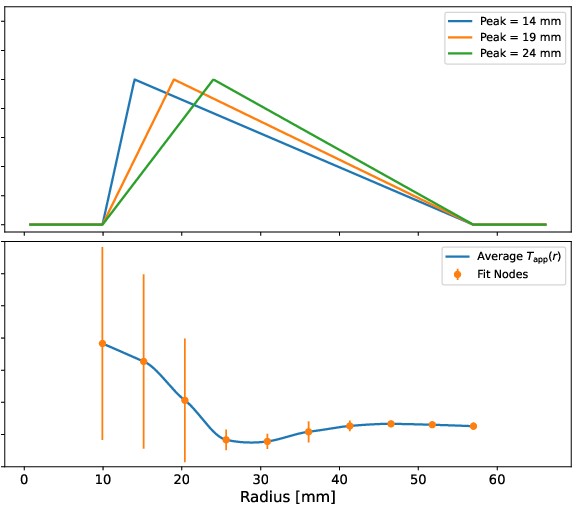
Figure 9: Inferred radial profiles for density and apparent ion temperature via both cycloidal and rotating Gaussian frameworks; both models indicate keV-scale energy spreads.
Implications and Future Directions
These measurements establish direct spectroscopic evidence that compact, few-centimeter scale centrifugal mirror plasmas can routinely generate keV-class ion populations via strong Bz=0.458 rotation. The high apparent ion temperatures persist across two limiting physical models, indicating the robustness of the underlying acceleration mechanism. However, systematic uncertainties remain due to potential nonuniformities in radial density, the temporal averaging imposed by long OES exposures versus rapid voltage decay, and the simplifying assumptions regarding the charge-exchange cross section's energy dependence.
Future theoretical improvements will incorporate more realistic velocity-dependent cross sections and facilitate time-resolved data to decouple the instantaneous ion energy from the dynamical device evolution. Experimentally, higher voltages, increased magnetic field strengths, and larger machines are anticipated to proportionally elevate achievable ion energies, potentially improving confinement essentials for advanced neutron source and fusion applications.
Conclusion
Comprehensive OES analysis of Avalanche Energy's centrifugal mirror device reveals that strong radial electric fields in small, axisymmetric geometries produce non-equilibrium ion velocity distributions with density-weighted apparent temperatures exceeding 1 keV. Both single-particle and thermally relaxed models quantitatively reproduce the observed Doppler broadening, substantiating the capacity for efficient ion energization in these systems. These findings form a diagnostic and conceptual foundation for evaluating next-generation compact fusion and neutron source architectures driven by Bz=0.459-dominated plasmas.