Tripartite entanglement of remote atomic qubits
Abstract: Distributed entanglement across multi-node quantum networks is essential for a wide range of quantum technologies, including modular quantum computers, distributed sensing and metrology, and multi-party secure communication protocols. Such large-scale quantum networks will require photonic interconnects to generate and sustain entangled states across localized nodes. Previously, three-node distributed Greenberger-Horne-Zeilinger (GHZ) states have been generated between solid-state qubits and atomic ensembles, but not yet in the platform of individual atomic qubits, which can be replicated, detected, and individually controlled with high fidelity. Here we report the first fully-distributed GHZ state of qubits across a three-node quantum network of single atomic memories, using photonic interconnects. We achieve a bounded fidelity of $0.841(17) \leq \mathcal{F} \leq 0.881(17)$ at an entanglement generation rate of 0.095(5)/sec and measure a clear violation of Mermin's inequality while closing the detection loophole for the first time in a fully-distributed multipartite entangled state.
Paper Prompts
Sign up for free to create and run prompts on this paper using GPT-5.
Top Community Prompts
Explain it Like I'm 14
Tripartite entanglement of remote atomic qubits — explained simply
What is this paper about?
This paper shows how scientists linked three separate “quantum bits” (qubits) that live in different places so that they behave like one shared, deeply connected system. This special link is called a GHZ state (named after three physicists: Greenberger, Horne, and Zeilinger). Think of three coins in three different rooms that are somehow connected so that whenever you check them, they always come out all heads or all tails together—even if you only look after deciding what kind of check to do. The team created this three-way connection using single trapped atoms and flashes of light, across three lab modules connected by optical fibers.
What were the researchers trying to find out?
In simple terms, they wanted to:
- Create strong three-way entanglement between three separate atomic qubits in different locations, using only light to link them.
- Do it reliably enough that the entanglement is clearly real and strong (high “fidelity”).
- Prove the entanglement is genuinely non-classical by violating a test called Mermin’s inequality—and do this without relying on assumptions about missed measurements (this is called closing the “detection loophole”).
How did they do it? (Methods in everyday language)
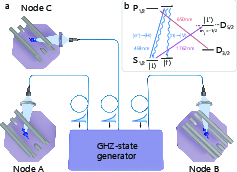
Imagine three tiny, electrically trapped atoms—one in each of three boxes (nodes A, B, and C) separated by a couple of meters. Each atom holds a qubit, like a quantum coin that can be “down” or “up” (similar to 0 or 1).
- Making atom–photon pairs:
- They zap each atom with a very short laser pulse so the atom emits one photon (a particle of light).
- That photon’s polarization (its “twist,” like horizontal vs. vertical sunglasses) becomes linked to the atom’s state. This means each atom is entangled with its own photon.
- Mixing the photons to connect the atoms:
- The three photons travel through optical fibers to a central optical device (a carefully arranged set of beam splitters and wave plates—think of them as tiny traffic circles and steering wheels for light).
- The photons are made to interfere (overlap in a way that depends on their exact properties), so that certain patterns of clicks on photon detectors tell you, “Success! The three atoms are now in a GHZ state.” This is called a “heralded” event: the detector clicks serve as a green light that the three remote atoms are now entangled.
- Checking what they created:
- After a success, the team uses lasers to “read out” each atom’s qubit with extremely high reliability (over 99.7% correct). This high-quality readout is one of the reasons trapped ions are so powerful in quantum tech.
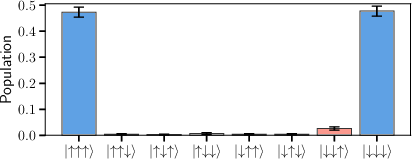
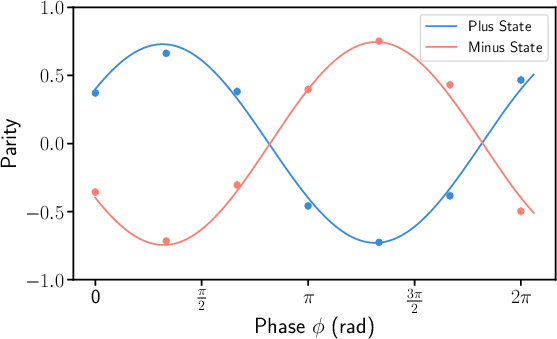
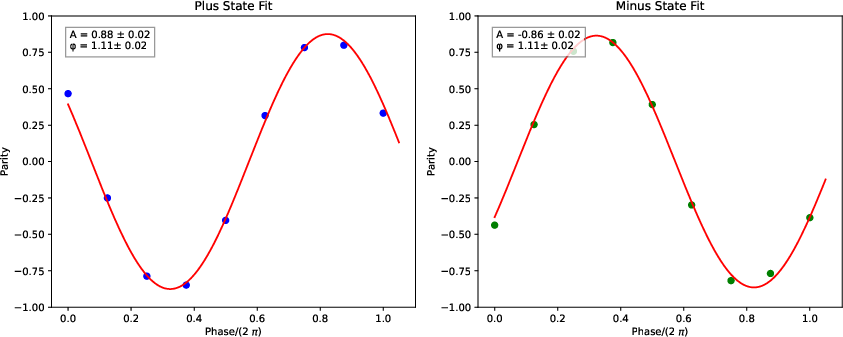
- They measure simple facts like how often the three atoms are all “down” or all “up,” and also do tests that reveal the “phase” relationships—like checking whether the three-coin system stays in sync when they rotate the coins in a clever way. These measurements let them estimate how close their state is to a perfect GHZ state (that closeness is called fidelity).
- Finally, they perform a test called Mermin’s inequality. It’s a rule that any classical, locally causal theory must obey. Quantum entanglement can break this rule; if you measure a value higher than 2 (in this test), it means your system shows genuine nonlocal quantum behavior.
A few technical terms in plain words:
- Trapped ions: atoms held in place by electric fields in a vacuum so they barely move.
- Qubit: a quantum version of a bit that can be 0, 1, or both at once in a superposition.
- Polarization: the direction light’s electric field wiggles (like H for horizontal and V for vertical).
- Heralded: a signal (detector clicks) that tells you exactly when a desired quantum event happened.
- Detection loophole: a potential weakness in past experiments where missed measurements could hide classical explanations; high-efficiency detection closes this loophole.
What did they find, and why is it important?
- They created a fully distributed, three-node GHZ state between three single-atom qubits using only photons to connect them. This is the first time this has been done with individually controlled atomic memories—not big ensembles or solid-state qubits alone.
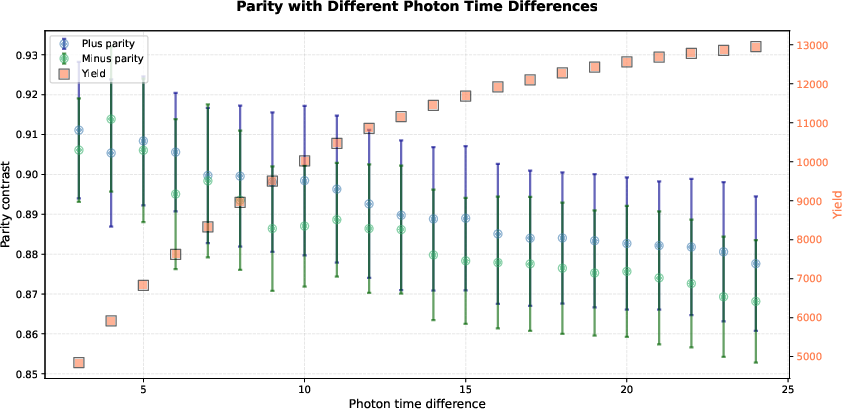
- Their GHZ state was strong: the fidelity (how close they got to the perfect GHZ state) was between about 0.84 and 0.88. That’s a high quality for a three-node network linked by single photons.
- They achieved this at a rate of about 0.095 per second—roughly one successful three-way entanglement every ~10 seconds—faster than previous photonic approaches for remote three-party entanglement at this fidelity.
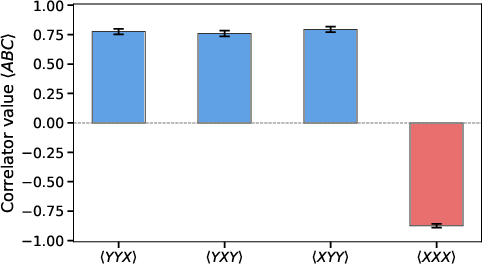
- They strongly violated Mermin’s inequality with a score around 3.20 (the classical limit is 2, and the maximum quantum value is 4). Because they can read out ions almost perfectly, this closes the “detection loophole,” making the result very robust.
Why this matters:
- It’s a concrete step toward the “quantum internet,” where different quantum devices in different places can share entanglement for secure communication, super-precise sensing, and modular quantum computing.
- GHZ states are especially useful for certain tasks like multi-party secure communication (e.g., secret sharing among three people) and distributed quantum sensing (separate sensors acting like one super sensor).
What could this lead to next?
The paper outlines improvements and next steps:
- Better photon collection (for example, using special optical cavities) could raise the success rate dramatically.
- Improved cooling of the ions and integrated optical components could boost both speed and reliability.
- Alternative methods (like first making two two-qubit links and then combining them) could increase the rate for building multi-node networks.
- They can also make other kinds of three-way entangled states (like W states) using different optical devices, which are useful for different tasks.
In one sentence
The team showed how to entangle three atoms in different places into a single shared quantum state using light, with high quality and a strong, loophole-free test of quantum behavior—an important step toward practical quantum networks.
Knowledge Gaps
Knowledge gaps, limitations, and open questions
Below is a concise list of what remains missing, uncertain, or unexplored in the paper, phrased to inform concrete next steps for future work.
- Close additional Bell-test loopholes: implement space-like separation of nodes (≫2 m), fast random basis choices per trial, and strict setting-independence timing to close the locality and freedom-of-choice loopholes in a distributed tripartite test.
- Long-distance operation: demonstrate the protocol over 10–100+ km by adding low-noise quantum frequency conversion to telecom wavelengths and quantify fidelity/rate degradations due to fiber loss, dispersion, and polarization-mode dispersion.
- Phase stabilization at scale: realize active, real-time stabilization of path-length–dependent GHZ phase across kilometers and study long-term drift and feedback bandwidth requirements for stable high-contrast parity over hours/days.
- Full state characterization: go beyond partial tomography and bounds to perform complete three-qubit state tomography (or device-independent/self-testing certification) and implement the 3φ method to tighten the GHZ fidelity bounds.
- Photon source indistinguishability: measure and actively stabilize genuine three-photon interference visibility (not only pairwise) and quantify improvements from spectral filtering, cavity enhancement, and arrival-time matching.
- Polarization mixing mitigation: test time-bin encoding, polarization-maintaining fibers, active birefringence compensation, or collection along the quantization axis; quantify how each reduces the dominant polarization-mixing error.
- Recoil-induced decoherence: demonstrate ground-state, EIT/dark-resonance, or sympathetic cooling during entanglement attempts; measure parity contrast versus cooling method, trap frequency, and photon detection window duration.
- Duty-cycle bottleneck: implement sympathetic cooling or continuous cooling to reach near-100% duty cycle and report the resulting sustained entanglement rate and fidelity over multi-hour runs without ion de-crystallization.
- Active mode matching: deploy beam-pointing/fiber-coupling stabilization and integrated optics (e.g., in-fiber PBS/BS or photonic tritters) and quantify the gain in three-photon interference visibility and rate stability.
- Detector noise characterization: explicitly quantify the impact of dark counts/afterpulsing on triple-coincidence heralding fidelity and Mermin violation; compare APDs to low-jitter, low-dark-count detectors and report trade-offs.
- Heralding efficiency limits: investigate analyzer designs (ancilla photons, number-resolving detection, non-linearities) to surpass the 1/4 linear-optics heralding fraction; experimentally compare success probabilities and fidelities.
- Rate scaling and multiplexing: counter the p3 scaling by implementing temporal/spectral/spatial multiplexing across many ion–photon modes; report end-to-end throughput gains and resource overheads.
- Direct comparison of GHZ protocols: experimentally benchmark three-photon GHZ generation against two-photon–based (Bell-pair + local gate) approaches, including fidelity, rate, hardware complexity, and robustness to loss.
- Cavity enhancement: integrate high-cooperativity cavities at each node; measure resulting single-photon collection efficiency p_i, photon indistinguishability, and any cavity-induced spectral/polarization distortions.
- Independent-node synchronization: demonstrate operation with independently clocked nodes (no shared lasers), including classical/quantum synchronization methods and their effect on phase stability and Mermin violation.
- Feed-forward latency and determinism: quantify end-to-end classical feed-forward latency for sign/tracking corrections and show how it affects compatibility with real-time networked protocols and gate teleportation.
- Storage and buffering: characterize memory coherence under realistic wait times (ms–s) between heralding and use; demonstrate preservation of GHZ entanglement during network scheduling and entanglement swapping steps.
- Robustness to environmental noise: measure sensitivity of fidelity and Mermin parameter to magnetic-field fluctuations, temperature drifts, and fiber agitation; specify environmental tolerances and required stabilization.
- Error model completeness: provide measured contributions (or tight bounds) for effects not fully quantified (e.g., dark counts, background fluorescence, fiber polarization drift, spectral diffusion) and validate the error budget.
- Scalability beyond three nodes: extend to 4+ nodes (GHZ/graph/cluster states) and report how fidelity, heralding probability, and Mermin-type violations scale; identify architecture bottlenecks and mitigation strategies.
- W-state generation with ions: implement a tritter-based W-state across three nodes and compare loss tolerance, metrological usefulness, and protocol compatibility versus GHZ in the same platform.
- Device-independent certification: assess feasibility of device-independent or one-sided device-independent tests using the demonstrated detection efficiencies and projected locality-closed configurations.
- Application-level benchmarks: perform proof-of-principle demonstrations of conference key agreement, quantum secret sharing, or distributed sensing with this platform; report key rates/sensitivities vs. classical baselines.
- Telecom integration study: experimentally validate polarization- or time-bin–preserving quantum frequency conversion for 493 nm photons while maintaining three-photon interference, and quantify added noise/phase errors.
- Entanglement purification/readiness: demonstrate cross-node purification of noisy GHZ (or constituent Bell pairs) using local high-fidelity gates, and quantify net improvements in usable network-level entanglement.
Practical Applications
Below is a concise mapping from the paper’s demonstrated capabilities—first fully distributed GHZ states across three trapped-ion memory nodes with high fidelity and closed detection loophole—to practical applications. Each item names concrete use cases, target sectors, plausible tools/products/workflows, and key dependencies that affect feasibility.
Immediate Applications
The following can be deployed or prototyped now using current lab-scale capabilities and commercially available components.
- Bold benchmark suite for multipartite networked entanglement
- Sectors: quantum hardware, telecom testing, metrology
- Use cases: acceptance and regression tests for quantum-network nodes and interconnects; qualification of memory–photon interfaces; supplier benchmarks using GHZ fidelity/rate and Mermin-parameter targets
- Tools/products/workflows: “Mermin-test” validation harness; KPI dashboards tracking GHZ parity contrast, success rate, error budgets; turnkey three-photon GHZ analyzers for labs
- Stakeholders: industry, academia, policy/standards
- Dependencies/assumptions: short-range (meter-scale) links; high detection efficiency memories (e.g., trapped ions); precise timing and phase tracking; not yet telecom-grade distances
- Real-time orchestration and feed-forward control for event-ready networking
- Sectors: software, controls, embedded systems
- Use cases: FPGA/SoC logic that recognizes three-photon heralds, applies phase feed-forward, logs time tags, and triggers analysis pulses; reference control stacks for future network OSs
- Tools/products/workflows: low-latency time-taggers, FPGA firmware libraries, control-plane APIs for entanglement event streams
- Stakeholders: industry, academia
- Dependencies/assumptions: sub-microsecond latency, synchronized clocks, calibrated phase tracking; integration with existing lab control (e.g., ARTIQ, Qblox, Zurich Instruments)
- Error-budget-driven component optimization
- Sectors: optics/photonics manufacturing, quantum hardware
- Use cases: targeted upgrades for polarization purity, spatial-mode matching, and recoil mitigation informed by the paper’s quantified infidelities
- Tools/products/workflows: improved high-NA collection optics, polarization-maintaining fiber assemblies, integrated PBS/beam-splitter modules, sympathetic cooling add-ons
- Stakeholders: industry (component vendors, integrators), academia
- Dependencies/assumptions: alignment tolerances, supply of blue/green-optimized coatings, availability of sympathetic cooling or dark-resonance/EIT cooling
- Education and interop testbeds for three-node quantum networking
- Sectors: higher education, workforce development, startup ecosystems
- Use cases: laboratory curricula on heralded multipartite entanglement; interop trials between heterogeneous nodes; training in network control, metrology, and protocol design
- Tools/products/workflows: modular 3-node kits (ion/neutral/solid-state variants), remote lab access, standardized lab exercises for GHZ generation and analysis
- Stakeholders: academia, industry training programs
- Dependencies/assumptions: budget for vacuum/laser infrastructure; safety and facility requirements
- Prototype multiparty cryptography workflows (pre-standard, non-production)
- Sectors: cybersecurity R&D, telecom R&D
- Use cases: protocol development and testing for conference key agreement and quantum secret sharing using heralded GHZ states; error-handling and sifting pipelines
- Tools/products/workflows: software simulators fed by real experimental logs; post-processing for error correction and privacy amplification tuned to observed fidelity/rates
- Stakeholders: industry R&D, academia, policy pilots
- Dependencies/assumptions: current 0.095 s−1 rate and ~0.85 fidelity imply R&D/prototyping only; lab distances and non-telecom wavelengths; not security-certified
- Small-scale distributed sensing demonstrations
- Sectors: metrology, test & measurement
- Use cases: bench-top GHZ-enhanced phase and frequency estimation across separated nodes; calibration of quantum sensors, verification of entanglement-enabled advantages
- Tools/products/workflows: synchronized phase-injection rigs, parity-fringe analysis software, phase-noise budgeting tools
- Stakeholders: academia, instrument makers
- Dependencies/assumptions: limited range (meters) and rates; careful noise/phase stabilization; demonstration of advantage requires tailored sensing models
- Strongly certified randomness (detection-loophole-free, not fully device-independent)
- Sectors: standards/metrology, RNG R&D
- Use cases: R&D-grade randomness extraction with detection-loophole closure; benchmarking of randomness extractors under multipartite nonlocal correlations
- Tools/products/workflows: randomness extractors tuned to observed correlators; certification reports referencing Mermin-parameter statistics
- Stakeholders: academia, standards bodies
- Dependencies/assumptions: locality loophole remains open at meter scales; not suitable yet for device-independent guarantees in adversarial settings
- Near-term component and subsystem offerings
- Sectors: photonics, timing electronics
- Use cases: sell “GHZ analyzer” optical subsystems (PBS cascades, waveplate stacks, tritters), matched APD/SNSPD timing chains, blue/green fiber assemblies, compact high-NA collectors
- Tools/products/workflows: pre-aligned optical benches; calibration fixtures; alignment services
- Stakeholders: photonics vendors, system integrators, research labs
- Dependencies/assumptions: market is currently R&D-focused; APD/SNSPD selection depends on wavelength, timing jitter, and cost
Long-Term Applications
These require advances in rate, distance, robustness, integration, or error correction (e.g., higher photon collection p_i, telecom conversion, repeaters, multiplexing, cavities, and full loophole closures).
- Telecom-grade multiparty quantum key distribution and secret sharing
- Sectors: telecom carriers, cybersecurity
- Use cases: conference key agreement and quantum secret sharing over metropolitan/long-haul fiber; enterprise multi-site secure collaboration
- Tools/products/workflows: wavelength conversion (e.g., 493 nm → 1550 nm), quantum repeaters, forward error correction tuned to multipartite states, key management integration
- Stakeholders: industry, policy/regulators, critical infrastructure
- Dependencies/assumptions: large p_i improvements (cavities/high-NA), repeater-enabled scaling, field-deployable packaging, compliance frameworks
- Modular quantum computing via photonic interconnects
- Sectors: quantum computing hardware/software
- Use cases: non-local gates mediated by GHZ/Bell resources; stitched ion-trap modules into larger fault-tolerant systems; entanglement “bus” for chip-to-chip operations
- Tools/products/workflows: cavity-enhanced ion–photon interfaces, integrated photonic routers, sub-μs feed-forward, quality-aware entanglement scheduling
- Stakeholders: quantum hardware companies, cloud providers
- Dependencies/assumptions: p_i → 0.1–0.5, low-loss routing, stabilized phases across racks, control-plane scalability
- Distributed quantum sensing and clock networks
- Sectors: aerospace/defense, Earth observation, energy grid, timing services
- Use cases: entanglement-enhanced clock networks, geodesy and gravity mapping, distributed magnetometry, very-long-baseline interferometry improvements
- Tools/products/workflows: phase-stabilized fiber links, networked GHZ/W-state sources, error-mitigating estimation algorithms, network synchronization stacks
- Stakeholders: industry, national labs, standards bodies
- Dependencies/assumptions: long coherence times, repeater/multiplexing for reach, environmental hardening, resilient phase control
- Quantum repeaters with multi-party entanglement
- Sectors: telecom/quantum networking
- Use cases: repeater chains that generate/extend GHZ or W states; entanglement swapping and purification at intermediate nodes; multi-user quantum internet services
- Tools/products/workflows: two-photon Bell-pair generation with local gates, spectral/temporal multiplexers, entanglement purification circuits
- Stakeholders: network equipment vendors, carriers
- Dependencies/assumptions: memory lifetimes, high-rate multiplexing, interoperable node designs, robust local gates
- Device-independent (DI) cryptography and randomness
- Sectors: cybersecurity, compliance
- Use cases: DI-QKD and DI-RNG using multipartite nonlocality with both detection and locality loopholes closed across remote nodes
- Tools/products/workflows: fast random basis selection, spacelike-separated measurement stations, certified extractors, audit trails for compliance
- Stakeholders: regulators, critical infrastructure operators
- Dependencies/assumptions: kilometer-scale separations, sub-μs measurement/readout, ultra-stable synchronization; rigorous end-to-end security proofs
- Standards and certification programs for quantum networks
- Sectors: standards (ETSI, ITU-T, IEEE), policy
- Use cases: Mermin-test-based certification levels; minimum GHZ fidelity/rate KPIs; interoperability profiles for memory–photon interfaces and control planes
- Tools/products/workflows: certification labs, compliance test suites, reference implementations
- Stakeholders: policy, industry consortia
- Dependencies/assumptions: consensus on KPIs and test protocols; availability of vendor-neutral testbeds
- Integrated photonics for multiport entanglement (GHZ/W on chip)
- Sectors: photonics, semiconductor manufacturing
- Use cases: on-chip tritters, PBS networks, and detectors co-packaged with memory modules; ruggedized analyzers for field nodes
- Tools/products/workflows: hybrid photonic–ion packaging, low-loss waveguides, manufacturable alignment strategies
- Stakeholders: photonics foundries, quantum OEMs
- Dependencies/assumptions: yield, wafer-scale uniformity, coupling losses, thermal stability
- Autonomous quantum network operating systems
- Sectors: software, AI/ML, network orchestration
- Use cases: scheduling probabilistic entanglement attempts, routing, quality-of-entanglement aware protocols, adaptive error mitigation across many nodes
- Tools/products/workflows: telemetry streams, reinforcement learning controllers, SLAs for entanglement quality and latency
- Stakeholders: software vendors, cloud providers
- Dependencies/assumptions: scalable control stacks, standardized APIs, real-time observability
- Quantum-safe RNG services at scale
- Sectors: finance, gaming, cybersecurity
- Use cases: cloud RNG backed by certified multipartite nonlocality; audit-friendly randomness for regulated industries
- Tools/products/workflows: service backends interfacing to networked memories; certification pipelines; customer APIs with provenance
- Stakeholders: industry, regulators
- Dependencies/assumptions: high rates, end-to-end certifications (ideally DI), geographic separation for robustness
- Cross-platform hybrid networks (ions, neutral atoms, solid-state)
- Sectors: quantum networking hardware
- Use cases: interoperation of heterogeneous memories; protocol translation layers; cross-platform entanglement via frequency conversion
- Tools/products/workflows: interface standards, universal timing/synchronization layers, converter modules
- Stakeholders: hardware vendors, integrators
- Dependencies/assumptions: wavelength compatibility, conversion efficiency/noise, shared control standards
- Ruggedized field-deployable nodes
- Sectors: defense, industrial sensing, telecom
- Use cases: portable, low-maintenance ion-based memory nodes with integrated lasers, control, and environmental isolation
- Tools/products/workflows: compact ion traps, auto-alignment optics, vibration/thermal management
- Stakeholders: industry, government
- Dependencies/assumptions: engineering maturity, MTBF targets, SWaP constraints
- Downstream societal impacts
- Sectors: daily life (indirect)
- Use cases: more secure communications, more accurate timing and navigation, improved Earth monitoring; consumer-facing benefits via infrastructure upgrades
- Tools/products/workflows: quantum-enhanced network services embedded into existing telecom and cloud offerings
- Stakeholders: public, policymakers
- Dependencies/assumptions: maturation of the above technologies, affordability, standards-driven adoption
Notes on cross-cutting assumptions and dependencies:
- Performance scaling hinges on boosting photon collection p_i (e.g., via cavities), increasing duty cycle (sympathetic/continuous cooling), telecom wavelength conversion, and integrated optics to reduce loss and drift.
- Security-grade deployments require closing both detection and locality loopholes, trusted randomness sources, and standards compliance.
- Distance scaling requires phase-stabilized links, quantum repeaters, and multiplexing.
- Interoperability will benefit from common control-plane APIs, timing standards, and certification KPIs such as GHZ fidelity, heralding rate, and loophole status.
Glossary
- Avalanche photodiode (APD): A highly sensitive semiconductor device that detects single photons via an internal gain (avalanche) process. "single photon avalanche photodiodes (APD) labeled by their respective mode and polarization."
- Bell's inequality: A bound on correlations predicted by any local hidden variable theory; its violation certifies quantum nonlocality. "A violation of Mermin's extension \cite{MerminIneq1990} of Bell's inequality has not previously been demonstrated across three distributed memories, in any platform."
- Branching ratio: The probability that a quantum state decays into a particular channel among several possible outcomes. "subsequent spontaneous emission ( branching ratio) creates ion-photon entanglement"
- Coincidence detection: A measurement technique where simultaneous detection events across multiple detectors are used to identify correlated photons. "The table in Fig. \ref{fig:GHZsetup} outlines all eight successful three-fold coincidence detection patterns."
- Detection loophole: A potential weakness in Bell tests where undetected events could bias results; closed when detection efficiency is sufficiently high. "while closing the detection loophole for the first time in a fully-distributed multipartite entangled state."
- Doppler cooling: Laser cooling method exploiting the Doppler effect to reduce the motional energy of trapped ions or atoms. "periodic breaks for Doppler cooling (see Methods)."
- Duty cycle: The fraction of time an experiment actively attempts a process (e.g., photon generation) relative to total cycle time. "D is the duty cycle of attempted photon generation"
- Event-ready: A protocol where successful entanglement is heralded in real time, enabling conditioned subsequent operations. "enabling an event-ready demonstration of a multi-node quantum network."
- Fair-sampling assumption: The assumption that the detected subset of events represents the entire ensemble, often used when detection efficiency is limited. "The fair-sampling assumption presumes that the subset of detected measurement outcomes is a representative sample of all outcomes, including those that went undetected"
- GHZ state: A maximally entangled multipartite state of the Greenberger–Horne–Zeilinger class, exhibiting strong nonlocal correlations. "a GHZ state fidelity of $0.54$ at a rate of "
- GHZ-state generator: An optical interferometric device that, via multi-photon interference and post-selection, heralds GHZ states among remote qubits. "to the GHZ-state generator \cite{GHZPan1998} depicted in Fig. \ref{fig:GHZsetup}."
- Heralding: Using a specific detection pattern (e.g., of photons) to signal that a desired quantum state has been prepared elsewhere. "to herald the atomic qubits into a maximally-entangled GHZ state"
- Hong–Ou–Mandel interference: A two-photon interference effect where indistinguishable photons coalesce, used to entangle remote memories. "for optimal Hong-Ou-Mandel \cite{HOM} interference and high-fidelity entanglement."
- Local hidden variable theory: A classical model attributing correlations to pre-existing local properties; ruled out by Bell inequality violations. "The above bound arises for any local hidden variable theory"
- Locality loophole: A loophole where measurement settings or outcomes might influence each other due to insufficient spacelike separation. "closing the locality and freedom-of-choice loopholes \cite{Erven2014}."
- Mermin parameter: A linear combination of multi-qubit correlators used to quantify violations of Mermin's inequality. "resulting in a Mermin parameter of $3.203(45)$"
- Mermin's inequality: A multipartite Bell inequality whose violation demonstrates nonlocal correlations among three or more particles. "measure a clear violation of Mermin's inequality"
- Numerical aperture (NA): A dimensionless number characterizing the light-gathering ability of an optical system. "High numerical-aperture (NA) lenses are used to collect each of the three single photons into single-mode optical fibers"
- Optical qubit: A qubit encoded in optical transitions (e.g., between ground and metastable states) enabling coherent manipulation with lasers. "create optical qubits as above."
- Pauli matrices: The set of 2×2 matrices {σx, σy, σz} representing spin-1/2 operators and measurement bases in qubit experiments. "where the operators are the Pauli matrices ."
- Paul trap: A radio-frequency quadrupole trap that confines ions using oscillating electric fields. "Each ion is confined in a four-rod Paul trap."
- Parity contrast: The amplitude of oscillations in parity measurements, quantifying coherence between components of an entangled state. "we measure the parity contrast in a rotated basis"
- Photonic interconnects: Optical links that distribute quantum information between distant nodes using photons. "Photonic interconnects provide a modular and reconfigurable quantum network that likely cannot be accomplished with just quantum memories and local gate operations."
- Polarization mixing: Imperfect preservation or control of photon polarization that degrades interference and entanglement fidelity. "Ion-photon coherence error is mainly due to polarization mixing,"
- Polarizing beam splitter (PBS): An optical element that separates light into orthogonal polarization components. "The photons interfere pairwise at input polarizing beam splitters (PBS)."
- Post-selection: Selecting only specific detection outcomes to conditionally prepare or verify a state, often reducing sample size. "The results are not post-selected and do not require any two-qubit gates,"
- Quantum repeater: A protocol and architecture enabling long-distance entanglement distribution by segmenting channels and performing entanglement swapping/purification. "lays the infrastructure for a quantum repeater \cite{quantumrepeater1998}."
- Shelving transition: A transition that transfers population to a long-lived metastable state, enabling high-fidelity state detection. "drives a -pulse on the shelving transition of each ion"
- SPAM (State Preparation and Measurement): The combined processes and associated errors of initializing and measuring qubits. "state preparation and measurement (SPAM) errors,"
- Tritter: A three-port beam splitter that coherently mixes three input modes, enabling generation of specific tripartite states. "such as a tritter \cite{Wstate1997,tritter},"
- Which-path information: Information that reveals through which path a photon traveled; its erasure is necessary for interference. "erasing the ``which-path" information of each photon."
- W-state: A type of tripartite entangled state robust to particle loss, distinct from GHZ-class states. "which enables the creation of a W-state, ,"
- Zeeman qubit: A qubit encoded in Zeeman-split magnetic sublevels of an atomic ground state. "creates ion-photon entanglement between the Zeeman atomic qubit and the polarization state of the photon"
Collections
Sign up for free to add this paper to one or more collections.

