- The paper develops robust thermal inversion techniques to extract asymptotic spectral densities and OPE coefficients for heavy operators.
- It provides explicit analytic expressions in both generalized free field and weakly interacting AdS models, achieving precise predictions even at moderate scaling dimensions.
- The analysis reveals a transition in operator density scaling and offers insights into black hole microstate physics in holographic CFTs.
Asymptotic CFT Data from Thermal One-point Functions: Weakly Interacting QFTs in AdS
Introduction: Thermal Correlators and Heavy-State CFT Data
Thermal correlators in conformal field theory (CFT) on S1×Sd−1 geometries give direct analytic access to sectors dominated by heavy operators, i.e., primary fields with large scaling dimensions and fixed spin, corresponding in AdS/CFT duality to multiparticle states in anti-de Sitter (AdS) backgrounds. While light operator sectors are well-explored via the numerical and analytical bootstrap, the heavy regime is less analytic accessible but is crucial for probing quantum aspects such as black hole microstates at high boundary temperatures. This paper systematically develops thermal inversion techniques to extract the asymptotics of the spectral density and OPE coefficients (especially heavy-heavy-light, or HHL, data) in 3D CFTs dual to massive scalars in AdS4, with both free and weakly interacting bulk interactions.
The analysis encompasses both the generalized free field (GFF; dual to free AdS scalar) and theories deformed by bulk Φ3 and Φ4 interactions, providing explicit expressions for the spectrum and OPE coefficients and their perturbative corrections. Notably, the study demonstrates that asymptotic formulas derived from high-temperature inversion remain accurate well beyond their naively expected regime, matching exact data at intermediate scaling dimensions.
GFF Partition Function, Spectral Density, and Particle Sector Resolution
The GFF partition function, Z0(q,y), is precisely solvable and encodes the spectrum through a character decomposition. The key result is an explicit asymptotic formula for the density of primary operators with fixed spin as Δ→∞ at fixed ℓ, which, unlike that of local 3D CFTs, displays scaling behavior analogous to local 4D CFTs due to the embedding of the theory as a massive scalar in AdS4: ρ0(Δ,ℓ)∼(2ℓ+1)⋅(π430Δ)−101/32−48Δϕ(12−9Δϕ+2Δϕ2)exp[c0Δ3/4+…]
with extensive subleading corrections precisely derived. Agreement with the exact operator multiplicity, even for moderate Δ, is quantitatively illustrated.
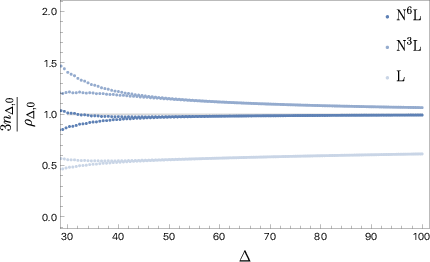
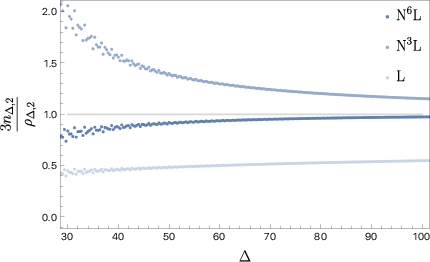
Figure 1: GFF spectral densities for 40, spin-0 (left), and 41, spin-2 (right), confirming the match of the asymptotic formula to the exact discrete spectrum.
Moreover, by introducing a fugacity for the particle number, the authors resolve the spectrum into sectors with fixed 42, deriving the exact and asymptotic primary multiplicities as 43, revealing a transition from polynomial to exponential growth as 44 increases. Operators with fixed 45 display 46 scaling, which diverges from the exponential scaling of the total density governed by operators with 47.
HHL OPE Coefficients in GFF and Canonical Sectors
The OPE coefficients relevant for heavy-heavy-light correlations, especially those arising in 48 for operators 49 of fixed Φ30, are determined via the asymptotic expansion of one-point functions and thermal inversion. The leading behavior (at fixed tensor structure label Φ31) is
Φ32
again mimicking the (dimensionally shifted) scaling of 4D local CFTs. Subleading corrections and full expressions for Φ33 are provided with comparative plots confirming quantitative fidelity down to Φ34.
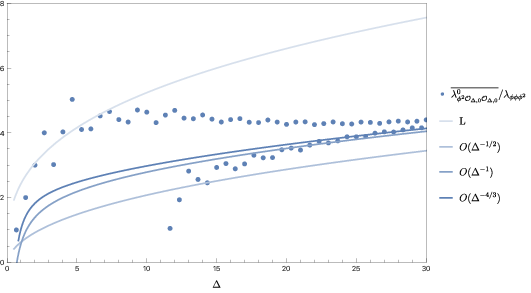
Figure 2: GFF OPE coefficients for scalars, Φ35, confirming the rapid convergence of asymptotic formulas.
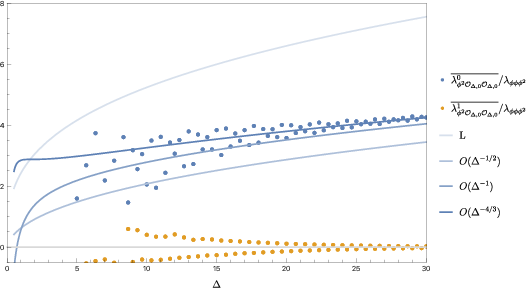
Figure 3: GFF OPE coefficients for spin-one, same parameter, including subdominant tensor structures.
The particle-resolved OPE asymptotics are also explicitly derived for fixed Φ36 sectors, yielding a different scaling,
Φ37
which dominates over the unrestricted ensemble only for small Φ38 and becomes subleading as Φ39 increases. Numerical comparisons again show excellent agreement at moderate dimension.
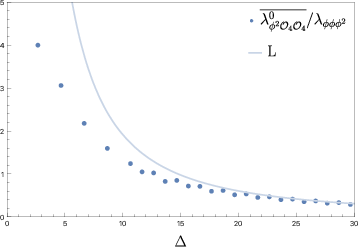
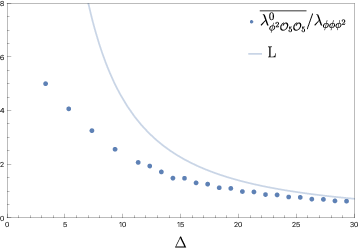
Figure 4: OPE coefficients for four- and five-particle scalar internal operators, Φ40, juxtaposing exact results and the leading asymptotic formula.
Weakly Interacting Theories in AdSΦ41: Anomalous Dimensions and OPEs
Including perturbative Φ42 and Φ43 interactions in AdSΦ44 modifies the spectrum through anomalous dimensions and alters the OPE coefficients. The leading correction to the partition function, and thereby to the spectral density, originates from the quartic interaction, whereas the cubic interaction is responsible for corrections to the one-point function of Φ45 and the associated OPE data.
The paper derives exact and asymptotic expressions for averaged anomalous dimensions of double- and multi-trace operators, making novel statements for Φ46-particle states. For Φ47, the large Φ48 anomalous dimensions scale as
Φ49
Evidence is provided that even the leading-order asymptotic expansion accurately describes the exact anomalous spectrum for Z0(q,y)0.
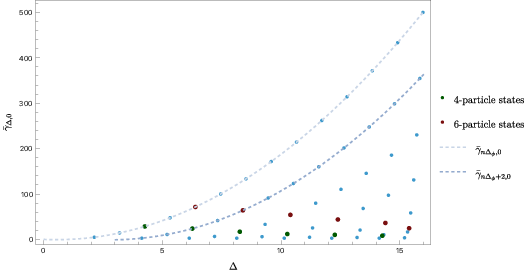
Figure 5: Low-lying anomalous dimensions for Z0(q,y)1, showing precise agreement between analytic formulae and the discrete spectrum for multiple particle families.
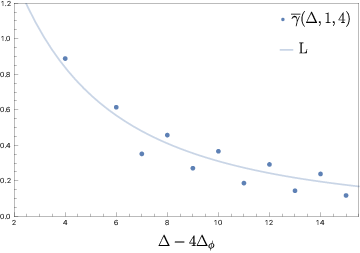
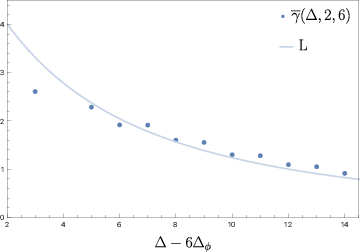
Figure 6: Exact and asymptotic anomalous dimensions for fixed Z0(q,y)2, again showing rapid convergence.
For OPE coefficients induced by cubic interactions, the one-point function is decomposed into thermal conformal blocks, and new high-temperature expansions for scalar-exchange blocks are presented (including for nonzero chemical potential). The leading asymptotics for the averaged OPE coefficients are:
- For Z0(q,y)3:
Z0(q,y)4
- For Z0(q,y)5:
Z0(q,y)6
with explicit formulae for Z0(q,y)7-particle sectors as well.
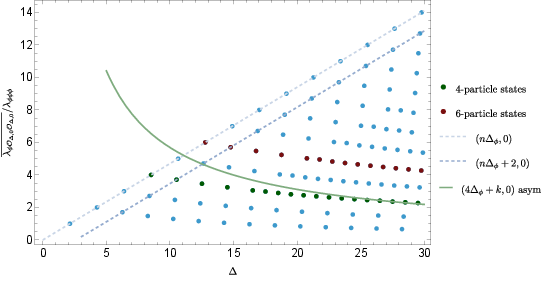
Figure 7: Normalized, averaged OPE coefficients for scalar exchange at Z0(q,y)8, illustrating the agreement of exact data and analytic asymptotics.
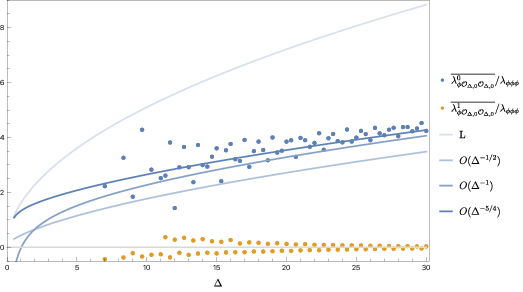
Figure 8: OPE coefficients for spin-one in the Z0(q,y)9 theory at Δ→∞0, highlighting the detailed fit of asymptotics to numerics at moderate scaling dimension.
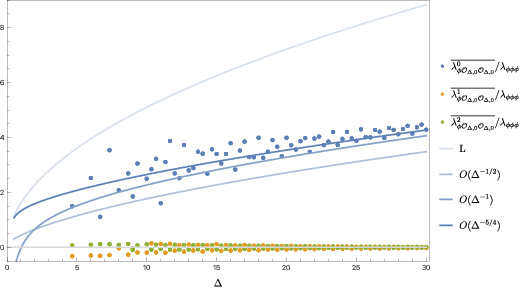
Figure 9: Spin-two OPE coefficients in the same theory, confirming analytic description.
The asymptotic analysis is again extended to canonical ensembles at fixed Δ→∞1, yielding the scaling: Δ→∞2
with the crossover in scaling tracked across parameter space and verified numerically.
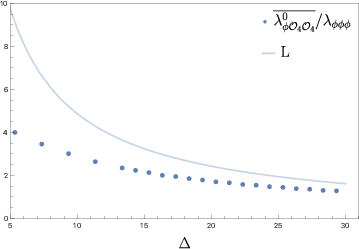
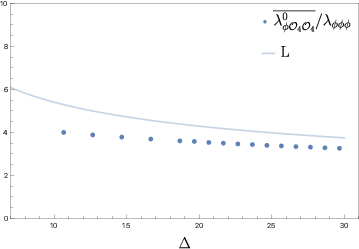
Figure 10: OPE coefficients for four-particle scalar operators at Δ→∞3 (left) and Δ→∞4 (right), overlaying exact results and leading asymptotics.
Coarse-graining over operator families produces a smooth curve matching analytic predictions.
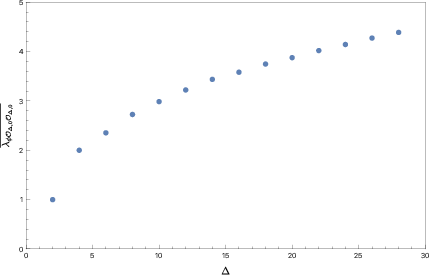
Figure 11: Coarse-grained scalar OPE coefficients, demonstrating the emergence of analytic asymptotics via averaging over operator families.
Theoretical and Practical Implications
The results show that thermal inversion techniques and high-temperature expansions provide not just qualitative, but precise quantitative access to CFT data in the heavy-operator regime, even for moderate conformal weights far from the strict saddle limit. This analytic control also elucidates the structure of the operator spectrum and OPE coefficients in both free and weakly interacting holographic models, and offers avenues for comparison with numerical bootstrap and effective field theory approaches.
- Theoretical implications: The findings clarify the scaling transition between polynomial and exponential operator densities as a function of particle number, elucidate the distinct scaling for OPE coefficients in restricted canonical versus grand-canonical ensembles, and rigorously map the impact of interactions on heavy-state CFT data.
- Practical reach: The results enable predictions for spectra and OPE coefficients in regimes relevant for black hole physics, inform future bootstrap studies, and connect closely with the thermal effective field theory paradigm, encouraging further development of analytic tools for thermal correlators in generic CFTs.
- Future prospects: Extensions include analytic studies of spinning operators, systematic development of thermal EFTs for one-point functions, multi-point thermal bootstrap, analysis in higher or lower AdS dimensions, and the potential crossover with large charge and large spin effective field theories. The techniques and results will be instrumental for understanding black hole microphysics in AdS/CFT, the emergence of bulk dynamics, and the high-energy/temperature sector of non-integrable CFTs.
Conclusion
This work provides a rigorous framework for extracting and controlling asymptotic OPE and spectral data in three-dimensional CFTs with AdS holographic duals, leveraging thermal inversion formulas and high-temperature expansions. The quantitative accuracy of derived asymptotic expressions, their extension to canonical particle sectors, and their resilience under weak bulk interactions underscore their utility for both analytic and numerical studies of heavy-state, high-temperature CFT dynamics. The methods and results set the stage for further advances in analytic bootstrap, thermal CFT, and AdS/CFT phenomenology.

