- The paper demonstrates that thermal spectral functions in holographic CFTs exactly factorize into a perturbative OPE component and a non-perturbative piece associated with black hole geometry.
- It applies semiclassical Virasoro blocks and Borel-resummed WKB methods to extract a full transseries structure, revealing exponential and oscillatory high-momentum corrections.
- The study connects non-perturbative corrections in field correlators to black hole singularity imprints, offering new diagnostic tools for holographic gravitational phenomena.
Exact Holographic Thermal Spectral Functions: OPE, Non-Perturbative Corrections, and Black Hole Singularity
Overview and Motivation
The work presents a comprehensive analytic study of thermal spectral functions in holographic CFTs with gravity duals, focusing on even-dimensional CFTs and scalar primaries of integer conformal dimension. Leveraging recent advances in both the operator product expansion (OPE) and exact connection techniques via semiclassical Virasoro blocks, the authors achieve two key outcomes:
- Demonstration that, in these settings, the spectral function at finite momentum factorizes exactly into a perturbative/OPE piece—fully captured by stress-tensor exchanges—and a non-perturbative piece encoding black hole interior data, such as horizon and singularity characteristics.
- Detailed extraction of the non-perturbative sector's complete transseries structure for large timelike momentum, using exact WKB analysis to obtain precise monodromy data for the dual black hole wave equation.
This factorization and subsequent analysis realize a clear technical connection between field theory correlators’ non-perturbative corrections and signatures of curvature singularities in the dual AdS black hole geometries.
OPE and Holographic Spectral Function Factorization
The authors rigorously anchor their spectral function analysis in the concept of the thermal OPE, emphasizing the truncation structure for holographic theories with large-N, large-gap dynamics. For scalar primaries ϕ of integer dimension Δϕ=2d+n in even d, perturbative corrections to the spectral function—arising from stress-tensor and multi-stress-tensor exchanges—truncate at finite order, beyond which all further corrections are genuinely non-perturbative.
Crucially, exact connection formulas derived from semiclassical Virasoro blocks (in the large-c limit) allow for a factorized representation of the full spectral function:
ρexact(ω,k)=ρpertOPE(ω,k)ρnp(ω,k)
For these cases, ρpertOPE matches explicit OPE calculations, while ρnp is governed solely by global monodromy data of the bulk wave equation, linking directly to the black hole geometry’s interior.
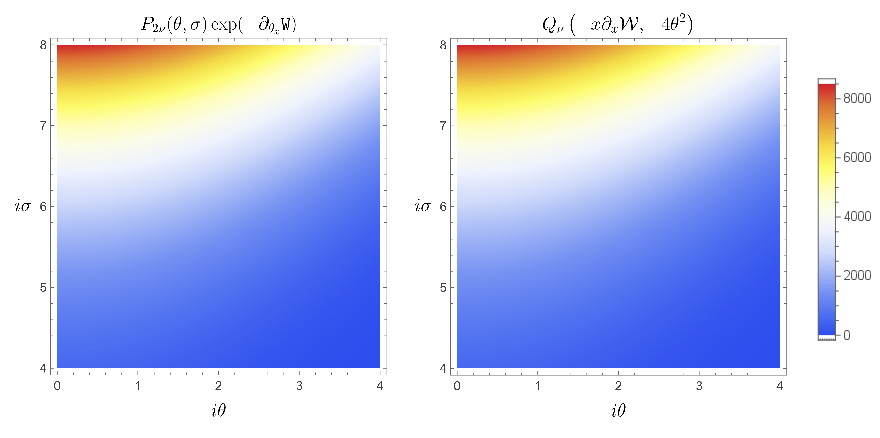
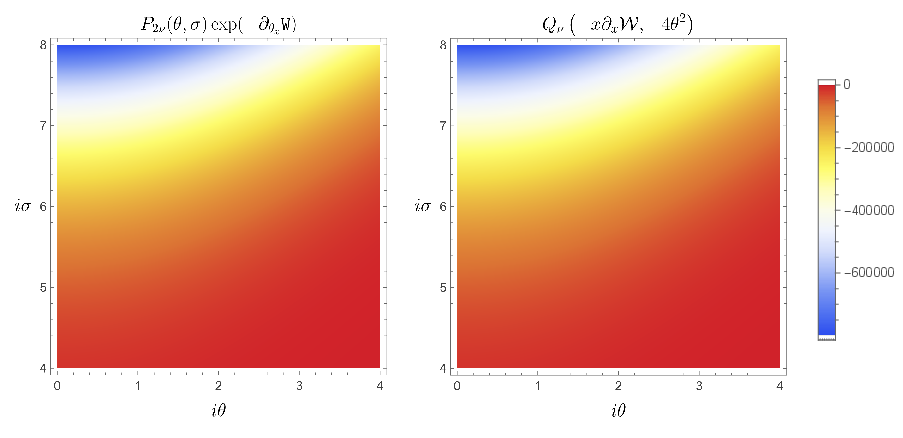
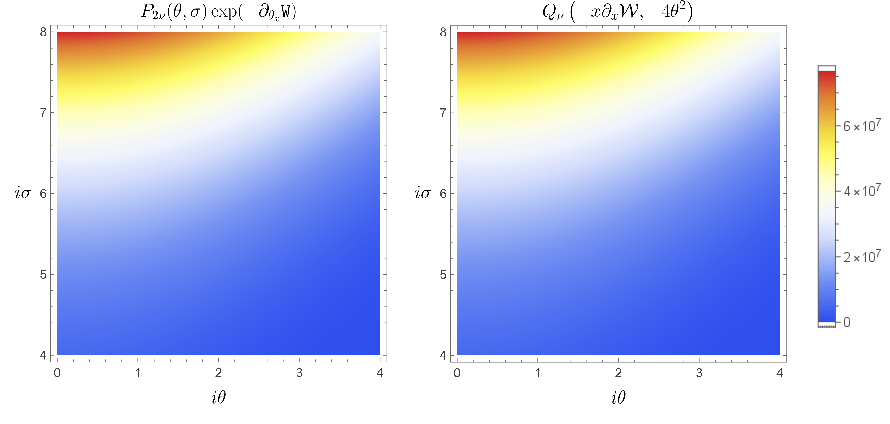
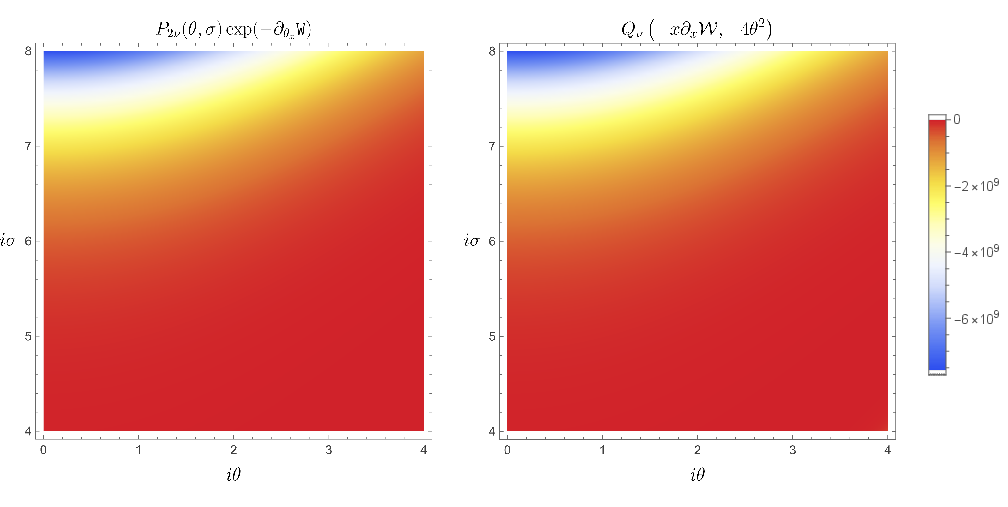
Figure 1: Schematic factorization of the holographic spectral function into an OPE/truncated piece and a non-perturbative/transseries sector.
This factorization is demonstrated both analytically—in terms of the relation to apparent singularities and near-boundary expansions—and numerically via Virasoro block calculations (cf. the results for d=4), confirming exact agreement with OPE predictions and identifying the monodromy's crucial role.
Non-Perturbative Transseries Structure and Monodromy Analysis
Moving beyond perturbative corrections, the paper develops a precise account of the non-perturbative sector by framing the large-momentum limit as an exact WKB problem for the bulk wave equation in AdS black hole backgrounds. The monodromy around the AdS boundary and horizon—encoded as TrMbdy,hor=−2cos(2πσ)—determines the non-perturbative contribution ϕ0.
The authors utilize modern exact WKB methods, especially Borel-resummed all-orders expansions, to extract a complete transseries of the monodromy in terms of WKB (Voros) periods:
ϕ1
This yields explicit non-perturbative exponential and oscillatory corrections as functions of large ϕ2 and ϕ3, in striking contrast to the conventional expectation that the thermal spectral function is purely dominated by its OPE content at high energies. Importantly, the transseries structure is sensitive to the scaling relation between spatial and temporal momenta, exhibiting both integer and fractional power corrections, the latter emerging in the limit ϕ4 due to merging of turning points in the WKB curve.
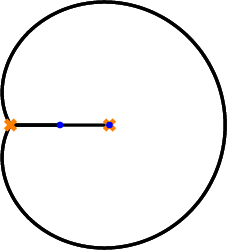
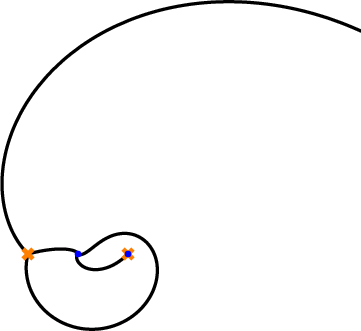
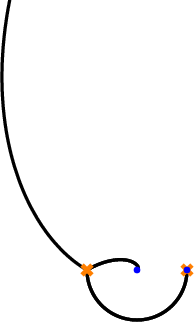
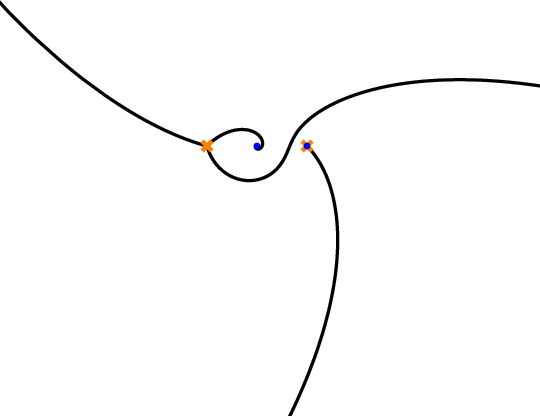

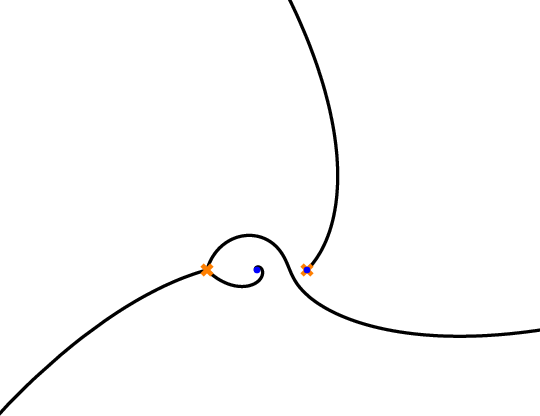
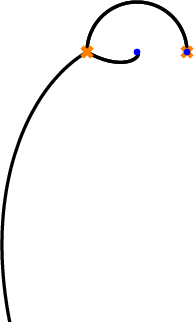
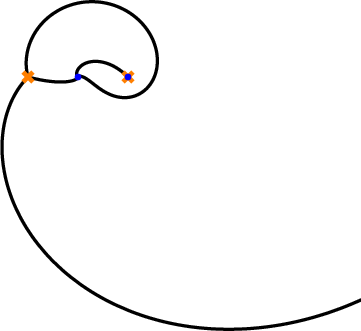
Figure 2: Illustration of the Stokes/anti-Stokes structure for the WKB analysis, highlighting the monodromy cycles sensitive to black hole interior data.
Black Hole Singularity Imprints and Complex-Time Singularities
A substantial portion of the work is devoted to translating these non-perturbative corrections in spectral data to physical signatures of the black hole singularity within dual CFT observables. By performing spatial averaging (momentum integration) and analytic continuation to complex time, the authors relate the branch points and singularities of the spectral function (visible in the ϕ5 sector) to the locus of complex-time singularities in thermofield double correlators.
Singularities are found at
ϕ6
with ϕ7 a classical WKB period related directly to the geometry near the black hole singularity. This demonstrates that non-perturbative spectral data provides a field-theoretic diagnostic of the spacelike curvature singularity inside the AdS black hole—a longstanding goal in the bulk reconstruction/holographic information program.
Figure 3: Complex-time singularities in the analytically continued two-sided correlator, as governed by the black hole singularity and non-perturbative WKB periods.
Numerical Results and Validation
The claims of exact factorization and precise agreement between analytic prediction and numerical evaluation are backed by detailed calculations. The authors carry out brute-force computations of Zamolodchikov’s recursion for semiclassical Virasoro blocks in ϕ8, confirming the exact match of the OPE and Virasoro structures across a wide range of parameters and operator dimensions.
Theoretical and Practical Implications
Theoretical Implications: The results solidify the understanding that, in holographic CFTs, non-perturbative phenomena in thermal spectral functions originate from the same geometric data that underpins the emergence of spacetime singularities in the dual gravity description. This advances both technical control and conceptual clarity in the AdS/CFT program’s treatment of black hole interiors and singularities, offering quantitative field theory diagnostics for Planckian/curvature singularities from boundary data.
Methodological Advances: The rigorous combination of exact OPE, semiclassical Virasoro blocks, and exact (Borel-summed) WKB methods for monodromy data sets a new standard for analytic tractability in real-time, finite-temperature holographic observables. The identification of precise transseries and resurgent structures opens further avenues in the study of non-perturbative gravitational phenomena from CFT.
Practical Applications: While immediate experimental relevance is limited to strongly coupled field theories with holographic duals, the methodologies and structural insights are transferable, e.g., to the analysis of transport, relaxation, and chaos in large-ϕ9 QFTs and condensed matter analogs.
Outlook and Future Directions
Several directions arise from these findings:
- Extending the factorization result and WKB/transseries analysis to charged and spherical black holes, or higher-spin/fermionic operators.
- Generalizing beyond integer dimensions and investigating the resurgent links between OPE data and non-perturbative sectors for generic Δϕ=2d+n0.
- Exploring deeper the relation between the observed complex-time singularity structure and the geometric/causal features of singularities, possibly in more exotic gravitational duals.
- Utilizing these methods to analyze information-theoretic quantities (e.g., OTO correlators, entanglement) with sensitivity to the deep interior.
Conclusion
Through analytic and numerical techniques exploiting the synergy between thermal OPE, semiclassical Virasoro blocks, and exact WKB monodromy analysis, this work achieves an exact factorization of the holographic thermal spectral function in certain cases, and completely characterizes the structure of its non-perturbative corrections. The black hole singularity is shown to imprint itself in the dual CFT through the monodromy structure of the spectral function, directly reflecting the geometry’s deepest features in observable boundary data. Future research will determine how universal and structurally robust this picture remains across broader gravitational and quantum field theoretical landscapes.

