- The paper demonstrates that fusion-born alpha particles effectively stabilize ion-scale turbulence via enhanced zonal flows.
- The paper reveals, through linear and nonlinear gyrokinetic simulations, that increased alpha density upshifts the ITG critical gradient and reduces turbulent heat fluxes.
- The paper highlights implications for reactor design by linking electromagnetic fast ion modes to improved transport control and optimized fusion performance.
Impact of Energetic Alpha Particles on Core Turbulence in ARC-Class Fusion Power Plants
Overview and Motivation
This study employs linear and nonlinear gyrokinetic simulations using CGYRO to analyze the effect of fusion-born alpha particles on core microturbulence and transport in the ARC tokamak, a burning plasma power plant concept. The fidelity of transport predictions is critical in next-generation fusion devices, where alpha particles dominate plasma heating and could actively shape turbulent transport. The investigation addresses high-performance operational scenarios and quantifies the interplay between fast ion-driven modes, zonal flows, and ion-scale turbulence. It systematically distinguishes direct and indirect stabilization mechanisms, and evaluates their relevance in the inner core plasma, drawing implications for reactor design and performance modeling.
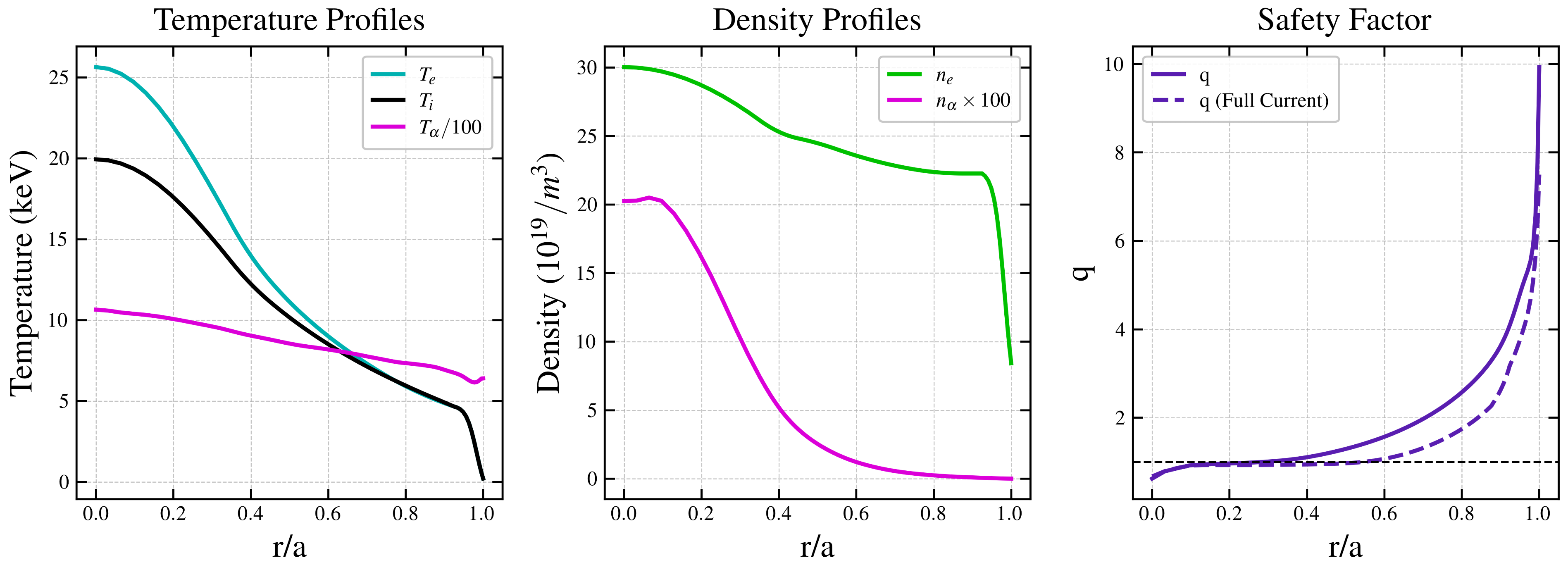
Figure 1: ARC kinetic profiles from medium-fidelity integrated modeling, highlighting alpha particle temperature and density with q-profile for operational context.
ARC Scenario Definition and Modeling Approach
The analysis targets a reduced-current ($9$ MA) ARC scenario, balancing computational tractability with physics relevance. Profiles are generated using MAESTRO medium-fidelity integrated modeling, leveraging quasilinear transport models (TGLF, Qualikiz), a neural network surrogate for the EPED pedestal, and full-wave fast ion deposition simulations (TORIC-FPPMOD). Alpha particle effective temperature and density are derived from high-resolution NUBEAM Monte Carlo slowing-down calculations. Manipulations—for example, lumping D and T into one main ion species—are validated against prior studies and facilitate cost-efficient linear and nonlinear simulations in CGYRO.
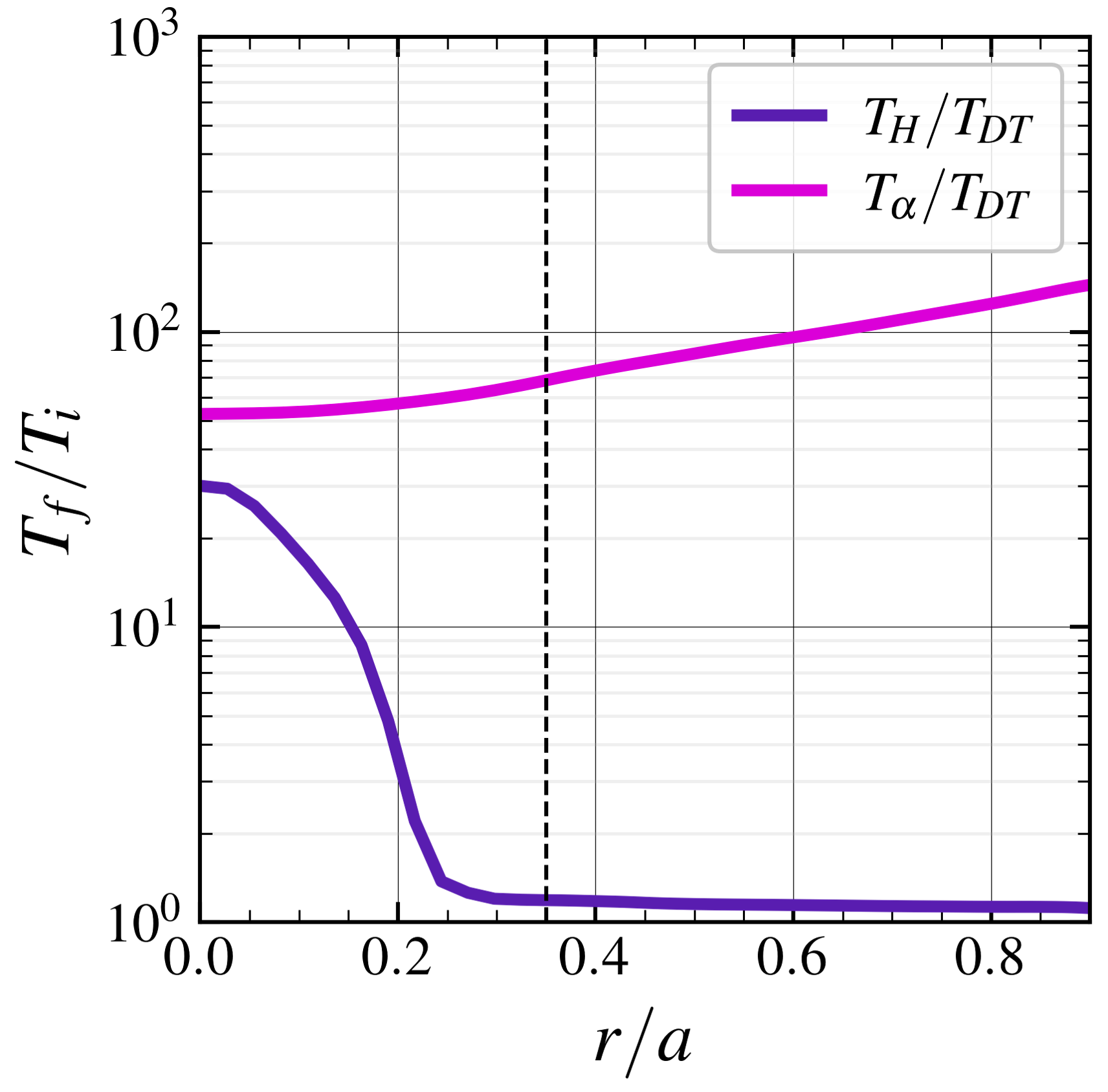
Figure 2: Fast ion to thermal ion temperature ratios for ICRH-accelerated hydrogen and fusion alphas, demonstrating radial localization and justification for thermal impurity treatment.
Linear Gyrokinetic Results
Linear CGYRO simulations, performed at multiple inner radial locations (r/a=0.2, $0.35$, $0.45$), reveal strong alpha-driven stabilization of ion-scale growth rates at r/a=0.2, primarily due to the contribution of alphas to normalized pressure gradients. At r/a=0.35, linear stabilization effects are minor; the presence of low-k alpha-driven modes, notably at kyρs=0.0525 (corresponding to n∼16), is observed. At $9$0, alpha density is sufficiently low to render fast particle effects negligible.
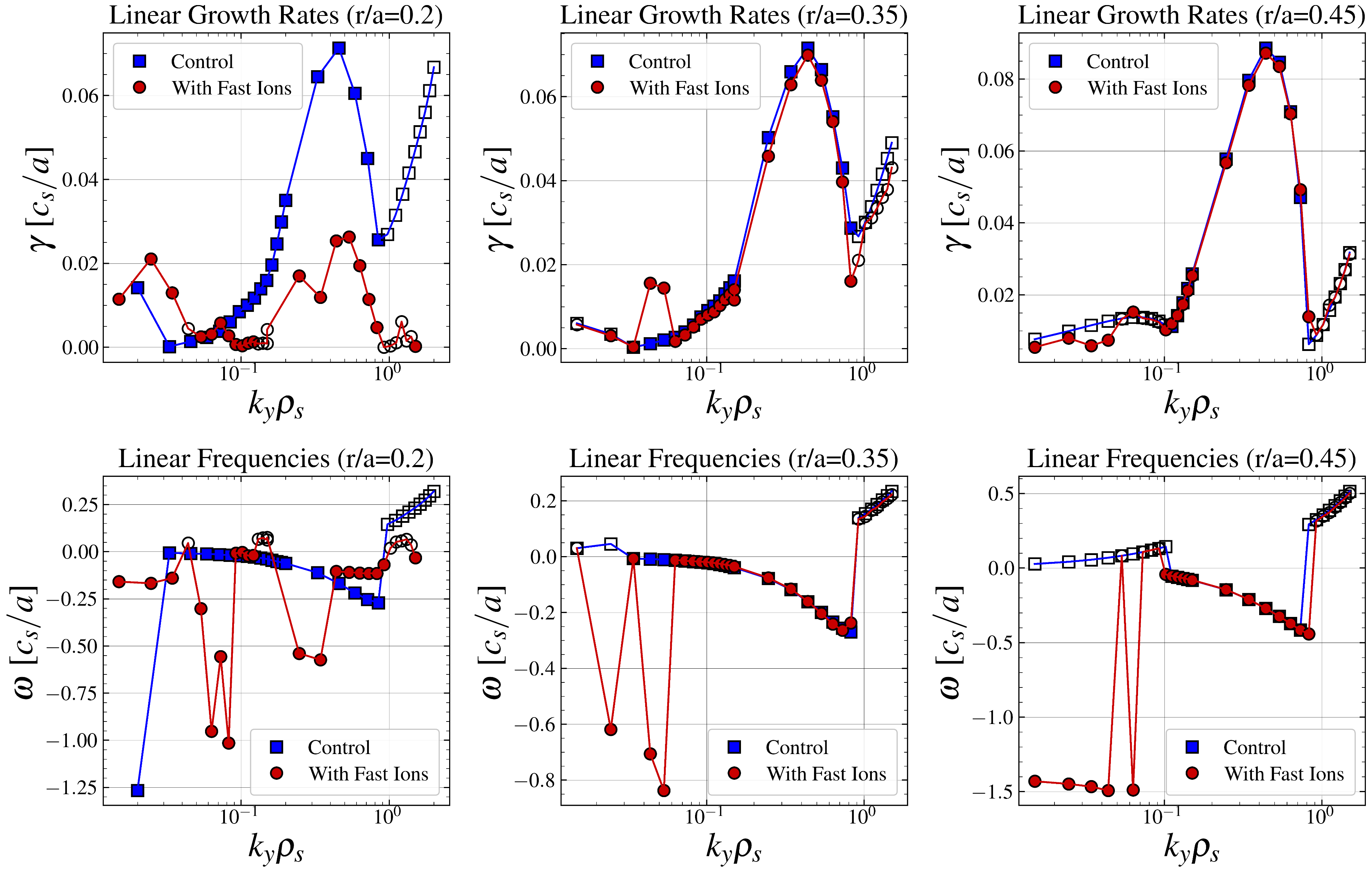
Figure 3: Linear growth rates showing ion and electron diamagnetic directed modes with and without fast alpha particles; strong ITG stabilization at $9$1, emergence of fast ion mode at $9$2, and minor effects at $9$3.
Increasing $9$4 and alpha pressure gradients selectively destabilizes electromagnetic fast ion modes, with polarization analysis confirming these modes as imperatively electromagnetic (substantial $9$5). The mode frequency and gap location are consistent with analytic predictions for TAEs; shear scans locate transitions between KBM-like and TAE-like instability characteristics.
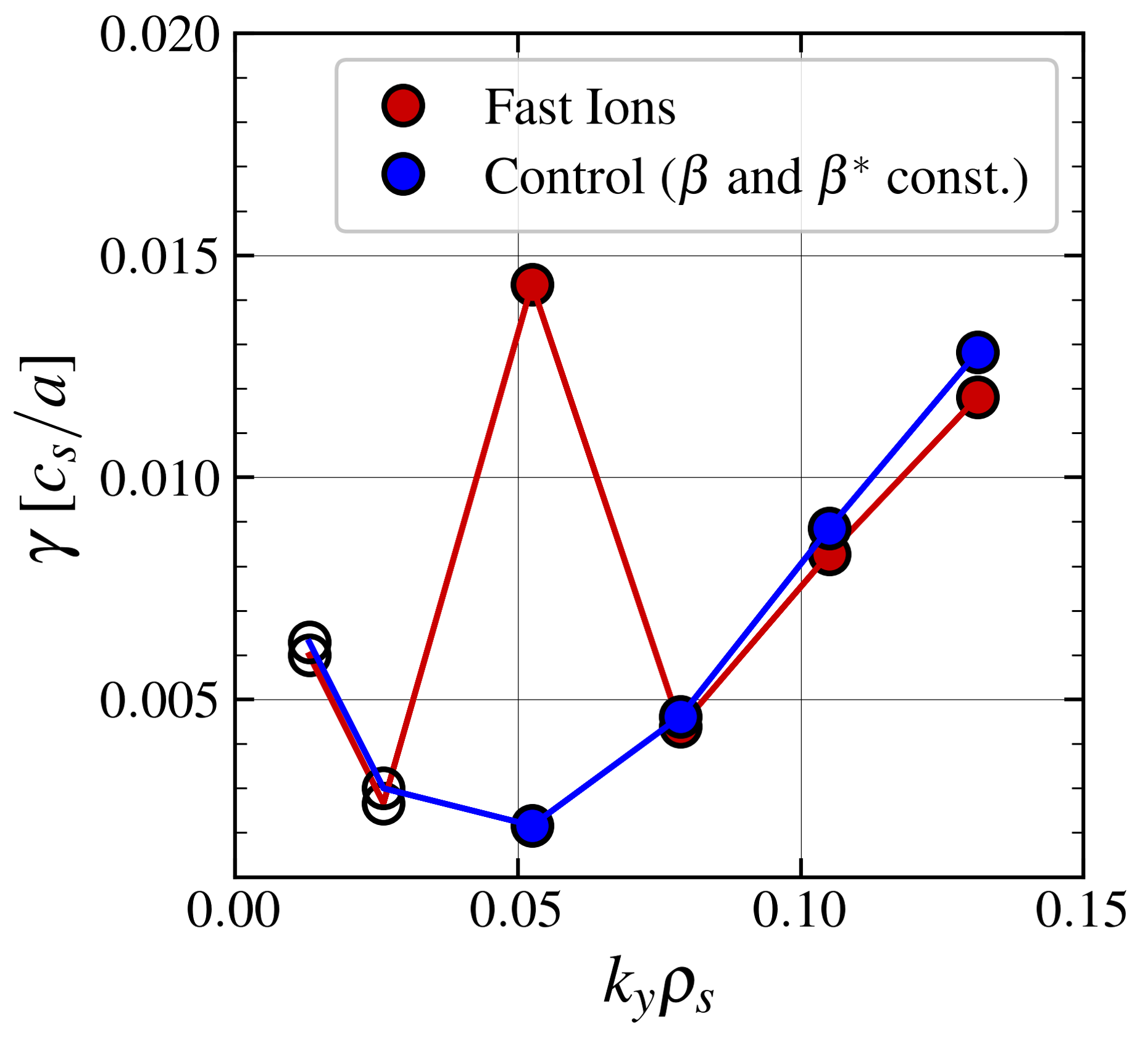
Figure 4: Linear scan at $9$6 showing decreased ITG growth rates with increased $9$7, and excitation of fast ion mode only with authentic fast alpha inclusion.
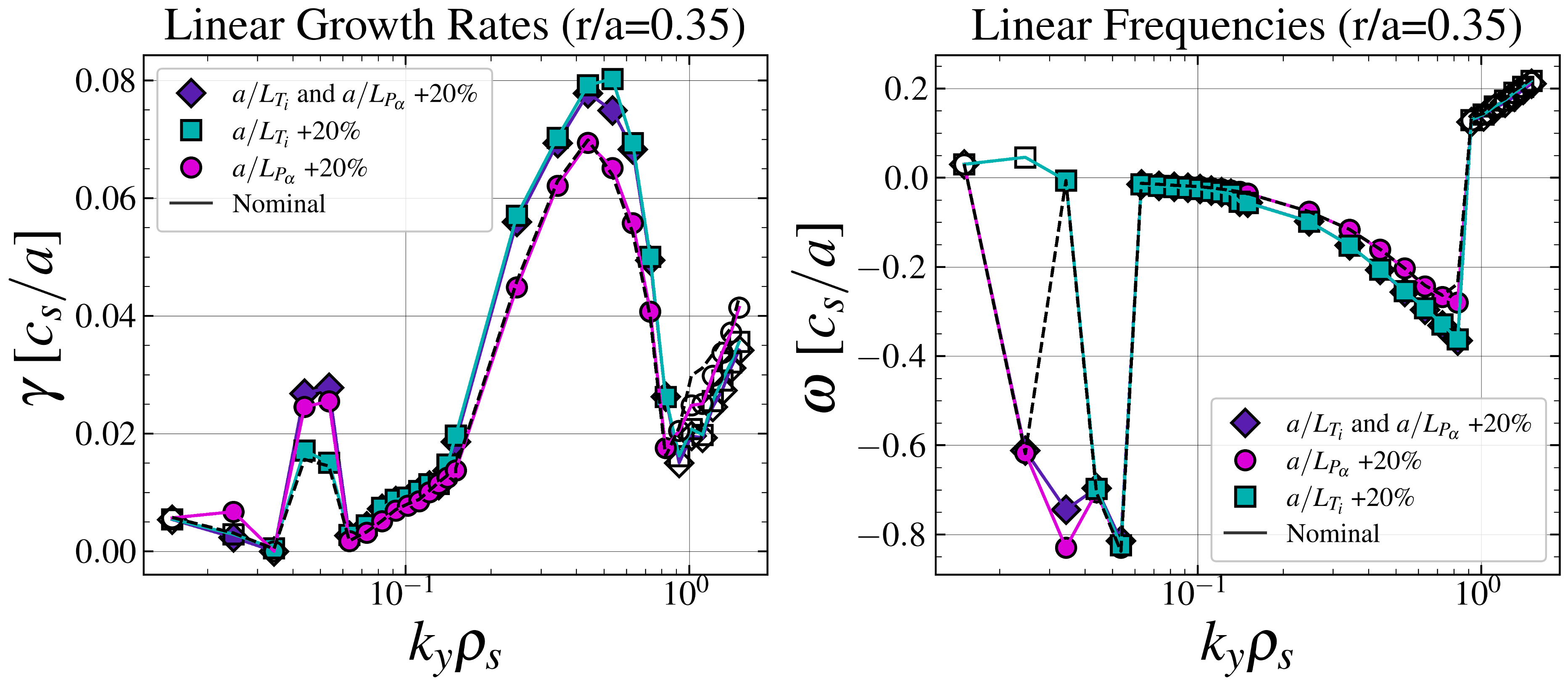
Figure 5: Sensitivity of linear growth rates to variations in main ion temperature and fast alpha pressure gradients.
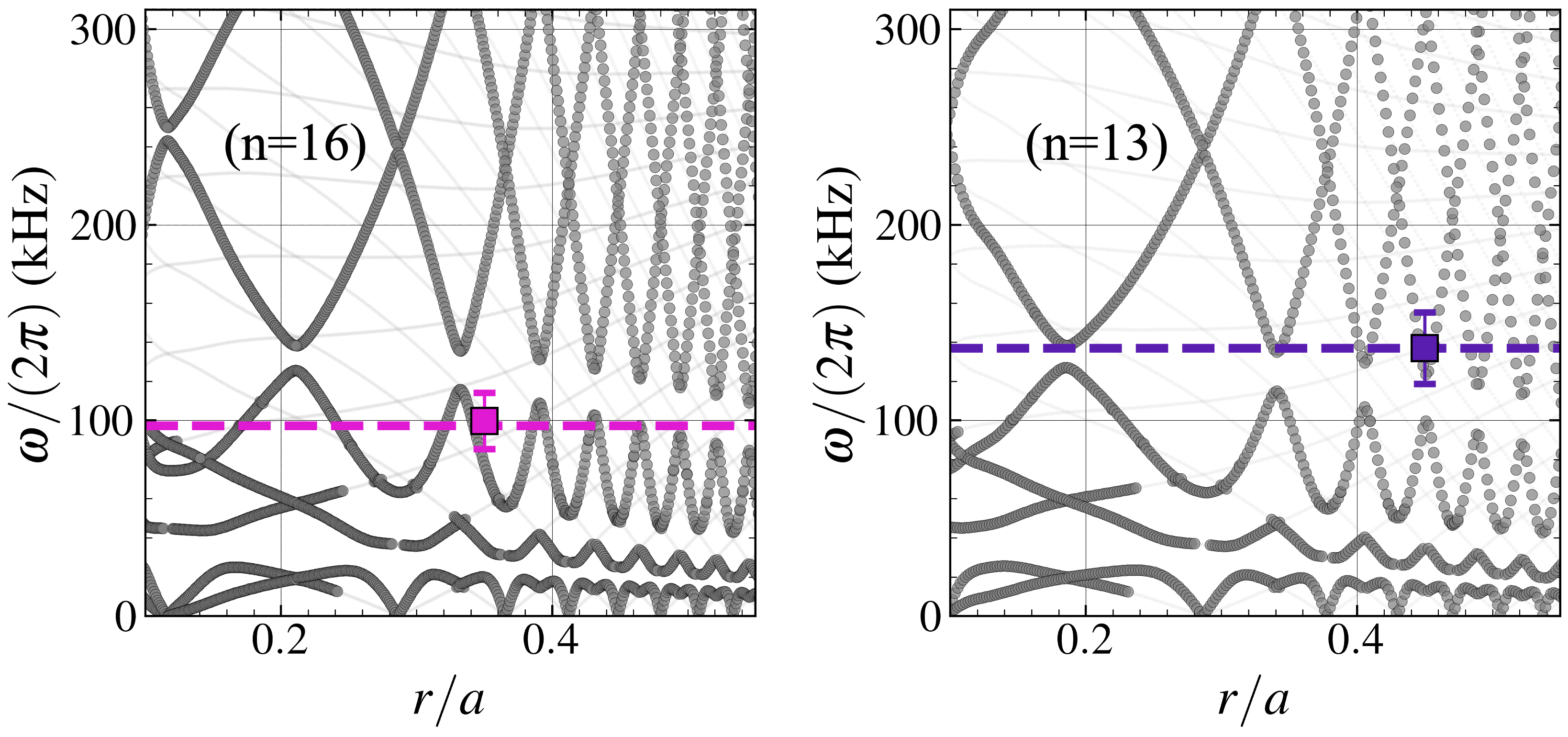
Figure 6: Shear Alfvén continuum and frequency gaps solved by ALCON, indicating location of fast ion mode frequencies with respect to TAE gaps.
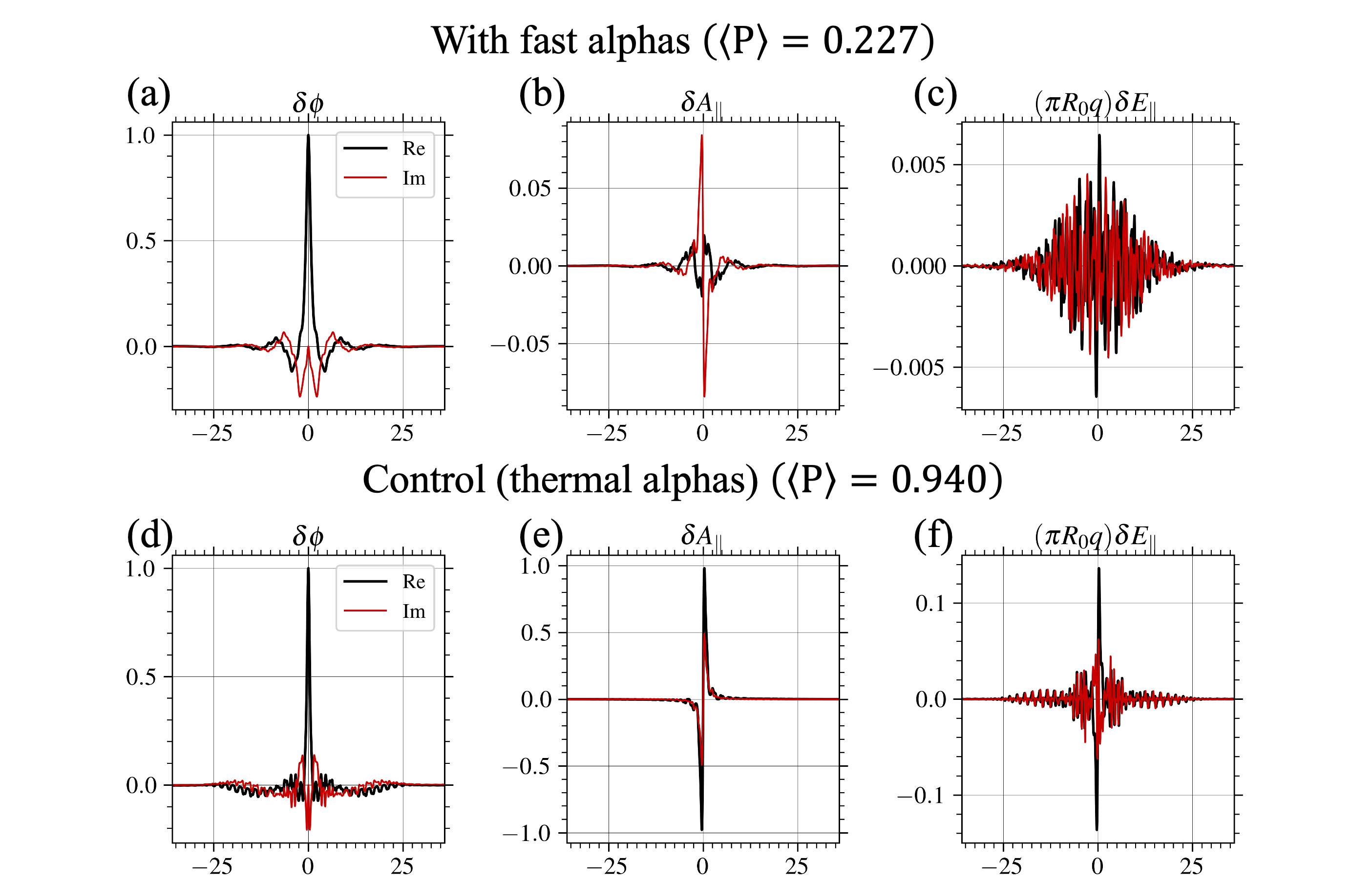
Figure 7: Fluctuation structure and polarization at $9$8 with and without fast alphas, highlighting electromagnetic character and field-line averaged polarization.
Nonlinear Gyrokinetic Modeling
Full nonlinear CGYRO simulations at $9$9 demonstrate major reductions in ion and electron turbulent heat fluxes—up to an order of magnitude lower than control (thermalized alpha) cases. The dominant mechanism is an upshift in the ITG critical gradient, attributed to fast ion-driven zonal flows. Initial transients in main ion heat flux coincide with the growth and saturation of fast alpha-driven modes. The heat flux spectra confirm that localized fast ion modes mediate this effect (especially at r/a=0.20).
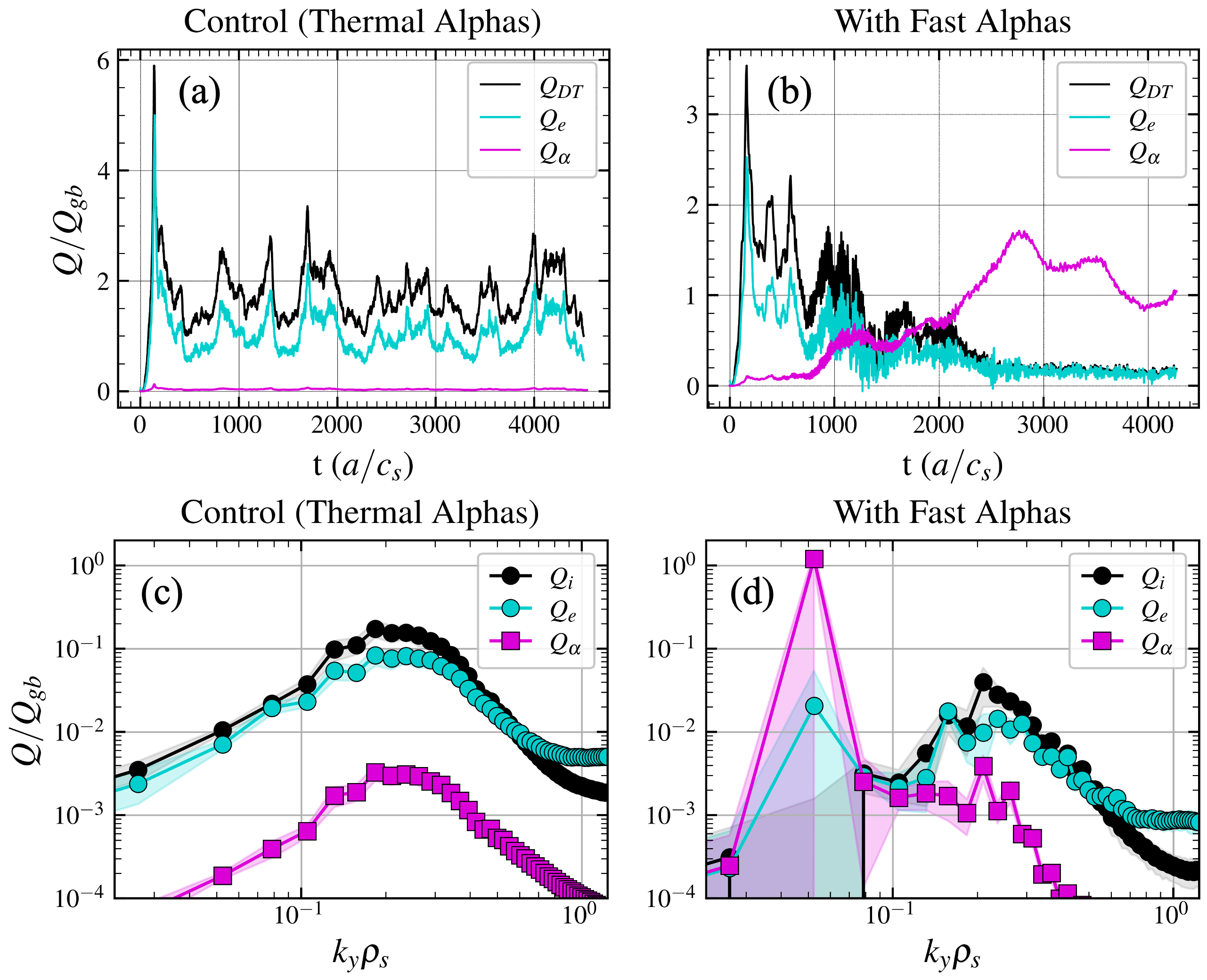
Figure 8: Nonlinear heat flux and spectra at r/a=0.21 with and without fast alphas, showing strong suppression and spectral localization of fast ion flux.
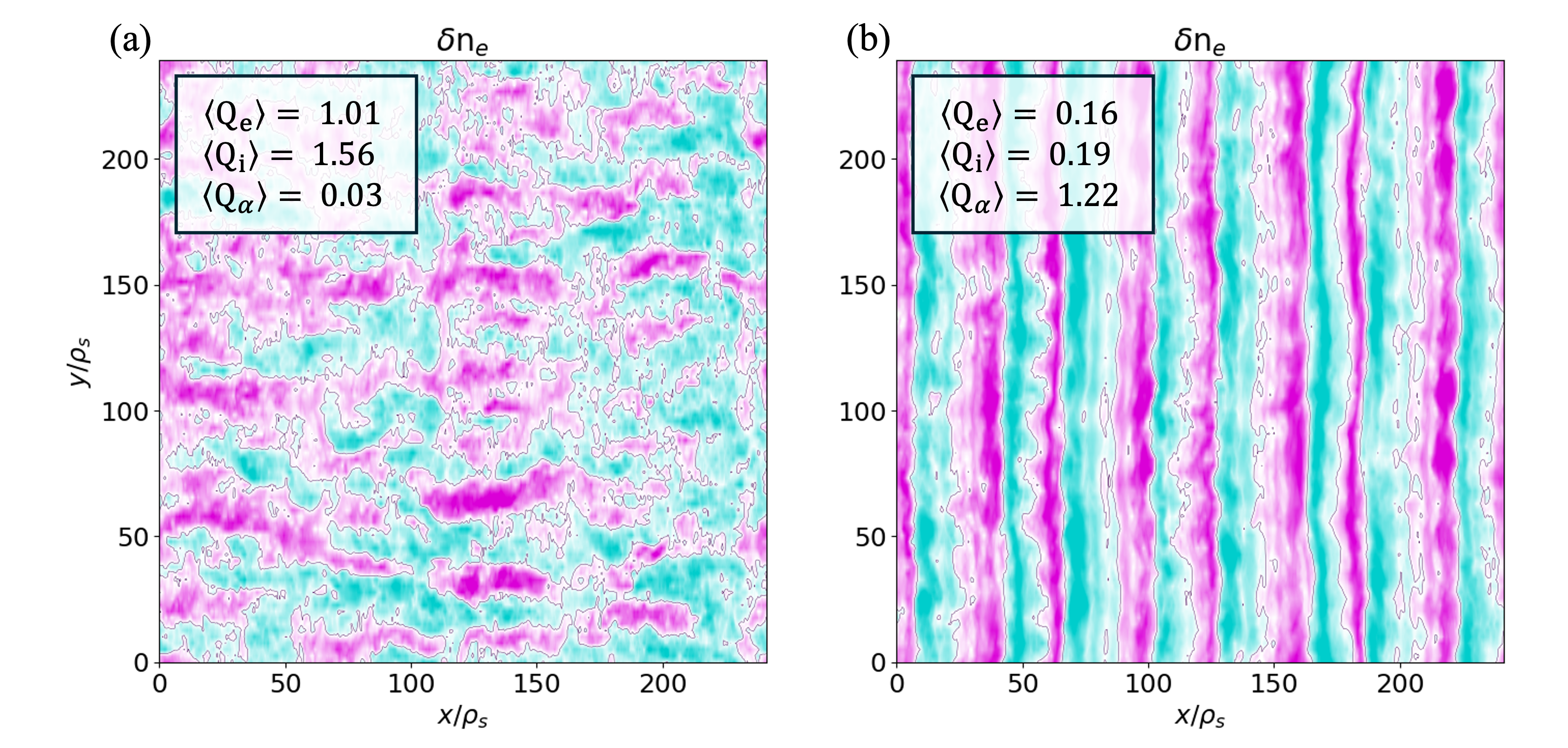
Figure 9: Real-space density fluctuations, illustrating zonal flow shearing and suppression of radial turbulent eddies in presence of fast alphas.
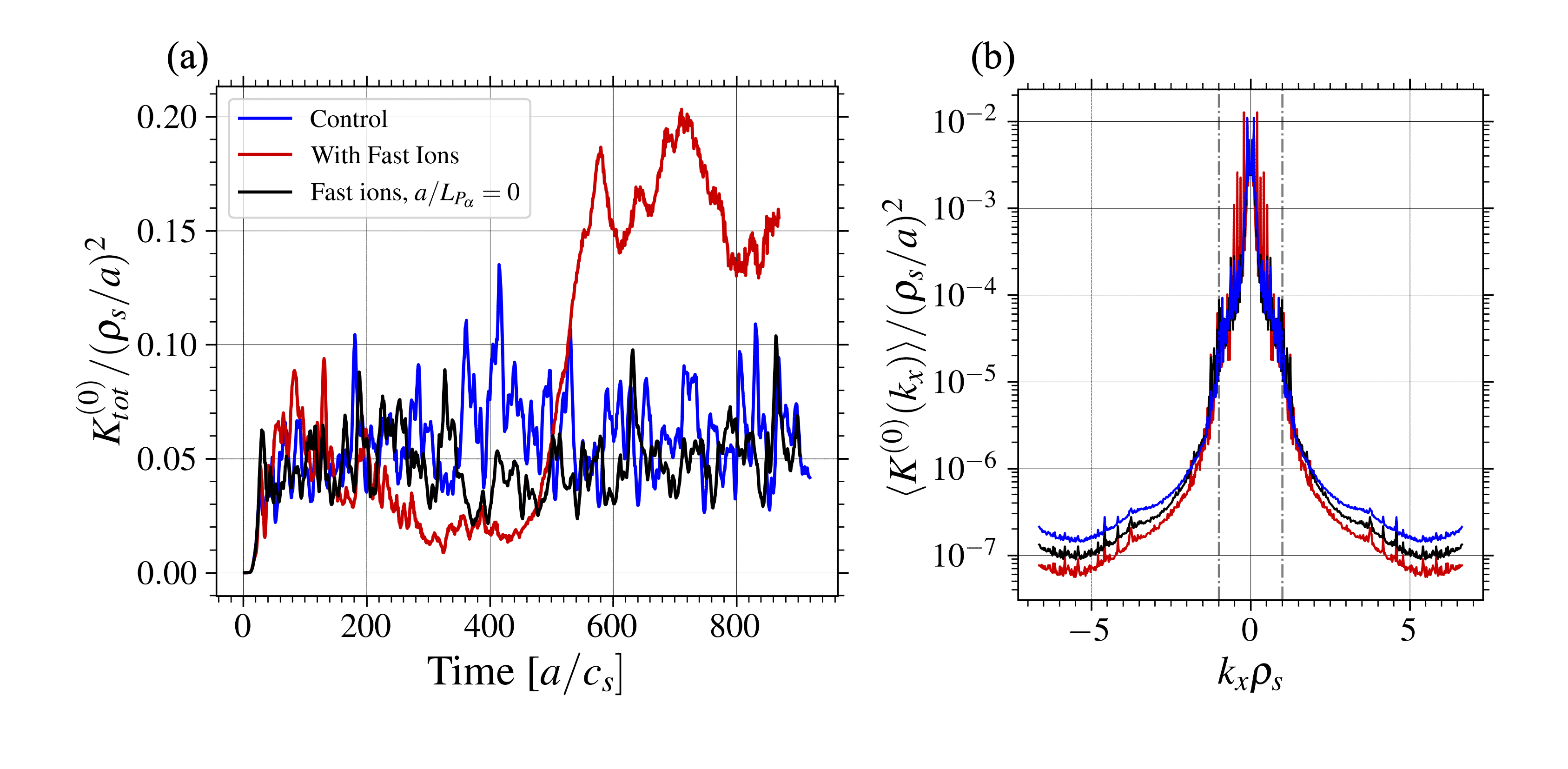
Figure 10: Zonal flow drift energy—enhanced in fast alpha runs, confirming zonal flow stabilization as the dominant nonlinear suppression mechanism.
Gradient scans reveal an upshifted ITG critical gradient with minimal change in stiffness, a result relevant for profile optimization in burning plasmas. The stabilization effect intensifies with increasing r/a=0.22 and alpha density, and is limited to regions within significant fast alpha density.
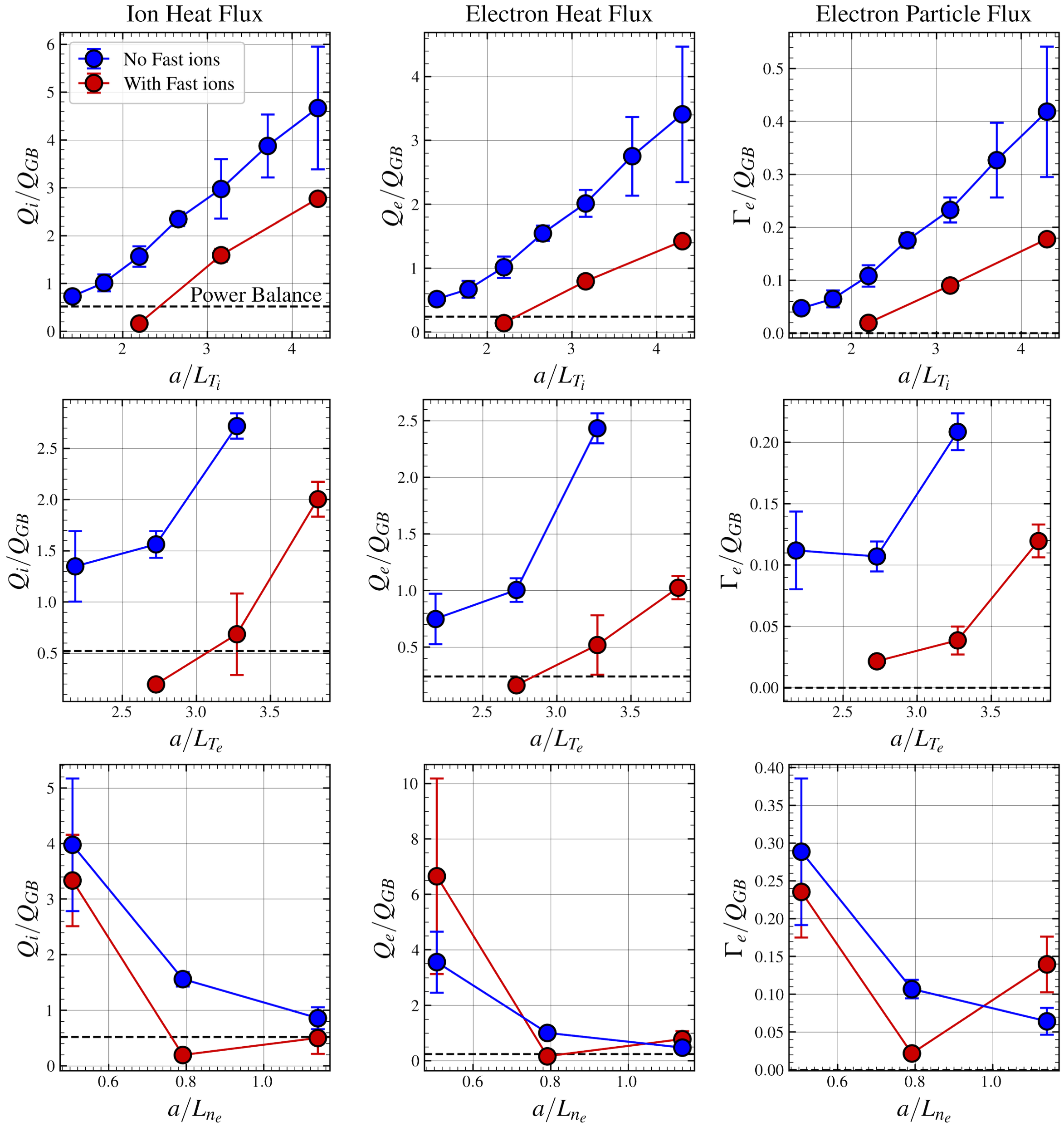
Figure 11: Gradient scans of temperature and density, denoting power balance targets and evidence for upshifted critical gradient.
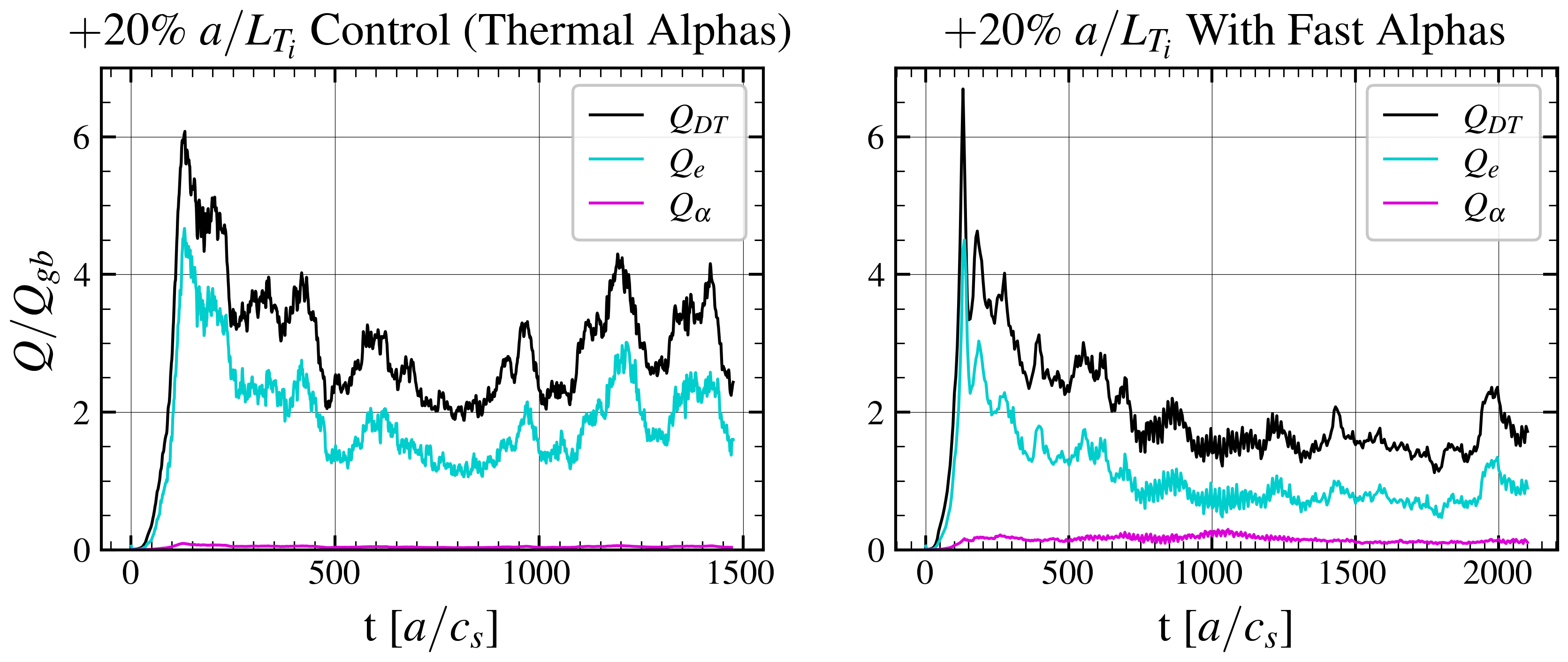
Figure 12: Nonlinear heat fluxes with increased main ion temperature gradient, further validating stabilization even in strongly driven ITG regimes.
Parametric and Radial Sensitivity
Varying alpha density and gradient demonstrates that turbulence suppression scales robustly with increased fast particle fraction (r/a=0.23), but is sensitive to unphysical density gradients that excessively destabilize fast ion modes and drive large alpha fluxes. These observations are consistent with theoretical scaling r/a=0.24.
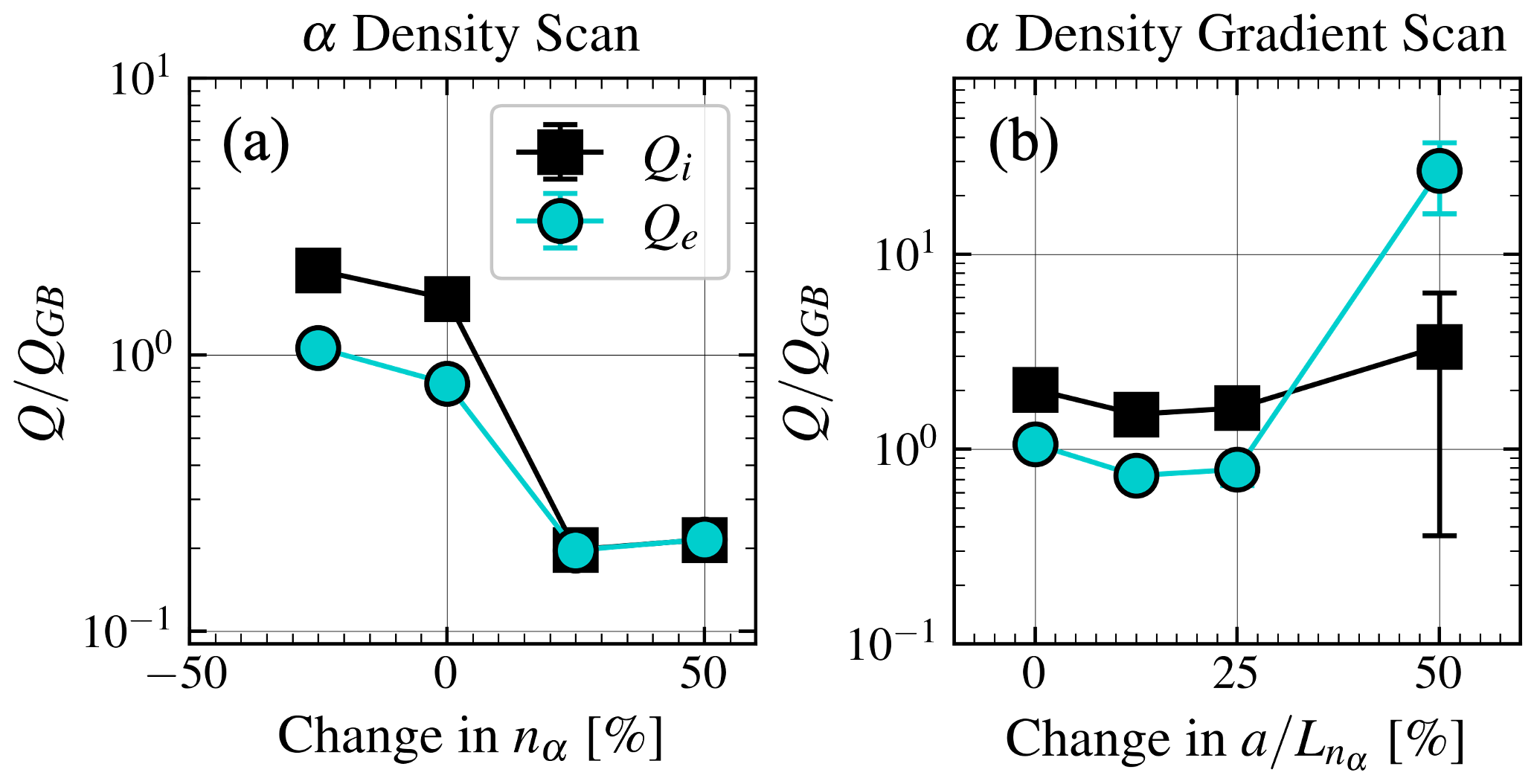
Figure 13: Scans in alpha particle density and density gradient, quantifying main ion/electron heat flux response and fast ion mode behavior.
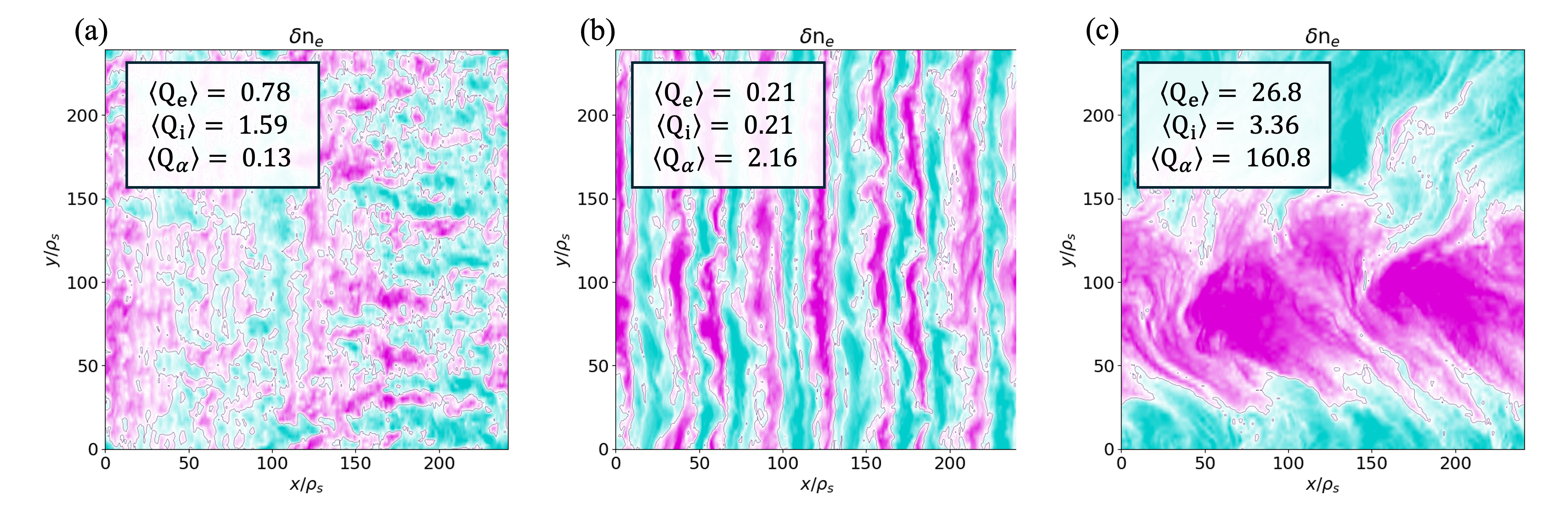
Figure 14: Real-space density fluctuations exploring effects of altered alpha density and gradients.
Beta-e scans establish that turbulence suppression disappears in the electrostatic limit, validating the fundamentally electromagnetic nature of fast ion stabilization.
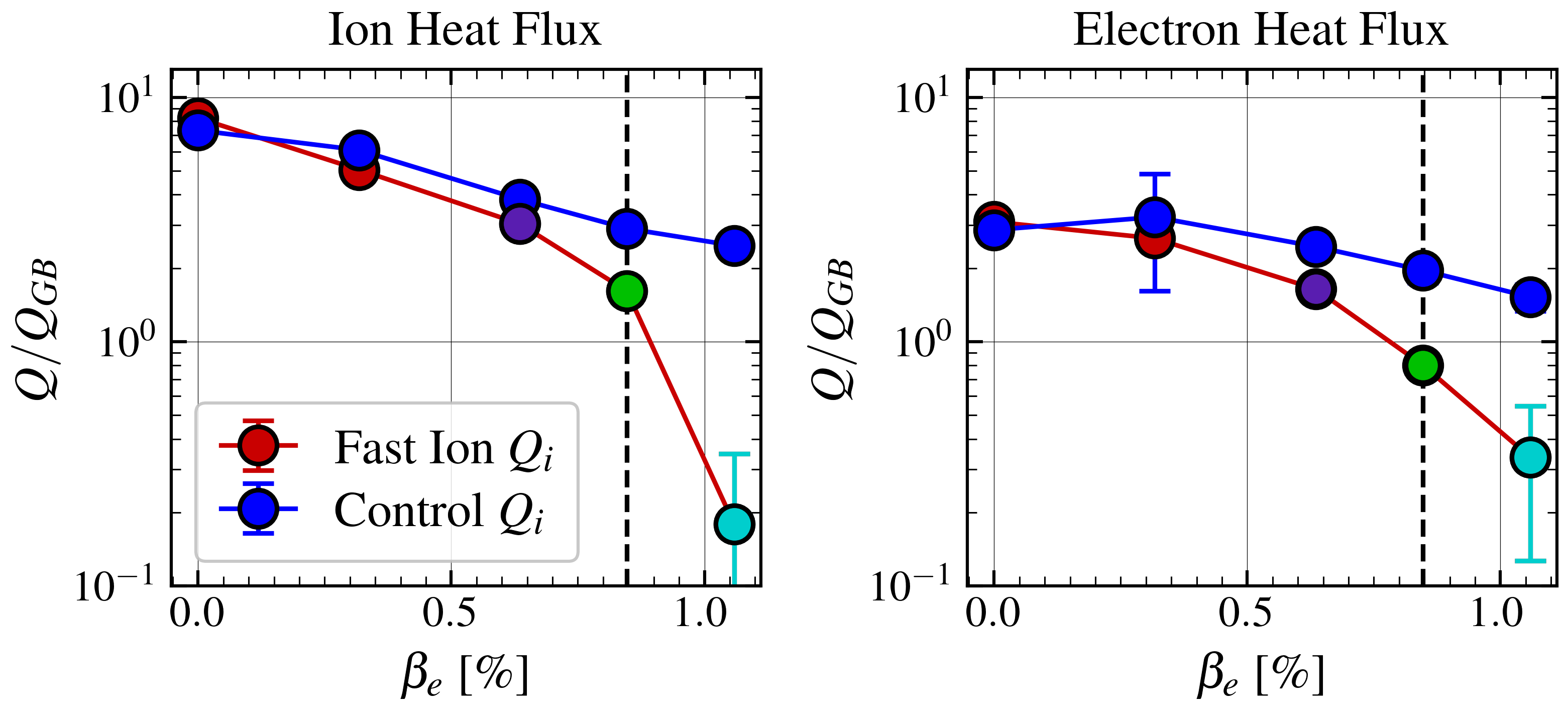
Figure 15: Nonlinear ion/electron heat flux versus r/a=0.25, differentiating electromagnetic and electrostatic regime effects.
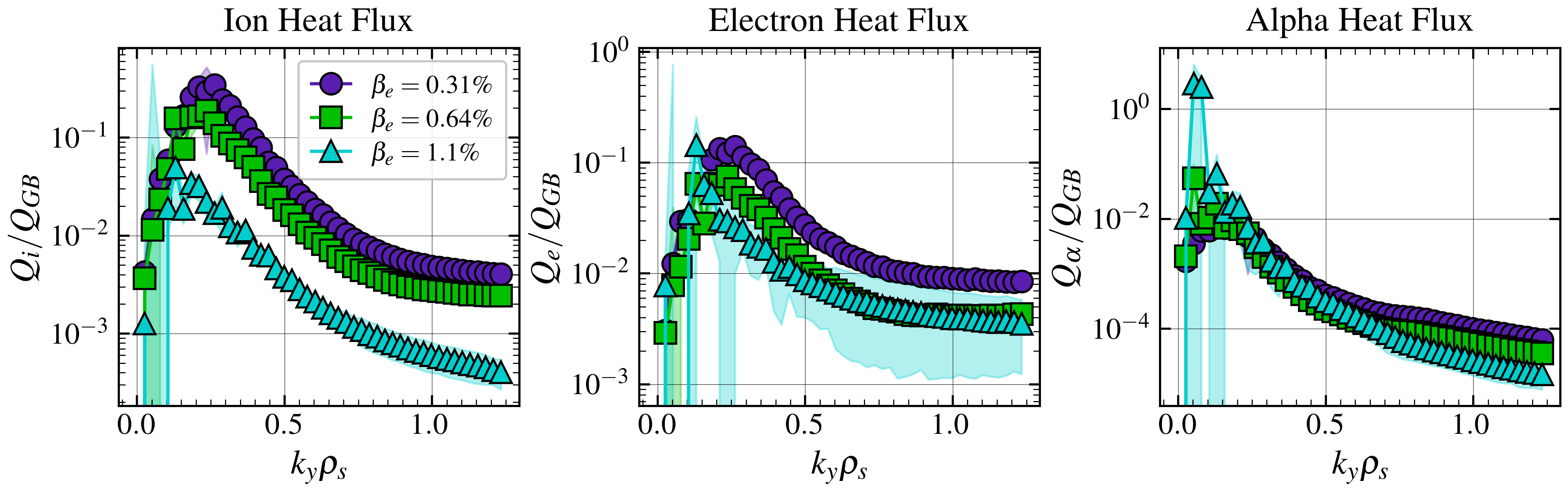
Figure 16: Heat flux spectra as a function of r/a=0.26, showing increased alpha heat flux and spectral peaking with elevated r/a=0.27.
Global performance implications are explored via radial location scans. Stabilization is significant in the inner core (r/a=0.28) and extends outward only when alpha density is artificially increased. No universal suppression is found at r/a=0.29, with some cases exhibiting larger fluxes due to mode structure intricacies.
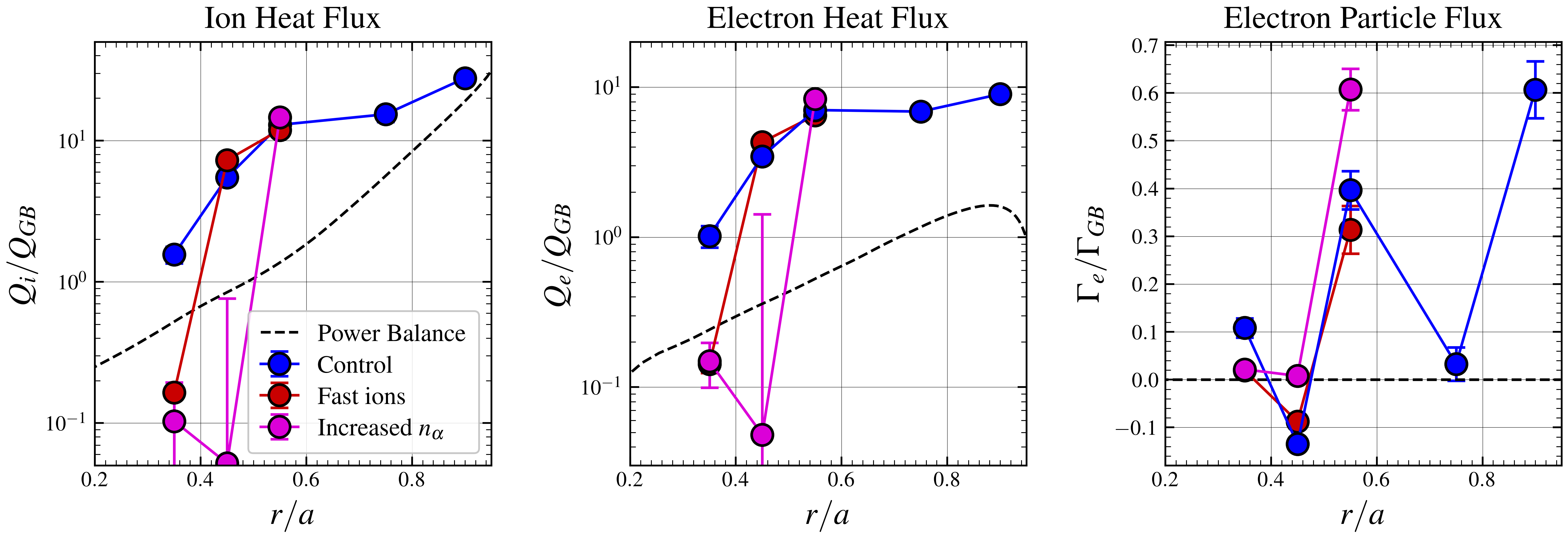
Figure 17: Radial scan, contrasting turbulent heat and particle fluxes as a function of alpha density fraction.
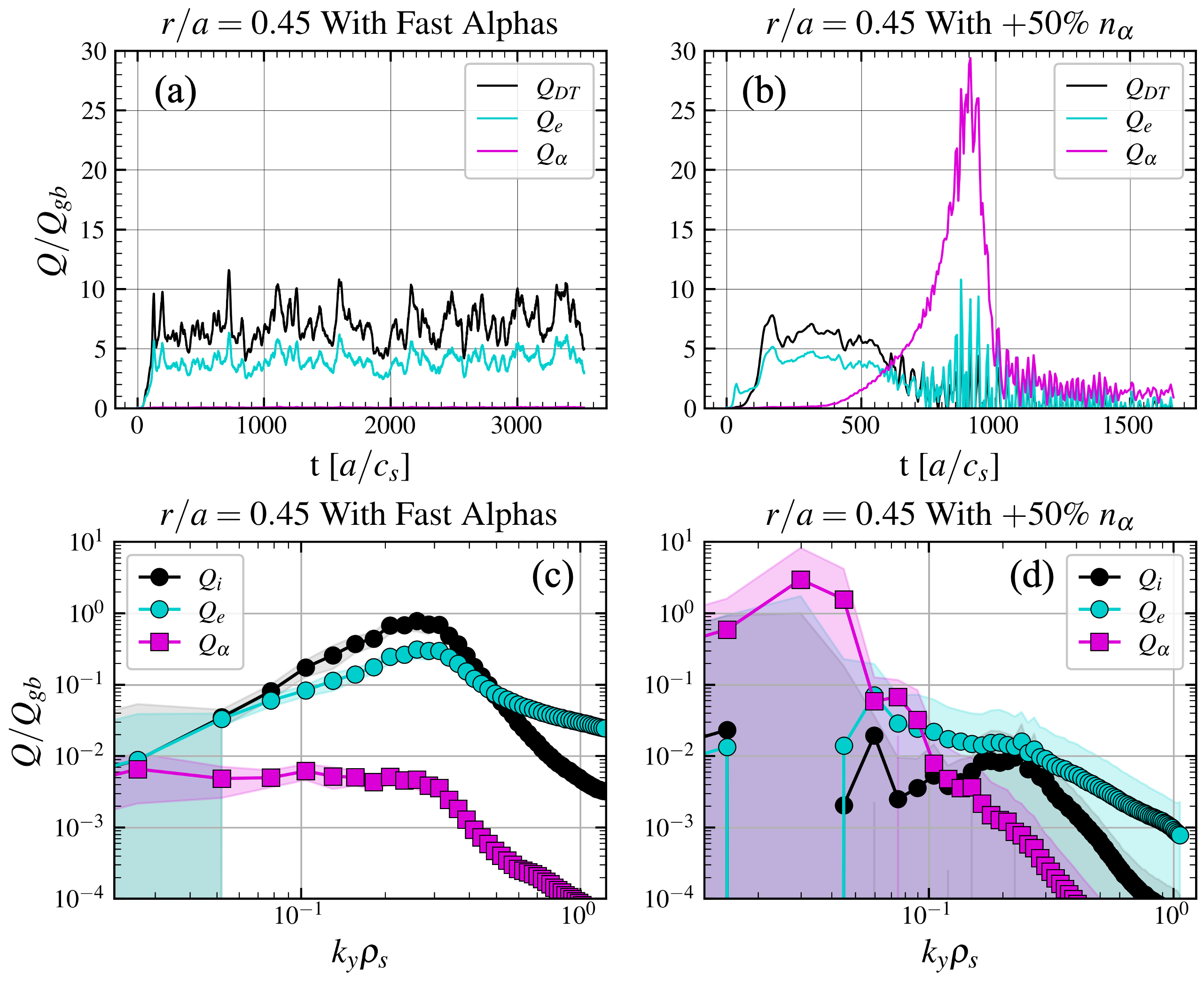
Figure 18: Nonlinear heat flux and spectra at $0.35$0 for nominal and increased alpha density, demonstrating spatial extension of stabilization.
Discussion and Implications
The findings underline that fast alpha-driven modes—TAEs and associated electromagnetic instabilities—actively stabilize ion-scale turbulence via zonal flow enhancement, producing beneficial upshifts in ITG critical gradients. Direct stabilization (pressure/dilution effects) is minor except in the extreme inner core. Results indicate turbulence suppression scales with alpha population and $0.35$1, providing a pathway for improved transport and higher performance in burning plasma reactors.
The theoretical and practical implications are substantial for integrated modeling and real-time profile control in fusion power plants. The results validate the utility of local gyrokinetic approaches under high-field, low $0.35$2 conditions, but underscore the necessity for self-consistent coupling with global fast ion transport and profile relaxation models (e.g., RBQ, TRANSP). The study motivates the future development of flux-matched profile prediction workflows incorporating nonlinear fast ion effects and anomalous transport, crucial for next-generation reactors where $0.35$3 heating dominates.
Conclusion
This comprehensive gyrokinetic investigation demonstrates that fusion-born alpha particles can induce substantial turbulence suppression in the core of ARC-class burning plasma tokamaks, predominantly through fast ion-driven zonal flow enhancement and indirect stabilization of ion heat and particle transport. The nonlinear upshift of the ITG critical gradient and the scaling of effects with alpha density and $0.35$4 are quantifiable and strongly suggest operational strategies for maximizing performance. These results establish a rigorous benchmark for the inclusion of fast ion dynamics in future predictive and control-oriented modeling for fusion power plants.

