- The paper demonstrates that incorporating trainable quantum channels mitigates barren plateaus and enhances model expressivity in quantum neural networks.
- It leverages system-environment interactions via Kraus decomposition to enable adaptive spectral deformation and improved gradient flows.
- Experimental evaluations on MNIST and EGSSD tasks confirm faster convergence and superior accuracy of channel-augmented QNNs over traditional unitary models.
Trainable Quantum Channels as Computational Primitives in Quantum Learning
Introduction
This paper presents a principled extension of variational quantum neural networks (QNNs) by introducing trainable quantum channels—parameterized completely positive trace-preserving (CPTP) maps—as integral, optimizable computational primitives. Standard QNNs are constrained to parametrized unitary transformations, rendering them susceptible to barren plateaus, poor generalization, and hardware noise, phenomena intrinsic yet problematic in NISQ-era devices. Traditionally, open-system effects and quantum dissipation have been treated solely as environmental noise to be mitigated. In contrast, this work reframes quantum channels as adaptive resources, offering an expanded hypothesis space, more flexible optimization geometry, and the potential for enhanced model performance.
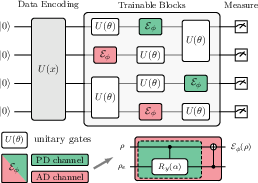
Figure 1: The architecture incorporates trainable quantum channels into variational QNNs via system-environment interaction and Kraus representation; channel parameters are optimized simultaneously with unitary parameters during training.
Theoretical Framework and Model Construction
Channel-Parameterized Quantum Models
The core architecture consists of encoding an input state ρx via a feature map, then processing it through a sequence comprising a parameterized quantum channel Eϕ and a conventional variational unitary U(θ). The output observable is thus
f(θ,ϕ)=Tr[OU(θ)Eϕ(ρx)U†(θ)],
with the channel's non-unitary CPTP evolution implemented physically via ancilla-assisted, system-environment unitary dynamics. Both amplitude damping (AD) and phase damping (PD) channels are realized using explicit controlled-unitary constructions, with the dissipation parameter ϕ introduced as a trainable variable.
Hypothesis Space Expansion
By leveraging the Kraus decomposition, the quantum model output can be recast as a superposition over channel branches, each governed by an effective observable Ok(θ,ϕ)=Ek†(ϕ)O(θ)Ek(ϕ). Critically, unlike in conventional QNNs where only similarity transformations are possible (implying spectral invariance of the observable), the inclusion of trainable channels imparts a form of adaptive spectral deformation; eigenvalues of the functional primitives can be continuously modulated by ϕ.
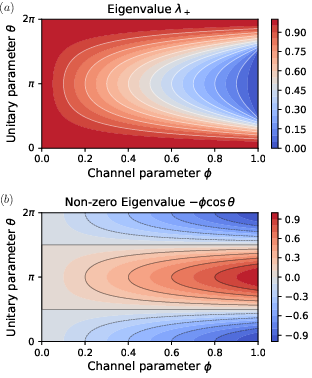
Figure 2: Eigenvalue evolution of effective observables as a function of both channel and circuit parameters, illustrating the channel-dependent, non-unitary spectral modulation.
This additional degree of freedom structurally expands the expressive capacity of quantum learning models, providing a strict hierarchy:
Hu⊊HE
where the conventional unitary hypothesis space is recovered as a special case ϕ→0.
Optimization Geometry Enhancement
The optimization landscape is simultaneously generalized. While the unitary directions are governed by standard commutator-induced gradients, the introduction of trainable channels:
- Averages gradients across an ensemble of channel-evolved states, and
- Enables direct gradient flows with respect to the non-unitary parameters ϕ, introducing supplementary optimization directions not accessible in the unitary submanifold.
Both mechanisms can flatten and enrich the geometry of the parameter space, facilitating improved training dynamics and potentially superior convergence behavior.
Experimental Evaluation
MNIST Classification
Empirical validation is performed on binary image classification (MNIST 0 vs. 1), comparing:
- Unitary QNNs
- PD-QNNs (QNNs with phase damping channels)
- AD-QNNs (QNNs with amplitude damping channels)
Training and test accuracy, as well as convergence characteristics, are systematically studied under increasing system sizes (4, 6, 8, 10-qubit circuits) and multiple encoding schemes (angle and amplitude encoding).
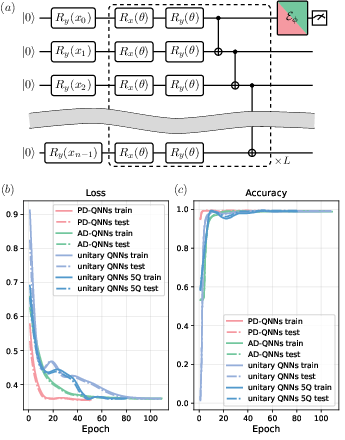
Figure 3: Circuit layout for MNIST binary classification. Training loss and test accuracy curves illustrate faster loss minimization and higher generalization for PD-QNN and AD-QNN architectures.
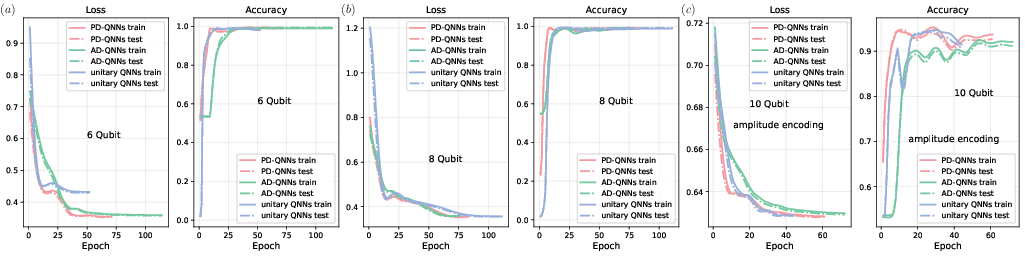
Figure 4: Comparative loss and accuracy across qubit scales and encoding schemes; channel-augmented models consistently outperform unitary baselines.
Key numerical results include:
- PD-QNNs exhibiting Eϕ053% fewer training steps required to reach equivalent loss on 4-qubit MNIST tasks versus the unitary baseline.
- Both PD-QNNs and AD-QNNs achieving higher test accuracy and lower loss across all tested qubit numbers and encodings, with superior convergence rates and loss smoothing.
Power Grid Stability (EGSSD)
A more complex task involving 11-dimensional real-world grid stability data (EGSSD) further substantiates these findings. Here, the quantum models implemented with trainable channels continue to outperform their unitary counterparts; even when accounting for the increased qubit number in the baseline, improvements in test accuracy for AD/PD-QNNs (2.9–3.9%) are substantially greater than what can be achieved by simply scaling unitary resources (0.3% improvement).
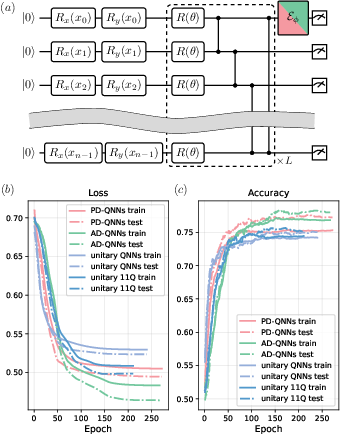
Figure 5: EGSSD binary classification architecture, loss, and accuracy; channel-based QNNs maintain significant advantages over both matched- and overparameterized unitary baselines.
Implications for Theory and Practice
The central implication is the elevation of noise—conventionally regarded as a purely adverse effect—to a tunable computational resource. Through explicit parameterization and joint optimization of dissipation in the learning loop, QNNs can achieve both enhanced expressivity and superior optimization dynamics. The channel-driven architecture generalizes unitary QNNs, accommodates hardware-level noise, and is physically implementable via standard Stinespring dilation.
Theoretically, these results establish that quantum differentially private, robust, and adaptive channels can be systematically embedded and trained within learning frameworks, transcending spectral rigidity. Practically, the approach prompts re-examination of NISQ-era device noise models from the perspective of functional utility rather than mere nuisance.
Future Developments
Further developments may include:
- Extension to multi-channel, multi-layer QNNs realizing more intricate open-system dynamics.
- Exploration of channel learning in generative quantum models, adversarial quantum training, and dynamically reconfigurable quantum circuits.
- Applications to larger, more complex quantum and classical datasets to probe scalability and ultimate expressivity bounds.
- Experimental demonstration on near-term quantum hardware to validate simulation findings under realistic noise.
Conclusion
This work systematically formulates and experimentally validates a channel-augmented quantum learning framework, wherein trainable quantum channels serve as computationally relevant, optimizable primitives. This approach provides not only generalized expressivity but also improved practical learning dynamics, significantly outperforming conventional unitary QNNs in a variety of tasks. The paradigm reframes quantum dynamical noise from a limitation into a resource, underpinning the path toward more powerful, flexible, and physically compatible quantum machine learning architectures.

