- The paper demonstrates that minimal classical resources in VMBQC—just one trainable correction probability—can outperform fully unitary models.
- It employs both analytical proofs and numerical experiments, using metrics like MMD loss to validate the enhanced channel expressivity.
- The findings provide practical design guidelines for resource-efficient quantum generative models that leverage measurement-induced randomness.
Minimizing Classical Resources in VMBQC for Generative Modeling
Introduction
The paper "Minimizing classical resources in variational measurement-based quantum computation for generative modeling" (2604.11578) addresses the fundamental resource tradeoff in variational measurement-based quantum computation (VMBQC) applied to quantum generative modeling. Specifically, it examines to what extent measurement-induced randomness—intrinsic to measurement-based quantum computation (MBQC)—can be leveraged to achieve generative modeling advantages over strictly unitary models, while minimizing the added burden of classical control parameters.
The central thesis is that quantum channel models defined by partially correcting measurement byproducts in VMBQC can surpass the expressivity of unitary models with only a single additional trainable parameter. This runs counter to prior approaches in which each qubit's correction was independently tunable, incurring significant overhead. Both analytical and numerical methods are deployed to support this assertion.
Variational Measurement-Based Quantum Computation as a Channel Model
VMBQC employs single-qubit measurements on a prepared highly entangled cluster state, using classical correction to process the randomness encoded by measurement-induced byproducts. The standard procedure is to fully correct these byproducts, yielding a deterministic quantum circuit. However, by probabilistically skipping some corrections, VMBQC defines a family of channel models—completely positive trace-preserving (CPTP) maps characterized by mixtures over possible byproduct propagation paths.
The generative modeling framework leverages this structure by parameterizing the correction probabilities, thus tuning the degree of randomness left uncorrected in the measurement outcomes. In existing approaches, each site (i,j) endowed in the cluster requires its own parameter pij, leading to a total of N×D additional classical parameters, where N and D are the width and depth of the cluster state used.
The essential question tackled is whether this proliferation of parameters is necessary to gain expressivity over unitary approaches, or if the quantum channel advantage of VMBQC for generative modeling can be realized more economically.
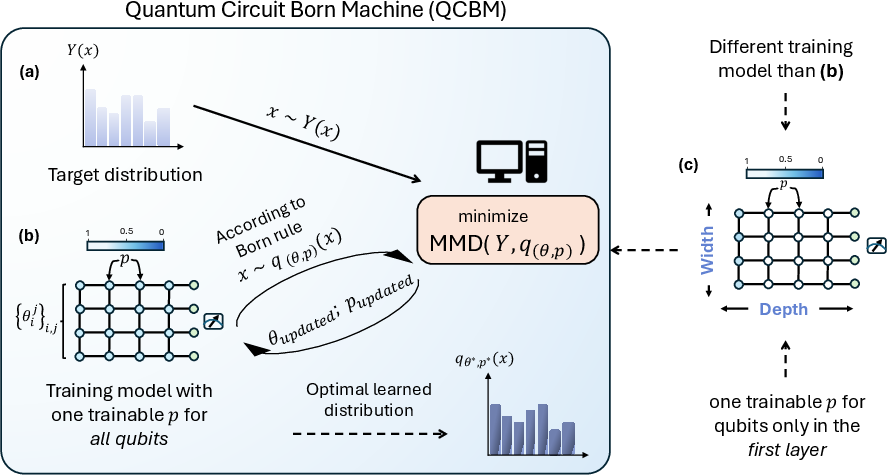
Figure 1: Quantum circuit Born machines with VMBQC; generative learning loop architecture illustrating target distribution sampling, quantum channel sampling, MMD loss computation, and single-parameter correction probability models.
Restricted Channel Models with Minimal Classical Overhead
The authors formalize several subclasses of the full VMBQC channel model, all with only a single trainable correction probability p. They analyze four specific scenarios, each with distinct topological or temporal placement of the single "partially uncorrected" qubit(s):
- Model A: All qubits share the same global correction probability.
- Model B: Only qubits in the first layer share the correction probability, the remaining qubits are always fully corrected.
- Model C: In each layer, a fixed qubit (e.g., a central qubit) is partially uncorrected.
- Model D: Only one (spatial-temporal) qubit in the entire cluster is partially uncorrected.
These structures are compared to the fully unitary VMBQC model (strictly deterministic correction) and to the unconstrained channel model with site-specific correction parameters.
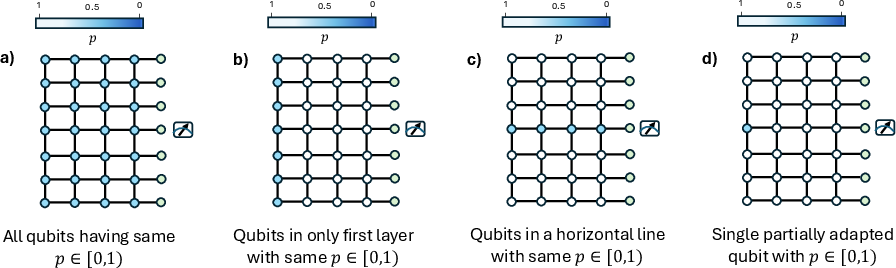
Figure 2: VMBQC models with one correction probability—schematic for scenarios A–D of restricted channel models with placement of trainable correction probability.
Theoretical and Numerical Evidence for Channel Advantage
The core theoretical result is the formal observation (a specialization of Theorem 1 from [majumder2024variational]) that even a single additional correction probability is sufficient for the VMBQC channel model to generate output distributions unattainable by the strictly unitary model, when cluster width, depth, and rotation angles are held fixed.
Numerical experiments substantiate this, employing the Maximum Mean Discrepancy (MMD) loss between samples from the learning model and a channel-based target model, itself constructed using randomized angles and correction probabilities. The experiments systematically benchmark the restricted single-parameter channel models versus the unitary model across several architectures.
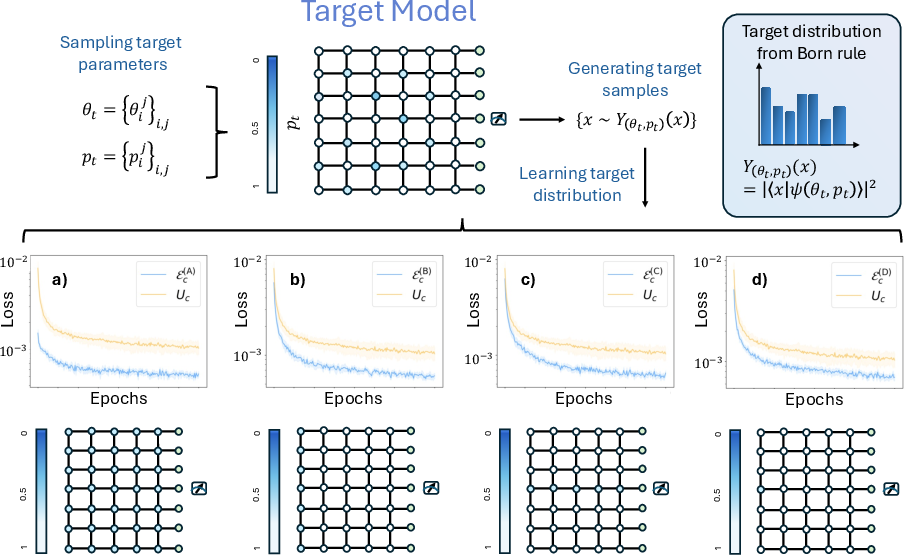
Figure 3: Learning performances of VMBQC models—averaged MMD loss trajectories for channel and unitary models, demonstrating clear expressivity separation.
Results consistently show that all single-parameter channel models outperform the unitary baseline in learning channel-generated target distributions, evidenced by lower final MMD loss values and reduced variance across independent initializations.
Byproduct Propagation and Its Expressive Impact
A further investigation quantifies how the ability of a unitary model to approximate a target VMBQC channel model depends on the spatial-temporal location of the (random) byproduct(s). Specifically, the expressive mismatch is maximal when the byproduct is positioned to influence a large forward lightcone of qubits, thereby introducing highly nonlocal non-Clifford effects in the output distribution.
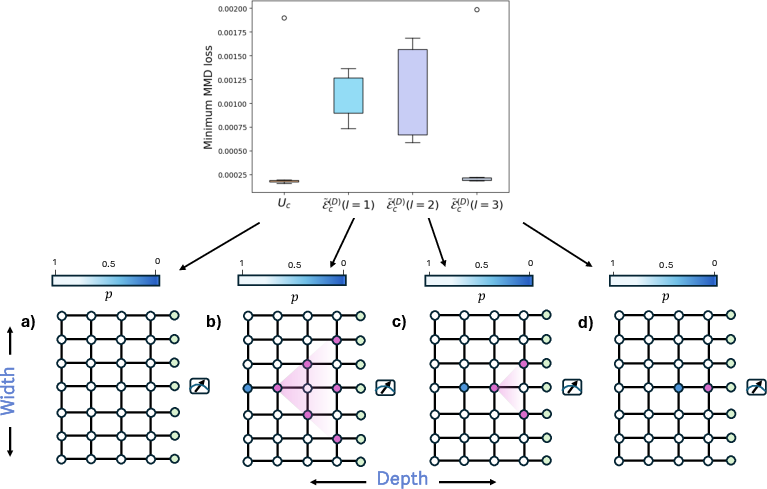
Figure 4: Effect of a single byproduct—box plots showing increased minimum attainable MMD loss for unitary models when attempting to learn target distributions with a single randomly located byproduct.
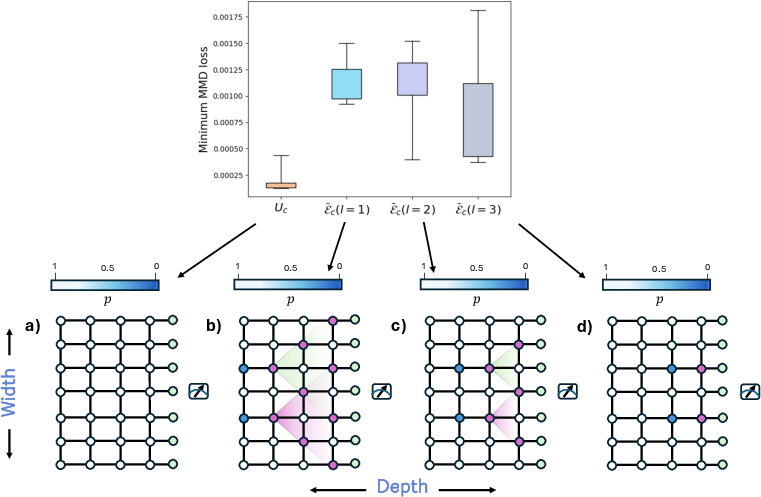
Figure 5: Effect of two byproducts—expansion of the non-Clifford region increases the expressivity gap between channel and unitary models, reflected in further increased MMD losses.
Models with byproducts late in the circuit, near the output layer, tend to yield output distributions more easily mimicked by unitary learning, since the byproduct has less opportunity for non-Clifford propagation.
Implications and Future Directions
This work has several direct implications for the design of quantum generative models and hybrid variational quantum-classical algorithms:
- Expressivity versus Trainability Tradeoff: The results establish that quantum channel expressivity can be accessed with negligible classical parameter overhead, circumventing the scaling problem present in site-by-site parameterizations and sidestepping trainability bottlenecks caused by overparameterization and barren plateaus [mcclean2018barren, cerezo2021cost].
- Resource-Efficient Hybrid Models: Even highly restricted instances of VMBQC channel models are provably more powerful, opening a route for near-term hardware implementations where only very limited classical feedback is feasible.
- Non-Classical Sampling Complexity: The findings further bind the non-unitarity and probabilistic correction in MBQC to concrete, practical improvements in distribution learning benchmarks, reinforcing the notion that noise (properly harnessed) can be a provable resource [wu2023r, coyle2025training].
- Optimal Byproduct Placement: The analysis underlines the importance of byproduct location and propagation for maximizing channel-based expressive advantage in variational protocols.
- Universal Generative Modeling: When combined with recent results on channel universality [kurkin2025note], these observations position VMBQC channel models as a central primitive for universal quantum generative modeling with reduced overhead.
Looking forward, it is plausible that similar minimal-channel techniques could be realized in other measurement-based or adaptive quantum-classical settings, and that systematic study of byproduct structure and propagation could yield further compressed but powerful generative quantum models.
Conclusion
The paper convincingly demonstrates, both analytically and numerically, that the measurement-induced channel advantage in VMBQC generative modeling persists with as little as a single additional classical trainable parameter. The approach not only minimizes classical overhead, making the scheme highly practical for near-term realizations, but also clarifies the mechanism for enhanced expressivity: the propagation of localized, intentionally uncorrected byproducts through the quantum circuit. These results provide clear design principles for scalable, resource-efficient quantum generative models and reinforce the significance of hybrid quantum–classical control strategies in harnessing the unique features of quantum measurement and channel dynamics.

