- The paper introduces MAPS, a novel framework that generalizes the Bloch sphere to higher-dimensional qudits by encoding both global and relative phases.
- It details a construction using unique spatial axes for each basis state along with a 'pseudo-orthogonal' phase separation, enabling intuitive state visualization.
- It presents the PASS_d gates for axial phase rotations, which simplify the design and simulation of complex quantum circuits in high-dimensional systems.
MAPS: A Multi-Axial Projective Sphere for Visualizing Higher-d Quantum State Spaces
Background and Motivation
Visualization frameworks for quantum state spaces are foundational to the analysis and manipulation of quantum systems. While the qubit's two-level system is elegantly represented by the Bloch sphere—an S2 geometry linking SU(2) and SO(3) structures—extending such geometric intuition to higher-dimensional qudit systems (d≥3) is intractable due to the exponential growth of state space dimension (from 3 to d2−1) and the loss of topological equivalence. Existing approaches, such as generalized Bloch bodies, Majorana representation, and phase-space constructions, address aspects of higher-d state visualization but yield highly nontrivial geometries, often unsuited for intuitive analysis or practical operator design.
The paper introduces the Multi-Axial Projective Sphere (MAPS), a unifying S2-derived framework for qudits (d≥3), aiming to restore the structural simplicity and direct visual interpretability enjoyed by the qubit Bloch sphere, while enabling explicit encoding of both global and relative phases—key aspects previously hidden or needing supplementary mathematical apparatus.
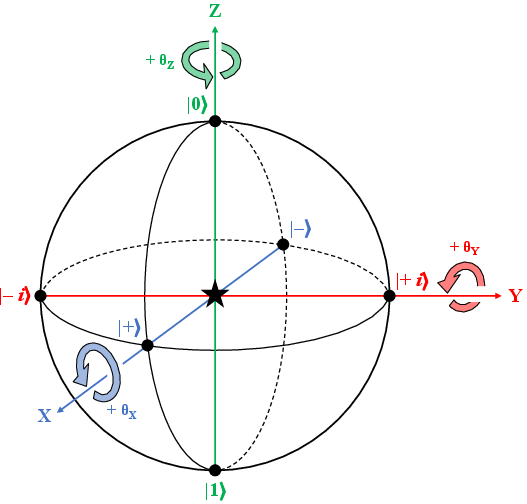
Figure 1: The Bloch sphere: three intersecting axes (X, Y, Z) hosting six pure states at the surface and the maximally mixed state at the origin.
The Multi-Axial Projective Sphere (MAPS)
MAPS is defined as a generalized S2 construction embedding S20 projectional intersecting spatial axes, with S21, each corresponding to one computational basis state S22 of a qudit. Every axis is associated with a set of relative phases S23, for S24, where S25. The spatial axes are separated by a "pseudo-orthogonal" angle S26 (restoring a constrained analog of qubit Cartesian orthogonality) and an azimuth displacement S27.
This construction ensures that:
- Each basis state is assigned to a unique axis.
- The global phase is attached to the S28 axis.
- All relevant relative phases are associated with their respective axes, and separated between hemispheres by the generalized equator.
- The full quantum state (including arbitrary superpositions and global/relative phases) is visually encoded without recourse to high-dimensional geometry or hidden algebraic constraints.
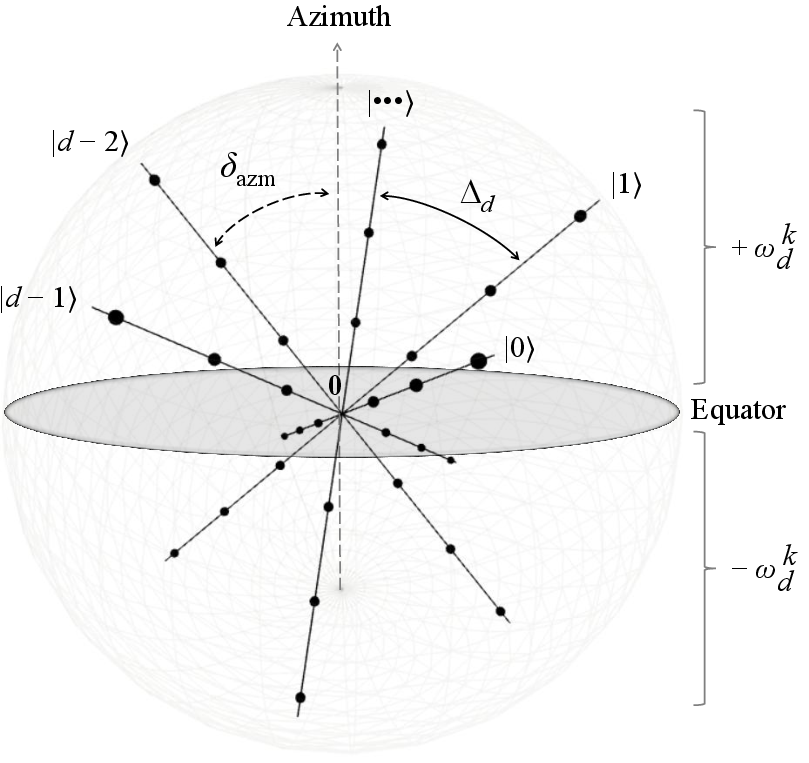

Figure 2: The MAPS as an S29 framework—spatial axes correspond to qudit basis states, with intersection at the origin and explicit phase mapping.
Explicit Visual Encoding for Qudits
The MAPS framework directly generalizes the Bloch construction. For SU(2)0 (qutrit), it yields three axes separated by SU(2)1, for SU(2)2 (ququadit), four axes separated by SU(2)3, and so forth, without overlap or angular inconsistency.
- Pure states map to points at the axis endpoints, their phase visually marked as a positive or negative rotation.
- Mixed (superposed) states form polygons whose vertices represent the weighted contributions/phases of each basis state.
- The global phase and all relative phases are geometrically explicit.
- Swiveling (changing sign) and shifting (complex rotation) along axes represent phase gates and general unitary operations.
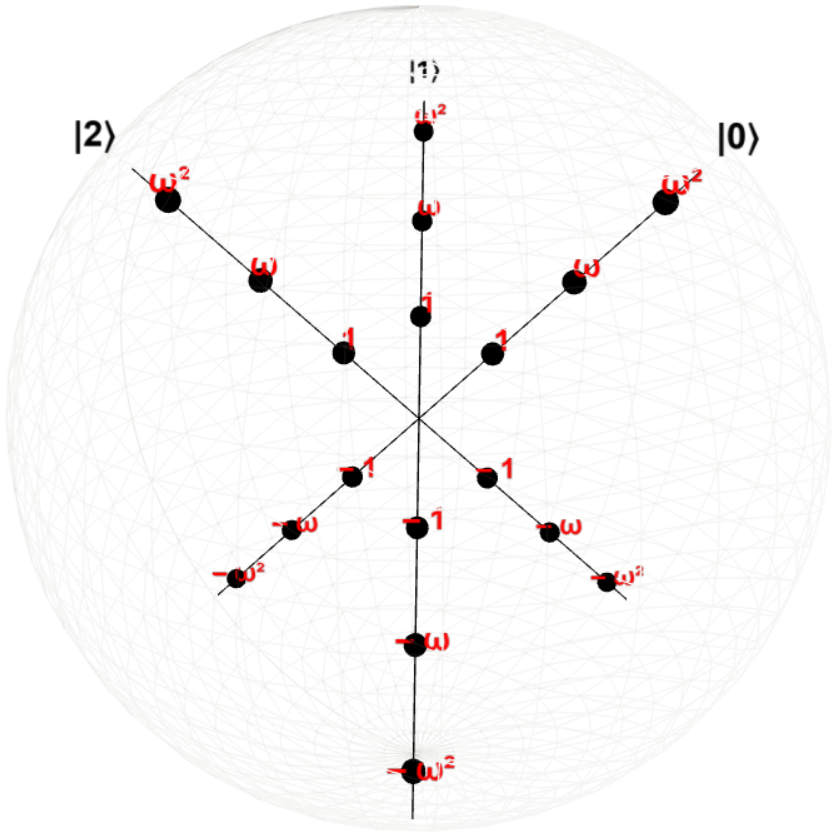
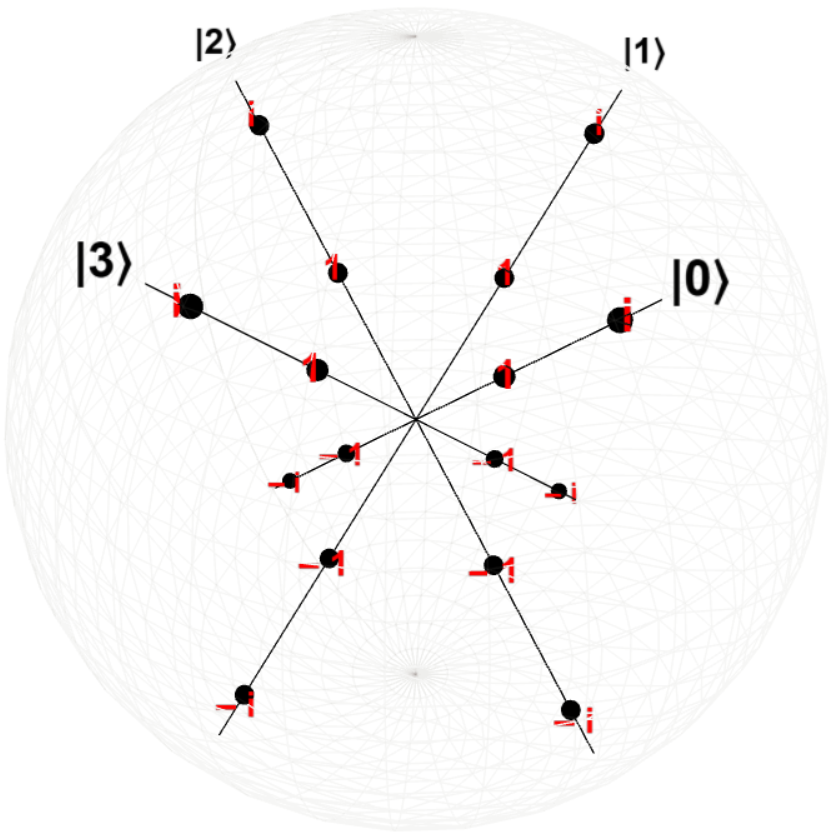
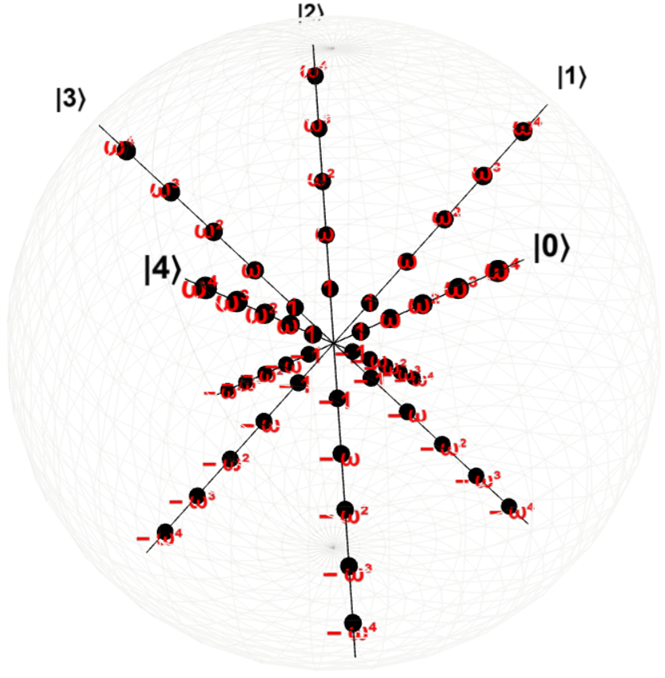
Figure 3: MAPS visualization for SU(2)4 (qutrit): each axis is assigned a distinct basis state, and the intersecting structure enables direct phase and state-space illustration.
Phase-Axial Swiveling and Shifting Gates
A key formal advance is the introduction of the SU(2)5 family: diagonal unitary operators acting as visualizable axial gates, generalizing SU(2)6 and its relatives but parameterized by explicit choice of axes and phase rotations. The SU(2)7 gates operate as follows:
- Swiveling: changes phase sign (moves a state from one hemisphere to another).
- Shifting: rotates phase within a hemisphere.
- Any combination can be applied, realigning both global and relative phases visually and algebraically.
The full set of SU(2)8 and SU(2)9 gates—numbering SO(3)0—is sufficient to generate all diagonal (phase) unitary transformations. These gates are visualized as reconfigurations of the MAPS, rather than abstract matrix manipulations.
Geometric Representation of States and Operations
The MAPS framework, combined with SO(3)1 gates, supports the following features:
- Any mixed state is represented as a polygon inscribed within the sphere, vertices corresponding to basis components and phases; for qutrits, this is a triangle.
- Composite gate sequences (e.g., Chrestenson superposition, then SO(3)2 axial rotations) are visualized as transformations of the polygon within the sphere, with explicit tracking of phase trajectories.
- Comparative analysis of multiple quantum states and gate sequences can be accomplished in a single visual framework, increasing interpretability for multi-qudit systems.
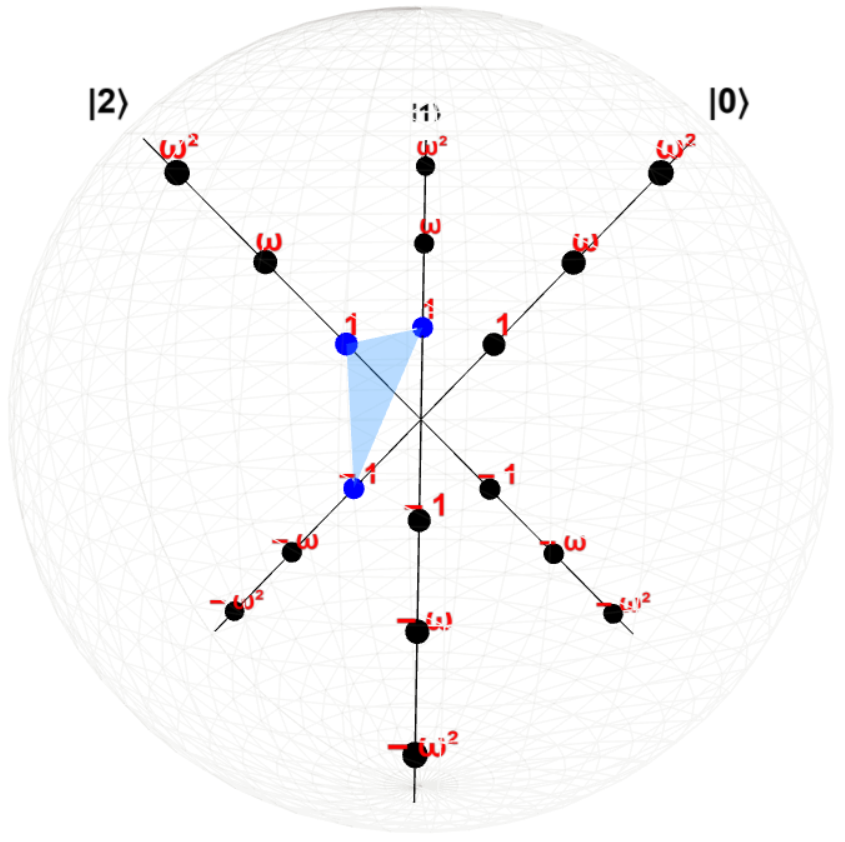
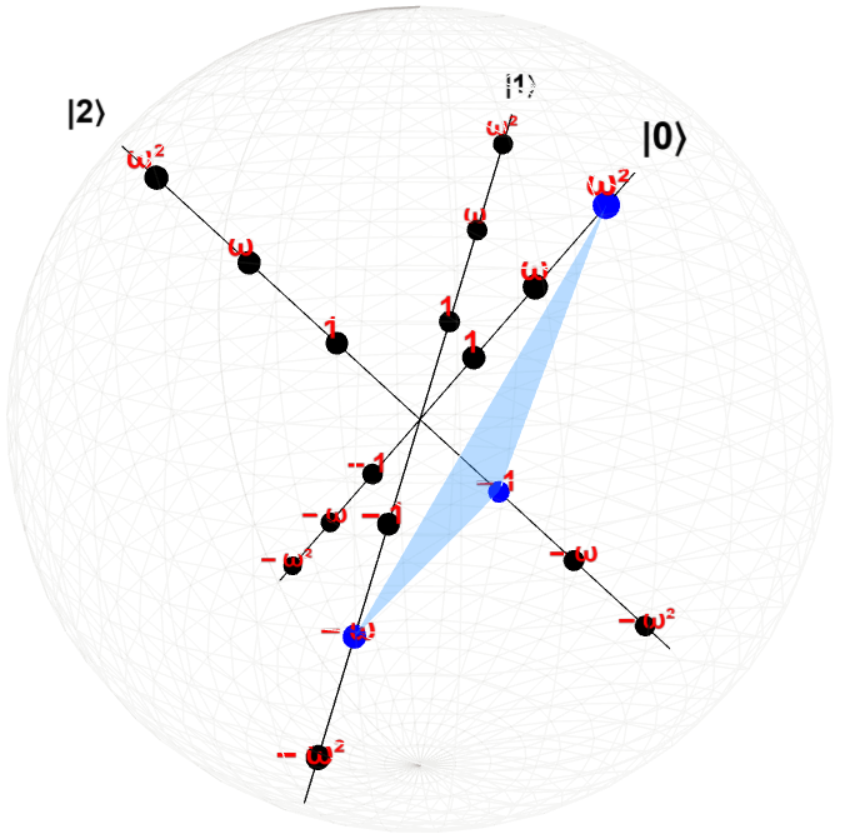
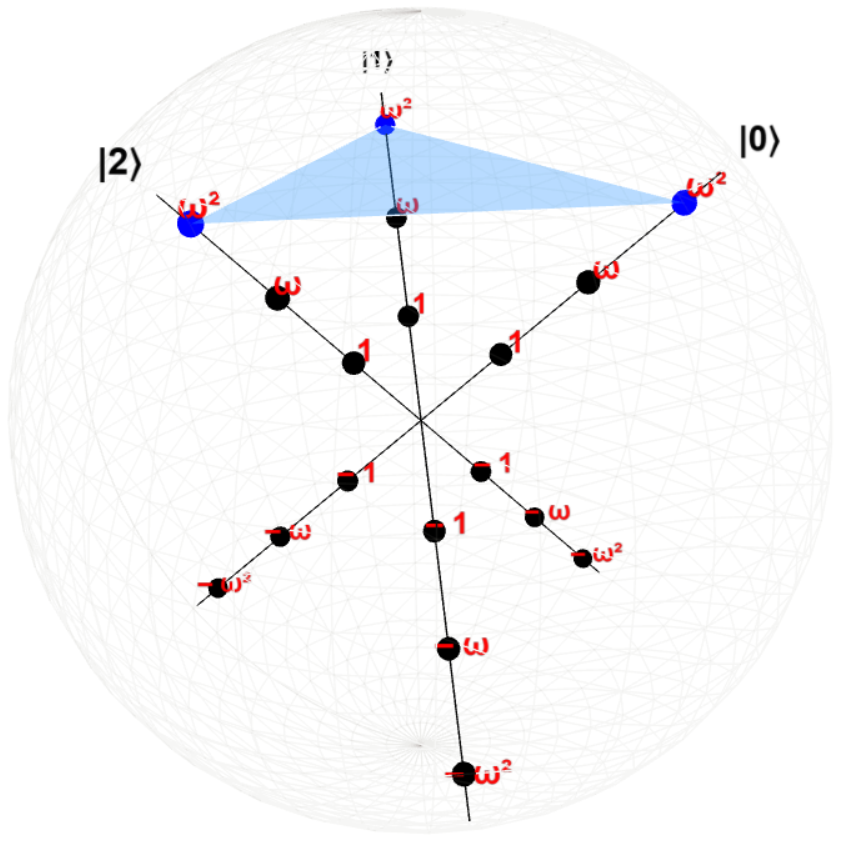
Figure 4: Application of Chrestenson and SO(3)3 gates (swiveling only): MAPS visualizes the transfer of the global phase and the distribution of phase across mixed states.
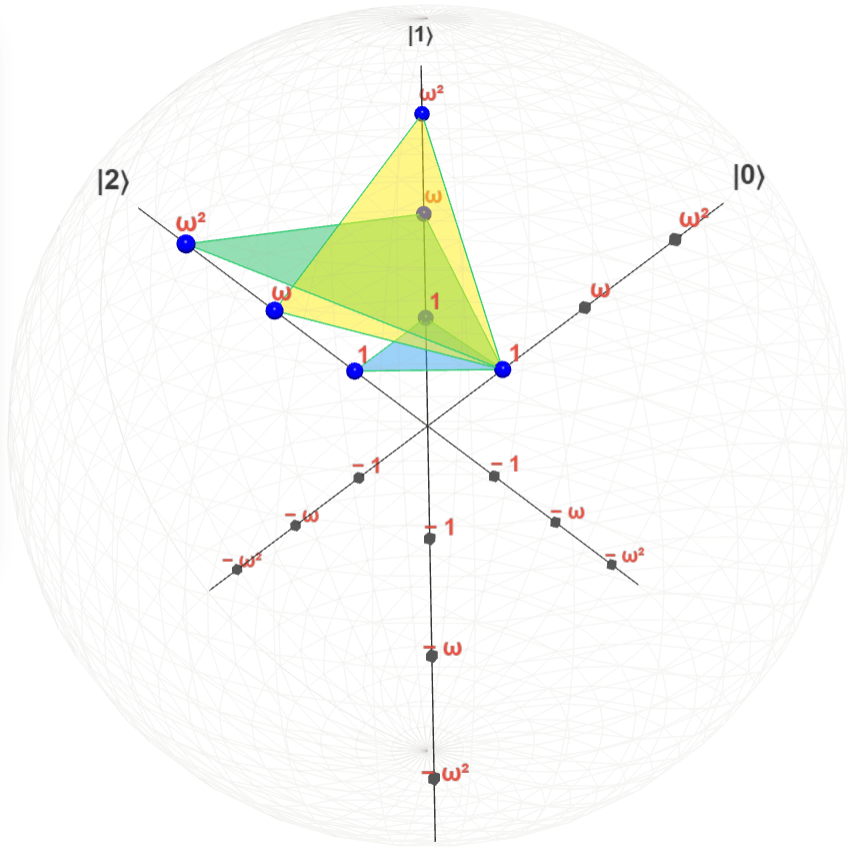
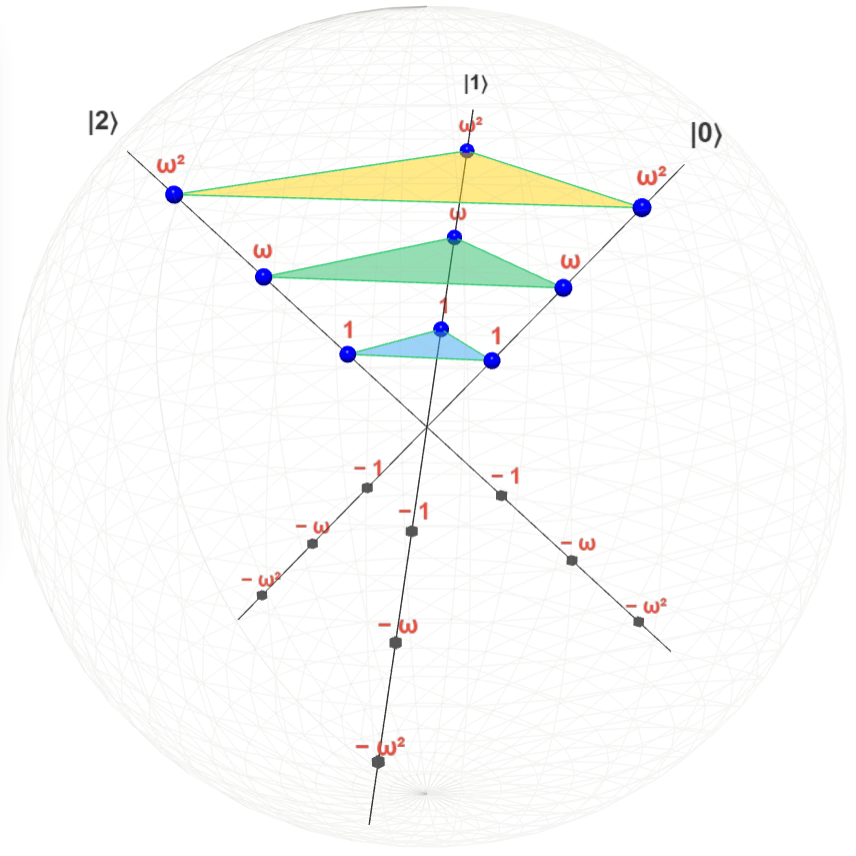
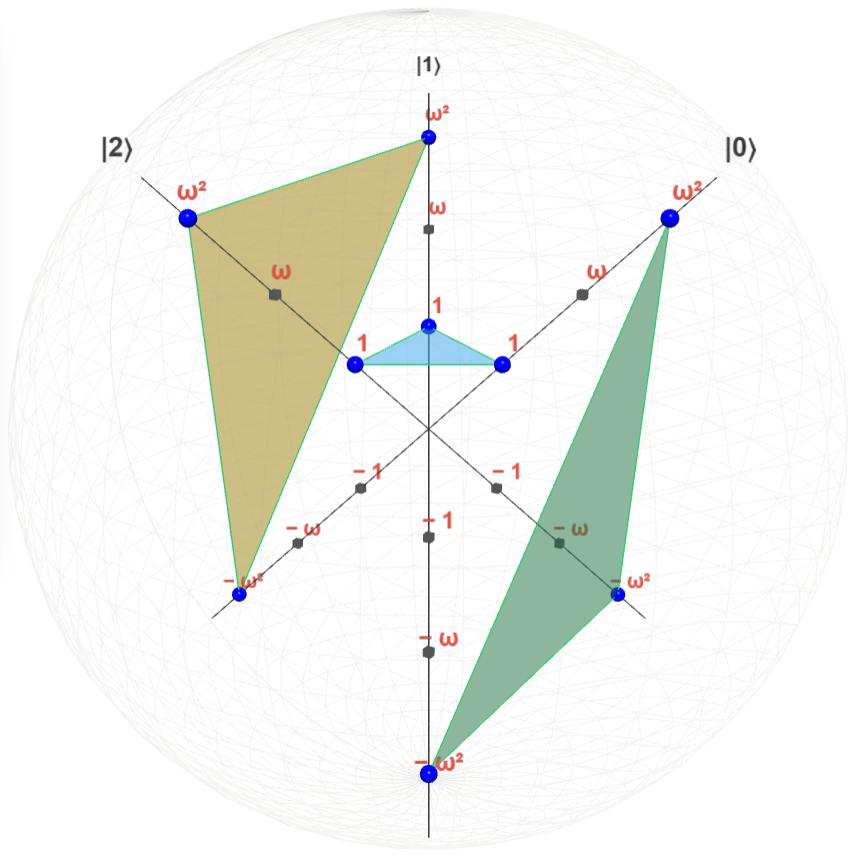
Figure 5: Chrestenson (SO(3)4) gate action only: the superposition state-space for three qutrits visualized as distinct triangles on the MAPS axes.
Practical and Theoretical Implications
MAPS offers a path toward geometric circuit and operator design in higher-dimensional quantum systems. Since all basis states and phase operations can be visualized as geometric manipulations, complex quantum operators (e.g., arithmetic circuits, comparators) may be synthesized and analyzed graphically, without recourse to large tensor-product matrix algebra.
The explicit nature of the MAPS—encoding both structure and phase—is advantageous for:
- High-dimensional quantum algorithm engineering, where visual intuition is often lost in algebraic formalism.
- Integration with quantum circuit simulators to provide more interpretable output for hybrid or non-binary architectures.
- High-dimensional classical data visualization, e.g., in machine learning or quantum chemistry, by analogy.
Additionally, the MAPS approach aligns with modern information-geometric perspectives: it is compatible with projective representations, preserves the physical requirement of unitarity, and maintains direct correspondence between state topology and observable geometric structure.
Future Directions
Extensions of MAPS may include:
- Automated and interactive circuit design tools using the visual framework.
- Exploration of entanglement and multipartite correlations within visualizable geometric constructs for multi-qudit systems.
- Fusion with tensor network and information geometry architectures for advanced visualization of quantum dynamics.
- Application beyond quantum information, facilitating visualization in high-dimensional classical data science domains, where axes represent arbitrary features.
Conclusion
The MAPS framework presents a generalized SO(3)5-based visualization applicable to all higher-dimensional qudit systems, overcoming the limitations of the traditional Bloch sphere and prior generalized approaches by providing structural clarity, direct phase representation, and operational transparency. The associated SO(3)6 gates enable visual and algebraic manipulation of both global and relative phases, facilitating practical circuit construction and analysis. The formalism is broadly adaptable, with implications for geometric quantum information processing, educational tools, and even non-quantum high-dimensional data interpretation.