- The paper generalizes encrypted cloning from qubits to arbitrary-dimension qudits, overcoming non-Hermiticity challenges with CAZAC sequence-based unitaries.
- It introduces a scalable encryption operator using Zadoff-Chu sequences that ensures the reduced density matrix remains maximally mixed for security.
- The work details quantum circuit designs for encryption and decryption, illustrating linear scaling for encryption and cubic complexity for decryption.
Cloning Encrypted Quantum States: Extending to Arbitrary Dimensions
Introduction and Problem Context
The work "Cloning Encrypted Quantum States in Arbitrary Dimensions" (2604.04888) generalizes the results of Yamaguchi and Kempf regarding the possibility of deterministically cloning encrypted qubits, extending the analysis to quantum systems with arbitrary (finite) Hilbert space dimension d. The motivation to extend such cryptographic primitives from qubits to qudits is clear: high-dimensional systems offer enhanced robustness, compactness in quantum communication, and facilitate multipartite secret sharing and advanced cryptographic schemes. The core technical challenge resolved in this paper is the failure of naive generalizations of the qubit protocol for d≥3, stemming primarily from the non-Hermiticity of generalized Pauli operators in higher dimensions and the requirement of unitarity for quantum gates.
Generalization Beyond Qubits: Algebraic Framework
A qudit is an element of a d-dimensional Hilbert space, manipulated via shift (Xd) and phase (Zd) operators (generalized Pauli or Weyl operators). Whereas for qubits (d=2) these operators are Hermitian, for d≥3 they no longer possess this property, which fundamentally obstructs the direct application of exponentials of Pauli operators as unitaries—compromising the generalization of the encryption process to higher-dimensional systems.
The authors remedy this by introducing encryption operators constructed from constant-amplitude zero-autocorrelation (CAZAC) sequences, specifically Zadoff-Chu sequences, ensuring flat spectra and orthogonality akin to properties required for cryptographic randomness and perfect indistinguishability.
Encryption Operator Construction
Let P denote either PX or PZ, defined as tensor products of the same generalized Pauli operator over the data and d≥30 ancilla qudits. The encryption operator is formulated as:
d≥31
with d≥32 the sampled Zadoff-Chu sequence. For both d≥33 and d≥34, the operator is shown to be unitary via the CAZAC/orthogonality property. The overall encryption circuit applies d≥35 to the data and ancilla qudits.
This construction reproduces the original qubit protocol for d≥36 and provides an explicit, scalable realization for any d≥37, satisfying all requirements for information-theoretic security—the reduced density matrix of any single ciphertext qudit is always maximally mixed.
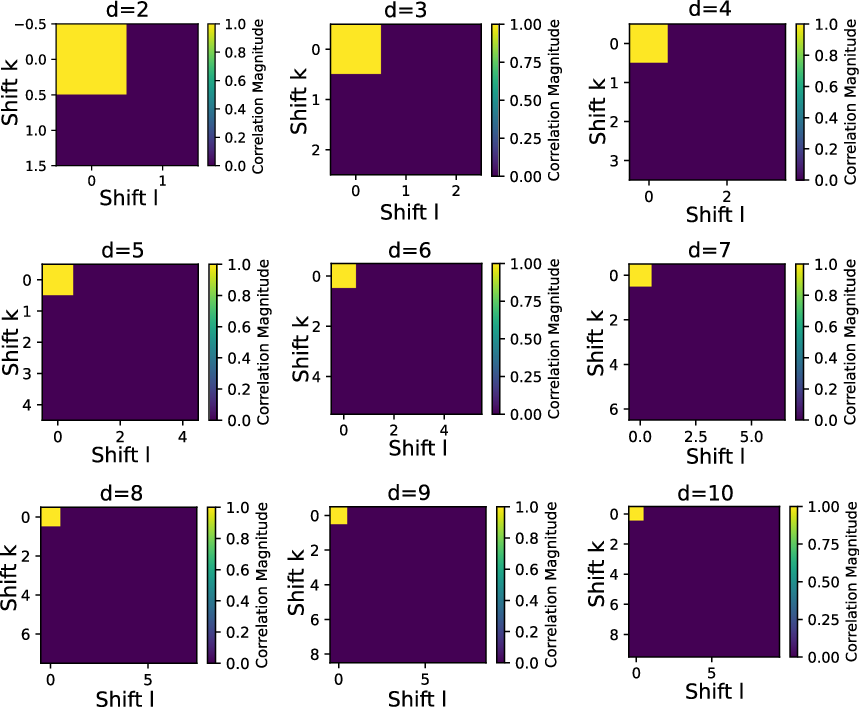
Figure 1: 2D autocorrelation of d≥38 coefficients for various qudit dimensions, showing a unique peak at d≥39 and vanishing elsewhere, confirming pseudo-randomness and cryptographically desirable properties for the constructed unitary.
Decryption Operator and Protocol Correctness
The decryption procedure adapts prior results to general d0, leveraging the nontrivial identity
d1
and generalizes the decryption operator to extract the original quantum data from any of the d2 encrypted clones. For d3, the Pauli algebra suffices, but higher d4 invokes new operator synthesis and circuit identities. The protocol guarantees that one selected party receives the original quantum state, while the others are left with maximally mixed states.
The paper provides formal proofs of unitarity and correctness for both encryption and decryption operators, leveraging the orthonormality of (generalized) Pauli operators and the properties of the Zadoff-Chu sequence.
Circuit Realization and Gate Complexity
The authors detail explicit quantum circuit constructions for the new encryption and decryption operators, specifying both single- and two-qudit gate decompositions. The implementation of d5 for d6 or d7 involves combinations of two-qudit controlled-X gates and diagonal phase gates parameterized by the CAZAC sequence, with the aid of the quantum Fourier transform for d8.
The encryption's overhead scales linearly in both the number of clones d9 and the qudit dimension Xd0 for single-qudit operations, while the two-qudit gate count is dimension-independent for encryption. Decryption, requiring (double-)controlled operations for each value in the Xd1-dimensional basis, scales as Xd2:
(Figure 2)
Figure 2: Required single- and two-qudit gate counts for encryption (Xd3) and decryption (Xd4) as functions of qudit dimension Xd5 and clone count Xd6, illustrating linear scaling for encryption and cubic for decryption.
Theoretical and Practical Implications
The construction demonstrates that the encrypted cloning protocol's main security and operational properties are not symptomatic of any particular structure of the qubit Hilbert space but are rather a general feature of finite-dimensional quantum systems—so long as the operator algebra and sequence construction are generalized appropriately. This opens the avenue to quantum cryptographic protocols leveraging high-dimensionality: secret sharing, secure multiparty quantum computation, and distributed quantum storage where access is finely tunable via gate sequence design.
Practically, the linear increase of circuit complexity with the qudit dimension for encryption is favorable, ensuring scalability for near-term hardware, while the cubic scaling for decryption is less of a bottleneck in scenarios with infrequent readout. The explicit construction avoids non-unitary artifacts, essential for physical realizability, and is robust to implementation error due to the flatness of the CAZAC spectra.
Future Directions
Several salient research threads are implied by this advancement. First, the adaptation of further quantum cryptographic primitives developed for qubits to high-dimensional qudits can yield new protocols optimized for realistic communication conditions (e.g., in high-dimensional photonic or atomic systems). Second, the connection between CAZAC sequences and quantum encryption may inspire new randomization and obfuscation techniques for quantum data protection. Third, an open question is the extension of this approach to infinite-dimensional Hilbert spaces (continuous variables), and to mixed-state inputs. Finally, optimization of the decomposition of multi-controlled gates for qudit logic may further reduce experimental overhead.
Conclusion
By establishing unitary, scalable encryption and decryption operations for cloning encrypted quantum states in arbitrary finite dimensions, this work both closes conceptual gaps in the foundations of quantum cryptography and offers practical algorithms for implementation in real high-dimensional quantum systems. The utilization of Zadoff-Chu sequences as a cryptographic resource in multi-level quantum logic constitutes a significant step in the construction of dimension-agnostic quantum information protocols, enabling new classes of secure communication and distributed quantum information processing (2604.04888).